Medical Gas Outlet Compatibility During Renovations: Field Audit Guide
Medical Testing SolutionsNovember 14, 20269 min read
Share
A respiratory therapist walks into a newly renovated ICU bay at 2:00 a.m. carrying an Ohmeda Diamond oxygen flowmeter, only to find the contractor installed Chemetron-compatible quick-connect faceplates on the new headwall. The patient needs high-flow oxygen immediately, and the crash cart doesn't carry conversion adapters. Worse yet, the nurse next door forces a slightly worn Puritan-Bennett vacuum regulator into an incompatible surgical corridor inlet, shearing the secondary check valve O-ring and dropping zone vacuum pressure across four rooms.
Managing medical gas outlet compatibility during renovations prevents these exact clinical failures and saves facilities from six-figure change orders. When hospitals remodel a single wing, expand an ambulatory surgery center, or replace aging headwalls, the disconnect between legacy rough-in assemblies and modern front-latching mechanisms creates immediate compliance and safety hazards. Before you approve a mechanical sub's submittal or demo a single partition wall, you need a clear audit of your existing back-bodies, front latches, and clinical secondary equipment.
How Legacy Rough-Ins Clash with Modern Remodel Specs
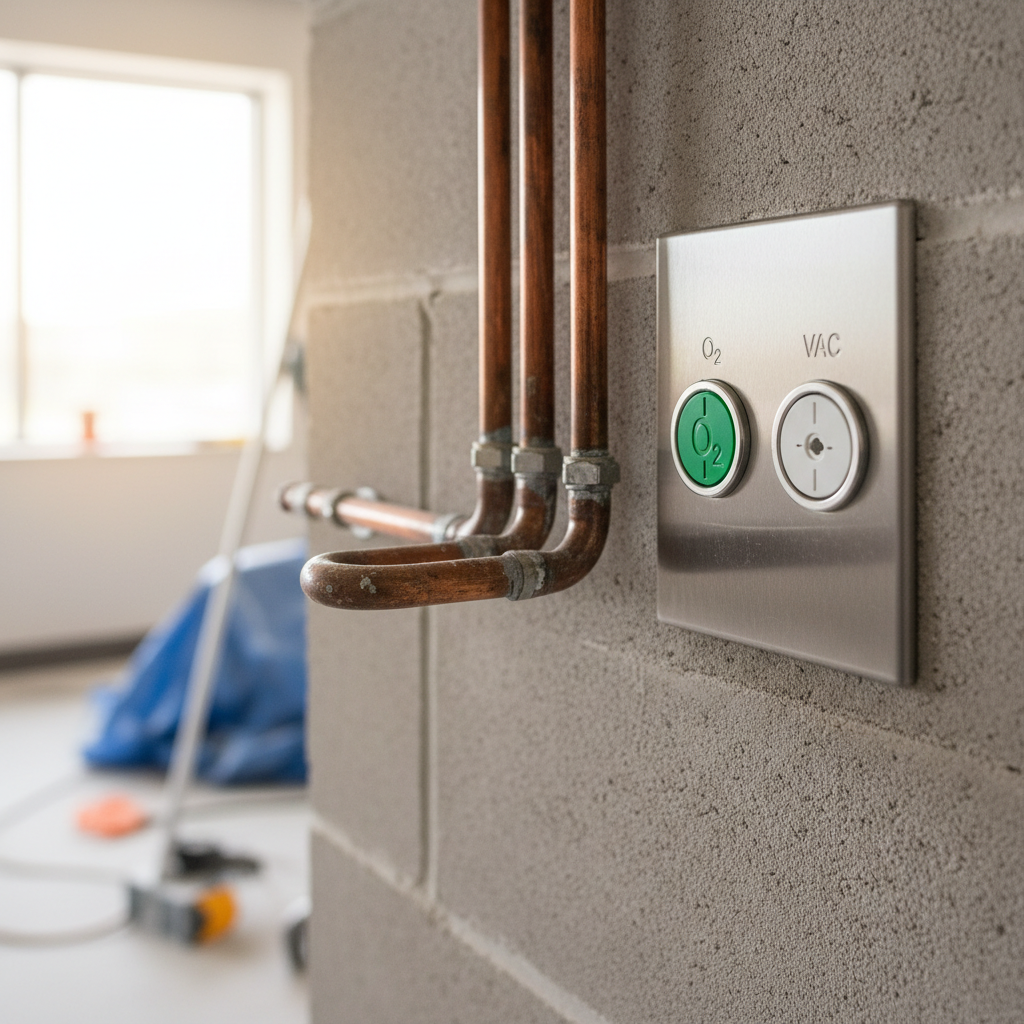
Every medical gas station outlet or inlet consists of two primary mechanical assemblies: the rough-in (back-body) brazed directly to the copper drop pipe behind the wall, and the latch-valve assembly (front body or faceplate) that receives the clinical adapter. During a facility renovation, engineering teams often specify a brand-new outlet series to match corporate standards without checking what sits inside the existing walls or what lives on the respiratory therapy shelves.
If your scope of work leaves existing copper drops in place to avoid opening rated corridors or interrupting active floors above, your new front latch assemblies must mate perfectly with the legacy rough-ins. A BeaconMedaes DiamondCare front latch will not bolt onto an older Amico or Tri-Tech rough-in body. Even within the same legacy lineage, such as older Oxequip, Medaes, or Ohmeda revisions, barrel pin spacing and secondary check valve plungers changed over the decades.
When contractors discover this mismatch mid-project, you face three choices: tear open the wall to braze in complete new outlet assemblies, source engineered retrofit conversion kits, or replace every flowmeter and vacuum regulator in the department.
Auditing Connection Styles Before Demolition Starts
Before finalizing architectural drawings, walk the renovation zone and adjacent departments to catalog both wall connections and plug-in appliances. You can review our breakdown of DISS, Ohmeda, Chemetron, and Puritan-Bennett medical gas outlet types to identify the specific latch geometries in your building.
Most acute care facilities operate a mix of four primary connection standards:
Ohmeda (Diamond): Uses two alignment pins on the adapter collar and a release ring you push or twist depending on the generation.
Chemetron: Features a rectangular striker plate with side latch arms and a central indexing pin configuration.
Puritan-Bennett: Relies on a push-button release mechanism and distinct guide pins spaced around the gas nozzle.
DISS (Diameter Index Safety System): Regulated by CGA V-5, using gas-specific threaded nut-and-nipple dimensions commonly required on ceiling columns, booms, and anesthesia locations.
An audit must look beyond the renovation boundary. If the 3rd-floor telemetry unit uses Chemetron quick-connects and you specify Ohmeda outlets for six renovated rooms on that same floor, staff floating between rooms will constantly hunt for adapters. Medical Testing Solutions helps facilities map these exact station inventories before construction starts so mechanical submittals match clinical reality.
To avoid costly tear-outs and failed inspections, partner with an experienced ASSE 6010 medical gas installation team during the pre-construction design phase.
Retrofit Conversion Kits vs. Full Back-Body Replacement
When you want to modernize the connection style on a unit without cutting into the pressurized copper piping behind the drywall, engineered retrofit conversion kits offer a clean path forward. Manufacturers like Amico, BeaconMedaes, and Tri-Tech produce front-body conversion assemblies that thread onto legacy rough-in blocks while presenting a different quick-connect profile on the room side.
Renovation Approach
Piping Impact
Shutdown Scope
NFPA 99 Testing Required
Relative Cost
Latch-Valve Repair Kit
None (front seal & spring swap)
None (uses secondary check valve)
Operational flow & leak check
Low ($40–$95 per station)
Front-Body Conversion Kit
None (mounts to legacy rough-in)
Zone valve closure recommended
Full station flow, pressure & cross-connection test
Moderate ($140–$260 per station)
Full Outlet Assembly Swap
Cut & braze new copper drop
Full zone shutdown & nitrogen purge
Complete ASSE 6030 installer & verifier testing
High ($450–$900+ per station Installed)
When Front-Body Conversions Work
Front-body conversion kits work best when the existing brass rough-in block, secondary check valve seat, and copper pigtail are free of corrosion, pitting, or mechanical thread damage. For example, if a hospital acquired an older surgery center fitted with Puritan-Bennett outlets on Ohmeda-style rough-ins, swapping the front latch assemblies converts the rooms to standard Ohmeda Diamond connections in about fifteen minutes per station.
When You Must Braze in New Rough-Ins
You cannot rely on front-body conversions if the legacy rough-in lacks a functional secondary check valve, exhibits stripped mounting threads, or sits at the wrong depth due to furred-out drywall or new headwall laminate panels. While manufacturer extension kits can bridge up to a 3/4-inch wall thickness variance, excessive wall build-out destabilizes the adapter engagement and causes heavy suction regulators to sag and leak. In those cases, an ASSE 6010 installer must isolate the zone valve, purge the line with oil-free dry nitrogen, and braze in a new complete station outlet.
When a renovation wraps up and clinicians realize their existing flowmeters don't fit the new wall outlets, someone inevitably orders a box of brass quick-connect-to-quick-connect adapters (such as Chemetron male to Ohmeda female). While quick-connect adapters solve the immediate emergency, relying on them permanently creates mechanical and regulatory problems.
Stacking an adapter between a wall outlet and a heavy vacuum regulator or oxygen flowmeter extends the cantilever distance from the faceplate by two to three inches. That extra leverage multiplies torque on the primary latch springs and the internal O-rings. Over a few months of staff bumping beds or carts against the protruding flowmeter, the front barrel warps, creating an audible gas leak or popping the primary poppet out of alignment.
Furthermore, unindexed or removable adapters get unplugged and carried from room to room. During a code, a missing $65 adapter renders a $2,000 wall station useless. If your facility has aging or mismatched secondary equipment, having your inventory serviced through professional flowmeter repair and calibration or re-fitted with permanent OEM-approved probes is safer than stacking adapters at the wall.
NFPA 99 Code Requirements for Renovated Station Outlets
Every modification to a medical gas station outlet during a remodel triggers specific requirements under NFPA 99 (Health Care Facilities Code), Chapter 5. Under Section 5.1.5, each station outlet and inlet must be gas-specific, whether it uses a non-interchangeable quick-coupler or a CGA V-5 Diameter Index Safety System (DISS) body.
Why this matters for compliance: Under NFPA 99 Section 5.1.12, any renovation that breaches the medical gas piping system, alters station outlet gas specificity, or replaces latch-valve assemblies requires formal testing to confirm gas identity, mechanical flow, and the absence of cross-connections before patients occupy the space.
Specifically, your renovation closeout package must satisfy these technical benchmarks:
Secondary Check Valves (NFPA 99 5.1.5.4): Every station outlet/inlet must contain an automatic secondary valve that stops gas flow when the primary latch-valve assembly is removed for servicing.
Mechanical Flow & Pressure Drop (NFPA 99 5.1.12.4.10): Oxygen, nitrous oxide, and medical air outlets must deliver 100 LPM (3.5 SCFM) with a pressure drop of no more than 5 psi, while nitrogen outlets must deliver 140 LPM (5.0 SCFM) with no more than a 5 psi drop.
Vacuum Inlet Performance: Medical-surgical vacuum inlets must draw 85 NLPM (3.0 SCFM) without dropping adjacent gauge pressure below 12 inHg.
Gas-Specific Indexing: Pin indexing on the rough-in body must physically prevent an installer from mounting an oxygen front faceplate onto a medical air or vacuum back-body.
Whenever a renovation alters headwalls, moves drops, or converts outlet styles, third-party ASSE 6030 medical gas verification is required to document that purity, particulate counts, pressure drops, and cross-connection checks pass code.
Coordinating Headwall Manufacturers and General Contractors
One of the most frequent disconnects during hospital renovations happens when pre-plumbed modular headwalls or ceiling booms arrive on site. Headwall vendors build their units on the factory floor weeks before delivery. If the electrical or architectural submittals specify headwall outlets without cross-referencing the facility's biomedical engineering standards, the units often show up pre-piped with the wrong outlet brand or connection geometry.
During submittal review, verify four details on the shop drawings:
Manufacturer and Series: Confirm the exact brand (e.g., Amico, BeaconMedaes, Tri-Tech, Genstar) so your facility's existing stock of replacement O-rings and repair kits will fit the new stations.
Connection Type by Gas: Many facilities use quick-connects (such as Ohmeda or Chemetron) for patient room oxygen, air, and vacuum, but require DISS outlets on surgical booms, NICU headwalls, and nitrous oxide/nitrogen stations.
Slide Bracket vs. Flush Mount: Vacuum inlets often need integrated bottle slide brackets mounted adjacent to or around the faceplate so collection canisters don't hang directly by the regulator stem.
MRI Conditional Ratings: If the renovation includes an MRI suite or diagnostic imaging bay, standard ferromagnetic steel springs and brass latches inside normal outlets create projectile hazards; specify dedicated non-magnetic MRI-compatible outlets.
Medical Testing Solutions works directly with hospital facility directors, general contractors, and mechanical subcontractors to audit existing assemblies before equipment orders are placed. You can also source OEM-compatible conversion latches, DISS assemblies, and repair kits directly through our medical gas products catalog to keep your project schedule on track.
Protecting New Outlets During Construction Phasing
Even when you select the right outlet compatibility and pass initial installer pressure tests, drywall dust, primer overspray, and construction debris can ruin new latch-valve assemblies before the verifier arrives. Drywall compound forced into a quick-connect barrel fouls the primary elastomeric seat and scratches the brass poppet.
Keep rough-in dust caps installed until final paint and wall protection are complete. Once the front latch assemblies are mounted, never use painter's tape directly over the gas port where adhesive residue can migrate into the valve. Instead, schedule your medical gas maintenance services and final verification after heavy trades have cleared the zone, and integrate the newly renovated wing into your hospital's annual medical gas inspections schedule to track latch wear over time.
If you are planning a unit remodel, headwall replacement, or surgery center build-out, Medical Testing Solutions can audit your existing outlets, supply the exact conversion assemblies you need, and perform your final ASSE 6030 certification. Request a quote online or call our technical team at (754) 315-1078 to schedule a pre-renovation site assessment.
Frequently Asked Questions
Yes, provided the existing brass rough-in block behind the wall is intact, undamaged, and made by a manufacturer with an approved retrofit kit. Companies like BeaconMedaes, Amico, and Tri-Tech offer front-body conversion assemblies that mount directly onto legacy back-bodies while changing the room-side latch geometry from Chemetron to Ohmeda or DISS.
Under NFPA 99 Section 5.1.12, any modification or replacement of a station outlet latch-valve assembly requires functional testing to verify mechanical flow, pressure drop, leak tightness, and gas-specific indexing. If the piping system behind the secondary check valve is breached or brazed, full ASSE 6030 third-party verification is required.
Stacking plug-in quick-connect adapters adds two to three inches of outward leverage to flowmeters and heavy vacuum regulators. This extra torque bends internal latch springs, wears down primary O-ring seals prematurely, and creates chronic leaks. Adapters also get misplaced during emergencies, leaving stations unusable when staff move equipment between rooms.
Look at the faceplate markings and release mechanism, then remove the cover plate (without unseating the latch valve) to inspect the brass rough-in stamping and gas-specific pin indexing pattern. Comparing the barrel profile against an identification chart for DISS, Ohmeda, Chemetron, and Puritan-Bennett will confirm the exact generation before you order repair or conversion kits.
Per NFPA 99 (5.1.12.4.10), renovated oxygen, medical air, and nitrous oxide station outlets must flow at least 100 LPM (3.5 SCFM) with a pressure drop not exceeding 5 psi. Nitrogen outlets require 140 LPM (5.0 SCFM) at a maximum 5 psi drop, and medical-surgical vacuum inlets must draw 85 NLPM (3.0 SCFM) while maintaining at least 12 inHg at adjacent inlets.
Request a quote for your facility
Talk with Medical Testing Solutions about your next inspection, repair or equipment request.