South Carolina Hospital Medical Air PM Handoff: Field Workflow & Logs
Medical Testing SolutionsNovember 16, 20269 min read
Share
Walk into the central plant of a coastal hospital in July and check the sight glass on the regenerative desiccant dryer. If the indicator beads have shifted from blue to pink, or the digital dew point monitor is hovering at +39°F (+3.9°C), you're looking at a system minutes away from tripping a master alarm. Usually, the technician just left the building. The preventive maintenance sheet is signed, the air intake filters are fresh, and the runtime hours are logged on a clipboard, yet nobody transferred the operational discrepancy to the facilities engineering desk. A South Carolina hospital medical air PM handoff fails most often in the thirty minutes between when an ASSE 6040 technician packs their tool bag and when the hospital compliance officer files the work order away for The Joint Commission or SC DHEC (now split into the Department of Public Health for facility licensing).
Signing a clipboard at the guard shack does not satisfy NFPA 99 requirements for central supply operations. When humidity spikes across the Lowcountry, the Midlands, or the Grand Strand, medical air compressors work under heavy latent moisture loads. If the preventive maintenance workflow stops at mechanical filter swaps without a structured data handoff, small drift metrics in carbon monoxide (CO), dew point, or lag compressor cut-in pressures turn into unplanned outages in the ICU.
Why Mechanical PMs Fail Without a Structured Handoff
Hospital facilities directors often treat medical gas maintenance like chilled water or boiler PMs. A vendor arrives, replaces wear items per the OEM schedule, checks belt tension or scroll tip seals, and emails an invoice two weeks later. That workflow leaves a blind spot in life safety documentation. Under NFPA 99 (Health Care Facilities Code), Section 5.1.14, health care facilities must maintain documented maintenance programs for all piped medical gas and vacuum systems, factoring in both manufacturer recommendations and system risk assessments.
When a technician completes quarterly or semi-annual maintenance on a multiplex medical air system, they alter the physical state of the plant. They cycle receiver drain valves, isolate dryer towers, and bleed instrument air lines. If they leave a manual bypass valve cracked or fail to record that Compressor 3 took four minutes longer to build from 85 psig to 105 psig than it did last quarter, your evening plant operator inherits an undocumented hazard.
A formal handoff bridges the physical work performed by an ASSE 6040 Medical Gas Maintenance Specialist and the facility's permanent compliance binder. Whether your facility manages everything internally or partners with a specialized Myrtle Beach medical gas contractor, the handoff protocol must verify that the system returned to full automatic redundancy before the technician badges out.
Core Data Points in a Medical Air Compressor PM
Before your engineering lead signs off on a field ticket, the technician must present quantitative data rather than checkmarks. A row of "OK" or "Pass" ticks on a carbonless form won't hold up during an accreditation survey if an auditor asks how you trend compressor degradation.
Dew Point and Carbon Monoxide Monitor Calibration
Under NFPA 99 Section 5.1.3.6.3.12, medical air systems require continuous monitoring for dew point and carbon monoxide. The dew point alarm must activate when the line pressure dew point exceeds +35°F (+1.7°C), and the local and master alarms must trigger if carbon monoxide levels exceed 10 ppm.
During a PM, swapping compressor intake filters is only half the task. The technician must challenge the dew point sensor and CO monitor using certified calibration gases (zero gas and span gas) to verify sensor accuracy. Sensors drift over time, especially electro-chemical CO cells which typically expire every 12 to 24 months. The handoff packet must record the "as-found" reading, the calibration gas lot number and expiration date, and the "as-left" reading after span adjustment.
Multiplex Lead-Lag Sequencing and Amperage Draw
Medical air plants rely on oil-less reciprocating or scroll compressors arranged in duplex, triplex, or quadraplex configurations so the facility can supply 100% of peak calculated demand with the largest single unit out of service. During the PM, the technician must manually force a lead-lag alternation and measure each motor's running amperage across all three phases under full load.
If a 15-horsepower scroll unit is drawing 12% over its nameplate FLA on leg L2, or if the check valve at the receiver tank chatters on shutoff, the compressor will still pass a basic pressure test. However, without documenting those numbers at handoff, the facility loses the chance to schedule a rebuild before a thermal overload trips the starter at 2:00 AM.
If your plant lacks standardized reporting templates or needs certified technicians to handle OEM intervals, explore our medical gas maintenance services to keep your source equipment aligned with NFPA 99.
What Belongs in the Post-PM Handoff Packet
Every South Carolina hospital medical air PM handoff should separate immediate mechanical status from long-term compliance records. Our field teams at Medical Testing Solutions organize this transition into a two-stage closeout: an at-the-skid physical walkthrough with the shift engineer, followed by a digital diagnostic ledger uploaded within 24 hours.
System Component
NFPA 99 / CGA Reference
Acceptable Field Threshold
Required Handoff Documentation
Pressure Dew Point
NFPA 99 § 5.1.3.6.3.12
≤ +35°F (+1.7°C) at 50–55 psig
As-found / as-left temp & hygrometer cal data
Carbon Monoxide (CO)
NFPA 99 § 5.1.3.6.3.12 / CGA G-7.1
≤ 10 ppm alarm threshold
Span gas cert number, cell expiration date
Final Line Pressure
NFPA 99 Table 5.1.11
50 to 55 psig (+5 / -0 psig)
Dual line regulator lock-in & relief pressure
Automatic Alternation
NFPA 99 § 5.1.3.6.3.9
Lag unit cuts in before line drops
Cut-in / cut-out pressures for each pump
Receiver Auto-Drain
NFPA 99 § 5.1.3.6.3.4
Zero standing condensate
Sight glass status & timer actuation verify
Air Purity (USP)
CGA G-7.1 Grade N / USP
19.5%–23.5% O2, no liquid hydrocarbons
Lab or portable analyzer printout
When reviewing the table data with your technician, verify that the dual line pressure regulators were actually swapped during the visit. Many facilities leave the primary regulator in service for five years straight until its diaphragm ruptures. Rotating the active regulator at every PM interval ensures both paths remain functional.
Why this matters for compliance: Under The Joint Commission utility system management standards (EC.02.05.01) and CMS Conditions of Participation, hospitals must not only perform preventive maintenance on life support utility systems at defined intervals, they must also document the completion, results, and any corrective actions taken. An incomplete PM log that omits calibration verification or fails to track unresolved discrepancies is cited identically to a missed inspection.
Addressing South Carolina Humidity and Intake Contamination
South Carolina's climate creates distinct mechanical stress on medical air source equipment. Ambient relative humidity routinely exceeds 80% from May through October, and coastal facilities deal with salt-laden outside air while inland plants in Columbia or Greenville face heavy spring pollen loads.
NFPA 99 Section 5.1.3.6.3.11 mandates that medical air intakes draw from a location outdoors, at least 25 feet from any ventilation exhaust, vehicle loading dock, vacuum exhaust, or plumbing vent, and at least 20 feet above ground level. In practice, rooftop screens clog with pine pollen and biological growth, restricting intake airflow. When intake suction drops, scroll compressors run hotter, tip seals wear prematurely, and aftercoolers struggle to drop the air temperature before it hits the desiccant or refrigerated dryers.
When compressor heads or dryer switching valves require replacement rather than simple adjustment, the scope shifts from routine maintenance to system modification. Any repair that breaches the medical gas pipeline or replaces major source components requires work by certified medical gas installation personnel (ASSE 6010) followed by formal third-party medical gas verification by an ASSE 6030 verifier before patient flow resumes. Your PM handoff should explicitly state whether any recommended follow-up repairs will trigger a purge and verification event.
Physical Valve and Alarm Verification Before Departure
The highest risk moment of any preventive maintenance visit is the technician's departure. While servicing zero-loss drains, coalescing filters, and charcoals filters on the duplex filter bank, technicians close isolation ball valves to depressurize one side of the manifold.
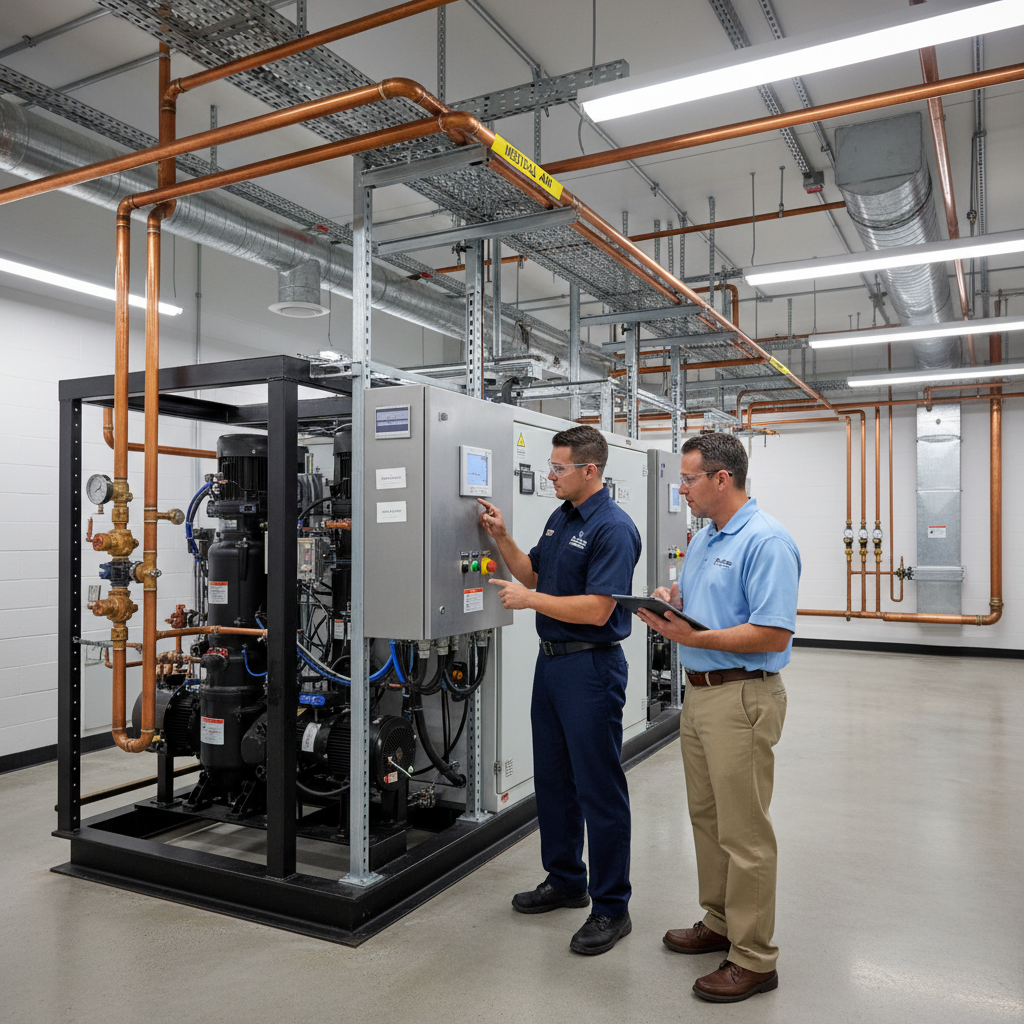
Never sign a PM ticket at a desk three floors away from the mechanical room. Walk to the medical air skid with the technician and run through this five-point physical closeout:
Hand-off-auto (HOA) switches: Confirm every compressor starter and dryer controller on the multiplex control panel is set to "Auto", never left in "Hand" or "Off" from bump-testing.
Filter and regulator bank valves: Verify that the active filtration line and primary regulator isolation valves are open, and the standby bank is aligned per your facility's redundancy policy.
Master and area alarm panels: Check the local compressor panel and the nearest master alarm panel to ensure no trouble signals (such as "Reserve In Use" or "High Dew Point") remain latched from testing.
Receiver sight glass and bypass: Inspect the receiver drain bypass valve to make sure it is fully seated and not bleeding compressed air into the floor drain.
Consumable labeling: Confirm that new intake filters, coalescing elements, and micron filters have the installation date and technician's ASSE 6040 certification number written directly on the housing.
Taking five minutes at the skid prevents the classic post-PM failure where the lead pump shuts down on a timer change and the lag pump fails to start because its selector switch was left in the "Off" position during amperage checks.
A clean compressor handoff makes your facility's broader compliance calendar much easier to manage. While source equipment requires quarterly or semi-annual maintenance depending on runtime hours and OEM specifications (such as BeaconMedæs, Amico, or Powerex guidelines), those visits feed directly into your comprehensive annual medical gas inspections.
During an annual survey, inspectors check outlet pressures, flow rates, zone valves, and master alarm actuation across the entire hospital, including surgical suites where line isolation monitor testing is also performed to ensure electrical safety in wet procedure locations. If your quarterly medical air PM handoffs are organized sequentially in your compliance binder, the annual inspector can immediately verify source purity trending, CO sensor life, and relief valve dates without tearing down the plant.
Medical Testing Solutions works with hospital facilities teams across the Southeast to eliminate the disconnect between mechanical wrench-turning and survey-ready documentation. We supply replacement filtration kits, dew point sensors, and rebuild components, and our ASSE-certified technicians perform full maintenance, installation, and verification services.
Standardize Your Medical Air PM Workflow
Don't wait for a surprise survey or a high-dew-point alarm on a humid August weekend to discover gaps in your vendor's maintenance reports. Medical Testing Solutions helps South Carolina healthcare engineering teams tighten their source equipment upkeep and build airtight compliance records. To schedule an ASSE 6040 maintenance evaluation or source replacement components for your plant, request a quote online or call our technical team directly at (754) 315-1078.
Frequently Asked Questions
Under NFPA 99 Section 5.1.3.6.3.12, the medical air dew point must be monitored continuously, and local and master alarms must activate if the line pressure dew point exceeds +35°F (+1.7°C) at 50 to 55 psig.
Technicians maintaining medical gas source equipment should hold an ASSE 6040 Medical Gas Systems Maintenance Personnel certification. If components are replaced by breaching the pipeline, an ASSE 6010 installer and ASSE 6030 verifier may also be required.
At minimum, the handoff report must include compressor runtime hours, three-phase motor amperage draws, lead-lag cut-in/cut-out pressures, coalescing and intake filter statuses, dew point readings, and carbon monoxide monitor calibration verification with span gas details.
High ambient humidity in South Carolina places heavy moisture loads on aftercoolers, water separators, and desiccant or refrigerated air dryers. If automatic receiver drains fail or desiccant beads saturate, moisture quickly enters the pipeline and trips the +35°F high dew point alarm.
Yes. Leaving a compressor selector switch in the 'Off' or 'Hand' position after bump-testing, or leaving a filter bank isolation valve closed, is the primary cause of pressure loss immediately following a preventive maintenance visit.
Request a quote for your facility
Talk with Medical Testing Solutions about your next inspection, repair or equipment request.