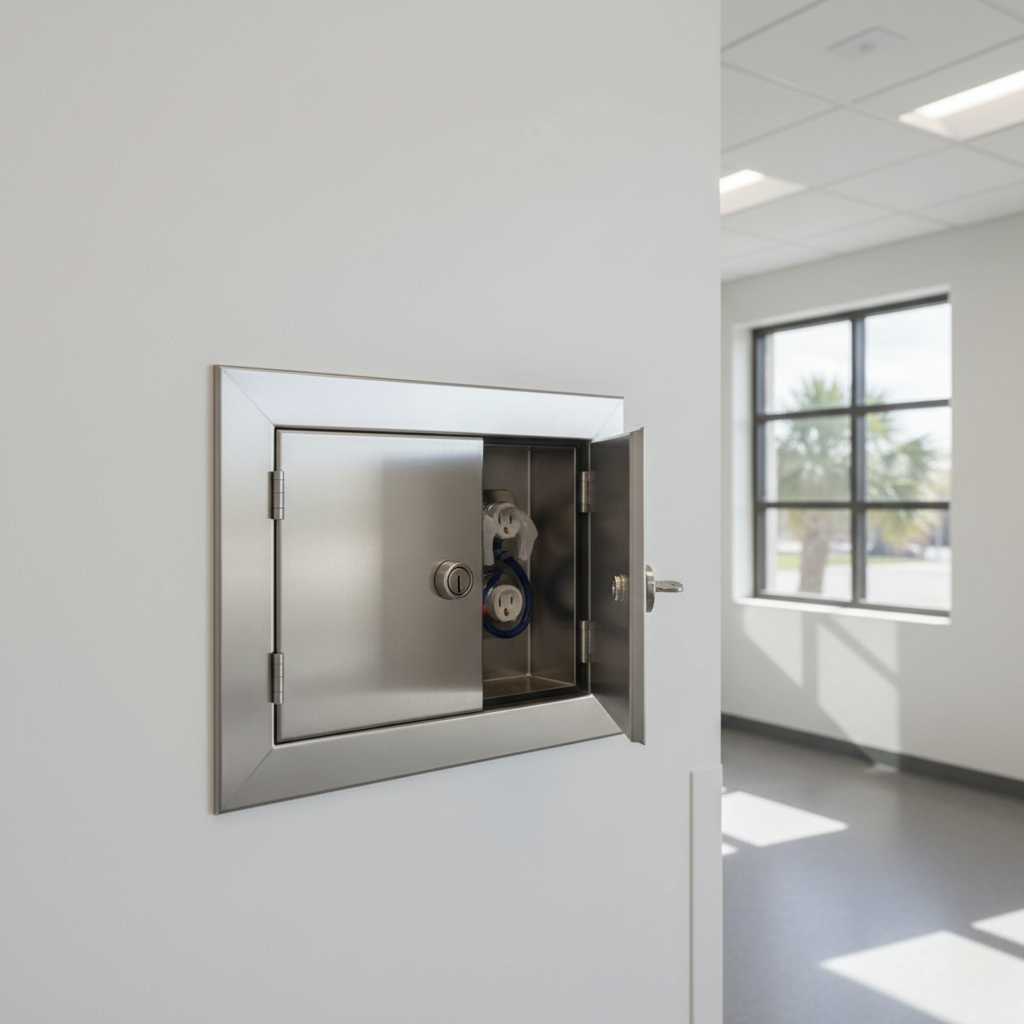
Psychiatric Medical Gas Lockbox Gainesville: Inspection & Code Guide
Medical Testing SolutionsNovember 14, 202610 min read
Share
During a recent annual inspection inside a behavioral health intake suite in North Central Florida, our verifier inserted the standard security key into a recessed wall enclosure and felt the lock cylinder spin freely. A patient had jammed a flattened plastic spoon handle into the keyway, sheared the cam tailpiece, and pried the lower edge of the stainless-steel door out by three-sixteenths of an inch. That tiny gap created an immediate ligature point and blocked nursing staff from accessing the oxygen and medical vacuum outlets inside during a clinical emergency.
When you manage a behavioral health unit or an emergency department assessment bay, managing a psychiatric medical gas lockbox Gainesville surveyors will scrutinize requires balancing two competing standards. You have to satisfy strict anti-ligature and tamper-resistance rules from The Joint Commission (TJC) and the Facility Guidelines Institute (FGI) while preserving full pneumatic performance and emergency accessibility under NFPA 99. Standard hospital headwalls fail instantly in acute psychiatric environments. Even heavy-gauge security enclosures degrade when subjected to repeated physical tampering, aggressive chemical wipe-downs, and misaligned drywall retrofits.
Medical Testing Solutions helps behavioral health facilities, psychiatric crisis units, and acute hospital campuses bridge the gap between life-safety code compliance and patient safety hardware.
Anatomy of a Psychiatric Medical Gas Lockbox
Acute psychiatric assessment rooms, often located inside busy emergency departments at systems like UF Health or AdventHealth, require medical gas delivery for medical clearance and emergency resuscitation without exposing patients to brass adapters, exposed latches, or protruding trim plates. Engineers solve this with a recessed, key-locking security enclosure (commonly called a psychiatric lockbox or behavioral health concealed outlet station).
A compliant lockbox assembly hides the terminal units (typically one oxygen and one medical-surgical vacuum station inlet) behind a flush-mounted, heavy-gauge stainless-steel door. When the patient room does not require active gas therapy, clinical staff remove the flowmeter and vacuum regulator, shut the door, and engage the deadbolt or institutional cam lock.
To survive high-acuity psychiatric environments and pass regulatory physical environment surveys, these enclosures rely on four hardware specifications:
Heavy-gauge door and frame construction: Doors use 14-gauge or 16-gauge Type 304 stainless steel with a satin finish to prevent flexing when pried by hand.
Continuous concealed piano hinges: Standard butt hinges create pinch and tie-off points; psychiatric lockboxes use flush stainless-steel piano hinges spot-welded inside the frame.
Beveled anti-ligature perimeter trim: The outer flange features a 30- to 45-degree sloped return to the finished drywall so cords, sheets, or clothing cannot catch on the top edge.
Pick-resistant institutional mortise or cam locks: Keyed-alike cylinders sit completely flush with the door face, eliminating thumb turns, pull rings, or protruding D-handles.
Common Field Failures in Behavioral Health Enclosures
Lockboxes take more physical abuse than almost any other piece of medical gas wall hardware. During routine annual medical gas inspections across Florida behavioral health units, our ASSE 6030 verifiers and ASSE 6040 maintenance specialists document two distinct failure categories: security hardware failures and internal pneumatic failures.
Mechanical and Anti-Ligature Breakdowns
The interface between the lockbox frame and the wall substrate is the most common failure point during a behavioral health environmental tour. If the drywall contractor cuts the rough opening too wide during construction or renovation, the beveled perimeter flange will not sit flat against the gypsum board. Staff often try to fill that gap with standard latex caulk. Patients quickly pick out soft caulk, exposing the sharp metal edge of the return flange. Facilities must seal that perimeter with pick-resistant, tamper-proof elastomeric security sealant (such as Pecora Dynaflex SC).
Lock mechanisms also fail under repeated use. When nurses force the door shut while a DISS dust cap or an oversized quick-connect latch sits slightly proud of the rough-in plate, the back of the stainless door slams against the outlet face. Over time, this bends the locking cam, warps the door leaf, and damages the secondary check valve inside the terminal unit.
Internal Terminal Unit Degradation
Because psychiatric lockboxes remain closed and locked 90% of the time, the medical gas outlets inside rarely get exercised by clinical staff. That inactivity breeds hidden pneumatic failures. Dust, drywall debris from original construction, and dried cleaner residue accumulate inside the recessed box. Seals dry out, and primary poppet valves stick when an emergency crash team finally unlocks the box and slams a flowmeter into the oxygen outlet.
Furthermore, recessed boxes restrict the clearance depth behind the closed door. If a facility attempts to leave a secondary piece of hardware attached or uses the wrong style of front-body latch, the door cannot close. If staff cannot lock the enclosure immediately after clearing a patient, the room falls out of compliance for psychiatric admissions.
If your behavioral health wing has sticking outlet latches, warped security doors, or overdue flow tests, schedule targeted medical gas maintenance services with our ASSE-certified technicians before your next survey window opens.
Psychiatric Lockbox vs Standard Recessed Wall Outlets
Facility engineers and compliance officers frequently ask how a true behavioral health medical gas enclosure differs from a standard architectural recessed console or a slide-poster concealment unit. The table below breaks down the engineering, code, and inspection criteria for each configuration.
Flush institutional key lock (mortise or heavy cam)
NFPA 99 Flow & Pressure Specs
Full compliance required (5.1.12)
Full compliance required (5.1.12)
Full compliance required (5.1.12)
TJC Ligature Risk Rating
High risk (prohibited in unmonitored psych)
High risk (panel can be ripped off track)
Compliant when locked and sealed flush
NFPA 99 and ASSE 6030 Testing Requirements Behind Locked Doors
Concealing medical gas outlets behind a steel security door never exempts them from NFPA 99 Health Care Facilities Code testing protocols. Every operational oxygen, medical air, and vacuum terminal unit inside a psychiatric assessment room is a life-safety device. Even if the behavioral health unit admits only ambulatory patients and hasn't hooked up a flowmeter in three years, The Joint Commission requires every piped medical gas outlet on the wall to be maintained and tested on schedule.
Why this matters for compliance: Under TJC Environment of Care standards (EC.02.05.09) and NFPA 99, an outlet inside a psychiatric lockbox cannot be labeled "out of service" or ignored simply because the door stays locked. If piped gas sits behind the valve, it must pass annual pressure, flow, and leakage verification, or be permanently capped and brazed off behind the wall by an ASSE 6010 installer.
When Medical Testing Solutions performs ASSE 6030 medical gas verification or annual preventive testing in a psychiatric unit, we coordinate directly with the charge nurse and facility security officer to unlock and inspect every enclosure. Our technical checklist covers both the NFPA 99 pneumatic side and the physical enclosure side:
Particulate and cross-connection checks (new installs/retrofits): Verifying under NFPA 99 Section 5.1.12.4 that no construction debris sits inside the recessed housing and that gas identity matches the copper pipeline.
Dynamic pressure and flow testing: Confirming that oxygen outlets deliver a minimum of 100 LPM (3.5 SCFM) with a pressure drop of no more than 5 psi (from a nominal 50–55 psi line pressure), and that medical-surgical vacuum inlets maintain at least 85 LPM (3.0 SCFM) without pulling nearby gauges below 12 inHg.
Mechanical latch retention and indexing: Testing the gas-specific indexing pins (whether Ohmeda, Chemetron, Puritan-Bennett, or DISS) with calibrated test adapters to guarantee smooth insertion and positive release without binding against the lockbox interior frame.
Seal integrity and box rigidity: Checking for audible or ultrasonic micro-leaks at the primary and secondary check valves while verifying that the recessed rough-in box does not flex inside the wall stud cavity when a nurse applies insertion force.
When facilities convert general emergency bays into dual-purpose psychiatric assessment rooms, we also supply and support turnkey medical gas installation upgrades through ASSE 6010 credentialed braziers, replacing exposed surface trim with code-compliant recessed security enclosures.
Navigating AHCA and Joint Commission Surveys in Gainesville and Across Florida
Operating a hospital or crisis stabilization unit in Florida means answering to two tough authorities: The Joint Commission (or DNV) and the Florida Agency for Health Care Administration (AHCA). When AHCA Office of Plans and Construction (OPC) reviewers inspect a new psychiatric lockbox installation or a behavioral health unit renovation in Gainesville, Ocala, or anywhere across the state, your documentation must satisfy Chapter 59A of the Florida Administrative Code and include a cleanly executed AHCA OPS Form 3110 (Medical Gas System Verification Report).
Inspectors look closely at the intersection of anti-ligature detailing and NFPA 99 accessibility. If a lockbox door sticks, lacks a working key at the nurse's station, or exhibits a gap wider than a credit card along the drywall perimeter, surveyors will cite the deficiency. Similarly, if your facility cannot produce current annual NFPA 99 inspection logs for those locked outlets, you face immediate Environment of Care findings.
Florida facilities also contend with severe weather risks that out-of-state providers rarely understand. Under NFPA 99 Section 5.1.12, any medical gas pipeline segment subjected to a loss of source pressure, flooding intrusion, or structural storm damage must undergo formal re-verification before returning to patient care. Because our South Florida and statewide crews live and work here, we mobilize rapidly after hurricanes or tropical storms hit North Central or South Florida.
Why Florida Facilities Partner with Medical Testing Solutions
Headquartered at 501 East Las Olas Blvd, Ste 300, Fort Lauderdale, FL 33301, Medical Testing Solutions provides ASSE 6010 installation, ASSE 6020 inspection, ASSE 6030 verification, and ASSE 6040 maintenance services across the entire state. Whether we are testing behavioral health lockboxes and acute care outlets for major healthcare networks like UF Health, AdventHealth, BayCare, or supporting South Florida systems such as Jackson Memorial, Baptist Health, Broward Health, Holy Cross, and Cleveland Clinic Florida, we bring local speed and regulatory precision.
Hiring an out-of-state verifier to inspect a psychiatric unit in Gainesville or Alachua County inflates your budget with airfare, rental cars, hotel nights, and daily per-diems. Medical Testing Solutions charges NO travel fees, NO lodging fees, and NO per-diem anywhere in Florida. Because our technicians operate statewide from our Florida medical gas service hub down through our Fort Lauderdale medical gas services and Miami medical gas services branches, most Florida hospitals and behavioral health centers save 10–25% compared to out-of-state ASSE 6030 verifiers.
Need replacement DISS latches, flush security lock cylinders, or recessed psychiatric outlet boxes? You can also source compliant hardware directly through our medical gas products catalog and have our certified technicians install and verify every component to AHCA and NFPA 99 standards.
Ready to bring your behavioral health medical gas enclosures up to full NFPA 99 and anti-ligature compliance without paying out-of-state travel markups? Call our Fort Lauderdale office at (754) 315-1078 for rapid statewide scheduling and same-day dispatch in South Florida, or request a quote online today.
Frequently Asked Questions
Yes. Under NFPA 99 and The Joint Commission (EC.02.05.09), every active medical gas terminal unit connected to the pipeline must undergo periodic pressure, flow, and leakage testing, even if it stays locked behind a stainless-steel security door 99% of the time. The only way to exempt an outlet is to have an ASSE 6010 installer permanently cut and braze-cap the drop behind the wall.
Surveyors most frequently cite gaps between the beveled stainless-steel return flange and the drywall, missing or soft latex caulk instead of pick-resistant security sealant, damaged cam locks that prevent the door from latching flush, and missing keys at the nursing station that delay emergency resuscitation access.
For renovations, additions, or new behavioral health unit construction in Florida, AHCA requires verification by a credentialed ASSE 6030 Medical Gas Verifier documented on AHCA OPS Form 3110 in accordance with Chapter 59A of the Florida Administrative Code and NFPA 99 Section 5.1.12.
No. Standard latex or silicone caulk can be easily peeled out by hand, exposing the metal edge of the lockbox frame as a potential self-harm or ligature hazard. Behavioral health enclosures must be sealed to the wall with a tamper-resistant, pick-proof elastomeric security sealant.
No. Medical Testing Solutions is headquartered at 501 E Las Olas Blvd in Fort Lauderdale and operates across the entire state of Florida with zero travel fees, zero lodging charges, and zero per-diem costs, saving Gainesville and Florida facilities 10–25% compared to out-of-state verifiers.
Request a quote for your facility
Talk with Medical Testing Solutions about your next inspection, repair or equipment request.