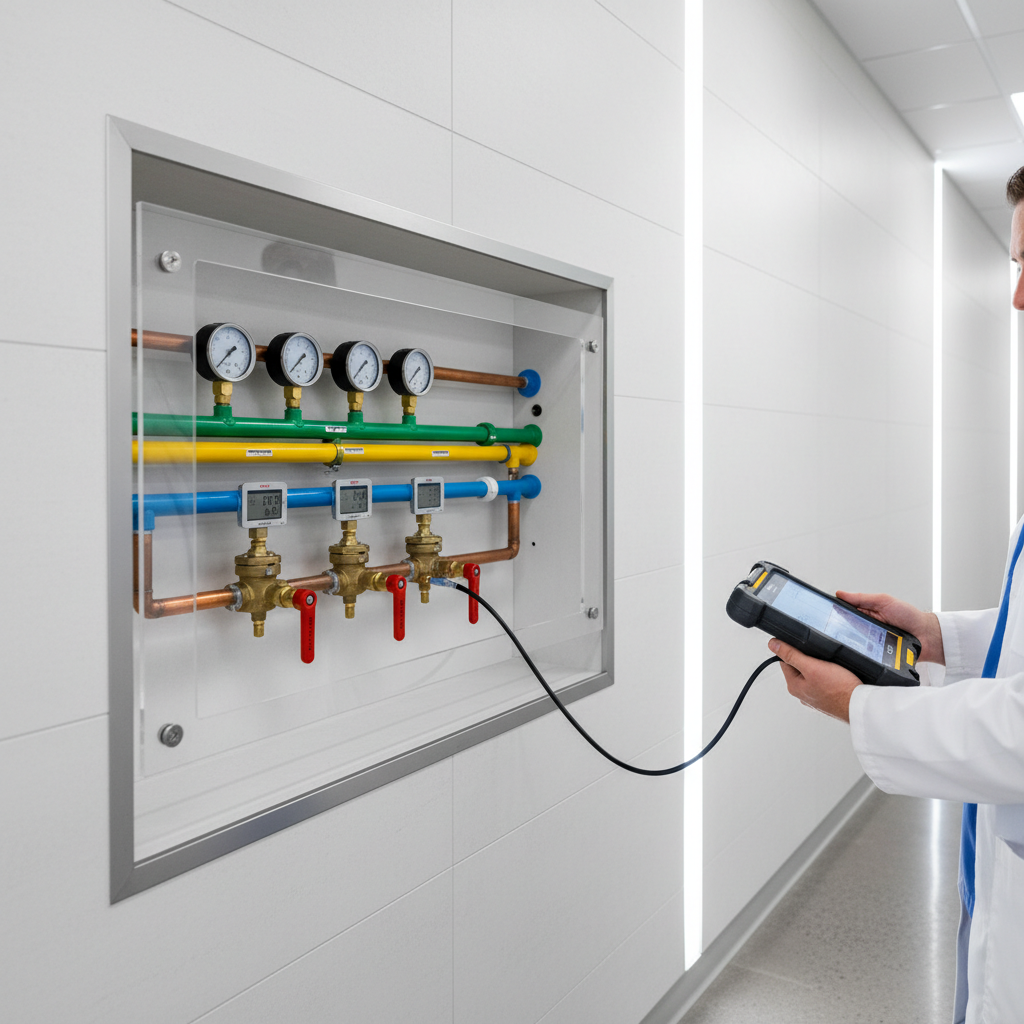
Myrtle Beach ASC Zone Valve Repair Verification: Renovation Handoff Guide
Medical Testing SolutionsNovember 14, 20269 min read
Share
You close the three-piece ball valve inside a corridor box to isolate Operating Room 2 for a quick weekend turnover, and the downstream pressure gauge drops only four psi before creeping right back up to 52 psi. The PTFE seat has cold-flowed or picked up a flake of copper oxide from an earlier tie-in, allowing oxygen to bypass the closed ball. In an ambulatory surgery center (ASC), a leaking zone valve turns a simple single-room repair into a facility-wide shutdown risk. Planning a Myrtle Beach ASC zone valve repair verification requires strict coordination between the mechanical installer, clinical leadership, and an independent verifier before anyone strikes an arc or loosens a union.
Along the Grand Strand, outpatient surgical volume leaves almost zero weekday downtime for pipeline maintenance. When a zone valve box fails an annual operational check or requires relocation during an OR expansion, the handoff between repair and verification determines whether you open for Monday morning cases on time. Here is how facility directors and mechanical contractors execute zone valve repairs, maintain legal isolation, and complete code-mandated verification without failing a South Carolina Department of Health and Environmental Control (DHEC) or accreditation survey.
Why ASC Zone Valves Fail During Coastal Renovations
Zone valve boxes sit untouched for years until an annual inspection or a remodel forces someone to cycle the handle. When our field teams inspect older surgery centers around Horry County, we see three primary failure modes that trigger a repair or box replacement.
First, internal seat blow-by happens when microscopic debris scores the virgin PTFE or TFE ball seats. Even if the handle hits the 90-degree mechanical stop inside the emergency pull-ring window, high-pressure gas slips past the seal. Second, stem packing leaks develop when the elastomeric O-rings or Teflon stem seals dry out and lose compression, causing a quiet leak around the handle shaft that only shows up under surfactant leak solution or ultrasonic detection. Third, gauge port or sensor port thread failures occur when someone over-torques a replacement pressure transducer into the 1/8-inch NPT brass port on the tube extension, cracking the silver-brazed joint or distorting the thin-wall copper stub.
Failure Condition
Allowed Repair Without Cutting Pipe
Requires Brazed Box Replacement
Required Post-Work Testing
Leaking stem packing or scored ball seats
Yes (if 3-piece swing-out body with external unions)
Yes (if older 1-piece soldered body or damaged tube ends)
Standing pressure leak check, operational flow check, gas identity
Cracked brazed joint on tube extension
No
Yes (requires nitrogen-purged hot work per NFPA 99)
Full installer testing (5.1.12.2) plus ASSE 6030 verification (5.1.12.4)
Drifting or dead box gauge
Yes (isolate or replace via self-sealing gauge check port)
No
Gauge accuracy comparison against calibrated digital master
Corridor wall relocation during ASC remodel
No
Yes (new box installation at revised smoke compartment boundary)
Full cross-connection, purge, purity, particulate, and operational verification
Isolation Planning Before Opening the Pipeline
An ASC cannot shut down its entire bulk oxygen manifold or medical air compressor package during business hours without canceling cases. Before your contractor unbolts a center section or cuts copper tubing, you have to trace the riser and branch topology to locate the next upstream shutoff valve. Under NFPA 99 (Health Care Facilities Code) Section 5.1.4.6, zone valves must be placed immediately outside each vital life-support, critical care, and anesthetizing location so that shutting off one room does not interrupt supply to adjacent operating rooms.
However, if the zone valve itself is the component under repair, you cannot use it to isolate its own box unless the leak is strictly downstream of the ball. You must move upstream to the main riser valve or the branch line valve serving that wing.
Walk the ceiling space above the corridor before scheduling the outage. Many older outpatient facilities built in the 1990s or early 2000s lack intermediate branch valves, meaning the nearest upstream isolation point might sit inside the mechanical room. If closing that upstream valve kills medical gas to all four operating rooms and the PACU, the repair must happen on a Friday evening or Saturday morning. Verify that the upstream isolation valve actually holds dead-end pressure before your crew cuts into the copper tube extensions.
Why this matters for compliance: Under NFPA 99 Section 5.1.4.1.6, standing pressure systems cannot be breached without written shutdown protocols signed by the facility's responsible authority. Guessing which rooms a riser valve feeds violates Joint Commission and AAAHC life safety standards and creates an immediate patient hazard.
If your facility needs help mapping risers or scheduling code-compliant pipeline repairs, explore our ASSE 6010 medical gas installation services to coordinate clean weekend turnarounds.
Repair Scope: Center-Section Rebuild vs. Full Box Replacement
How you scope the repair changes both your outage window and your testing obligations. Modern medical gas zone valve boxes from manufacturers like Amico, BeaconMedæs, and Ohio Medical use a three-piece, four-bolt swing-out valve body. This design allows an ASSE 6010 installer to depressurize the upstream segment, remove three bolts, loosen the fourth pivot bolt, and swing the brass center casting out of the pipeline without disturbing the copper tube extensions inside the drywall.
When rebuilding a three-piece valve in place, the technician replaces the ball, PTFE seats, stem seals, and body O-rings using factory-cleaned, oxygen-safe rebuild kits. Because no cutting or brazing occurs, no copper oxide scale forms inside the pipeline.
Full box replacement is a different engineering event. If the facility is renovating an operating room, re-framing a corridor wall, or replacing an obsolete single-piece valve that lacks union ends, the installer must cut the Type K or Type L hard-drawn seamless copper tubing. Under NFPA 99 Section 5.1.10.4, every new joint must be brazed using BCuP series filler metal while purging the interior of the pipe continuously with oil-free, dry nitrogen (NF) to prevent internal oxidation.
Before hiring a contractor to execute hot work on your pipeline, review the local compliance requirements we covered in our guide to choosing a medical gas contractor in Myrtle Beach, SC. Every brazed repair requires an continuous nitrogen purge until the joint cools to ambient temperature, followed by installer blow-down and pressure testing before the independent verifier steps onsite.
NFPA 99 Mandates for Independent ASSE 6030 Verification
A common compliance error in outpatient surgery centers occurs when the mechanical plumber who replaces or modifies a zone valve signs off on the final certification paperwork. NFPA 99 Section 5.1.12.4.1 strictly separates installer preliminary testing from final system verification. Final verification must be performed by an ASSE 6030 Medical Gas Systems Verifier employed by a party technically and financially independent of the installing contractor.
Whenever a zone valve box is replaced, relocated, or breached in a way that could introduce contaminants or alter piping geometry, the independent verifier must conduct specific downstream tests at every affected medical gas outlet and vacuum inlet:
Standing Pressure and Leak Verification: Checking that all newly assembled unions, stem packings, and brazed joints hold line pressure (typically 50 to 55 psi for positive pressure gases, 180 to 185 psi for nitrogen/instrument air) with zero decay.
Cross-Connection and Gas Identity: Using a calibrated oxygen analyzer and gas-specific instrumentation at every downstream OR outlet to verify that oxygen, nitrous oxide, medical air, carbon dioxide, and vacuum lines were not crossed during box replacement.
Particulate and Purge Testing: Passing high-flow test gas through a 0.45-micron filter at the furthest downstream outlet to confirm that zero brazing slag, copper shavings, or seat debris entered the zone.
Purity and Contaminant Analysis: Testing downstream gas against source gas for moisture (dew point), total gaseous hydrocarbons, and carbon monoxide per NFPA 99 Section 5.1.12.4.8.
Area Alarm and Transducer Calibration: When a zone valve box houses the local area alarm sensors on its downstream gauge port, the verifier tests high and low pressure setpoints (+/- 20% for positive pressure gases, 12 inHg threshold for medical-surgical vacuum) to confirm the alarm triggers audibly and visually.
Medical Testing Solutions provides independent ASSE 6030 medical gas verification with complete digital documentation packages formatted for DHEC, Joint Commission, and AAAHC surveyors.
Coordinating Verification Travel from Fort Lauderdale to Myrtle Beach
Wait times for qualified ASSE 6030 verifiers in coastal South Carolina frequently stall ASC renovation schedules. If your mechanical contractor finishes brazing a new zone valve assembly at 2:00 PM on a Saturday, you cannot wait until Wednesday for a verifier to arrive if you have orthopedic or GI blocks scheduled for Monday morning at 7:00 AM.
Medical Testing Solutions dispatches ASSE 6010 installers, ASSE 6020 inspectors, and ASSE 6030 verifiers directly from our headquarters in Fort Lauderdale, Florida, on a pre-scheduled mobilization timeline. Rather than leaving your center on a reactive dispatch waitlist, we lock in the exact handoff hour with your general contractor or mechanical lead weeks in advance.
When we schedule a Myrtle Beach mobilization, our team coordinates two distinct phases if needed:
Pre-Outage Valve and Kit Staging
Need replacement zone valve boxes, rebuild kits, or area alarm transducers before the shutdown? We supply code-compliant components through our medical gas products catalog and ship them directly to your facility ahead of the outage window so your contractor has exact-match parts on the cart.
Same-Weekend Verification and Turnover
Our ASSE 6030 verifier arrives onsite as the installer completes their preliminary standing pressure test. We execute the purge, particulate, purity, concentration, and operational pressure drop tests across all affected ORs and recovery bays immediately. Before leaving the building, we hand your facility director the signed verification report so you can restore normal clinical pressures with zero administrative delay.
Preventing Post-Renovation Survey Deficiencies
Passing the physical pressure test is only half of the renovation handoff. During your next accreditation survey or annual medical gas inspection, the surveyor will walk directly to the renovated corridor and inspect the zone valve box installation against NFPA 99 Section 5.1.4.6 and Section 5.1.11.2.
Make sure your handoff checklist covers three visual details that frequently trigger citations after a valve repair:
Updated Room Labeling: If the renovation renumbered Operating Room 3 to Procedure Room 1, or added an extra recovery bay downstream, the permanent label on the zone valve piping and window cover must match the exact room numbers currently posted on the corridor doors.
Line of Sight and Door Swing: Newly framed doors, crash rails, or mobile anesthesia carts cannot block access to the emergency pull-out window. A zone valve box can never sit behind a door that swings open against it, and it cannot be located inside the same room as the outlets it controls.
Preventive Maintenance Integration: Once the repaired or replaced valve passes verification, add the new assembly and its elastomeric seals to your ongoing medical gas maintenance services schedule and update your master medical gas certification binder so surveyors see an unbroken chain of custody from shutdown to clinical reopening.
Planning a zone valve repair or OR remodel at your surgery center? Call Medical Testing Solutions at (754) 315-1078 or request a quote online to schedule your equipment delivery, isolation review, or independent ASSE 6030 verification in Myrtle Beach.
Frequently Asked Questions
If the technician only replaces the internal ball, PTFE seats, and stem seals on a three-piece union-body valve without cutting or brazing the copper pipeline, a documented standing pressure leak test, operational flow check, and gas identity check are required under NFPA 99 maintenance protocols. However, if the valve box is cut out, relocated, or re-brazed, full independent ASSE 6030 verification under NFPA 99 Section 5.1.12.4 is mandatory before patient use.
No. NFPA 99 Section 5.1.12.4.1 requires final verification to be performed by an ASSE 6030 Medical Gas Systems Verifier who is technically and financially independent of the installing contractor. The ASSE 6010 installer must perform preliminary installer tests (such as blow-down and standing pressure tests), while a separate third-party verifier performs the final certification.
An in-place center-section rebuild on a three-piece zone valve typically takes 45 to 90 minutes once the upstream riser or branch valve is shut down and downstream lines are bled to zero pressure. A full brazed zone valve box replacement requires cutting, continuous nitrogen purging during brazing, cool-down, installer pressure testing, and ASSE 6030 verification, which typically requires a 6-to-12-hour weekend shutdown window.
Under NFPA 99 Section 5.1.4.6, zone valves must be installed immediately outside each anesthetizing location or critical care area in an accessible corridor where they remain visible and unobstructed. They cannot be placed inside the operating room they control, nor can they be positioned behind a door that swings open and covers the box.
Yes. Medical Testing Solutions schedules dedicated travel from our Fort Lauderdale headquarters to Myrtle Beach and across South Carolina for weekend ASC outages. By coordinating the handoff window in advance with your mechanical contractor, our ASSE 6030 verifiers complete testing and deliver signed compliance reports before your Monday morning surgical schedule begins.
Request a quote for your facility
Talk with Medical Testing Solutions about your next inspection, repair or equipment request.