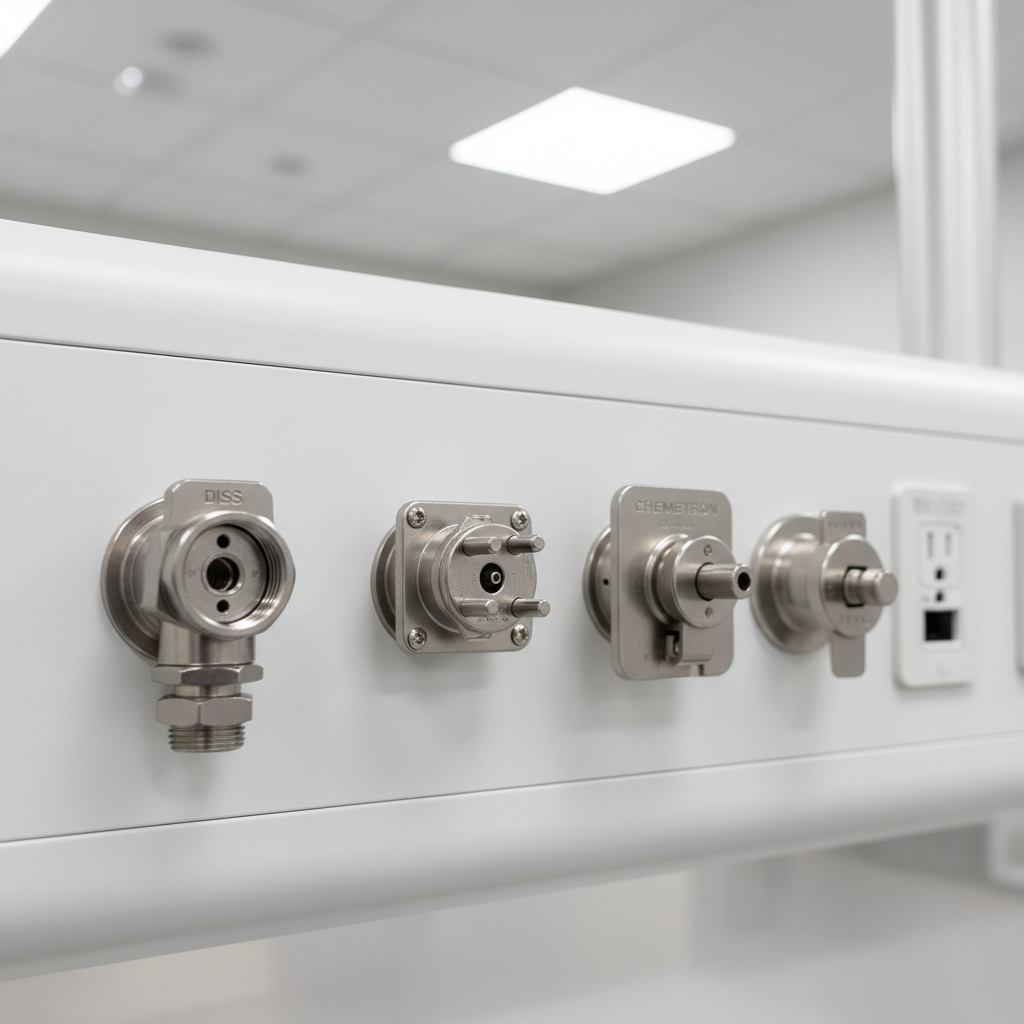
Your Guide to Medical Gas Outlet Types: DISS, Ohmeda, Chemetron, and Puritan Quick-Connect
Medical gas outlets are the critical final connection point between a facility's gas distribution pipeline and the life-saving equipment that serves patients. Understanding the different outlet standards is not just a matter of convenience, it is a fundamental requirement for patient safety and regulatory compliance. The array of connector types, including DISS, Ohmeda, Chemetron, and Puritan Bennett, can be confusing. Each has a unique design to prevent the misconnection of gas services, a cornerstone of standards like NFPA 99. This guide will demystify these common outlet types, compare their features, discuss cross-compatibility and retrofitting, and explain how to ensure your facility meets current codes. We will provide the authoritative information you need to manage your medical gas systems safely and effectively.
What are Medical Gas Outlets?
Medical gas outlets, also known as terminal units, are the wall- or ceiling-mounted ports that allow healthcare staff to connect equipment like flowmeters, ventilators, and anesthesia machines to the central medical gas pipeline system. Their most important feature is a gas-specific indexing system. This means an oxygen outlet will only accept an oxygen connector, preventing a tragic and avoidable error like plugging a medical air hose into a carbon dioxide outlet. This safety principle is mandated by the National Fire Protection Association (NFPA) in standard NFPA 99, Health Care Facilities Code.
Outlets consist of two main parts:
- The Rough-in Assembly: This is the portion installed within the wall or headwall, connecting directly to the facility's copper pipeline. It includes the gas-specific valve mechanism.
- The Finish Assembly (or Latching Assembly): This is the visible, exterior portion that includes the indexed faceplate and the connection point for the secondary equipment.
Proper installation and maintenance of these components are essential, a process governed by ASSE International standards. For new construction or renovations, an ASSE 6030 certified verifier must confirm every outlet is installed correctly, provides the correct gas, and meets all pressure and flow requirements.
Why This Matters for Compliance
NFPA 99 (2024 edition, Section 5.1.4.1) mandates that "Gas-specific connection points shall be provided for all gas and vacuum systems." It further requires these connections to be "noninterchangeable." Using the correct, standardized outlet type is the primary method of achieving this noninterchangeability and ensuring a compliant, safe environment.
The Four Major Outlet Standards Compared
While several standards exist globally, four dominate the U.S. market: DISS, Ohmeda (now part of Ohio Medical), Chemetron, and Puritan Bennett. The primary distinction lies in their connection mechanism.
DISS (Diameter Index Safety System)
DISS is not a quick-connect system. It uses a threaded connection where a nut on the equipment hose is tightened onto the outlet. The safety indexing is achieved through a series of concentric, varying diameters on the connector components. Each gas has a unique set of diameters, making it physically impossible to thread a mismatching connector.
- Connection Type: Threaded (nut and nipple)
- Common Uses: Often found on flowmeters, ventilators, and other equipment where a secure, non-accidental disconnection is paramount. Also common in laboratory settings.
- Advantage: Extremely secure connection that is unlikely to be accidentally dislodged.
- Disadvantage: Slower to connect and disconnect compared to quick-connect types.
The "Big Three" Quick-Connect Styles
These outlets allow for rapid, one-handed connection and disconnection. A probe on the secondary equipment is simply pushed into the outlet until it clicks and locks. The gas-specific indexing is achieved through unique pin or key patterns on the outlet face and the corresponding probe.
1. Ohmeda (Ohio Medical / Diamond™)
Ohmeda outlets are one of the most common quick-connect types. They use a simple push-to-connect mechanism with a twist-and-pull release. The indexing is achieved by the shape of the connector and the arrangement of pins.
- Connection Type: Push-to-connect, twist-to-release.
- Identifier: Often has a distinctive rectangular faceplate and a prominent release button on the side or top.
2. Chemetron (Allied Healthcare / Schrader)
Chemetron outlets are another widely used quick-connect standard. They are known for their "straight-in, straight-out" connection. The probe is inserted and locks automatically; disconnection usually involves pressing a release button on the outlet face.
- Connection Type: Push-to-connect, button-release.
- Identifier: Typically features a circular faceplate and a release button integrated into the surrounding ring.
3. Puritan Bennett (PB / Medaes)
Puritan Bennett is the third major quick-connect style. It uses a push-in connection and often requires a twisting motion of the outer ring to release the probe.
- Connection Type: Push-to-connect, twist-ring-to-release.
- Identifier: The shape of the faceplate and the knurled metal release collar are key identifiers.