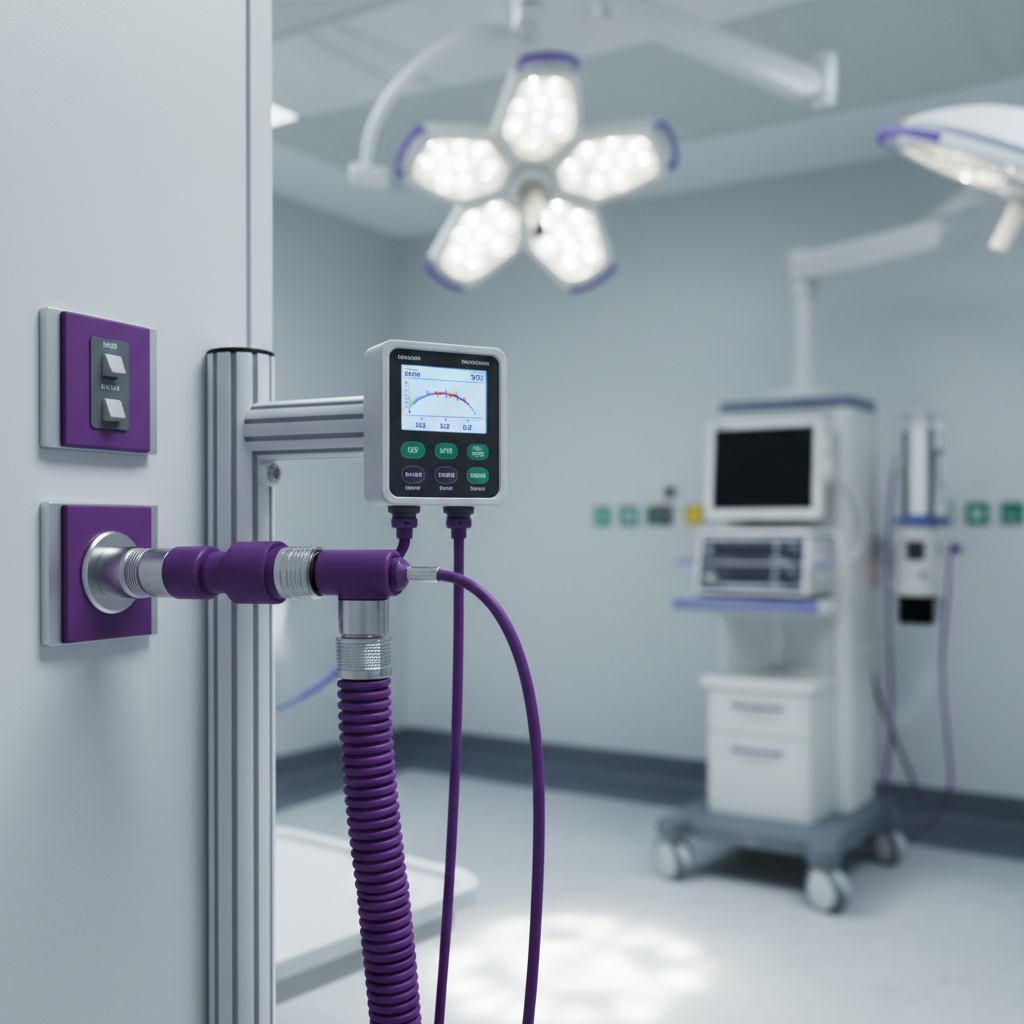
WAGD System Testing Johnson City TN: Flow Capacity & OR Scavenging
Medical Testing SolutionsNovember 14, 20268 min read
Share
Walk into an operating suite during a morning anesthesia machine checkout and listen to the active scavenging receiver on the back of the workstation. If you see the float ball pinned tightly to the top of the sight glass while the reservoir bag collapses, someone opened the needle valve too far on a high-vacuum pipeline. Worse, if the float rests dead at the bottom while the machine runs, your waste anesthetic gas disposal (WAGD) inlet isn't drawing the required volumetric flow. Both conditions fail compliance and put surgical staff or the patient's breathing circuit at risk.
Managing WAGD system testing Johnson City TN facilities rely on requires more than slapping a vacuum gauge onto a purple wall inlet and writing down inches of mercury. Static mercury pressure alone tells you almost nothing about whether the piping network can move 50 liters per minute (LPM) of scavenging gas when four adjoining operating rooms run simultaneously. You have to audit dynamic flow capacity at the terminal inlet and balance the scavenging interface pressure on the anesthesia machine itself.
Why Static Vacuum Readings Miss Real Scavenging Failures
Technicians who test a WAGD inlet the exact same way they test a standard white surgical vacuum inlet often miss dynamic starvation. A partially closed zone valve, a kinked flexible ceiling drop hose, or lint buildup inside a DISS check valve will still allow static vacuum pressure to equalize to 18 inHg when no gas is moving. The moment you open a calibrated flowmeter to simulate an active anesthesia scavenging load, the pressure behind that restriction drops to near zero.
Under NFPA 99 (Health Care Facilities Code), Section 5.1.12, and routine maintenance workflows led by ASSE 6030 verifiers and ASSE 6040 maintenance personnel, WAGD networks must prove they can sustain flow under load. Depending on the type of anesthesia scavenging interface installed in your surgical suite, the pipeline operates under two totally different physical profiles: high-vacuum/low-flow or low-vacuum/high-flow (dedicated regenerative blower systems). Testing one profile with the acceptance criteria of the other produces false passes or damages equipment.
High-Vacuum vs. Dedicated Blower WAGD Profiles
Before clipping a test rig into an operating room wall plate or ceiling column, you need to know how your source equipment generates negative pressure. Many hospitals combine WAGD onto the central medical-surgical vacuum pump skid (permitted under NFPA 99 Section 5.1.3.8 when total oxygen concentrations in the airstream stay safely managed and pumps use oxygen-compatible lubricants), while others install dedicated claw or regenerative ring blowers solely for anesthesia gas disposal.
System Attribute
High-Vacuum / Combined Source
Low-Vacuum / Dedicated Blower (Venturi/Ring)
Typical Static Vacuum
15 to 19 inHg
0.5 to 2.5 inHg (high volume, low negative pressure)
Scavenging Receiver Type
Open reservoir with adjustable needle valve
Open or closed interface with fixed orifice / damper
Minimum Flow Per Inlet (NFPA 99)
25 to 50 LPM (1.0 to 1.8 SCFM) depending on interface
High volumetric draw, continuous 50+ LPM
Primary Failure Mode
Needle valve clogging, collapsed boom hoses
Blower damper drift, loss of flow at furthest OR
Risk of Over-Vacuum
High (can apply negative pressure to breathing circuit)
Low (insufficient static pull to collapse circuit bags)
Knowing which design serves your surgical department determines how you configure your calibrated test tree. High-vacuum systems require you to measure both static inches of mercury and sustained SCFM/LPM flow without causing unacceptable pressure drops at adjacent outlets.
If your surgical department needs a documented flow capacity audit or trace gas survey, explore our WAG chemical vapor monitoring services to keep your operating rooms within occupational exposure limits.
Auditing Dedicated WAGD Vacuum Flow Capacity
When Medical Testing Solutions performs an audit of your WAGD pipeline, we start at the source equipment and work outward to the most hydraulically remote operating room. For dedicated WAGD producers under NFPA 99 Section 5.1.3.8, the source must consist of at least two duplexed vacuum producers wired to the essential electrical system, capable of maintaining demand when the largest single unit is out of service.
At each purple-coded WAGD terminal inlet (using standard DISS 2220 fittings or manufacturer-specific quick-connects like Ohmeda, Chemetron, or Puritan Bennett), the flow audit verifies three specific metrics:
Mechanical Latch and Seal Integrity: Insertion and withdrawal force must hold the heavy corrugated scavenging hose securely without leaking room air past worn O-rings.
Static Negative Pressure: Measured with a NIST-traceable digital manometer before opening the flow control valve.
Dynamic Flow Under Load: Measured using a calibrated rotameter or mass flow meter opened to simulate active scavenging demand (typically 25 to 50 LPM continuously, with surges checked up to 1.8 SCFM).
Adjacent Inlet Drawdown: Opening multiple outlets across the same branch zone simultaneously to confirm the sub-main piping doesn't starve the furthest surgical suite.
Why this matters for compliance: Under NFPA 99 Section 5.1.12.4.10, medical vacuum and WAGD inlets must demonstrate adequate flow capacity without pulling the zone below operational thresholds. If a ceiling column hose has delaminated internally, a static gauge check will pass, but the dynamic flow test will expose the blockage before sevoflurane or nitrous oxide spills into the breathing zone of the anesthesia provider.
Balancing OR Scavenging Receiver Pressures
Getting adequate suction to the wall outlet or ceiling boom is only half the equation. From the wall outlet, a purple hose feeds the anesthesia workstation's scavenging system. If that interface isn't balanced, two dangerous scenarios happen inside the operating room.
Scenario 1: Under-Scavenging and Trace Gas Spill
When the needle valve on an open-reservoir scavenging interface is throttled down too far, or the inline particulate filter screen becomes matted with surgical lint, the receiver cannot pull at least 25 to 30 LPM out of the disposal assembly. During peak exhalation or high fresh-gas flows, waste anesthetic gas overflows the open reservoir porting directly onto the OR floor. Staff soon fail NIOSH recommended exposure limits (2 ppm for halogenated agents like sevoflurane or desflurane, and 25 ppm for nitrous oxide over a time-weighted average).
Scenario 2: Over-Scavenging and Negative Circuit Pressure
When a clinician or biomed technician cranks the scavenging needle valve wide open on a high-vacuum pipeline (pulling 18+ inHg) and the negative-pressure relief valve on a closed interface sticks shut, high vacuum transfers straight into the breathing system. This can prematurely empty the ventilator bellows or draw positive end-expiratory pressure (PEEP) out of the patient's lungs. Balancing the OR scavenging receiver requires adjusting the flow control valve so the indicator float stays smoothly suspended between the minimum and maximum etched witness marks during both idle and high-flow oxygen flush cycles.
Ceiling Columns, Boom Hoses, and Common Choke Points
Even when the hard copper main behind the drywall passes every pressure and flow calculation, surgical suites rely on articulating ceiling booms and retractable utility columns. Inside those booms, flexible polymer hoses carry WAGD from the ceiling plenum down to the headwall manifold.
Over five to seven years of twisting, repositioning, and constant negative pressure, these internal boom hoses fatigue. We frequently open ceiling columns where a WAGD hose has kinked at a 90-degree brass elbow or partially collapsed inward. Because the inner liner pinches shut only when high flow is demanded, the anesthesia machine passes its low-flow morning check but spills trace gas during long cases. Pairing your pipeline flow audit with annual medical gas inspections catches degraded boom assemblies and worn DISS check valves before a surveyor walks onto the surgical floor.
Checking the Source Exhaust Discharge
A complete WAGD test doesn't stop inside the operating room. NFPA 99 Section 5.1.3.7.7 and 5.1.3.8 require vacuum and WAGD exhausts to discharge outdoors in a location that prevents re-entry into building air intakes, windows, or doors. During a system audit, verifiers inspect the rooftop discharge piping to ensure insect screens haven't corroded or clogged, low-point drain traps are clear of condensation, and the exhaust stacks sit at safe distances from HVAC fresh-air louvers.
Coordinating WAGD Testing Across Eastern Tennessee
Hospitals and outpatient surgery centers operating under the oversight of the Tennessee Department of Health, whether major regional networks like Vanderbilt University Medical Center and Methodist Le Bonheur Healthcare or community surgical facilities across the Tri-Cities, must maintain complete documentation of their medical gas and vacuum testing for state licensing and accreditation surveys.
Medical Testing Solutions is headquartered in Fort Lauderdale, Florida, and our ASSE 6030 verifiers and environmental monitoring specialists travel regularly to support facilities listed on our Tennessee medical gas services page. By grouping medical gas verification after renovations with routine medical gas maintenance services and trace gas testing, we coordinate regional site visits efficiently around your OR surgery schedule. We also supply replacement DISS inlets, ceiling hose assemblies, and pipeline components through our medical gas products catalog so your facility engineering team can swap out restricted hardware immediately.
If you need to schedule a WAGD flow capacity audit, balance OR scavenging interfaces, or set up routine compliance testing in Johnson City, request a quote online or call Medical Testing Solutions directly at (754) 315-1078 to coordinate your inspection window.
Frequently Asked Questions
A static gauge only shows that negative pressure can equalize behind a closed valve. If an internal boom hose is kinked or a particulate screen is clogged with surgical lint, static vacuum may still read 18 inHg, but flow will drop to near zero the moment the anesthesia scavenging system demands 30 to 50 LPM.
Open-reservoir scavenging receivers on anesthesia machines generally require a sustained draw between 25 and 50 LPM (roughly 1.0 to 1.8 SCFM) so the indicator float stays suspended between the witness marks without overflowing trace gas or applying excessive suction to the breathing circuit.
Yes. NFPA 99 Section 5.1.3.8 permits WAGD inlets to connect to the medical-surgical vacuum source provided the pumps are sized for the combined demand and use oxygen-compatible fluids or dry claw/ring technology if oxygen-enriched mixtures are present.
NIOSH recommends a ceiling limit of 2 parts per million (ppm) over a 1-hour sampling period for halogenated anesthetic agents (such as sevoflurane, isoflurane, and desflurane) and 25 ppm as a time-weighted average during anesthetic administration for nitrous oxide.
WAGD inlets, boom hoses, and source equipment should be inspected and flow-tested at least annually as part of a facility's NFPA 99 medical gas maintenance program, as well as immediately following any ceiling boom hose replacement or pipeline modification under ASSE 6030 verification rules.
Request a quote for your facility
Talk with Medical Testing Solutions about your next inspection, repair or equipment request.