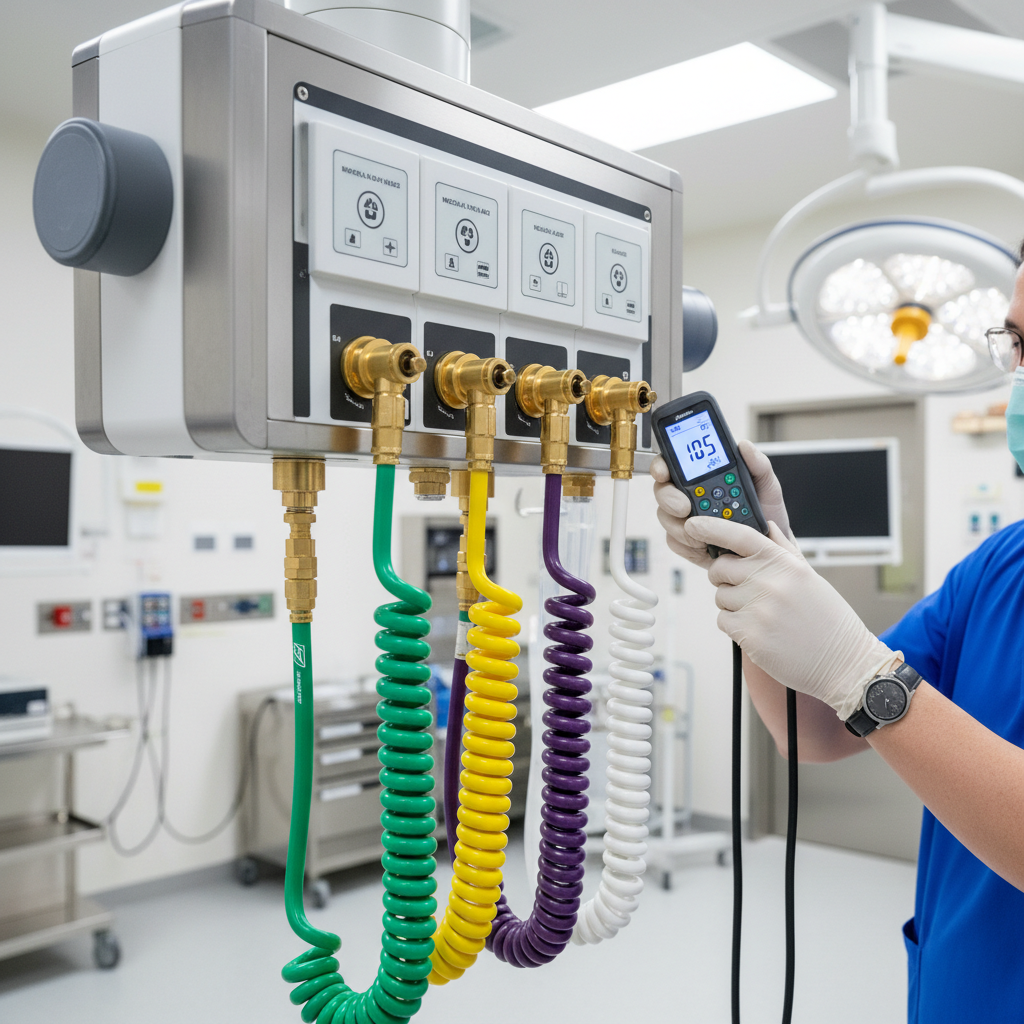
Surgical Boom Medical Gas Hose Inspection: Fatigue & Flow Testing
Medical Testing SolutionsNovember 13, 20269 min read
Share
Pull back the sterile silicone boot on a ten-year-old articulating OR ceiling boom, and you will often find fine black powder dusted across the internal stainless steel spindle. That dust isn't dirt from the interstitial space. It is abraded conductive neoprene shedding from the outer jacket of the vacuum and oxygen hoses every time the surgical team swings the pendant across the table. Because hidden internal hoses and exposed drop hoses carry the exact same life-safety load as brazed copper walls, a methodical surgical boom medical gas hose inspection is the only thing standing between a fatigued elastomer core and an intra-operative pressure drop.
Most hospital preventive maintenance schedules treat boom hoses as passive accessories until an anesthesia machine throws a low-supply-pressure alarm mid-case. By the time a hose audibly hisses or fails a quick visual glance from the floor, internal braid separation or ferrule creep has already compromised flow capacity. Understanding what happens inside both the external drop assembly and the hidden articulating knuckle lets your facility engineering team catch material fatigue before an operating room goes offline.
Anatomy of an OR Ceiling Boom Gas Delivery Path
An articulating surgical boom splits medical gas delivery into two distinct flexible zones. First, internal jumper hoses bridge the stationary ceiling flange above the plaster line to the rotating horizontal arms and vertical column. Second, exposed drop hoses connect the boom head's gas outlets to the anesthesia machine, heart-lung bypass unit, or surgical insufflator.
Both zones rely on flexible medical gas assemblies built to CGA E-10 and NFPA 99 specifications, yet they fail in completely different ways. External drop hoses suffer from chemical attack, cart run-overs, and high-cycle strain at the terminal outlet check valve. Internal boom hoses never see quaternary ammonium disinfectants or rolling casters, so inspectors frequently ignore them. Instead, those concealed jumpers endure thousands of tight-radius torsional twists inside a dark, enclosed aluminum channel.
NFPA 99 and CGA E-10 Standards for Flexible Assemblies
NFPA 99 (Health Care Facilities Code) regulates medical gas boom assemblies under Chapter 5 for manufactured assemblies and Chapter 15 for ongoing maintenance. Specifically, NFPA 99 Section 5.1.10.11.6 prohibits the use of non-metallic flexible connectors inside concealed spaces unless they are part of a listed manufactured assembly, which is the exact exception that allows internal surgical boom hoses to exist. Because these hoses sit inside an engineered equipment enclosure, NFPA 99 requires facilities to inspect and maintain them according to the manufacturer's instructions for use (IFU) and risk-based maintenance protocols under Section 5.1.14.
Every medical gas hose in an operating room must also conform to CGA V-5 (DISS connections) and CGA E-10 (Maintenance of Medical Gas and Vacuum Systems). Color-coding is mandatory in the United States: green for oxygen, yellow for medical air, purple for WAGD, blue for nitrous oxide, black for nitrogen, and white for medical vacuum. Beyond color, the hose jacket must remain permanently legibly marked with the gas service and maximum working pressure.
Why this matters for compliance: Joint Commission surveyors and CMS inspectors increasingly cite facilities under EC.02.05.01 when biomed and facilities teams cannot clarify who owns the boom head versus the wall valve. Establishing a clear NFPA 99 medical gas hose replacement cadence eliminates the compliance gap between OEM boom service and annual piped gas testing.
If your operating rooms are due for credentialed testing, schedule your annual medical gas inspections with an ASSE 6030 verifier to evaluate boom drops alongside your facility's zone valves and alarms.
External Visual Inspection Parameters for Drop Hoses
Inspecting external drop hoses takes more than checking whether the green jacket looks clean. You need to relieve line pressure, disconnect the quick-connect or DISS nut from the boom outlet, and examine the entire assembly under bright light from the upper strain relief down to the machine manifold connection.
Pay close attention to the top six inches immediately below the boom terminal connection. Because the weight of a twelve-foot hose hangs continuously from that single point, gravity pulls the inner core downward while staff yank the hose laterally to reach the anesthesia cart.
Look for five specific physical failure markers during your tactile and visual sweep:
Ferrule slip and bare core exposure: If you see more than 1/16 inch of clean, unweathered hose inner core protruding below the brass crimp collar, the hose is pulling out of its fitting and must be condemned immediately.
Circumferential micro-cracking: Bend the hose into a tight four-inch loop near the fittings; surface cracks that open up into the reinforcing textile braid indicate ozone and disinfectant degradation.
Jacket blistering or soft spots: Bubbles under the outer cover mean high-pressure gas has pinholed through the inner tube and is migrating along the synthetic yarn braid.
DISS hex nut galling and stripped threads: Worn brass threads or deformed nipple noses prevent a gas-tight seal and force clinicians to use wrenches on hand-tight fittings.
Loss of electrical conductivity on vacuum and WAGD hoses: Debris buildup or internal wire breakage can compromise static dissipation paths where conductive tubing is specified.
Articulation Fatigue Markers in Concealed Boom Jumpers
While drop hoses fail right in front of the clinical staff, internal boom hoses fail out of sight inside the central spindle and arm knuckles. Accessing these assemblies requires removing the boom's cosmetic shroud panels and rotational stop covers. Only technicians trained under ASSE 6040 (Medical Gas Maintenance Personnel) or qualified boom specialists should open energized multi-arm pendants, as high-voltage wiring and pneumatic brake lines share the same column.
Inside the pivot knuckles, hoses route through rotational guides that typically limit rotation to roughly 330 degrees. Over years of heavy surgical volume, two mechanical problems develop: rotational stops wear down or break, and internal hose bundles shift out of their low-friction nylon tracks.
Torsional Bird-Caging and Kinking
When a mechanical rotational stop fails, staff can spin the boom arm past its design limit. This twists the internal hose bundle like a wrung towel. Even before the inner tube kinks shut, the reinforcing braid separates from the inner core, a defect known as bird-caging. You can feel bird-caging by squeezing the unpressurized hose along the pivot radius; the hose will feel spongy or flattened rather than firm and round.
Abrasion at the Spindle Bulkhead
Every time a circulating nurse repositions the boom, the internal hoses flex slightly against the cast aluminum bulkhead edges. If the protective grommet splits or slides out of place, the cast metal acts like a file against the hose jacket. When Medical Testing Solutions performs comprehensive medical gas maintenance services, our technicians check the bottom tray of the boom head for colored rubber shavings, green, yellow, or black dust is an unmistakable warning that a pressurized hose is rubbing through its outer wall.
Pressure Drop and Dynamic Flow Testing Across the Boom
A hose can pass a basic static visual inspection and still starve an anesthesia ventilator or orthopedic nitrogen reamer during peak demand. Internal lining delamination, where the inner tube peels away from the wall and acts like a one-way flapper valve, only shows up under dynamic flow testing. Similarly, a partially kinked internal jumper inside a boom arm will hold 50 psig static pressure all day, then plummet to 25 psig the moment a high-flow device opens.
To verify mechanical integrity, testing must be performed with the boom articulated into its worst-case geometric positions (full extension, hard left rotation, and hard right rotation).
Gas Service
Nominal Operating Pressure
NFPA 99 Dynamic Flow Test Rate
Maximum Allowable Pressure Drop
Oxygen (O2)
50–55 psig
100 LPM (3.5 SCFM)
< 5 psi across zone and boom
Medical Air
50–55 psig
100 LPM (3.5 SCFM)
< 5 psi across zone and boom
Nitrous Oxide (N2O)
50–55 psig
100 LPM (3.5 SCFM)
< 5 psi across zone and boom
Nitrogen / Instrument Air
160–185 psig
140 LPM (5.0 SCFM)
< 5 psi from source to outlet
Medical Vacuum
15–29 inHg
85 LPM (3.0 SCFM) free air
Maintain >= 12 inHg at outlet
During a formal ASSE 6030 medical gas verification, the verifier connects a calibrated digital test gauge and flowmeter assembly to the boom head outlet. If the pressure drop exceeds 5 psi on positive pressure gases at 100 LPM while the nearby wall outlet holds steady, the restriction lives inside the boom's internal hose bundle or its terminal check valve. When you test the removable drop hose itself, attach the test rig to the downstream end of the hose to measure the total pressure loss across both the boom and the drop assembly.
Cross-Connection and Purity Risks After Hose Replacement
Replacing an internal boom hose or building a new set of color-coded OR drop hoses is never a simple swap-and-go task. Internal boom hoses terminate at hard-piped manifolds above the ceiling using either DISS fittings or manufacturer-specific blocks. Because multiple gas lines run inches apart inside a tight metal arm, accidental cross-connection during a midnight repair is a documented, catastrophic hazard.
Whenever a facility opens the sealed gas path inside a surgical boom to replace fatigued jumpers, NFPA 99 Section 5.1.12 requires rigorous post-maintenance testing before returning the room to patient use. Medical Testing Solutions provides both replacement medical gas hose assemblies and products and the credentialed field verification required to sign off on the repair.
Post-replacement verification on a surgical boom must include four critical checks:
Standing pressure leak test: Pressurize the repaired section and confirm zero pressure decay over the specified test window using dry, oil-free nitrogen or the source gas.
Cross-connection (anti-confusion) testing: Test each boom outlet individually while all other gas systems are depressurized or set to differential pressures to guarantee oxygen flows only from oxygen outlets.
Gas purity and particulate testing: Purge the new hose assembly with source gas against a white lint-free cloth to check for manufacturing debris, and verify oxygen concentration equals or exceeds 99.0% with an inline analyzer.
Final flow and pressure verification: Confirm every outlet on the boom column meets NFPA 99 dynamic flow requirements without excessive pressure drop.
Never allow field staff to repair a leaking medical gas hose with barb splicers, worm-drive hose clamps, or standard hardware-store brass ferrules. Field-repaired hoses violate CGA E-10 guidelines and create projectile hazards on 50 psig and 160 psig surgical lines. Only factory-crimped, pressure-tested, and cleaned-for-oxygen assemblies belong in an operating room.
Schedule Your OR Boom Inspection and Verification
Keeping your surgical suites safe and survey-ready requires catching elastomeric fatigue and hidden articulation damage before an emergency shuts down a case. Medical Testing Solutions performs ASSE 6030 verification, ASSE 6010 installation, preventive maintenance, and full NFPA 99 compliance testing for hospitals and ambulatory surgery centers nationwide. Contact our team to request a quote online or call (754) 315-1078 to book your operating room medical gas inspection or order replacement drop hoses.
Frequently Asked Questions
NFPA 99 does not mandate a single arbitrary expiration year for every hose, but requires facilities to follow the manufacturer's instructions for use (IFU) and a documented risk-based maintenance program. Most surgical boom manufacturers specify replacing internal articulating hoses every 5 to 7 years and inspecting external drop hoses annually, replacing them every 2 to 5 years depending on wear.
A high pressure drop across an OR boom during a 100 LPM flow test is typically caused by a kinked or twisted internal jumper hose inside the boom arm knuckle, inner-tube delamination acting as a check valve, or particulate buildup inside the outlet's primary check valve. Testing the boom in multiple articulated positions helps isolate whether a twisted hose is pinching shut.
No. CGA E-10 and NFPA 99 prohibit field-splicing or clamping damaged medical gas hoses. If a drop hose shows ferrule slip, exposed braid, or cracking near the fitting, the entire hose assembly must be removed from service and replaced with a factory-crimped, cleaned-for-oxygen assembly.
Yes. Replacing internal jumper hoses inside a surgical boom breaks the closed medical gas piping distribution path. Under NFPA 99 Section 5.1.12, any breach or modification of the system requires standing leak tests, cross-connection verification, particulate purging, and flow testing by an ASSE 6030 verifier before patient use.
Fine black, green, or yellow powder inside a boom shroud indicates mechanical abrasion. As the boom arms rotate, an internal medical gas hose is rubbing against a metal bulkhead, rotational stop, or braided wire harness, shaving off the outer elastomer jacket and risking an imminent rupture.
Request a quote for your facility
Talk with Medical Testing Solutions about your next inspection, repair or equipment request.