VIE Oxygen Vaporizer Icing Inspection Clearwater: Bulk Pad Guide
Medical Testing SolutionsNovember 16, 20269 min read
Share
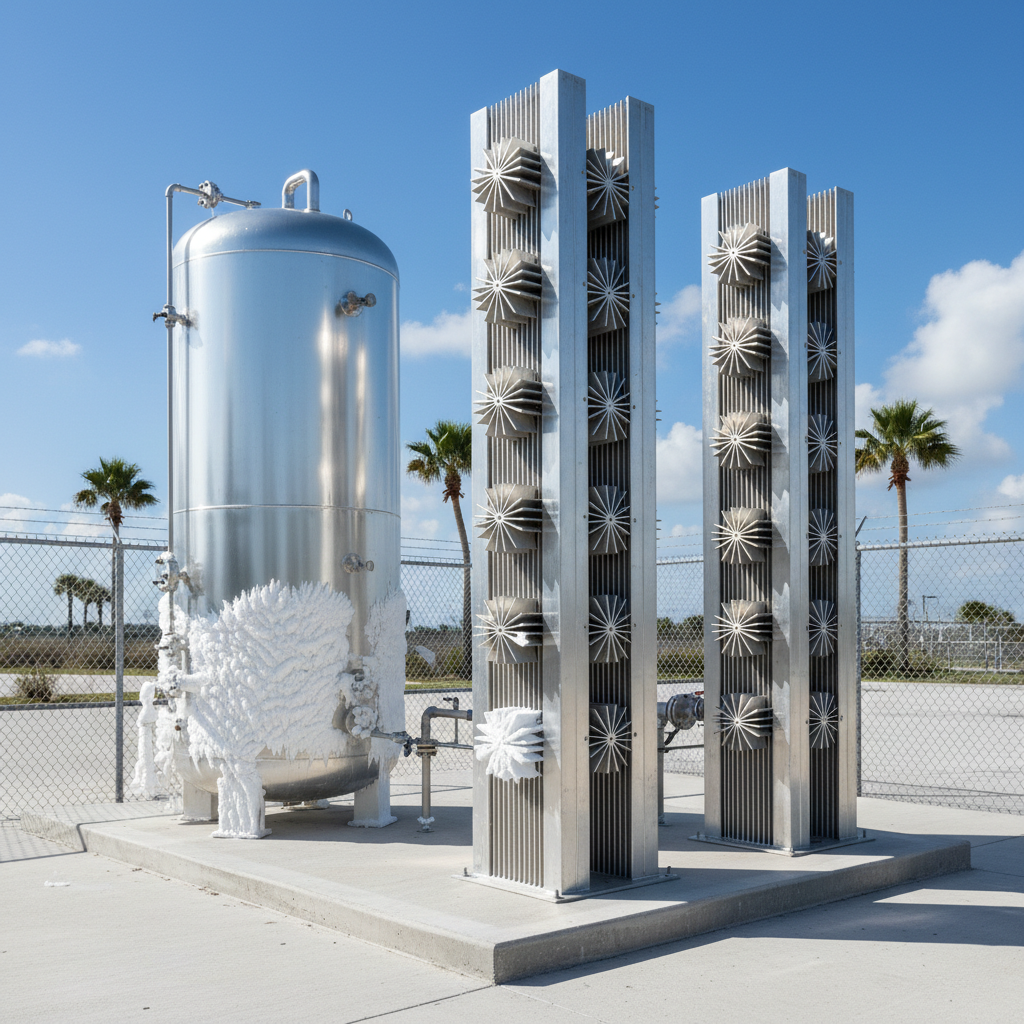
When 85% coastal Gulf humidity hits a vacuum-insulated evaporator (VIE) bulk oxygen pad during a sudden respiratory admission surge, the ambient air vaporizers don't just sweat, they entomb themselves in solid ice within six hours. We frequently walk onto bulk oxygen pads in Pinellas County where the primary vaporizer bank is completely bridged with rime ice across 90% of its aluminum star-fin surface area. Down the line, the carbon steel and copper piping heading toward the main facility shutoff valve shows visible frost past the pressure control assembly, indicating that dangerously cold gas is bypassing the thermal exchange stage altogether.
Conducting a thorough VIE oxygen vaporizer icing inspection in Clearwater requires looking beyond surface frost. Facility engineers at regional campuses like BayCare's Morton Plant Hospital and nearby AdventHealth facilities know that high dew points accelerate ice bridging across ambient fins. Once ice bridges the gap between fins, airflow stops, heat transfer plummets, and liquid oxygen threatens to enter downstream piping designed strictly for ambient-temperature gas.
Thermodynamics of Ambient Vaporizer Icing in Pinellas County
Liquid oxygen sits inside the VIE vessel at roughly -297°F (-183°C) under working pressures typically ranging from 125 to 185 PSIG. To convert that cryogenic liquid into breathable USP gaseous oxygen at safe delivery temperatures, ambient air vaporizers rely on natural convection across extruded aluminum star-fin tubes. Each pound of liquid oxygen requires significant thermal energy from the surrounding air to boil off and warm up to within 10°F of ambient temperature.
Clearwater's subtropical climate creates a deceptive trap for facility directors. High ambient air temperatures help boil the liquid, but the relentless relative humidity coming off the Gulf of Mexico deposits massive amounts of moisture onto the sub-freezing lower manifold passes. Moisture condenses, freezes into rime ice, and acts as a thermal insulator. As the ice sheath thickens on the initial liquid passes, the boiling zone migrates further up and down the vaporizer bank until the entire array loses capacity.
Frost Accumulation Percentage
Visual Fin Condition
Downstream Gas Temp (Typical)
Required Engineering Action
0% – 30% Ice Coverage
Light frost on lower intake manifold and first two passes
Within 10°F of ambient air
Normal operation; monitor cycling schedule
35% – 60% Ice Coverage
Solid ice bridging between lower and middle star-fins
NFPA 99 and CGA G-4.4 Mandate for Vaporizer Switching
Under NFPA 99 (Health Care Facilities Code) Section 5.1.3.5.12 and Compressed Gas Association (CGA) G-4.4 (Oxygen Pipeline Systems), bulk cryogenic supply systems designed for continuous operation must incorporate a means to prevent excessive ice accumulation from degrading system pressure or temperature. In continuous high-demand hospitals, a single ambient vaporizer bank will inevitably ice up if never given a defrost cycle.
Consequently, modern bulk pads utilize dual-manifold ambient vaporizer banks controlled by an automatic divergence valve assembly. While Bank A handles the hospital demand for a set period (usually 4 to 8 hours), Bank B sits idle, allowing Florida's warm ambient air to melt the accumulated ice block. When the cycle completes, motorized or pneumatically actuated cryogenic globe valves swap the active and standby banks seamlessly.
Why this matters for compliance: During surveys by The Joint Commission (TJC) or the Florida Agency for Health Care Administration (AHCA), inspectors evaluate bulk oxygen enclosures under NFPA 99 Chapter 5 and CGA M-1. Unchecked ice bridging past the final regulator or a failed alternating control panel is cited as an Immediate Threat to Life, directly impacting facility licensure under Chapter 59A of the Florida Administrative Code and invalidating your AHCA OPS Form 3110 verification sign-off.
If your bulk pad exhibits heavy frost build-up past the alternating valves or lags during bank switchovers, schedule professional annual medical gas inspections with our ASSE 6030 verifiers to audit your cryogenic source controls before a surveyor arrives.
Inspecting Dual-Manifold Auto-Cycling Failures
During a VIE oxygen vaporizer icing inspection in Clearwater, the most common mechanical culprit behind severe over-icing isn't an undersized vaporizer, it's a stalled dual-manifold switching valve. If the automated diverter fails to transition from Bank A to Bank B, Bank A runs continuously until it becomes a solid monolith of ice while Bank B sits bone-dry in the sun.
Actuator and Pneumatic Pilot Valve Seizure
Automated switchover manifolds generally use pneumatic actuators driven by dry instrument gas tapped off the downstream oxygen line, governed by an electronic timer panel. In coastal Pinellas County, salt air corrosion attacks solenoid vent ports and actuator stem seals. If moisture infiltrates the pneumatic pilot line, the pilot freezes or corrodes open, leaving the cryogenic diverter valve stuck mid-stroke or locked onto a single bank.
Low-Temperature Cutout Sensor Drift
Properly engineered alternating panels don't rely solely on a clock timer; they integrate a resistance temperature detector (RTD) or thermocouple mounted on the vaporizer discharge header. If hospital oxygen demand spikes, such as during winter respiratory peaks, the active bank may ice over in three hours instead of eight. The RTD should detect discharge gas dropping below 32°F (0°C) and force an early switchover. During inspections, we frequently find RTD probes pulled out of their thermowells, hanging in mid-air, or bypassed entirely at the PLC terminal block.
Downstream Cryogenic Line Cooling and Embrittlement Risks
When an iced-over vaporizer loses its heat exchange efficiency, ultra-cold oxygen gas, or worse, unvaporized cryogenic liquid, exits the vaporizer bank and hits the downstream pressure control cabinet. Standard hospital pipeline components downstream of the main source valve are not rated for cryogenic temperatures.
If gas below -20°F (-29°C) reaches elastomer regulator diaphragms, PTFE valve seats, or standard carbon steel flange bolts, severe mechanical failure follows quickly:
Regulator Diaphragm Stiffening: Final line pressure regulators freeze open or tear their elastomeric diaphragms, sending 150+ PSIG directly toward the main line relief valve and triggering the master alarm panel for High Line Pressure.
Valve Seat Contraction: Brass and bronze seats contract unevenly at cryogenic temperatures, causing internal bypass leakage across the reserve manifold isolation valves.
Piping Contraction and Joint Stress: Rapid thermal contraction puts immense tensile stress on brazed copper joints (required to meet NFPA 99 Section 5.1.10) where the bulk pad transitions underground into the building entry.
Master Alarm Sensor Failure: Pressure transducers and switches wired to NFPA 99 master alarms drift wildly when exposed to sub-freezing gas lines.
Field Checklist for a VIE Oxygen Vaporizer Icing Inspection
Facility technicians should perform visual pad walks daily, supplemented by quarterly technical audits by an ASSE 6020 medical gas inspector or ASSE 6030 verifier. When Medical Testing Solutions inspects a bulk VIE installation, we evaluate five specific operational points beyond standard tank level gauges.
Measure Fin-Bridge Percentage: Visually divide the active vaporizer array into quadrants. If solid ice bridges the open air channels across more than 60% of the active bank before the scheduled switchover, the timer interval is too long or flow demand has exceeded the bank's SCFH rating.
Verify Diverter Valve Stroke and Timer: Manually initiate a bank transfer at the control panel (where allowed by vendor protocol) or observe a scheduled switchover. Confirm that the stem indicators on both cryogenic three-way or dual two-way valves travel 100% to their mechanical stops without chattering.
Infrared Thermography of the Discharge Header: Using a calibrated IR thermometer or thermal camera, measure the pipe surface temperature immediately upstream of the final line pressure regulator assembly. Even with heavy frost on the vaporizer fins, the gas entering the regulator manifold must remain above 20°F, and ideally within 15°F of ambient air.
Inspect Pad Drainage and Structural Footings: Heavy defrost cycles in Clearwater dump tens of gallons of meltwater onto the concrete pad every day. Ensure melting ice isn't pooling around liquid oxygen pump bases or eroding the grounding straps on the VIE frame.
Test Low-Temperature Alarm Contacts: Verify that the low-discharge-temperature alarm on the bulk pad triggers the corresponding "Bulk Supply Malfunction" or "Reserve in Use" dry contact on the hospital's NFPA 99 master alarm panels.
Hurricane Re-Verification and Post-Storm Cryogenic Checks
Pinellas County sits directly in the crosshairs of Gulf tropical storms and hurricanes. High winds combined with torrential horizontal rain strip heat away from vaporizer fins in an unpredictable way, while flying debris can smash pneumatic actuator tubing, knock out electric trim heaters, or sever master alarm signal conduits.
More critically, NFPA 99 Section 5.1.12 mandates re-testing and verification whenever a medical gas system experiences a loss of source pressure, pipeline breach, or structural storm damage. If a hurricane knocks out utility power to an electrically heated trim vaporizer or damages the dual-manifold control cabinet, your facility cannot simply reset the breaker and resume normal clinical operations without documenting system integrity.
Because Medical Testing Solutions is headquartered in Florida at 501 East Las Olas Blvd, Fort Lauderdale, FL 33301, our crews mobilize immediately after severe weather clears, whether supporting facilities along the Gulf Coast in Clearwater and Tampa or hospital systems like Jackson Memorial, Baptist Health, Broward Health, and Cleveland Clinic Florida on the Atlantic coast. When you partner with our team for medical gas verification and medical gas maintenance, you never wait four days for an out-of-state technician to book a flight.
Furthermore, working with a Florida-based ASSE 6010, 6020, and 6030 provider delivers a substantial budget advantage. Medical Testing Solutions charges no travel fees, no hotel lodging, and no per-diem anywhere in Florida. Most Clearwater and Tampa Bay medical centers save 10% to 25% on their annual verification, source equipment maintenance, and emergency re-certification budgets compared to hiring out-of-state contractors. You can review our full statewide capabilities across our Florida medical gas services network, backed by our main dispatch teams handling Fort Lauderdale medical gas services and Miami medical gas services. We also supply replacement master alarm boards, transducers, and regulators directly through our medical gas products catalog to eliminate parts delays.
Schedule Your Clearwater Bulk Oxygen Pad & Pipeline Inspection
Don't wait for an iced-over vaporizer bank to freeze your final line regulators or trigger an emergency drop to your high-pressure reserve manifold during peak ICU occupancy. Call our Fort Lauderdale office at (754) 315-1078 for rapid statewide scheduling and same-day emergency dispatch in South and Central Florida, or request a quote online to lock in ASSE 6030 verification and preventative maintenance with zero travel fees.
Frequently Asked Questions
Up to 50% or 60% frost coverage across the lower and middle star-fin passes of the active vaporizer bank is normal during high-humidity summer days in Clearwater. However, if solid ice bridges across more than 70% of the fins or frost extends past the vaporizer discharge header into the pressure regulator assembly, the bank is overloaded or the automatic switchover valve has failed.
A dual-manifold vaporizer fails to switch banks primarily due to corroded pneumatic pilot solenoids, seized cryogenic actuator stems from salt-air exposure, timer relay failures in the control box, or a faulty Resistance Temperature Detector (RTD) probe on the discharge header that fails to sense sub-freezing gas temperatures.
Yes. NFPA 99 Section 5.1.3.5.12 and CGA G-4.4 require bulk cryogenic oxygen systems to maintain continuous gas supply at safe operating pressures and temperatures. During Joint Commission (TJC) and Florida AHCA surveys, excessive ice build-up that encroaches on final line pressure regulators or inoperable alternating valves will result in immediate compliance citations.
Never chip away ice with hammers or metal tools, which can rupture pressurized aluminum star-fins and cause an oxygen-enriched fire hazard. First, verify if the standby vaporizer bank is clear of ice and manually actuate the diverter valves to switch flow to the warm standby bank. If valves are frozen, contact your bulk gas supplier and an ASSE-certified medical gas technician immediately while monitoring downstream line pressure and temperature.
Under NFPA 99 Section 5.1.12, any medical gas source system that experiences a loss of pressure, mechanical storm damage, or actuator repair must undergo re-verification by an ASSE 6030 verifier before being certified for patient care. Even if pressure held, pneumatic switching lines, electrical trim heaters, and master alarm wiring on the exterior pad should be inspected immediately post-storm.
Request a quote for your facility
Talk with Medical Testing Solutions about your next inspection, repair or equipment request.