Medical Testing SolutionsNovember 16, 20269 min read
Share
When the primary cylinder bank on a duplex oxygen manifold drops below its switchover setpoint, a sticking intermediate dome regulator or a fouled check valve can freeze the changeover mid-cycle. In humid Gulf Coast mechanical rooms, condensation and salt-laden air accelerate corrosion around outdoor reserve enclosures, brass bonnet vents, and unsealed gauge ports. If that primary bank depletes during a high-demand surgical shift and the reserve header fails to open, main line delivery pressure can plunge toward the 40 psig low-pressure alarm threshold before facilities staff reach the cylinder room.
For hospital facility engineers and ambulatory surgery center directors managing an oxygen manifold inspection Biloxi MS, visual pressure gauge checks aren't enough. A compliant preventive inspection requires simulating primary supply depletion, measuring dynamic switchover differentials, verifying dual line pressure regulators, and testing safety relief valves against NFPA 99 requirements.
High-Pressure Header Switchover Mechanics and Failure Modes
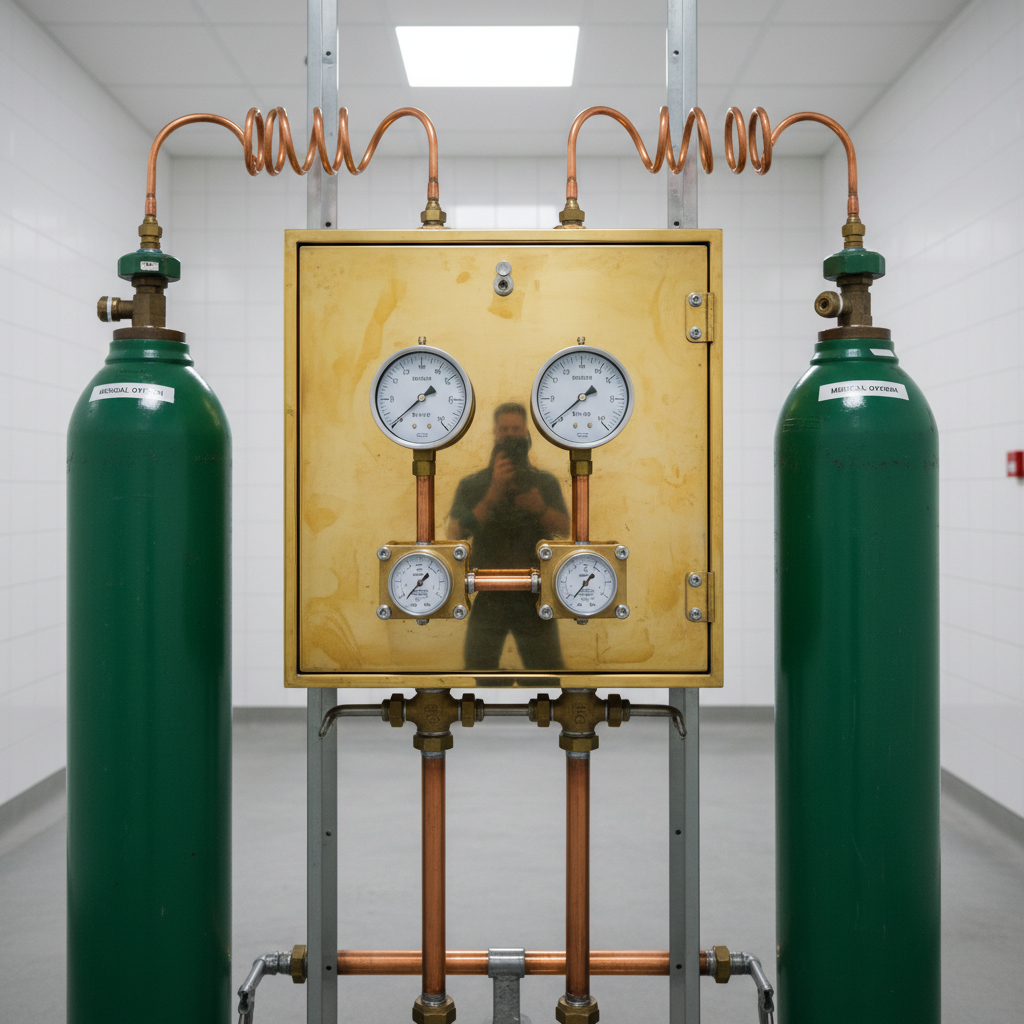
An automatic high-pressure cylinder manifold relies on either a pneumatic differential shuttle valve or an electro-pneumatic solenoid transducer assembly to transition between the primary ("in-service") and secondary ("reserve") cylinder banks. Under normal operating conditions, high-pressure oxygen enters the header from the cylinders at roughly 2,000 to 2,200 psig through individual cylinder pigtails fitted with permanent reverse-flow check valves.
In a standard two-step pressure reduction architecture, each bank feeds an initial bank regulator (often set between 130 psig and 175 psig for the primary side and 100 psig to 140 psig for the reserve side, depending on the manufacturer's design). That pressure differential keeps the reserve pathway closed while the primary bank satisfies system demand. Once the primary cylinders deplete to the intermediate setpoint, the reserve regulator opens automatically and triggers the "Reserve in Use" dry contact signal to the master alarm panel.
During field inspections, we frequently uncover three distinct switchover failure modes:
Intermediate Regulator Seat Creep: Particulate contamination from cylinder swaps embeds into the polychloroprene or PTFE seat of the bank regulator, allowing high-pressure gas to bleed downstream and equalize both headers. When both headers equalize, the manifold draws down both banks simultaneously instead of sequentially.
Pigtail Check Valve Fouling: NFPA 99 Section 5.1.3.5.10 requires a check valve at each header connection to prevent loss of gas when changing empty cylinders. If a brass check valve sticks open, bleeding down an exhausted bank vents the residual manifold header into the manifold room.
Pressure Transducer Drift: On digital manifolds, moisture or electronic drift skews the transducer reading by 15 to 30 psi, causing the master alarm to stay silent even after the mechanical shuttle valve has already shifted to the reserve bank.
Simulating Bank Depletion During Switchover Testing
You can't verify automatic changeover solely by pressing the electronic "test" button on the manifold control cabinet faceplate. That button only tests the logic board and master alarm wiring. To prove mechanical and pneumatic switchover under load, the technician must isolate the primary supply and force the manifold to transition under live pipeline flow.
First, we record the static and flowing pressures on the primary bank gauge, reserve bank gauge, intermediate header gauge, and main line delivery gauge. Before manipulating any header valves, we coordinate directly with clinical charge nurses and verify that all reserve cylinders are full and open. Next, the inspector slowly closes the cylinder valve on the active primary bank while bleeding down the isolated primary header pressure through the test port or normal system consumption.
As the primary header pressure drops through the manufacturer's switchover threshold, we observe two simultaneous events: the intermediate pressure must smoothly stabilize at the reserve bank regulator setting without pulling main line delivery pressure below 50 psig, and the local manifold indicator plus every facility master alarm panel must annunciate "Reserve in Use" (or "Changeover to Secondary Supply") simultaneously. Once verified, we reopen the primary bank, reset the manifold routing logic, and confirm the alarm clears cleanly.
If your coastal Mississippi facility needs credentialed support to test source equipment without disrupting surgical schedules, explore our annual medical gas inspections to keep your manifold and alarm infrastructure compliant.
Dual Line Pressure Regulator Performance and Isolation
Downstream of the high-pressure bank changeover controls sits the final line pressure control assembly. Under NFPA 99 (Section 5.1.3.5.5), central supply systems must incorporate duplex final line pressure regulators piped in parallel with isolation valves upstream and downstream of each regulator. This parallel arrangement ensures that one line regulator can be isolated and serviced while the redundant regulator maintains full uninterrupted 50 to 55 psig delivery to the hospital pipeline.
A proper oxygen manifold inspection evaluates each final line regulator independently. Most facilities leave one regulator active and the parallel regulator isolated, or leave both open with slightly staggered spring tensions. During inspection, the technician opens the standby line regulator isolation valves and closes the active regulator isolation valves while watching the downstream main line pressure gauge.
If the standby regulator has sat idle for months, its diaphragm may have stiffened or its spring setpoint may have drifted down to 44 psig or climbed past 58 psig. We measure both static ("lock-up") pressure and flowing dynamic pressure on Regulator A and Regulator B independently. A lock-up spike greater than 5 to 8 psi above the flowing setpoint indicates internal seat wear that requires an oxygen-clean regulator rebuild kit before it causes a main line high-pressure alarm.
Debris keeping poppet open during cylinder exchange
Duplex Final Line Regulators
5.1.3.5.5
50 – 55 psig dynamic delivery
Diaphragm stiffness or lock-up creep on standby regulator
Line Safety Relief Valve
5.1.3.5.6
75 psig (50% above 50 psig line pressure)
Improper vent termination or unplgged outdoor rain cap
Reserve-in-Use Alarm Switch
5.1.9.2.4
Actuates immediately upon bank switchover
Corroded dry-contact terminal or transducer calibration drift
Safety Relief Valve Verification and Venting Compliance
If a high-pressure bank regulator and a final line regulator both fail open simultaneously, high-pressure oxygen could surge into the copper distribution piping and rupture terminal outlets or patient ventilators. To prevent catastrophic overpressurization, NFPA 99 Section 5.1.3.5.6 requires every central supply system to have at least one pressure relief valve installed downstream of the final line regulators and upstream of any shutoff valve.
Why this matters for compliance: Under NFPA 99 Section 5.1.3.5.6.3, pressure relief valves for positive-pressure medical gas systems musthave a relief setting no higher than 50 percent above the normal system operating pressure. For a standard 50 to 55 psig oxygen system, the final line relief valve is factory-set and ASME-stamped at 75 psig (with intermediate header relief valves commonly set between 200 and 250 psig). Furthermore, any isolation valve placed upstream of a relief valve for maintenance must be mechanically interlocked so that closing one relief valve automatically opens a redundant relief path.
During an inspection, you should never manually pop an oxygen relief valve in-place using unregulated cylinder pressure, as brass-on-brass reseating under oxygen flow frequently causes persistent seat leakage. Instead, our ASSE 6030 and 6040 technicians perform a detailed physical and pneumatic verification:
ASME Stamp and Setpoint Audit: Verify the relief valve brass body carries a legible cracking pressure stamp (75 psig on the main line; manufacturer-specified intermediate pressure on the control cabinet) and shows no signs of green copper oxide or thread sealant extrusion.
Seat Integrity Check: Apply an oxygen-compatible leak detection solution at the relief discharge union while the manifold operates at peak static lock-up pressure to confirm zero weeping across the valve seat.
Vent Discharge Piping Inspection: Trace the relief vent line to the building exterior. Per NFPA 99 Section 5.1.3.5.6.1, oxygen relief valves must vent outside the building (except small compressed air or nitrogen headers under specific volume thresholds). The exterior termination must turn downward and feature an insect screen to prevent mud daubers and Gulf Coast debris from plugging the exhaust line.
When relief valves exceed their manufacturer service life or exhibit seat weeping, medical gas maintenance services allow your facility to swap in factory-certified, oxygen-cleaned relief valves without risking pipeline contamination.
Header Pigtails, CGA 540 Fittings, and Cylinder Room Safety
The physical bridge between your high-pressure cylinders and the stationary manifold bar takes more mechanical abuse than any other component in the source room. Every time delivery personnel or plant operations staff roll out spent K-cylinders and wrench on full cylinders, the pigtails endure flexing, torsional stress, and adiabatic compression shocks.
NFPA 99 Section 5.1.3.5.10.2 specifies that high-pressure oxygen headers must use rigid or semi-rigid metallic (copper or brass) or stainless-steel braided flexible leads, non-metallic flexible hoses (such as PTFE-lined hoses) are strictly prohibited on high-pressure oxygen manifolds due to adiabatic compression ignition hazards when a 2,200 psig cylinder valve is opened rapidly. During an inspection, we check every CGA 540 bullnose nipple and nut for galling, rounded wrench flats, and illegal PTFE tape. Thread tape has no place on a CGA 540 face-seal connection; it shreds into the gas stream and fouls the intermediate regulator seat.
We also audit the manifold enclosure environment itself. High-pressure cylinder manifolds holding more than 3,000 cubic feet of gas require dedicated mechanical or natural ventilation per NFPA 99 Section 5.1.3.3.3, lockable doors labeled for oxidizing gas hazards, and cylinder chain restraints securing every active and standby tank.
Coordinating Manifold Testing Across Coastal Mississippi
Healthcare facilities in Harrison County and across the state answer to the Mississippi State Department of Health (MSDH) Health Facilities Licensure and Certification division, along with CMS-approved accrediting bodies such as The Joint Commission and DNV. Whether surveyors are walking a major regional campus like University of Mississippi Medical Center or North Mississippi Health Services, or reviewing surgical center logs along the Biloxi and Gulfport corridor, they expect complete documentation proving that manifold switchover and relief systems function as designed.
Medical Testing Solutions is headquartered in Fort Lauderdale, Florida, and our credentialed specialists travel regularly to support hospitals and surgery centers throughout Mississippi. We coordinate regional service visits in advance so coastal facilities can bundle annual manifold inspections, master alarm testing, and ASSE 6030 medical gas verification into a single planned trip. If a manifold controller is obsolete or requires upgrading during a renovation, Medical Testing Solutions also supplies replacement manifolds, copper pigtails, and regulators while performing turnkey medical gas installation and post-work medical gas certification.
Don't wait for an unscheduled primary bank depletion to discover a seized intermediate regulator or a silent reserve-in-use alarm. Contact Medical Testing Solutions to request a quote or call (754) 315-1078 to schedule your Biloxi oxygen manifold inspection on our next regional Mississippi route.
Frequently Asked Questions
Under NFPA 99 and standard manufacturer preventive maintenance schedules, oxygen manifolds should undergo a documented technical inspection and functional changeover test at least annually, while facility staff should perform daily visual checks of bank pressures and main line delivery pressure.
The line pressure relief valve situated downstream of the final line pressure regulators on a standard 50 to 55 psig medical oxygen system must be set at no more than 50 percent above normal operating pressure, which equals 75 psig under NFPA 99 Section 5.1.3.5.6.3.
No. NFPA 99 prohibits polymeric or PTFE-lined flexible hoses on high-pressure oxygen manifold headers because rapid compression (adiabatic heating) when opening a 2,200 psig cylinder can ignite non-metallic liners. Oxygen pigtails must be metallic, such as rigid annealed copper or all-metal corrugated braided leads with integral check valves.
If both banks draw down together, the intermediate regulator on the reserve bank is either set too close to the primary regulator pressure, or a worn regulator seat is allowing gas to creep across the shuttle valve. A technician must test the intermediate pressures and rebuild or recalibrate the bank regulators.
Medical Testing Solutions is headquartered in Fort Lauderdale, Florida, and dispatches ASSE-certified technicians across the Southeast. We coordinate scheduled trips to Biloxi and coastal Mississippi to perform annual inspections, manifold repairs, and ASSE 6030 verifications.
Request a quote for your facility
Talk with Medical Testing Solutions about your next inspection, repair or equipment request.