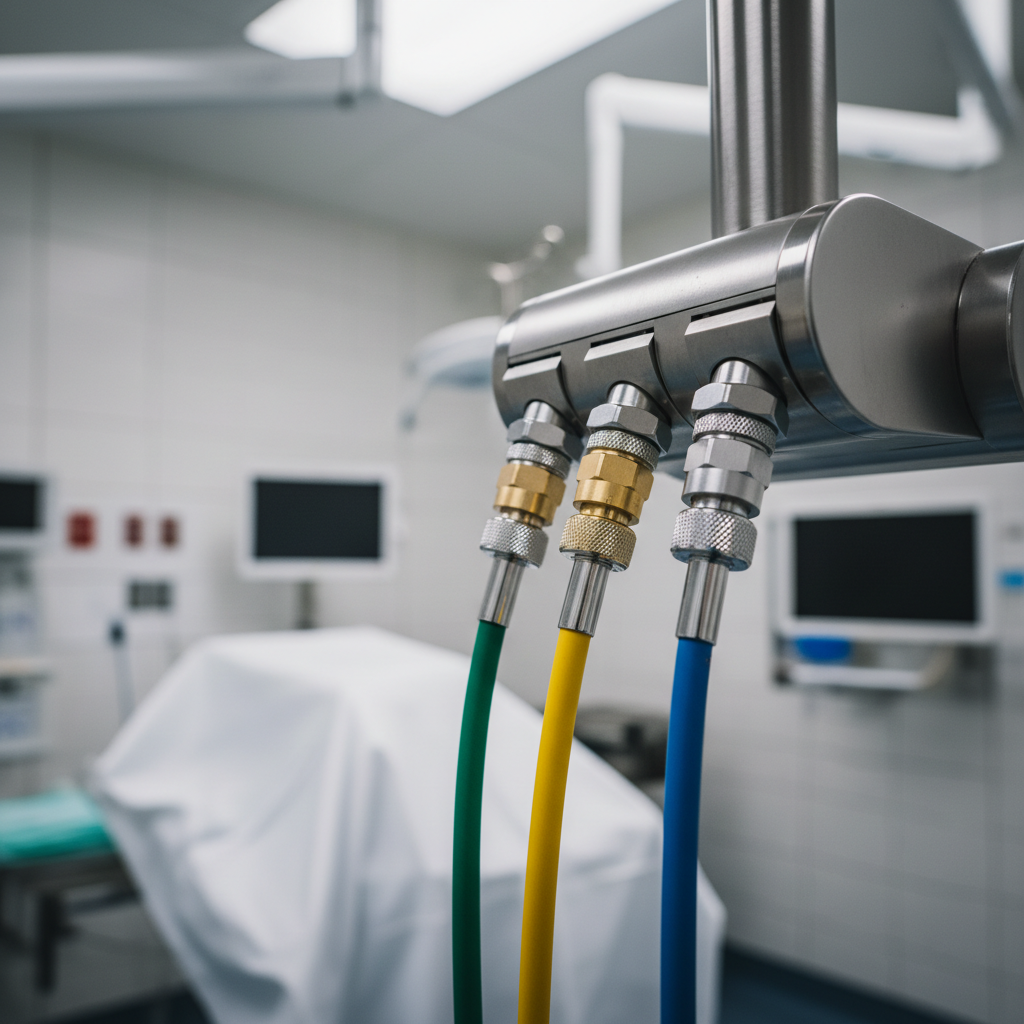
Replacing Medical Gas Hose Assemblies: NFPA 99 Cadence & Safety
Flexible medical gas hose assemblies represent the most vulnerable interface in clinical gas delivery systems. While rigid copper piping remains sheltered behind drywall and ceiling plenums, hose drops, boom assemblies, and equipment interconnects endure constant mechanical flexion, tensile strain, chemical cleaning agents, and high operational pressures. Over time, internal elastomeric liners oxidize, outer jackets degrade, and crimped end fittings work loose, creating critical life-safety hazards including gas leaks, fire risks, cross-connections, and catastrophic pressure drops during surgery.
Understanding the mandatory inspection protocols, replacement timelines, and fabrication standards for these components is vital for clinical engineers, healthcare facility managers, and safety officers. In this technical guide, you will learn the regulatory frameworks established by NFPA 99 and the Compressed Gas Association (CGA), the physiological mechanisms of hose failure, step-by-step assessment workflows, and why custom-manufactured assemblies outperform generic off-the-shelf alternatives.
The Critical Role of Flexible Medical Gas Hose Assemblies
Flexible hose assemblies bridge the gap between stationary pipeline station outlets and movable clinical equipment. They are found across critical care environments: operating rooms, intensive care units (ICUs), post-anesthesia care units (PACUs), emergency departments, and procedural sedation suites.
Every assembly serves a specific life-support function, channeling:
- Medical Air (USP) for ventilators, incubators, and high-flow blending systems.
- Oxygen (USP) for anesthesia machines, resuscitators, and life-support circuits.
- Nitrous Oxide (USP) for inhaled surgical anesthesia and conscious sedation.
- Carbon Dioxide (USP) for laparoscopic insufflation and robotic surgical suites.
- Medical Vacuum for surgical suction, airway clearance, and wound drainage.
- Waste Anesthetic Gas Disposal (WAGD) for scavenging halogenated fluorinated hydrocarbons.
- Instrument Air for powering orthotic, neurological, and general surgical pneumatic tools.
Because flexible assemblies absorb the mechanical movement of articulating surgical booms, anesthesia carts, and patient stretchers, they experience dynamic stressors absent anywhere else in the central medical gas pipeline. If an internal liner collapses inside an oxygen drop hose feeding an anesthesia machine, the pressure drop can trigger ventilator alarms, hypoxic patient episodes, or complete gas delivery failure.
Regulatory Framework: NFPA 99, CGA, and ASSE Requirements
Healthcare compliance bodies, including The Joint Commission (TJC), DNV-GL, and CMS, hold facility managers accountable to the standards published by the National Fire Protection Association (NFPA) and the Compressed Gas Association (CGA).
NFPA 99 Health Care Facilities Code
Under NFPA 99 (Health Care Facilities Code), Chapter 5 dictates the installation, maintenance, testing, and operational parameters of medical gas systems. Flexible connectors and hose assemblies are subjected to rigorous scrutiny:
- Material Compatibility: Hoses used for medical gas service must have an operational working pressure rated for the specific gas (typically 200 psi minimum for standard 50–55 psi systems, and up to 400 psi or higher for Instrument Air/Nitrogen operating at 160–185 psi).
- Non-Interchangeability: Hoses must strictly adhere to the Diameter-Index Safety System (DISS) or Quick-Connect standards (Chemetron, Ohmeda, Puritan-Bennett, Schrader) to eliminate any risk of gas cross-connection.
- Electrical Conductivity: Hoses handling flammable or flammable-adjacent environments, as well as vacuum/scavenging systems, must have appropriate conductive properties to prevent the accumulation of static electrical charges.
CGA Standards (C-9 and V-5)
The Compressed Gas Association publishes standard guidelines that govern the manufacture, maintenance, and labeling of hose assemblies:
- CGA C-9: Standard for Color Marking of Compressed Gas Cylinders and Flexible Hose Connections Intended for Medical Use. This dictates rigid adherence to gas-specific color coding (e.g., Green for Oxygen, Yellow for Medical Air, Blue for Nitrous Oxide, White for Vacuum).
- CGA V-5: Diameter-Index Safety System (DISS). Governs the dimensional tolerances of non-interchangeable threaded connections.
ASSE 6000 Professional Qualifications
Field inspection, verification, and replacement of medical gas infrastructure require trained personnel certified under the ASSE Series 6000 Standard:
- ASSE 6010: Medical Gas Systems Installers.
- ASSE 6030: Medical Gas Systems Verifiers.
- ASSE 6040: Medical Gas Systems Maintenance Personnel.
Why this matters for compliance: The Joint Commission (TJC) Environment of Care Standard EC.02.05.09 requires accredited hospitals to inspect, test, and maintain medical gas and vacuum systems. A visibly degraded, cracked, or leaking hose assembly constitutes an immediate Category 1 life-safety finding during a survey, exposing the institution to conditional accreditation status and immediate correction mandates.
Routine oversight during annual medical gas inspections guarantees that minor hose wear is caught and remediated well before catastrophic failure occurs in an active clinical suite.
Recommended Hose Replacement Cadence: How Often Should Hoses Be Replaced?
Unlike rigid copper piping, which can endure for decades under continuous operating pressures, flexible hose assemblies have a finite physical lifecycle. NFPA 99 requires healthcare facilities to establish and execute a preventative maintenance program that aligns with manufacturer recommendations and facility risk assessments.
| Application Environment | Recommended Replacement |
|---|
| High-Flex Booms (OR, Trauma, Cath Lab) | 24 – 36 Months (2–3 Years) |
| Mobile Anesthesia & Ventilator Drops | 36 – 48 Months (3–4 Years) |
| Stationary Equipment Interconnects | 48 – 60 Months (4–5 Years) |
| Wall-to-Wall Utility / Pass-Through | Max 60 Months (5 Years) |
The 3-to-5-Year Benchmark
Leading medical device and hose manufacturers establish a maximum functional service life of three to five years for flexible polymer hoses. Even when a hose shows no visible exterior degradation, the internal core tube experiences continuous material breakdown caused by oxidative exposure, pressure cycling, and micro-contaminants.
Hoses installed in ceiling drops, articulating arm booms, and motorized booms in operating theaters experience severe cyclic torsion. In these high-wear zones, proactive replacement every two to three years is standard industry best practice to prevent unexpected intra-operative downtime.
5 Warning Signs Your Medical Gas Hose Assemblies Need Immediate Replacement
Clinical staff and biomedical engineers often miss early indicators of hose failure because wear typically originates internally or beneath protective braided sleeving. If any of the following five conditions appear during daily operations or regular rounds, the assembly must be tagged out and replaced immediately:
1. Surface Micro-Fissures, Dry Rot, and Discoloration
Aggressive quaternary ammonium and bleach-based hospital disinfectants degrade PVC, polyurethane, and neoprene outer covers. As plasticizers leach out of the polymer matrix, the hose hardens, loses flexibility, and forms fine spiderweb cracks. Micro-fissures quickly propagate through the reinforcement layer when the hose is flexed.
2. Localized Blistering or Bulging
A visible bubble, blister, or localized swelling on the hose exterior indicates that the inner liner has ruptured. High-pressure gas is migrating into the reinforcing braid and gathering beneath the non-breathable outer jacket. This represents an impending catastrophic blowout.
3. Ferrule Slip or Fitting Separation
Inspect the interface where the metal ferrule is mechanically crimped onto the hose. If there is visible pulling-away of the hose jacket, exposed braided nylon or stainless steel reinforcement, or rotational play between the fitting and the hose, the mechanical retention is compromised. The fitting can violently detach under line pressure.
4. Pressure Decay and Pre-Use Test Failures
Modern anesthesia machines perform automatic pre-use pressure decay leak checks. If an anesthesia workstation repeatedly fails its low-pressure or high-pressure system leak checks, the culprit is often a worn medical air or nitrous oxide hose drop whose internal core has pinhole perforations.
5. Chemical Odors or Outgassing
Over time, synthetic compounds in deteriorating hoses can break down, imparting plasticizer odors to the delivery gas stream. This is unacceptable for patient safety and can alter the composition of respiratory gas streams delivered to neonatal and immunocompromised patients.
Failure Modes: What Happens When Hoses Degrade?
Understanding failure modes helps facilities justify proactive replacement schedules to budget committees before equipment failure affects patient care:
| Failure Mode | Clinical & Safety Consequence |
|---|
| Internal Liner Delamination | Core polymer collapses inward, |
| starving downstream ventilators. |
| Catastrophic Rupture (Blowout) | Sudden deafening bang, whip hazard |
| from pressurized hose, particulate |
| projectile risk, pressure loss. |
| Chronic Fitting Micro-Leak | WAGD/Nitrous leak polluting OR air; |
| enriched O2 elevating fire risk; |
| compressor cycling increases. |
| Cross-Threading / DISS Wear | Worn DISS threads allow wrong |
| connections under forced seating; |
| critical gas misconnection. |
Internal Liner Delamination
The internal core tube of a medical gas hose is chemically bonded to the reinforcement layers. Constant dynamic flexing inside articulating booms causes delamination, the liner detaches from the reinforcement mesh. When gas flows, the loose liner acts like a one-way check valve, fluttering closed and starving downstream ventilators of flow while pipeline pressures at the station outlet read normal.
Chronic Gas Leaks and Occupational Exposure
A leaking nitrous oxide or WAGD hose quietly contaminates the surgical field. Chronic exposure to waste anesthetic gases has documented occupational health consequences for surgical personnel, including reproductive hazards and neurological impairment.
If your facility is investigating suspected anesthesia gas leaks, conducting specialized WAG and chemical vapor monitoring pinpoint whether degraded hose assemblies or leaking boom seals are dispersing halogenated agents into the breathing zone.
Technical Specifications: Standard Bulk Hose vs. Certified Assemblies
Not all medical gas hoses are engineered equally. When purchasing replacement assemblies or contracting a replacement service, facility directors must understand the technical distinctions between generic bulk hose materials and custom-manufactured, certified medical gas assemblies.
| Feature / Parameter | Field-Fabricated Bulk Hose | MTS Certified Manufactured Assembly |
|---|
| Manufacturing Standard | Assembled on-site with hand crimpers | Factory-manufactured to calibrated tolerances |
| Material Chemistry | Generic commercial PVC or vinyl | Medical-grade, non-conductive/conductive conductive urethane/elastomer |
| Reinforcement | Single polyester spiral or loose braid | High-tenacity synthetic yarn or multi-layer braid |
| Burst Pressure Rating | Often unverified; rated ~800 psi | ≥ 1000 psi burst minimum (4:1 safety factor) |
| Working Pressure | Variable (often <150 psi) | 200 psi continuous working pressure |
| Color Fastness & Identification | Printed ink prone to solvent rub-off | Deep pigment extrusion complying with CGA C-9 |
| Proof Testing Protocol | Rare or visual test only | 100% pneumatic proof-tested at 150% rated pressure |
| End Fittings | Standard brass barbed fittings | Solid 360 brass/stainless DISS, Chemetron, Ohmeda |
| Cleaning for Oxygen Service | Unknown / non-cleaned | Cleaned to CGA G-4.1 standards (oil- and hydrocarbon-free) |
At Medical Testing Solutions, our specialized manufactured assemblies undergo comprehensive quality control and pressure testing before shipping. Discover our full selection of pre-configured and custom-length hose options in our products catalog.
Step-by-Step Procedure for Replacing Medical Gas Hose Assemblies
The replacement of flexible hose assemblies must be approached as a controlled medical gas operational procedure. Even simple maintenance actions carry inherent risks of accidental line contamination, system depressurization, or particulate introduction.
| Diagram text |
|, |
| 1. Verification & Clinical Isolation |
| Identify gas type, tag out device |
| 2. Controlled Depressurization |
| Isolate outlet, bleed trapped gas |
| 3. Inspection of Mating Connections |
| Check DISS threads, O-rings, pins |
| 4. Torque-Calibrated Installation |
| Hand-tighten + fractional turn |
| 5. Leak & Non-Interchangeability Test |
| Snoop test, verify gas purity/flow |
Step 1: Verification, Labeling, and Clinical Isolation
Confirm the specific gas service of the hose assembly being replaced. Check the station outlet labeling, the equipment inlet, and the hose body markings. Ensure clinical operations are not active on the targeted line. Coordinate with clinical staff to ensure no patient depends on the device during the swap.
Step 2: Controlled Depressurization
Turn off or disconnect the line. If replacing a drop hose connected to a quick-connect outlet, disengage the connector collar to isolate the line. For DISS connections, shut the local sub-zone valve if required, or unthread the primary connection while containing the small discharge of residual trapped gas. Never attempt to cut or unseat a pressurized medical gas line.
Step 3: Inspection of Mating Connections and Sub-Components
Examine the female station outlet block and the male equipment fitting. Look for:
- Damaged, flattened, or cross-threaded DISS male threads.
- Degraded, hardened, or missing elastomeric O-rings on quick-connect stems.
- Physical damage to alignment pins that ensure indexed fitment.
Clean mating surfaces with non-shedding lint-free wipes suitable for oxygen service. Do not apply thread sealants, Teflon tape, or hydrocarbon lubricants to any gas-specific DISS fitting or O-ring.
Step 4: Installation of the New Manufactured Assembly
Seat the new hose assembly squarely against the connection point. For quick-connects, push firmly until a positive tactile and audible latch is confirmed. For DISS fittings, hand-tighten the hex nut to prevent cross-threading, then use a calibrated DISS torque wrench to apply the manufacturer-specified torque (typically 5 to 8 ft-lbs). Excessive torque crushes the internal nose seal, permanently ruining both the hose fitting and the station outlet.
Step 5: Post-Installation Testing and Verification
Once pressurized, perform a two-step validation:
- Leak Detection: Apply an approved oxygen-compatible leak detection solution (meeting ASTM G121/MIL-PRF-25567) to every mechanical joint, crimp, and swivel connection. Inspect for continuous bubble formation over a two-minute dwell period.
- Non-Interchangeability & Flow Verification: Verify that the quick-connect or DISS connection physically rejects any attempt to dock into an incorrect gas service. Test operational static and dynamic flow pressures using a calibrated test gauge.
For larger facility overhaul projects where multiple drops, zone valve boxes, and column manifolds are upgraded simultaneously, complete medical gas verification by an independent ASSE 6030 verifier provides compliance documentation for state licensing authorities and accreditation surveyors.
The Hazards of Improper Installation and "Home-Made" Assemblies
In an effort to trim maintenance operating budgets, some facilities attempt to repair damaged hose assemblies in-house. A maintenance technician cuts off the damaged end of a hose, inserts an off-the-shelf brass hose barb from an industrial supply distributor, and clamps it using a worm-gear hose clamp.
This practice is a severe safety violation under NFPA 99 and CGA standards.
- Hydrocarbon Fire Hazards: Standard commercial brass barbs and fittings are machined using hydrocarbon-based cutting lubricants. When introduced into an Oxygen (USP) or Nitrous Oxide (USP) pipeline, the presence of oils in a concentrated oxidizer environment creates an immediate risk of adiabatic compression flash-fire or explosion.
- Mechanical Blowout Under Load: Worm-gear clamps create localized pinch points on medical-grade urethane, slicing into the reinforcement fibers. Pressurized gas surges will cause the hose to slip off the barb, converting the pressurized hose into a flailing whip hazard.
- Cross-Connection Disasters: Field fabrication risks the accidental attachment of wrong-gas fittings to colored hoses (such as a Medical Air DISS nut on a Green Oxygen hose). A gas cross-connection is an immediate life-safety sentinel event that has historically led to patient mortality.
All medical gas hose replacements must be factory-built, certified assemblies supplied by reputable manufacturers whose assembly facilities are clean-room maintained and compliant with ASSE requirements.
Comprehensive Facility Maintenance Programs for Pipeline Systems
Hose management is one critical component of a comprehensive physical plant reliability strategy. Medical gas distribution networks require ongoing diagnostic validation across all connected subsystems:
Integrating Hose Replacements with Master PM Schedules
Rather than waiting for a catastrophic leak or an adverse survey finding during an unannounced inspection, leading healthcare facilities establish rotating hose change-out programs. By replacing 20% to 25% of all flexible assemblies annually, the entire hospital's inventory is renewed every 4 to 5 years, smoothing operational budgets and mitigating acute failure risk.
These replacement efforts are most efficiently performed during scheduled medical gas maintenance services, allowing credentialed technicians to replace aged assemblies, lubricate outlet latching mechanisms, recalibrate pressure switches, and service source equipment in a single mobilization.
Special Considerations for High-Risk Environments
Different clinical settings present distinct environmental stressors that accelerate hose degradation:
- Surgical Operating Rooms: Ceiling booms rotate through 330-degree arcs, putting continuous cyclic torsional loads on hose bundles inside the boom articulated arm. Internal boom drops must use flexible, anti-torsion hose configurations with external protective sleeving.
- Magnetic Resonance Imaging (MRI) Suites: Hose assemblies inside the RF-shielded zone must be constructed from 100% non-magnetic materials. Standard brass fittings often contain trace nickel or ferrous alloys that transform them into missile hazards around high-Tesla magnets. MTS manufactures non-magnetic certified assemblies engineered specifically for MRI applications.
- Isolated Power & Wet Procedure Locations: Operating rooms and procedure areas that qualify as wet procedure locations utilize line isolation systems to prevent electrical shock. When servicing ceiling booms and equipment booms, ensure that hoses and accompanying conductive bonding straps are intact. For facilities managing these specialized environments, routine line isolation monitor testing confirms electrical safety around patient beds and surgical tables.
How Medical Testing Solutions Builds Superior Assemblies
Medical Testing Solutions manufactures precision medical gas hose assemblies that meet or exceed all NFPA 99, CGA, and FDA performance specifications.
Custom Engineered to Facility Specifications
Whether your facility utilizes vintage Chemetron latching outlets, modern DISS threaded manifolds, or specialized European quick-connect standards, Medical Testing Solutions fabricates hose assemblies customized to your exact operational parameters:
- Custom Lengths: Available from 12 inches to over 100 feet to eliminate excess line slack and trip hazards in clinical spaces.
- Factory Hydrostatic & Pneumatic Proofing: Every completed assembly is pressurized to 150% of rated working pressure to verify crimp integrity and structural retention before leaving our manufacturing facility.
- Cleaned for Oxygen Service: All sub-components are degreased and cleaned according to CGA G-4.1 protocols, sealed in protective poly-bag packaging to ensure pristine delivery to your facility.
- Traceability & Serial Identification: Each assembly features durable, permanent labeling indicating part number, gas service, operating pressure, and date of manufacture for effortless preventive maintenance tracking.
Beyond supplying superior manufactured products, Medical Testing Solutions fields ASSE-credentialed technicians who deliver turn-key medical gas services nationwide:
- ASSE 6010 Certified Installation: Professional replacement and modification of medical gas pipeline networks via our medical gas installation division.
- Complete Verification & Certification: Comprehensive system audits, flow testing, and purity testing backed by formal medical gas certification credentials.
- Total Physical Plant Audits: Source equipment servicing, environmental vapor analysis, and annual safety verification.
Upgrade Your Facility's Medical Gas Safety Today
Compromised, aging medical gas hose assemblies pose an unacceptable risk to patient safety, clinical workflow, and regulatory compliance. Partnering with Medical Testing Solutions guarantees that your facility receives precision-manufactured, fully certified assemblies designed to withstand the rigorous demands of modern healthcare environments.
Whether you need a full inventory replacement for your surgical suites or an urgent custom assembly fabricated to precise specifications, our ASSE-certified team is ready to assist.
Ready to upgrade your medical gas hose assemblies or schedule a facility inspection?
Contact Medical Testing Solutions today: