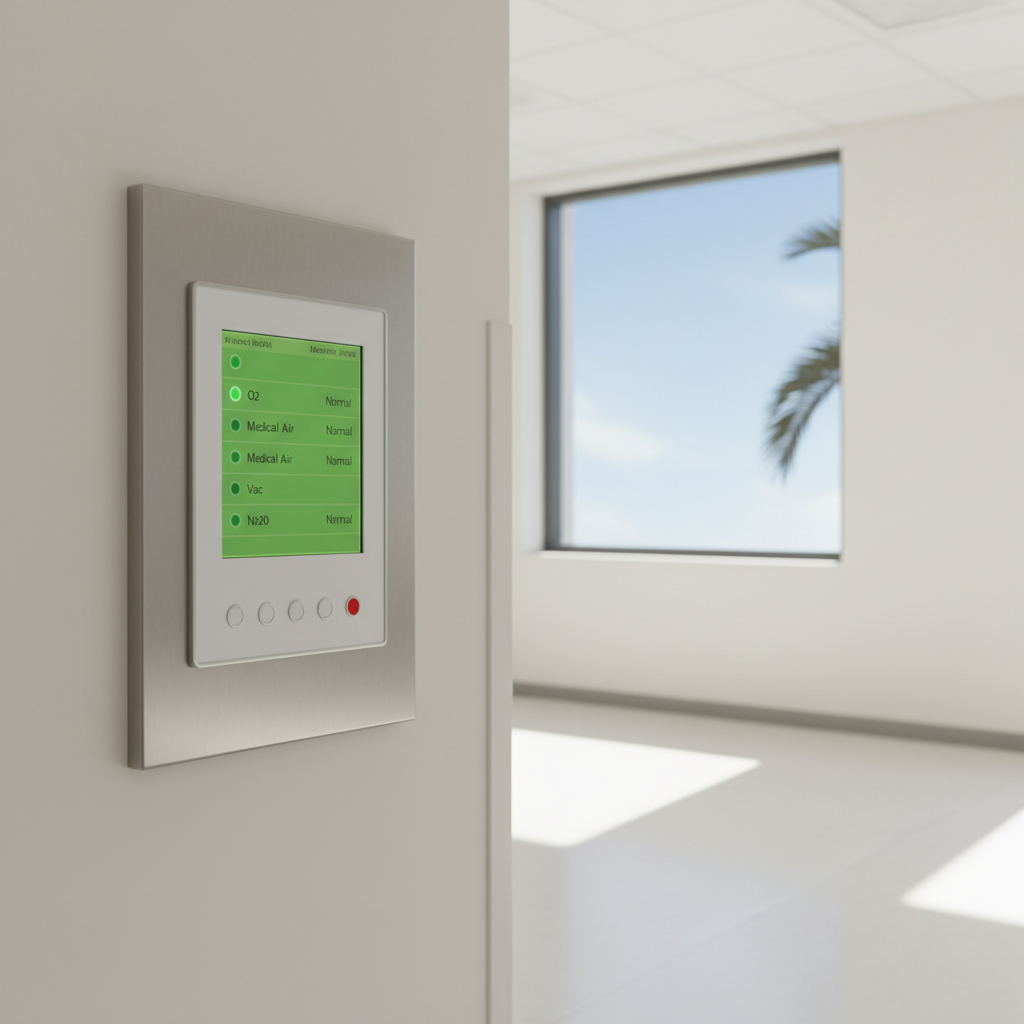
Master Alarm Panel Installation in Jacksonville: A Retrofit Guide
Medical Testing SolutionsMay 30, 20266 min read
Share
For any Jacksonville healthcare facility, the master alarm panel is the central nervous system of your medical gas system. It provides the real-time, at-a-glance monitoring required by NFPA 99 to ensure patient safety and system integrity. However, as technology advances and older panels reach their end-of-life, a low-voltage retrofit becomes not just an upgrade, but a necessity. An outdated or failing alarm system can lead to compliance issues, operational downtime, and potential risks to patient care.
This definitive guide is for hospital facility managers, biomedical engineers, and construction project leads in the Jacksonville and Duval County area. We will walk you through every stage of a master alarm panel installation, from understanding Florida-specific compliance requirements to the step-by-step retrofit process. You will learn how to plan for a seamless upgrade that minimizes disruption and leverages the cost advantages of using a local, Florida-based ASSE-certified company like Medical Testing Solutions.
Why Upgrade Your Master Alarm Panel?
Deciding to retrofit a master alarm panel is driven by several key factors, all centered on safety, compliance, and operational efficiency.
NFPA 99 Compliance: The Joint Commission (TJC) surveyors rigorously enforce NFPA 99 standards. An outdated panel may not meet the specific visual, audible, and mapping requirements outlined in the latest code editions.
End-of-Life (EOL) Systems: Many older panels are no longer supported by their manufacturers, making it impossible to source replacement parts. A failure in an EOL panel could force an emergency replacement, causing significant disruption.
Improved Monitoring & Safety: Modern digital panels offer superior functionality, including more precise monitoring, clearer on-screen instructions, and network connectivity (like BACnet) for integration with your building management system (BMS).
Long-Term Cost Savings: A new, reliable panel reduces the risk of emergency call-outs and costly repairs. Furthermore, by partnering with a Florida-based provider like Medical Testing Solutions, facilities in Jacksonville can eliminate travel, lodging, and per-diem fees, often saving 10-25% on the total project cost.
Navigating NFPA 99 and Florida AHCA Requirements
For Jacksonville hospitals, compliance isn't just about NFPA 99; it's about satisfying the Florida Agency for Health Care Administration (AHCA) as well. Your verification reports and system functionality must meet state-level scrutiny.
NFPA 99 5.1.9 (Alarms): This is the core chapt
er governing medical gas alarm systems. It mandates that master alarms be located in an area of continuous surveillance (e.g., the primary engineering or security office) and be able to audibly and visually communicate any failure or pressure deviation in your medical gas sources.
AHCA and Joint Commission: Verification reports following an installation must satisfy AHCA OPS Form 3110 and Chapter 59A of the Florida Administrative Code. TJC surveyors will expect to see documentation of annual medical gas inspections and proper alarm functionality.
Hurricane Re-Verification: NFPA 99 5.1.12 is critical for Florida facilities. It requires a re-test of the system by a qualified ASSE 6030 verifier after any loss of source pressure, such as during a hurricane or other natural disaster. Having a South Florida-based team allows for rapid mobilization post-storm to get you back online.
Why this matters for compliance: A non-compliant alarm panel is a direct red flag during an AHCA or TJC survey. It can lead to citations, require a corrective action plan, and potentially jeopardize your facility’s accreditation. Ensuring your panel is correctly installed and verified is a cornerstone of operational compliance.
Planning Your Low-Voltage Retrofit Installation
A successful installation is 90% planning. A low-voltage retrofit can be accomplished with minimal disruption if carefully mapped out.
Initial Site Assessment and System Design**
Before any work begins, an ASSE-certified technician should perform a complete site walk. This involves identifying all existing alarm points, tracing wiring, and understanding how the new panel will integrate. This is the stage where we help you design a solution that meets both code and your facility's specific needs, whether at UF Health Jacksonville or Baptist Health.
Choosing the Right Master Alarm Panel**
There are several excellent manufacturers of medical gas alarms. The right choice depends on your budget, the number of gas sources you need to monitor, and whether you require network integration. Our team is proficient in installing and servicing all major brands.
Assembling Your Installation Team**
NFPA 99 and ASSE standards are clear: any individual installing medical gas equipment must be certified to the ASSE 6010 standard. Using uncertified, in-house staff is a major compliance risk. Medical Testing Solutions provides ASSE 6010 certified installers and ASSE 6030 certified verifiers to ensure the job is done right from start to finish.
Master Alarm Panel Brand Comparison
While we can install any panel you specify, here is a general comparison of a few industry-leading brands we frequently work with.
Feature
Tri-Tech Medical "Med-Master"
Amico "Saturn" Series
BeaconMedaes "TotalAlert"
Display
Full-color touchscreen
Full-color touchscreen
Full-color touchscreen
Max Points
Up to 60 sources
Up to 40 sources
Up to 60 sources
Communication
Ethernet, BACnet, Modbus
Ethernet, BACnet, Modbus
Ethernet, BACnet
Installation
Low-voltage, wall-mounted
Low-voltage, wall-mounted
Low-voltage, wall-mounted
Key Advantage
Highly customizable display
Sleek, compact design
Robust history & reliability
The Installation Process: A Step-by-Step Guide
An ASSE 6010 certified technician follows a precise, documented procedure. While every project is unique, the core steps remain the same.
Pre-Installation Assessment: We review your current system and develop a detailed plan to minimize downtime.
Safe System Coordination: We work with your team to coordinate any necessary, localized system shutdowns. In many low-voltage retrofits, a full shutdown is not required.
Decommissioning the Old Panel: The old panel is disconnected and carefully removed.
Mounting and Wiring the New Panel: The new panel is mounted, and the low-voltage sensor wires are meticulously connected.
System Power-Up and Configuration: The panel is powered on and configured with your facility's specific high/low set-points and alarm parameters.
Full ASSE 6030 Verification: After the physical installation, an ASSE 6030 verifier tests every single alarm point and function to ensure 100% accuracy and generates a detailed report for your records.
The MTS Advantage: Local Florida Expertise for Jacksonville
As a Florida-based company, we offer distinct advantages for facilities in Jacksonville and across the state. Our headquarters is at 501 East Las Olas Blvd, Ste 300, Fort Lauderdale, FL 33301, making us a truly local partner.
This means NO travel fees, NO lodging costs, and NO per-diem charges for work performed anywhere in Florida. For a project like a master alarm installation, this translates into significant savings. Our deep familiarity with AHCA regulations and the challenges unique to Florida, from hurricane preparedness to serving major hospital systems like Cleveland Clinic Florida and Broward Health, ensures a smoother, more efficient process. We proudly serve the entire state from our hubs, including providing Miami medical gas services and supporting the broader Florida medical gas community.
Frequently Asked Questions
A standard retrofit can often be completed in a single day (6-10 hours), but this depends on the system's complexity and the size of the facility. We work with your team to create a schedule that minimizes disruption to patient care.
Costs vary based on the panel chosen and the number of gas services monitored. However, because our ASSE-certified technicians are based in Florida, MTS clients typically save 10-25% by avoiding the travel, lodging, and per-diem fees charged by out-of-state competitors.
Not always. A low-voltage retrofit can often be performed with minimal disruption. Our team performs a detailed pre-installation assessment to plan the work and, if necessary, coordinate a localized, temporary shutdown with your facility's managers to ensure patient safety is never compromised.
Yes. NFPA 99 requires that any installation, modification, or repair to the medical gas system be fully verified by an ASSE 6030 certified verifier. This ensures all components are functioning correctly and the system is safe for patient use. Medical Testing Solutions provides this [verification service](/medical-gas-verification).
Choosing a local Florida company like MTS eliminates costly travel fees and ensures faster response times, especially for post-hurricane re-verifications required by NFPA 99. Our headquarters is in Fort Lauderdale, and we understand the specific AHCA and Joint Commission requirements for Florida healthcare facilities.
Request a quote for your facility
Talk with Medical Testing Solutions about your next inspection, repair or equipment request.