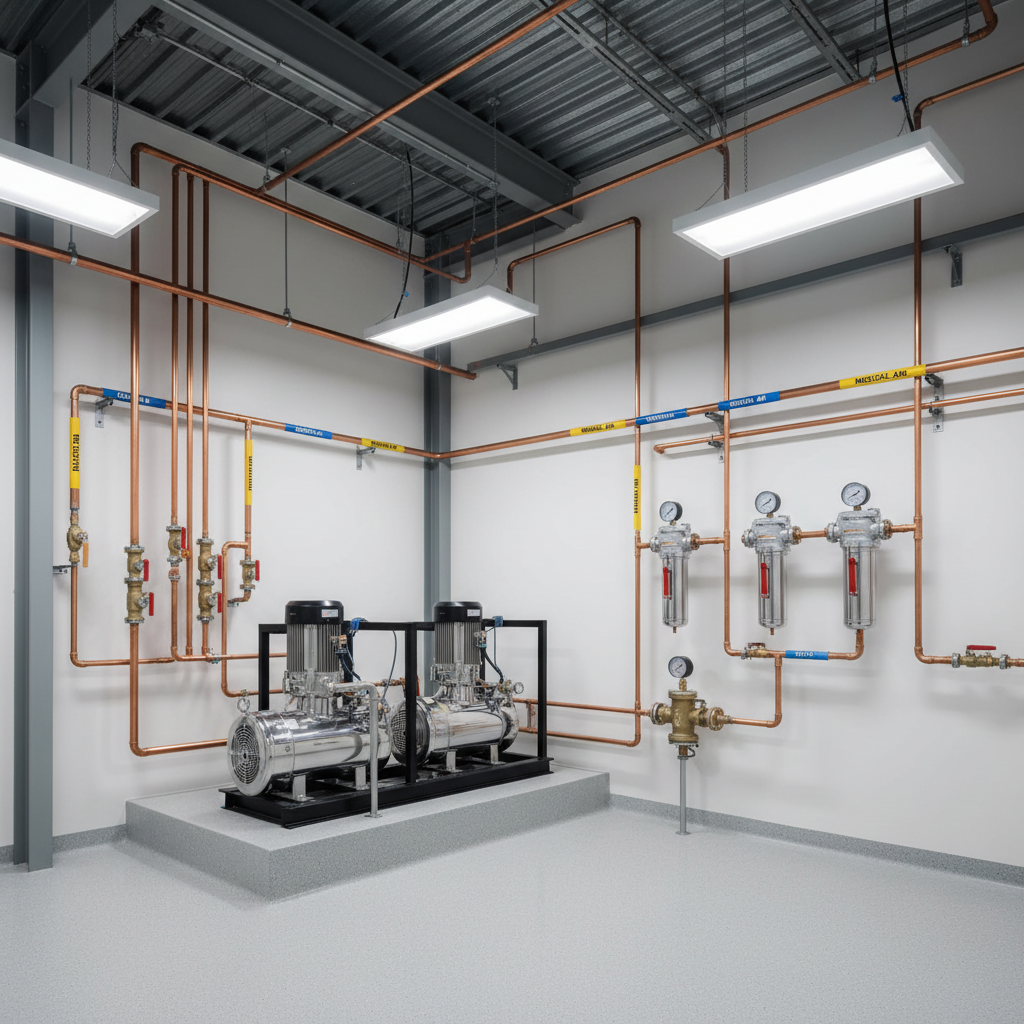
Ambulatory Surgery Center Medical Gas Install Washington DC DC Guide
Medical Testing SolutionsNovember 7, 202610 min read
Share
Building an outpatient surgical facility in the District of Columbia requires navigating some of the strictest health, building, and life safety regulations in the nation. An ambulatory surgery center medical gas install in Washington DC DC demands precision engineering, certified trades, and total adherence to NFPA 99 (Health Care Facilities Code), DCMR Title 22-B, and DC Department of Buildings (DOB) mechanical codes. Whether you are building an ophthalmic suite on K Street or a multi-specialty surgical pavilion in Ward 8, medical gas pipeline systems (MGPS) are Category 1 life-support infrastructure. A single brazing defect or particulate breach can delay your Certificate of Occupancy or fail DC Health licensing inspection.
This technical guide outlines the ground-up build-out process for Ambulatory Surgery Centers (ASCs) across the District. You will learn the exact sequence of design, code classification, source equipment selection, ASSE 6010 installation, pipe-level purging protocols, and the independent ASSE 6030 medical gas verification required for Authority Having Jurisdiction (AHJ) sign-off.
1. Regulatory Framework: DC Health, NFPA 99, and the DCMR
Healthcare construction in Washington, DC answers to multiple layers of oversight. Before a single stick of copper is ordered, facility planners must reconcile national standards with local municipal amendments:
NFPA 99 (Health Care Facilities Code): Mandates system risk assessments, gas purity standards, and installation safeguards. Most operating rooms within an ASC fall strictly under Category 1 (deep sedation/general anesthesia, where equipment failure can cause major injury or death).
DCMR Title 22-B (Public Health & Medicine): Outlines specific licensing criteria for DC ambulatory surgical facilities, administered by the DC Health Regulation and Licensing Administration (HRLA).
DC Department of Buildings (DOB) & DC Fire and EMS (FEMS): Enforce local amendments to the International Plumbing Code (IPC), International Building Code (IBC), and NFPA 1/101 Life Safety codes.
ASSE Series 6000 Professional Qualification Standard: Requires that installers hold ASSE 6010 certification, inspectors hold ASSE 6020, and third-party verifiers hold ASSE 6030 credentials.
Why this matters for compliance: DC Health will not issue an operating license without a verified NFPA 99 Medical Gas Pipeline System test report signed by a third-party ASSE 6030 verifier who has zero financial or business interest in the installing contractor.
2. Category 1 vs. Category 2 Risk Assessment for DC Surgery Centers
NFPA 99 Chapter 4 requires a documented Risk Assessment to establish whether your surgery center's medical gas piping is Category 1, Category 2, or Category 3.
In an Ambulatory Surgery Center, procedures involve general anesthesia, conscious intravenous sedation, or deep regional nerve blocks. Because interruption of medical gases (such as Oxygen or Medical Air) or loss of Medical-Surgical Vacuum directly compromises airway management, all operating suites and Phase I Post-Anesthesia Care Units (PACU) are designated as Category 1 spaces.
Pre-operative holding areas and Phase II recovery areas may occasionally be classified as Category 2 depending on the clinical care protocol. However, most DC healthcare facilities engineers pipe the entire ASC to Category 1 specifications to permit clinical flexibility, simplify AHJ reviews, and prevent future structural retrofits.
3. Core Medical Gas System Components for an ASC
A turn-key ASC pipeline infrastructure relies on critical source equipment, isolation valves, emergency shutoffs, and delivery terminals:
Bulk and Manifold Source Equipment
Medical Oxygen: High-pressure cylinder manifolds (e.g., dual-bank automatic switchover systems with digital pressure controls) or Micro-Bulk cryogenic vessels, installed per CGA M-1 and NFPA 99 Chapter 5.
Medical Nitrous Oxide ($N_2O$): Automatic switchover manifolds fitted with dual line-pressure regulators, typically located in a dedicated, one-hour fire-rated gas storage room vented to the outdoors.
Medical-Surgical Vacuum: Duplex or triplex rotary vane or oil-less claw pump packages. Systems must provide 100% redundant capacity with the largest single pump out of service.
Medical Air: Duplex scroll or reciprocating oil-free compressors equipped with dual desiccant dryers, carbon monoxide (CO) monitors, and high dew-point alarms (dew point must remain below 32°F at 50 psig).
Waste Anesthetic Gas Disposal (WAGD): Integrated into the vacuum system or provided via a dedicated blower. Protect staff using active WAG chemical vapor monitoring alongside your installation.
| Diagram text |
|, |
| TYPICAL ASC GAS PIPELINE PATH |
| [Source Manifolds / Compressors] - → [Main Line Shutoff Valve] |
| [Zone Valve Box (ZVB)] |
| [Operating Room / Procedure Area] → - [Area Alarm Panel] |
| [Ceiling Columns/Booms] - → [DISS/Quick-Connect Outlets] |
Valves, Alarms, and Terminal Units
Source Valves & Main Line Valves: Positioned at the source equipment and entering the facility perimeter.
Zone Valve Boxes (ZVBs): Placed immediately outside each operating suite and recovery bay. They must be clearly visible, unobstructed, and labeled with the gas name, room served, and operating pressure.
Master Alarm Panels: Installed in two separate locations observed continuously (e.g., the facility control room and the central nurse station) per NFPA 99 §5.1.9.2.
Area Alarm Panels: Installed in the nursing station or outside operating rooms to continuously display pressures for line services, alarming within $\pm 20%$ of normal working pressure.
Medical Gas Outlets/Inlets: DISS (Diameter Index Safety System) or approved quick-connect (Chemetron, Ohmeda, Puritan-Bennett) recessed in walls or integrated into ceiling surgical booms.
4. Source Equipment Specs: Vacuum, Air, and Manifolds
Selecting the right plant footprint is critical in dense urban Washington, DC environments where floor space, sound transmission, and rooftop access are tightly constrained.
Equipment Type
Required Sizing / Redundancy
Key DC Code Considerations
NFPA 99 Reference
Medical Air Compressor
Duplex minimum; must carry peak load with largest pump offline
Intake $\ge 25$ ft from exhausts, sewer vents, and patient drop-off areas
NFPA 99 §5.1.3.6.3
Med-Surg Vacuum Pump
Duplex or Triplex; $N-1$ redundancy standard
Exhaust directed outdoors away from windows; oil-less claw preferred
NFPA 99 §5.1.3.7
High-Pressure Manifolds ($O_2, N_2O$)
Dual-bank automatic switchover with intermediate reserve
1-hour fire-rated enclosure; mechanical ventilation to the outside
NFPA 99 §5.1.3.3
Instrument Air
Optional in ASCs; required if pneumatic tools exceed vacuum capabilities
Dew point alarm set to $-40^\circ\text{F}$; dry, oil-free gas stream
NFPA 99 §5.1.13
When designing electrical backup systems for your central plant and life safety branch, ensure line isolation units are audited. Our technicians routinely execute line isolation monitor testing in wet-procedure environments to ensure uninterrupted power delivery to life-support drives.
5. The ASSE 6010 Installation Process
Installing medical gas is specialized plumbing governed by ASSE Standard 6010. Mechanical contractors cannot assign standard commercial plumbers to braze Category 1 medical gas piping.
| Diagram text |
|, |
| STEP 1: Plan Submittal, Engineering & DOB Permitting |
| STEP 2: Copper Delivery & NFPA 99 Material Inspection |
| STEP 3: Continuous Nitrogen Purge & BCuP Brazing |
| STEP 4: Initial System Blow-down & Standing Pressure |
| STEP 5: Third-Party ASSE 6030 Testing & AHJ Approval |
Step 1: Material Verification
Piping must be seamless copper tube conforming to ASTM B819 (Type K or L), factory-cleaned, degreased, and capped. Fittings must be wrought copper per ASME B16.22, bagged and tagged specifically for oxygen service.
Step 2: Nitrogen Purge Brazing
Every single copper joint must be continuously purged with oil-free dry Nitrogen ($NF$) during the heating and brazing cycle. The purge prevents the formation of cupric oxide scale inside the pipe. If copper is brazed without nitrogen, black particulate will deposit along the pipe interior, immediately fouling check valves, plugging ventilator flowmeters, and failing verification tests.
Brazing Filler Metal: BCuP series (phosphorus-copper-silver) without flux. Flux is prohibited on copper-to-copper joints under NFPA 99 §5.1.10.5.
Step 3: Initial Installer Pressure Tests
The ASSE 6010 mechanical team completes initial inspections before wall close-in:
Blow-down Test: Pulsing dry nitrogen through lines to confirm no particulate accumulation.
Initial Pressure Test: Pressurizing the piping with oil-free nitrogen to 150 psig (or 1.5 times working pressure) for positive gases, maintained without measurable drop.
Initial Cross-Connection Test: Ensuring lines are isolated from one another before terminal equipment is hung.
For turnkey mechanical delivery, partnering with a certified provider for ASSE 6010 medical gas installation guarantees that all brazing logs, purge records, and installer affidavits comply with DC municipal mandates.
6. ASSE 6030 Third-Party Verification Protocol
Once the installation team finishes secondary testing and drywall finishes are complete, a third-party agency must be brought in. Medical Testing Solutions provides comprehensive, non-affiliated ASSE 6030 verification across Washington, DC, Maryland, and Northern Virginia.
The independent verification process involves rigorous physical and chemical tests:
Cross-Connection Elimination Test: Verifying that each terminal outlet delivers its dedicated gas (e.g., zero crossover between $N_2O$ and $O_2$).
Valve Closure Integrity: Exercising every source valve, main line valve, and zone valve box to prove that shutting a labeled valve cuts flow strictly to the designated operating suite without bleeding into adjacent rooms.
24-Hour Standing Pressure Test: Holding piping at $20%$ above normal working pressure (60 psig for 50-psig systems; 190 psig for high-pressure systems) for 24 continuous hours, corrected for thermal expansion and ambient temperature swings.
Alarm Calibration and Response: Calibrating master alarms, area panels, pressure switches, transducer modules, and remote audible notifications.
Particulate and Purity Testing: Measuring gas quality at every terminal outlet:
Total Hydrocarbons (as methane) $< 25\text{ ppm}$
Carbon Monoxide ($CO$) $< 10\text{ ppm}$
Carbon Dioxide ($CO_2$) $< 500\text{ ppm}$
Water Vapor / Dew Point $< -30^\circ\text{F}$ at 50 psig
Halogenated solvents and particulates $< 1\text{ mg/m}^3$
Upon completion, MTS issues a comprehensive binder containing ASSE 6030 verification documentation, test matrices, outlet maps, and certification letters.
7. Securing AHJ Sign-Off in Washington, DC
DC Health’s Health Regulation and Licensing Administration (HRLA) will schedule an on-site survey before an ASC can accept its first patient. Furthermore, the DC Department of Buildings requires mechanical and fire life-safety sign-offs to close permits.
Documentation Checklist for District Inspectors:
Certified ASSE 6010 brazing logbooks, coupon test samples, and welder qualification credentials.
Independent ASSE 6030 Verification Final Report issued by an accredited firm like Medical Testing Solutions.
As-Built mechanical and riser drawings detailing pipe sizes, line drops, check valves, and isolation zones.
Medical gas source equipment cut sheets, seismic bracing certifications (if specified), and UL/ETL listings.
Medical Air compressor air quality test logs showing dew point, CO monitoring calibration, and filter change protocols.
If your ASC houses an on-site compounding suite for specialized ophthalmic or pain management medications, coordinate your cleanroom airflow and pressure regimes under USP 797 and 800 standards to avoid overlapping mechanical disputes during the HRLA walkthrough.
Achieving your Certificate of Occupancy is simply day one of your compliance timeline. NFPA 99 §5.1.14 dictates that healthcare facilities maintain an ongoing testing protocol for all pipeline systems, central plants, alarms, and patient delivery devices.
Ambulatory facilities should source dependable replacement hardware, medical gas hoses, regulators, and secondary devices directly from trusted distributors. Review our catalog of hospital-grade assemblies, alarms, and components in the Medical Testing Solutions product store to keep your facility stocked with NFPA-compliant components.
For continuous operational readiness, establishing structured medical gas maintenance services protects patient safety, extends the life of costly compressor and vacuum packages, and guarantees your surgery center passes unannounced CMS or AAAHC accreditation audits.
Partner with Medical Testing Solutions
Building or expanding an ambulatory surgical facility in Washington, DC requires zero-tolerance execution. From blueprint review and equipment procurement to ASSE 6010 installation, maintenance, and third-party ASSE 6030 verifications, Medical Testing Solutions is your dedicated compliance partner.
Contact our technical services team today to review your plan drawings or schedule your verification.
All brazing, rough-in, and installation work must be performed by mechanics certified to ASSE 6010 (Medical Gas Systems Installer). DC Department of Buildings inspectors and third-party commissioning agents will request active ASSE 6010 credential cards and brazing coupon qualification records before signing off on rough-in inspections.
No. NFPA 99 §5.1.12.1.1 expressly requires that medical gas verification be performed by an independent, third-party entity certified to ASSE 6030. The verifier cannot be employed by the installing mechanical contractor, the design engineer, or the equipment manufacturer, guaranteeing an unbiased audit of the installation.
Under NFPA 99 §5.1.3.6.3, the outside air intake for medical air compressors must be located at least 25 feet away from all building exhausts, sewer vents, fuel storage vents, combustion exhausts, and vehicle loading docks/drop-offs. In tight Washington, DC lot footprints, intakes are typically routed vertically to penthouse or roof levels away from prevailing wind drafts.
NFPA 99 Chapter 5 mandates that all master alarms, area alarms, and pressure switch activations be tested at least annually. Zone valves must be visually inspected and exercised regularly to guarantee unobstructed operation in an emergency.
Request a quote for your facility
Talk with Medical Testing Solutions about your next inspection, repair or equipment request.