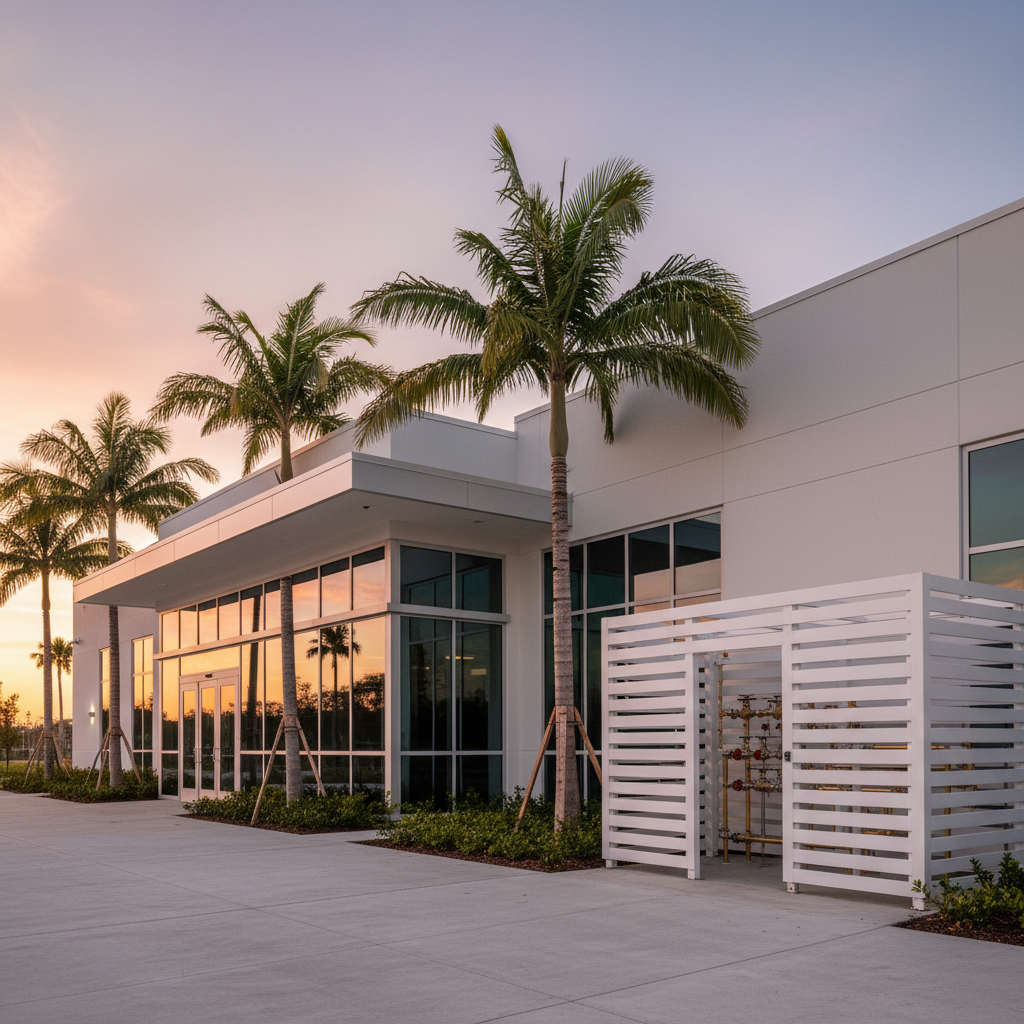
Freestanding ER Medical Gas Piping Boca Raton: Category 1 Rules
Medical Testing SolutionsNovember 12, 20269 min read
Share
During a pre-occupancy inspection at an off-campus emergency department off Glades Road last summer, our verifier shut the trauma bay zone valve box and watched the corridor observation bays lose oxygen pressure at the exact same moment. The plumbing contractor had piped both the critical resuscitation room and the general treatment cubicles off a single branch line without independent service valves, violating NFPA 99 section 5.1.4. That single blueprint oversight delayed their state opening survey by three weeks while ASSE 6010 installers cut into finished drywall to braze in new isolation valves and re-run nitrogen purge tests.
Planning freestanding ER medical gas piping Boca Raton projects requires strict adherence to Category 1 life safety rules, even when the facility sits miles away from the main hospital campus in a commercial retail corridor. Because off-campus emergency departments administer life-supporting gases and deep sedation to unstable trauma and cardiac patients, state and national regulators treat their pipeline architecture identically to an acute-care hospital trauma center. Understanding how branch isolation valves, emergency oxygen supply connections, and dual-source manifolds interact will keep your construction timeline on track.
A freestanding emergency department (FSED) is not an urgent care clinic. Patients arriving by ambulance or walk-in may require immediate intubation, mechanical ventilation, or continuous positive airway pressure before transfer to a tertiary facility like Baptist Health Boca Raton Regional Hospital or Broward Health North. Under NFPA 99 (Health Care Facilities Code) Chapter 4, any facility where interruption of piped medical gas or vacuum would place patients in imminent danger of major injury or death must be designed and verified as a Category 1 system.
Category 1 designation dictates every mechanical decision from the bulk yard or manifold room to the patient headwall. You cannot use single-cylinder portable setups as your primary supply, nor can you share medical vacuum pumps with laboratory or non-medical drainage systems. Every foot of ASTM B819 copper tubing must be brazed under a continuous purge of oil-free dry nitrogen by certified medical gas installation specialists holding valid ASSE 6010 credentials.
Why this matters for compliance: The Florida Agency for Health Care Administration (AHCA) classifies hospital-based off-campus emergency departments under acute care licensure rules in Chapter 59A-3 of the Florida Administrative Code. If your piping is erroneously engineered to Category 2 outpatient standards, AHCA architectural reviewers will reject your Office of Plans and Construction (OPC) final survey and withhold occupancy approval until every non-compliant valve, alarm, and source feed is rebuilt to Category 1 specifications.
Designing Dual-Source Feeds and EOSC Placements in South Florida
Main hospitals rely on massive liquid bulk cryogenic tanks with vaporizers, primary and secondary reserves, and dedicated ring mains. A freestanding ER on a tight Palm Beach County lot rarely has the footprint or daily consumption volume to justify a massive cryogenic vessel, yet it still requires an uninterrupted Category 1 source. Most Boca Raton FSEDs solve this using either a micro-bulk liquid oxygen system with a high-pressure cylinder reserve or a fully automatic dual-bank high-pressure cylinder manifold (NFPA 99 section 5.1.3.5.10).
Whether you select micro-bulk or high-pressure cylinders, the system must feature an automatic changeover mechanism that switches from the depleted primary bank to the secondary reserve without dropping line pressure below the 50 to 55 psig delivery threshold. Furthermore, if your oxygen source resides outside the building envelope or consists of an exterior micro-bulk station, NFPA 99 section 5.1.3.5.14 requires an Emergency Oxygen Supply Connection (EOSC) mounted on the exterior wall. The EOSC allows a temporary bulk trailer to hook directly into the building main if a supply vendor is delayed or an exterior tank suffers damage.
Piping Component
Category 1 Freestanding ER Requirement (NFPA 99)
Category 2 Urgent Care / Clinic Standard
Common Boca Raton Field Violation
Source Supply
Primary, secondary, and reserve (or dual-bank manifold) with automatic changeover
Single-point fail-safe supply permitted if non-life-supporting
Missing check valves or improper relief valve venting on reserve headers
EOSC Assembly
Required when cryogenic/bulk supply sits outside building; needs 3 ft clearance and check valves
Not required
Mounted behind locked dumpster gates or lacking brass caps and chains
Zone Valve Boxes
Immediately outside every critical care/resuscitation room; operable from standing position
Corridor isolation permitted for grouped treatment rooms
Placed inside the trauma room or hidden behind swing-open entrance doors
Alarm Systems
Both Master Alarms (two locations or multiplexed to main campus) and Local Area Alarms
Area alarm monitoring common line pressure
Master alarm wired to unmonitored back-office breakroom instead of 24/7 nurse station
Vacuum & Medical Air
Duplex (redundant) pumps and compressors; 100% capacity with largest unit out of service
Simplex units permitted where procedures are strictly minor
Lead-lag alternation failure during simulated power transfer testing
If you are finalizing mechanical drawings or preparing for rough-in sign-off in Palm Beach County, schedule third-party ASSE 6030 medical gas verification with Medical Testing Solutions before ceiling tiles drop so our technicians can verify your valve zoning and manifold headers while the walls are still open.
Branch Piping Isolation Valves and Zone Valve Box Rules
Isolation valves and zone valve boxes represent the highest failure rate during initial verification in freestanding ERs. Architects often compress the floor plan of an off-campus ER to fit a 10,000-square-foot pad, clustering resuscitation rooms, CT imaging suites, triage bays, and decontamination showers around a single central nurse core. That tight geometry tempts mechanical subcontractors to share branch lines across distinct clinical risk zones.
NFPA 99 section 5.1.4 delineates rigid separation rules for service valves and zone valve boxes:
Riser and Branch Service Valves: Every branch line taking off from a main distribution riser requires a locked or secured ceiling service valve so maintenance crews can isolate a wing without shutting down the entire facility.
Trauma and Resuscitation Independence: Critical life-support rooms, such as the main trauma or cardiac resuscitation bay, must have their own dedicated zone valve box located immediately outside the room entrance. That valve cannot shut off oxygen or vacuum to adjacent exam rooms along the same corridor.
Visibility and Obstruction: Zone valve boxes must be installed where they are visible and accessible at all times, never concealed behind open doors, crash carts, or lead-lined imaging doors.
Gauge and Label Accuracy: Each valve box must feature a pressure or vacuum gauge upstream of the main room outlets and permanent color-coded labeling identifying the specific room numbers controlled.
AHCA Form 3110 and Joint Commission Readiness
Passing the municipal building department pressure test is only the first hurdle. Before a freestanding ER in Boca Raton can admit its first patient, the parent healthcare system, whether affiliated with Baptist Health, Tenet, Cleveland Clinic Florida, or UF Health, must complete an AHCA Office of Plans and Construction physical plant inspection.
During the final OPC survey, state engineers inspect your documentation package alongside the physical installation. Your verifier's final report must align seamlessly with AHCA Form 3110-0011 and Chapter 59A-3 requirements. Inspectors check for brazier qualification continuity logs, standing 24-hour pressure test charts, cross-connection verification data, gas purity lab results (testing for carbon monoxide, carbon dioxide, moisture dew point, total hydrocarbons, and halogenated refrigerants), and verified master alarm signal mapping.
Once the doors open, compliance shifts from construction verification to The Joint Commission (TJC) Environment of Care standards (EC.02.05.09). Because an FSED operates under the hospital's main CMS provider number, TJC surveyors hold the off-campus site to the exact same inspection rigor as the primary inpatient tower. Scheduling comprehensive annual medical gas inspections ensures your emergency department maintains documented proof of outlet flow testing, area alarm calibration, and source equipment preventative maintenance before an unannounced surveyor walks through the glass sliding doors.
Hurricane Re-Verification Protocols in Palm Beach County
Coastal South Florida facilities face an environmental hazard that Midwest verifiers rarely encounter: Category 3 to 5 tropical cyclones. High winds, flying debris, and storm surge along the I-95 and Federal Highway corridors can damage outdoor bulk enclosures, shear exhaust stacks, or flood vacuum receiver pits. Furthermore, prolonged commercial power loss places intense thermal and mechanical loads on emergency generator transfer switches powering medical air compressors and vacuum pumps.
Under NFPA 99 section 5.1.12, any medical gas system that suffers physical structural damage, water intrusion into the intake or pipeline, or a total loss of source pressure during a storm event must undergo formal re-verification before returning to clinical service. If a micro-bulk relief valve vents down completely during an evacuation, atmospheric moisture and contaminants can migrate backward into the pipeline. Medical Testing Solutions maintains rapid-response emergency verification crews right here in South Florida to run particulate, purity, and standing pressure checks immediately after a storm passes so your freestanding ER can reopen to emergency traffic without delay.
The Local Cost Advantage: Fort Lauderdale Dispatch vs. Out-of-State Verifiers
Many national general contractors building freestanding ERs across Florida hire out-of-state verification firms out of habit, absorbing bloated airfare, rental car, hotel, and daily per-diem surcharges on every rough-in and final trip. When construction phased schedules slip by forty-eight hours, those out-of-state travel change orders multiply rapidly.
Medical Testing Solutions is headquartered locally at 501 East Las Olas Blvd, Ste 300, Fort Lauderdale, FL 33301, less than thirty minutes south of Boca Raton via I-95. Because our ASSE 6010 installers, ASSE 6020 inspectors, and ASSE 6030 verifiers live and work in South Florida, we charge zero travel fees, zero lodging fees, and zero per-diem anywhere in Florida. Most healthcare construction and facility management clients save 10% to 25% compared to out-of-state verifiers while gaining true same-day dispatch when a rough-in inspection window opens unexpectedly.
We support off-campus emergency departments, ambulatory surgery centers, and main hospital campuses across the entire state through our Florida medical gas services network, including rapid-response coverage from our West Palm Beach medical gas services and Fort Lauderdale medical gas services teams. In addition to field verification and testing, Medical Testing Solutions supplies replacement beacon medaes and amico zone valve components, manifold regulators, and alarm circuit boards directly to keep your facility compliant.
Ready to schedule your rough-in verification, AHCA final check, or annual NFPA 99 compliance inspection in Boca Raton? Call our Fort Lauderdale office today at (754) 315-1078 for same-day dispatch in South Florida, or request a quote online to lock in transparent local pricing with zero travel markups.
Frequently Asked Questions
Yes. Because off-campus and freestanding emergency departments treat unstable patients who may require mechanical ventilation, resuscitation, or deep sedation, both NFPA 99 Chapter 4 and the Florida Agency for Health Care Administration (AHCA) classify their piped medical gas and vacuum systems as Category 1 life-support systems.
NFPA 99 section 5.1.4.6 requires a dedicated zone valve box located immediately outside each critical care or resuscitation space so staff can shut off gas flow in an emergency without entering the room and without cutting off oxygen or vacuum to adjacent treatment bays down the corridor.
Under NFPA 99 section 5.1.3.5.14, an exterior Emergency Oxygen Supply Connection (EOSC) is mandatory whenever the bulk or micro-bulk liquid oxygen source sits outside the building structure. It allows an emergency trailer to supply the facility if the primary outdoor vessel fails or is damaged.
AHCA Office of Plans and Construction (OPC) engineers require ASSE 6030 verifier reports demonstrating standing 24-hour pressure tests, cross-connection and valve zoning audits, master and area alarm functional tests, outlet flow and pressure checks, and gas purity verification aligning with AHCA Form 3110-0011 and Chapter 59A-3 F.A.C.
Per NFPA 99 section 5.1.12, any medical gas pipeline that completely loses positive source pressure, suffers physical storm impact, or experiences floodwater intrusion into source equipment must undergo targeted ASSE 6030 re-verification—including purge, pressure, and purity testing—before resuming patient care.
Request a quote for your facility
Talk with Medical Testing Solutions about your next inspection, repair or equipment request.