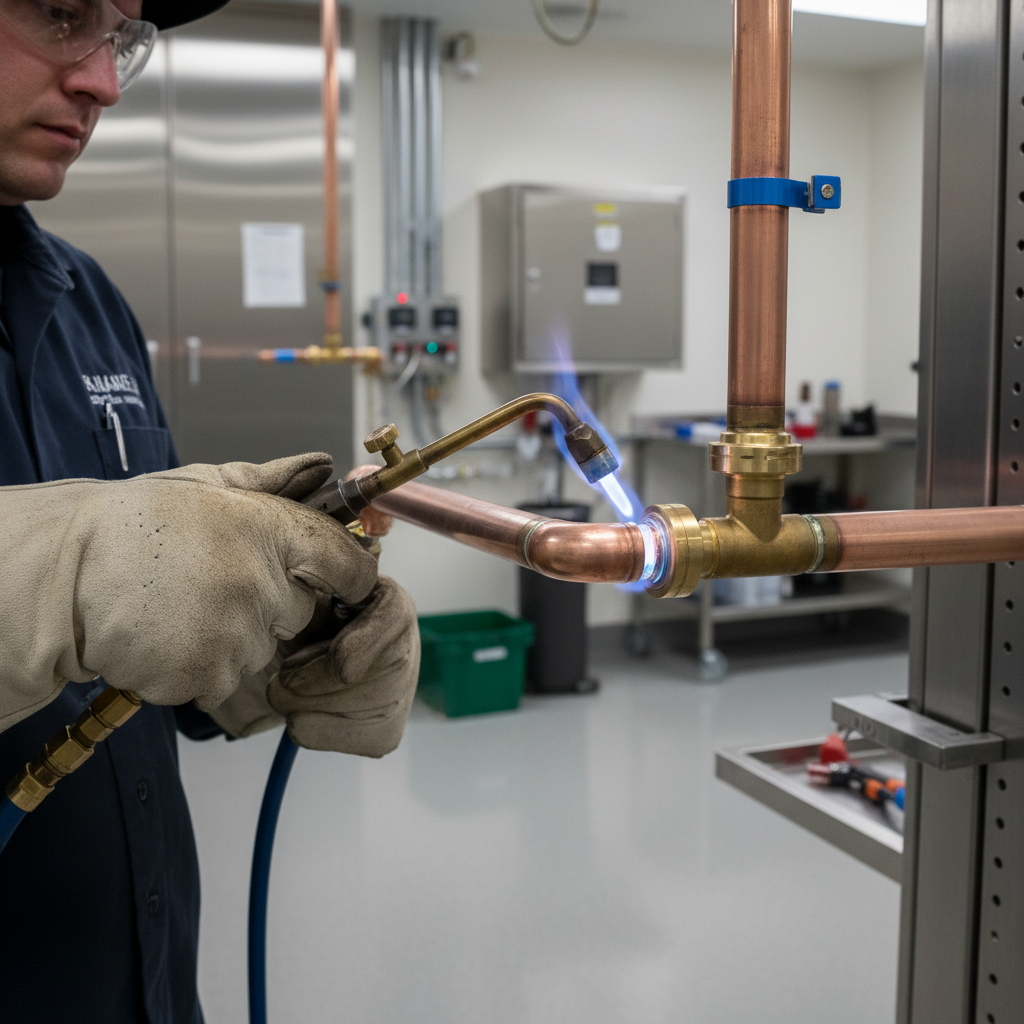
Cut open a copper joint on a failed medical gas pipeline, and you will immediately see why brazing standards in healthcare facilities have zero tolerance for error. If an installer fails to purge with oil-free dry nitrogen while heating the fitting, dark cupric oxide flakes form on the pipe's interior wall. When that system is pressurized with 50 to 55 psi of medical oxygen and placed into service, those brittle flakes dislodge. They travel downstream, foul line pressure regulators, shred ventilator solenoid seals, and create an extreme fire hazard inside patient care terminal units.
Earning your medical gas pipeline brazing certification confirms you understand these physical stakes and master the metallurgical procedures required by code. Healthcare construction demands verified competency. When general contractors, hospital facility directors, and mechanical engineers solicit bids for life-safety systems, they require personnel who carry recognized credentials under ASSE Series 6000.
Whether you work for a mechanical contractor stepping onto your first hospital job site or you are an experienced plumber aiming to formalize your credentials, this guide explains what it takes to pass the ASSE 6010 installer qualification and the required AWS B2.2 or ASME Section IX brazing performance examination.
The Regulatory Framework: NFPA 99 and ASSE Series 6000
Medical gas piping is governed by strict code cross-references. You cannot read NFPA 99 (Health Care Facilities Code) in isolation; it directly mandates national qualification standards developed by the American Society of Sanitary Engineering (ASSE).
Under NFPA 99 Section 5.1.10.11.10, all personnel who install medical gas and vacuum piping systems must be qualified under ASSE Standard 6010, the Professional Qualifications Standard for Medical Gas Systems Installers. Section 5.1.10.11.11 requires that all brazers be qualified in accordance with either ASME Boiler and Pressure Vessel Code, Section IX, or AWS B2.2 (Standard for Brazing Procedure and Performance Qualification), as modified by NFPA 99.
The professional landscape separates specific responsibilities across distinct ASSE certifications. Knowing where the installer credential fits prevents compliance bottlenecks:
- ASSE 6010 (Installer): Qualified to braze, install, alter, and rough-in Category 1, 2, and 3 medical gas piping networks.
- ASSE 6020 (Inspector): Represents the facility owner, general contractor, or authority having jurisdiction (AHJ) to inspect work in progress.
- ASSE 6030 (Verifier): Independent third-party specialist who performs physical testing and quality verification before system sign-off.
- ASSE 6040 (Maintenance Personnel): Healthcare facility employees who maintain and operate active medical gas equipment.
- ASSE 6050 (Instructor): Authorized trainers qualified to teach the 6000 series curricula.
To legally braze medical gas copper in an acute care hospital, surgical clinic, or dental operatory, you must hold the ASSE 6010 installer credential, which includes successful passage of a performance-tested brazing qualification. Contractors seeking professional support frequently partner with our team for code-mandated medical gas installation to ensure their crews align with current NFPA requirements.
Prerequisites and Eligibility for ASSE 6010
You cannot simply walk off the street, pay an examination fee, and test for your certification. National certification bodies such as the National Inspection Testing Certification (NITC) corporation enforce minimum trade experience prerequisites.
Candidates must demonstrate at least four years of documented field experience in the plumbing, pipefitting, or mechanical contracting trade. Some programs accept registered apprentices who are in their final year of an approved apprenticeship program, provided their training program submits formal verification of hours.
Once your practical trade experience is documented, you must complete a minimum of 32 hours of classroom training delivered by an ASSE 6050 certified instructor. This coursework covers:
- Health Care Facilities Code (NFPA 99) Chapter 5 requirements
- System layout, clean storage, and tube end preparation
- Sizing and distribution of medical gases and vacuum
- Nitrogen purging techniques and manifold operations
- Pre-testing protocols, including initial pressure tests and standing pressure checks
After completing classroom instruction, you face two exams: a written theoretical exam and a practical hands-on brazing performance test.
Anatomy of the Hands-On Brazing Test
The practical test does not allow for guesswork. You braze coupon assemblies under strict observation by a registered proctor, and those coupons undergo rigorous mechanical and visual examination.
The test standard requires you to braze copper tube assemblies using copper-to-copper fittings in multiple orientations. NFPA 99 Section 5.1.10.11.11 specifies that qualification must be conducted on the maximum diameter pipe the installer will work on, or using standard test assembly sizes that establish thickness and position ranges. The most common qualification coupon utilizes 1-1/2 inch or 2-inch nominal Type L medical copper tubing (ASTM B819).
Testing takes place in two specific pipe orientations: horizontal rolled or fixed (2G/5G) and vertical fixed (5G/6G equivalents). You must demonstrate full capillary penetration around the entire circumference of the socket without burning through the base metal or washing out the joint.
| Test Parameter | Code Requirement (NFPA 99 / AWS B2.2 / ASME IX) | Field Failure Consequence |
|---|
| Purge Gas | NFPA-grade oil-free dry nitrogen | Internal oxidation (scale) clogs downstream terminal equipment |
| Purge Oxygen Level | Less than 1.0% O2 residual at outlet | Heavy internal coking and scaling along the heat-affected zone |
| Filler Metal | BCuP series (BCuP-2 through BCuP-5), min 1000°F melting point | Low-temp solder yields under hospital fire conditions |
| Flux Usage | Prohibited on copper-to-copper joints; permitted only on brass/bronze | Corrosive acid residues contaminate patient breathing gas lines |
| Joint Clearance | 0.001 to 0.005 inches capillary fit | Excessive clearance causes incomplete penetration and joint fracture |
| Post-Brazing Clean | External wash with water/wire brush to inspect fillet | Trapped slag conceals pinholes, cracks, and incomplete fillets |
Testing laboratories put your completed test coupons through destructive testing. The pipe assembly is halved or quartered lengthwise. The evaluator inspects the internal root for complete capillary draw, uniform bonding, and the absence of cupric oxide. Many agencies subject test coupons to a mechanical bend or peel test to verify metallurgical fusion. If your coupons pass both visual and destructive evaluations, the testing agency issues your performance qualification record (PQR) and welder/brazer performance qualification (BPQ).
Essential Brazing Procedures: Mastering the Nitrogen Purge
The single most critical procedural skill for an ASSE 6010 brazer is managing the nitrogen purge. Air contains roughly 21 percent oxygen. When you heat copper tubing above 800 degrees Fahrenheit in the presence of oxygen, oxidation occurs rapidly. Above 1200 degrees Fahrenheit, scale builds rapidly on the pipe's internal surfaces.
NFPA 99 Section 5.1.10.5.5 explicitly demands that an inert purge gas, specifically oil-free, dry nitrogen NF, be directed through the tubing during all brazing operations. The purge must flow continuously until the joint is cool to the touch.
Purging requires precise flow control, not blast volume:
- Pre-purge: Displace atmospheric air from the piping run prior to applying heat. Run nitrogen at a high enough rate to flush the volume of the pipe segment, typically 20 to 30 cubic feet per hour (CFH) depending on line diameter.
- Active purge: Drop your flow rate to a gentle trickle (often 4 to 8 CFH) while heating and applying braze alloy. If your flow rate is too high, you create positive internal pressure inside the tube. This backpressure blows pinholes through molten BCuP alloy just as you complete the cap.
- Exhaust verification: Never assume nitrogen has reached your target joint. Confirm the oxygen level at the discharge point using a handheld oxygen analyzer. NFPA 99 mandates that the oxygen content must measure below 1 percent before heating begins.
- Cooling phase: Keep nitrogen flowing through the assembly until the joint naturally drops below 400 degrees Fahrenheit. Quenching joints with cold water is strictly forbidden by most installation specifications because it shocks the crystalline structure of the copper and causes brittle microfractures.
Code Rules: Filler Metals, Flux, and Cleaning
Medical gas brazing differs fundamentally from commercial refrigeration and hydronic heating. Shortcuts that pass on a commercial chiller will fail you immediately on an ASSE 6010 exam and can trigger federal compliance penalties on an actual hospital job site.
Tube Preparation and Cleanliness
You must use copper tubing labeled ASTM B819, which is factory-cleaned, degreased, and plugged or capped by the manufacturer. If you cut tubing on-site, use clean wheel-type tubing cutters. Never use saws that leave metal cuttings inside the pipe. Ream the interior diameter to remove burrs that cause turbulent flow or trap debris. Clean the outside mating surface of the tube and the inside cup of the fitting using non-shedding abrasive pads such as Scotch-Brite. Never use carbon steel wire brushes or emery cloth containing iron oxide or oil-based adhesives, as they leave contaminants that outgas when exposed to medical vacuum or nitrous oxide.
Filler Metal Chemistry
NFPA 99 requires filler metals from the BCuP (copper-phosphorus) or BAg (silver) series. When joining copper-to-copper, you must use BCuP series alloys, such as BCuP-2, BCuP-3, BCuP-4, or BCuP-5, which contain between 4.8 and 7.5 percent phosphorus. Phosphorus acts as a self-fluxing agent on copper, eliminating the need for chemical flux.
The Strict Rules on Flux
Applying chemical flux to a copper-to-copper medical gas joint is an immediate code violation. Flux contains acid compounds, including fluorides and chlorides. If introduced to a medical pipeline, it corrodes valves and poisons patient circuits.
The only scenario where chemical flux is permitted is when you join copper tubing to a dissimilar metal, such as a cast bronze valve or brass equipment connection. In those specific instances, NFPA 99 Section 5.1.10.5.3 allows sparse, careful application of BAg filler metal with AWS Type FB3-A or FB3-C water-soluble brazing flux. You must apply the flux lightly to the male tube end only, never inside the female fitting cup, to prevent excess flux from being pushed into the gas stream. After brazing, the exterior must be washed with clean hot water to prevent exterior green corrosion.
If you ever need an independent audit of your job-site brazing practices, our certified inspectors provide comprehensive medical gas certification across healthcare systems to verify procedural alignment.
Preparing for the Written ASSE 6010 Exam
The practical coupon test trips up installers with poor torch control, but the written exam stops tradespeople who rely purely on muscle memory rather than book knowledge.
The written exam consists of 100 multiple-choice questions administered over a two- to three-hour window. A passing score requires at least 70 to 75 percent correct answers, depending on the certifying body (such as NITC, MedGas, or MGPHO).
To prepare effectively, you must master the following core topics within NFPA 99:
- Category Distinctions: Understand the operational differences between Category 1 (deep sedation, life support), Category 2 (minor sedation), and Category 3 (non-sedation, such as basic dental suites).
- Pipe Supports and Hangers: Know maximum hanger spacing rules from NFPA 99 Table 5.1.10.11.4.1. For instance, 1/2-inch copper requires support every 6 feet, while 1-inch pipe requires hangers at 8-foot intervals. You must also know rules for isolating copper from dissimilar metals to prevent galvanic corrosion.
- Valves and Zone Boxes: Memorize rules for zone valve box (ZVB) locations. Zone valves must be placed on the same floor as the patient rooms they serve, outside patient rooms, and immediately accessible in corridors without passing through locked doors.
- Testing Pressures: You must distinguish between the initial blowdown, the initial pressure test (1.5 times operating pressure or minimum 150 psig with dry nitrogen), and the standing pressure test (20 percent over operating pressure for 24 hours).
Reviewing code clauses directly from the NFPA 99 handbook is far more effective than memorizing third-party flashcards. Spend time understanding why specific clearances, materials, and safety margins exist.
Continuity Records: Keeping Your Card Valid
Passing your brazing exam and receiving your wallet card is not a permanent, lifetime pass. The codes recognize that fine motor skills and procedural habits decay if not practiced regularly.
Under ASME Section IX and AWS B2.2, your medical gas pipeline brazing qualification remains active for six months from your test date. To maintain continuity, you must document that you have brazed medical gas piping using an ASSE 6010 procedure at least once every six months.
This continuity must be formally tracked on a Brazing Continuity Record log. The log typically requires:
- Date of brazing activity
- Project name and physical address
- Piping material, alloy, and dimensions
- Signature of a certified ASSE 6020 inspector, ASSE 6030 verifier, employer, or QA manager confirming your work
If you let six months slip by without a signed continuity entry, your brazing performance qualification expires. Regaining compliance requires re-testing: you must sit for a practical brazing coupon test again, submit your samples for laboratory bend or sectioning tests, and pay laboratory evaluation fees.
Your full ASSE 6010 credential also requires renewal every three years. Renewal entails completing a continuing education update course on changes to the latest edition of NFPA 99 and re-submitting your active brazing continuity record. If your facility maintenance staff handles daily system operations, having them complete targeted medical gas maintenance services ensures overall infrastructure stays compliant with life-safety codes between major renovations.
Common Job-Site Inspection Pitfalls
Even certified installers with active cards can make careless mistakes under tight construction deadlines. When Medical Testing Solutions performs third-party ASSE 6030 verification, our verifiers frequently catch errors that bring projects to a sudden halt.
Burn-Through and Joint Overheating
MAPP gas or standard air-acetylene torches struggle to provide sufficient, uniform heat on pipe diameters of 1-1/2 inches and larger. Installers often switch to oxy-acetylene rigs. If you hold the inner cone of an oxy-acetylene flame too close to thin-wall Type L tubing, you burn through the copper, boil off the phosphorus in the BCuP alloy, and blow slag directly into the line. Maintain a neutral or slightly carburizing flame and rely on broad, sweeping torch movements to heat the fitting uniformly.
Leaving Caps Off Clean Copper
ASTM B819 tubing arrives cleaned and sealed with end caps. When installers cut lengths for a riser and leave the remaining tube uncapped on dusty concrete floors, debris, concrete dust, and moisture settle inside. Section 5.1.10.5.1 states that any tubing contaminated prior to installation must be discarded or cleaned per CGA G-4.1 protocols. Keep pipe ends capped until the exact moment you align the joint.
Inadequate Valve Disassembly
Ball valves used in medical gas systems contain Teflon or elastomer seats and stem packings. If you braze an inline zone valve or source shutoff valve without pulling the center section or wrapping the valve body with saturated rags, you scorch the soft seats. A scorched seat ruins the valve seal, resulting in failure during the final standing pressure test.
Missing Pre-Testing Documentation
Never enclose piping inside finished drywall before completing initial test procedures. NFPA 99 requires you to run the initial blowdown with nitrogen, perform initial tie-in checks, and maintain an initial pressure test at 150 psig for copper joints before walls are hung. Documenting these steps in real time saves you from cutting access holes through finished drywall to prove joint integrity. If your mechanical team wants to validate documentation before the verifier arrives, you can coordinate an annual medical gas inspection or pre-test audit to catch deficiencies early.
Moving from Certification to Confident Installation
A medical gas pipeline brazing certification is more than a card for your wallet; it is your verified promise that patients breathing through that pipeline receive pure, medical-grade gas. The difference between an ordinary plumber and a certified healthcare piping specialist rests on strict discipline: measuring your nitrogen purge, keeping contaminants out of every fitting, and refusing to cut procedural corners.
Medical Testing Solutions supports mechanical contractors, healthcare facilities, and project engineers across the United States. We sell medical gas equipment, perform ASSE 6030 verification, provide ASSE 6010 installation, and handle system certification and ongoing testing. When your job site needs an independent review, code consultation, or final verification sign-off, work with professionals who live and breathe life-safety standards.
To schedule your project verification, audit your installation procedures, or source NFPA-compliant equipment, contact Medical Testing Solutions at (754) 315-1078 or submit an inquiry through our contact page today.