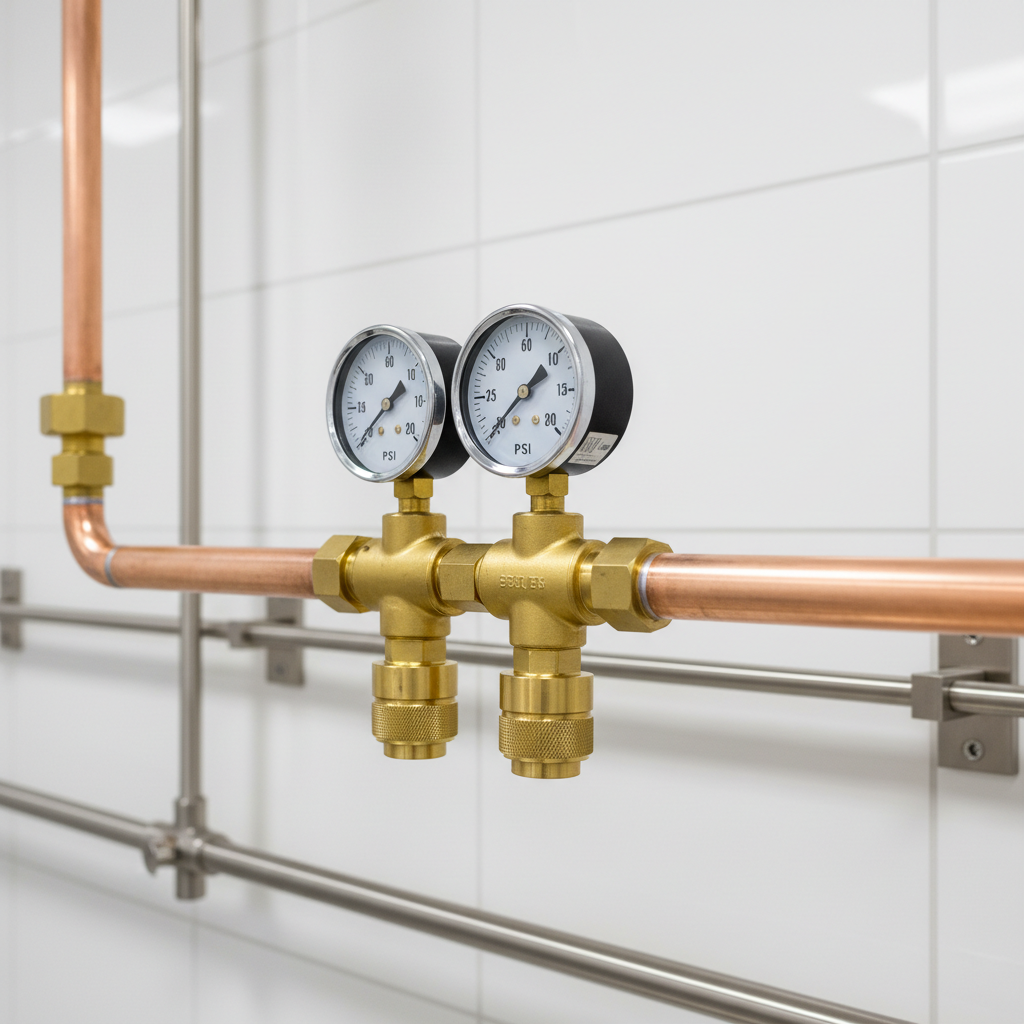
When you walk your manifold room during a routine morning inspection and hear a faint, high-pitched hiss coming from behind an automatic changeover cabinet, your first instinct is usually to check the pigtail connections. But when you hit the joint with an oxygen-approved leak detection fluid like Snoop and see no bubbling at the CGA nut, your eyes naturally move downstream to the line regulator. If the delivery gauge is creeping five to ten pounds above its 50 psig setpoint with zero flow demand downstream, you are looking at a classical seat creep failure on a high-pressure primary or secondary stage regulator.
For decades, facility engineers and biomedical technicians faced with this scenario reached for a Western Enterprises catalog. Western’s brass line regulators, medical manifold regulators, and high-flow cylinder regulators have sat inside changeover cabinets and bulk gas pads across the United States since the late twentieth century. However, supply chain shifts, product discontinuations, and extended lead times on legacy Western components have created a maintenance headache for healthcare facilities. When an operating room suite or intensive care unit relies on consistent pipeline pressure, you cannot wait six to twelve weeks for a backordered regulator rebuild kit.
The industry-standard solution is cross-referencing your aging Western hardware to Superior Products (or matching equipment from Harris and Concoa) to keep your system fully operational and compliant with current codes. At Medical Testing Solutions, our ASSE-certified technicians execute these changeovers routinely across hospitals, ambulatory surgical centers, and outpatient clinics. Swapping these units requires more than matching pipe thread sizes. It demands an understanding of CGA connection standards, venting codes, seat materials, flow coefficients ($C_v$), and verification requirements.
Identifying Western Enterprises Regulators in Medical Gas Service
Before sourcing a replacement, you have to determine exactly what you have bolted to your manifold header or wall bracket. Western Enterprises manufactured several distinct lines of pressure-reducing devices for medical gas distribution. The most ubiquitous units found in piped healthcare systems are the M1 series manifold regulators, the HP series high-pressure cylinder regulators, and the Western MedTech series compact line regulators.
Most legacy Western units feature a forged brass body with stampings on the perimeter or bottom boss. Look closely for a model designation such as M1-540-FG (denoting a manifold regulator with a CGA 540 oxygen inlet and a delivery gauge) or an RP series part number. You will also find stamped date codes and maximum inlet pressure ratings, typically 3,000 psig for cylinder manifold service or 400 psig for secondary station regulators.
The failure points on these older Western regulators follow predictable patterns:
- Elastomeric Diaphragm Fatigue: Over years of pressure cycles and cold adiabatic expansions during high-draw periods, neoprene and Buna-N diaphragms stiffen, micro-crack, and vent process gas out of the atmospheric relief hole.
- Seat Indentation and Creep: Particulate matter traveling down copper pigtails embeds itself into the PCTFE (Kel-F) or PTFE seat, preventing absolute shutoff when flow stops. Delivery pressure slowly climbs toward inlet pressure.
- Bonnet Ring Seizure: Brass-on-brass threads on unmaintained bonnets corrode or gall, preventing technicians from recalibrating delivery pressure during annual verifications.
- Friction Pin and Spring Corrosion: Moisture from ambient air entering the vented spring housing causes galvanic reaction between steel springs and internal brass guides.
If your diagnostic tests confirm internal seat leakage or external bonnet venting, field rebuilds are rarely cost-effective or advisable. Installing a complete modern regulator from an established manufacturer like Superior Products delivers fresh warranties, modern cleaning certifications, and guaranteed compliance.
Direct Cross-Reference Guide: Western Enterprises to Superior Products
Superior Products has emerged as the premier direct replacement brand for legacy Western gas-handling infrastructure. Manufactured with high-purity medical gas protocols and standard CGA configurations, Superior regulators match or exceed the flow coefficients ($C_v$) and pressure stabilization curves of the original Western units.
When replacing these components, physical envelope dimensions matter. Automatic manifolds have restricted cabinet space. If the replacement regulator’s center-to-face dimensions differ by more than a quarter-inch, you risk placing severe mechanical stress on rigid copper headers.
| Service Application | Gas Service & CGA | Legacy Western Part Number | Direct Superior Replacement | Delivery Pressure Range | Inlet Rating |
|---|
| High-Pressure Oxygen Manifold | Oxygen (CGA 540) | M1-540-HG / WM-540 | Superior M1-540-125 | 0–125 psig | 3,000 psig |
| Nitrous Oxide Manifold Line | Nitrous Oxide (CGA 326) | M1-326-HG / WM-326 | Superior M1-326-125 | 0–125 psig | 3,000 psig |
| Medical Air High-Flow Header | Medical Air (CGA 346) | M1-346-HG / WM-346 | Superior M1-346-125 | 0–125 psig | 3,000 psig |
| Carbon Dioxide Manifold | Carbon Dioxide (CGA 320) | M1-320-HG / WM-320 | Superior M1-320-125 | 0–125 psig | 3,000 psig |
| Nitrogen High-Pressure Driving Gas | Nitrogen (CGA 580) | M1-580-HG / WM-580 | Superior M1-580-225 | 0–225 psig | 3,000 psig |
| Pipeline In-Line Intermediate Dual | Medical Gases (1/2" NPT) | RP-3-2 / RP-Series | Superior SR4-Series | 30–80 psig | 400 psig |
| High-Flow Emergency Supply (EOSC) | Oxygen (CGA 540 / 1" NPT) | M1-540-XF | Superior HFR-540 Series | 40–100 psig | 3,000 psig |
When crossing over nitrogen drive gas regulators for surgical tools, remember that delivery pressure requirements differ substantially from life-support gases. While standard medical pipeline gases operate at 50 to 55 psig, surgical nitrogen systems operate at 160 to 185 psig. Ensure your Superior replacement model number ends with the high-pressure spring designation (typically -225 rather than -125).
If you are maintaining gas mixing systems or central lines that feed outpatient suites, consult our dental flowmeter repair and calibration services to make sure downstream equipment pressures harmonize with manufacturer tolerances.
Critical Technical Differences: Flow Rates, Droop, and Construction
Swapping a Western Enterprises regulator for a Superior unit is not simply a plumbing task. You need to evaluate the fluid dynamics of the gas supply. Regulators do not deliver a fixed pressure under dynamic conditions; as downstream demand surges, delivery pressure falls. This drop is called "droop."
Legacy Western M1 regulators utilized a classic large-diaphragm, single-stage design. While robust, they exhibited noticeable droop when demand jumped, such as when several high-flow ventilators or surgical suction units initiated simultaneously. Superior Products addresses this by utilizing balanced stem or optimized orifice geometries that maintain tighter setpoint bands across wild swings in demand.
Material construction also requires close inspection:
- Diaphragm Substrates: Older Western units relied heavily on reinforced neoprene. Modern Superior replacements feature 302/316 stainless steel or fabric-reinforced Viton diaphragms. Stainless steel eliminates the risk of elastomeric gas outgassing and offers impervious protection against diaphragm rupture in aggressive cycles.
- Seat Compounds: Where Western historically employed Kel-F or hard Teflon seats, modern replacements leverage specialized PCTFE or Vespel configurations specifically passivated for high-pressure adiabatic oxygen compression.
- Porting Layouts: Standard Western M1 series typically featured four or five ports (one high-pressure inlet, one low-pressure delivery, one gauge port per side, and an auxiliary relief port). Superior regulators match this multi-port architecture, allowing you to mount your pressure relief valves and monitoring sensors without fabricating new manifold tees.
- Cleaning Protocols: Any replacement regulator installed in an oxygen or nitrous oxide stream must arrive cleaned and bagged in strict accordance with CGA G-4.1 (Cleaning Equipment for Oxygen Service). Never install an industrial-grade brass regulator into a patient gas pipeline, even if the CGA numbers match.
Why this matters for compliance: NFPA 99 (2024 edition), Section 5.1.3.5.4 strictly mandates that all central supply system components, including regulators, relief valves, and piping in oxygen service, must be cleaned for oxygen service per CGA G-4.1 prior to installation. Installing an off-the-shelf industrial regulator introduces hydrocarbons into an oxidizer environment, creating a severe fire and explosion hazard.
Regulatory Standards: NFPA 99 and ASSE Compliance for Regulator Retrofits
Healthcare facility managers sometimes make the mistake of treating a manifold regulator replacement like a standard mechanical room repair. Under the life-safety umbrella, a medical gas regulator is a vital component of a Category 1 or Category 2 piped distribution network. Every phase of the replacement process falls under strict jurisdictional oversight.
Under NFPA 99 Health Care Facilities Code, manifold systems must include duplex (dual) line pressure regulators to ensure that gas delivery continues uninterrupted if one regulator fails or requires servicing. Section 5.1.3.5.11 requires that central supply systems have isolation valves upstream and downstream of each regulator, paired with check valves or three-way diverter valves to prevent backfeeding during maintenance.
Furthermore, credentialing standards are clear:
- ASSE 6010 Installer Qualification: Anyone breaking into the medical gas pipeline to remove or install a threaded or brazed regulator must hold an active ASSE 6010 Medical Gas Systems Installer certification. Routine maintenance personnel lacking this certification cannot legally perform invasive piping alterations on Category 1 systems.
- ASSE 6030 Third-Party Verification: NFPA 99 Section 5.1.12.1.1 dictates that whenever an operational component of a central supply system is breached, replaced, or repaired, the system must undergo inspection, pressure testing, and gas concentration verification by an ASSE 6030 certified verifier prior to being put back into patient service.
To review these credentialing mandates and ensure your facility stays protected during mechanical changeovers, explore our specialized medical gas installation and medical gas verification services. Medical Testing Solutions maintains a deep bench of dual-certified field specialists who handle both the mechanical retrofit and the mandatory third-party paperwork on the same deployment.
Step-by-Step Replacement Protocol for Central Supply Regulators
Replacing a Western regulator requires strict adherence to system depressurization, particulate containment, and controlled restoration. Never rush a regulator swap on an active manifold.
1. Preparation, Permitting, and Redundancy Verification
Before turning any handle, confirm that your facility’s medical gas reserve system is fully online. If your manifold uses an automatic bank changeover, lock out the primary bank and ensure the secondary bank is carrying the building load with steady delivery pressure. Notify clinical engineering and nursing leadership about the maintenance window. Pull necessary hot-work or mechanical permits per your facility's safety manual.
2. Isolation and Zero-Energy Depressurization
Close the upstream isolation ball valve feeding the target Western regulator. Close the downstream regulator shutoff valve. Slowly crack the test port or bleed valve between the regulator and the upstream shutoff to vent trapped high-pressure gas to atmosphere. Observe both the high-pressure and low-pressure gauges on the regulator body until both needles rest firmly on the zero pins.
3. Disconnection and De-Mounting
Using clean, oil-free mechanics' tools, back out the union nuts or threaded NPT pipe nipples securing the Western regulator to the header. Never strike the regulator body with a steel hammer to loosen stubborn joints. If the unit uses threaded connections, inspect the mating female threads on the copper manifold headers for galling, deformation, or residual thread sealant.
4. Preparation of the Replacement Superior Regulator
Unpack the Superior Products regulator in a clean, dust-free environment. Check the manufacturer's label to confirm it has been cleaned and bagged per CGA G-4.1. Verify that the flow direction arrow on the new regulator matches the pipeline stream. Apply an oxygen-compatible, PTFE-based paste or approved thread tape (certified to ASTM D5204 and free of petroleum distillates) to the male NPT threads only, leaving the first two threads bare to prevent thread sealant fragments from migrating into the downstream regulator seat.
5. Mounting and Torquing
Thread the new Superior regulator into the header unions by hand to prevent cross-threading. Tighten the fittings using smooth-jawed pipe wrenches or open-end brass wrenches. Align the delivery and supply gauges so they face directly outward, easily legible to operators standing outside the cabinet perimeter. Re-mount any structural support brackets to isolate the regulator body from vibrational stress.
6. Pressure Testing and Atmospheric Leak Checks
With the downstream isolation valve closed, slowly open the upstream isolation valve to introduce supply pressure to the newly installed regulator. Adjust the bonnet pressure screw until the delivery gauge reads the required operating pressure (typically 50 to 55 psig for standard gases). Apply oxygen-approved leak test solution around all threaded ports, gauge fittings, bonnet seams, and upstream unions. Maintain static pressure for at least 15 minutes, verifying zero pressure decay on an uncalibrated test gauge.
If your facility is approaching its accreditation survey window, you can combine this equipment replacement with our comprehensive annual medical gas inspections to certify the entire pipeline from source to terminal outlet.
Troubleshooting Post-Installation Anomalies
Even a brand-new Superior Products regulator can exhibit irregular behavior if header lines contain contamination or if dynamic system conditions fight the setpoint. Knowing how to diagnose post-installation issues saves hours of downtime.
Pressure Creep on New Assemblies
If your newly installed Superior regulator shows climbing delivery pressure during static (no-flow) conditions, do not assume the new unit has a factory defect. Over 90 percent of immediate seat failures on fresh installations stem from particulate contamination.
When you depressurize an old copper header to remove a Western regulator, microscopic copper shavings, crystallized pipe sealant, or oxidation flakes break loose from the inner pipe walls. The moment you introduce 2,000 psig of tank pressure, that debris accelerates down the pipe and lodges directly into the new regulator’s virgin PCTFE seat. To prevent this, always crack the upstream valve for a microsecond to blast the header clear of debris before threading on the new regulator.
Excessive Delivery Droop Under Load
If the pipeline pressure plunges from 52 psig to 41 psig the moment an OR suite fires up an arthroscopic shaver or surgical drive system, the regulator is undersized or improperly adjusted. Ensure that the internal seat orifice matches the maximum expected peak demand of your facility as calculated under NFPA 99 sizing matrices. Also check the cylinder pigtail check valves; a stuck internal check valve restricts volume before the gas ever hits the regulator inlet, mimicking a failing regulator diaphragm.
Loud Chattering, Buzzing, or Acoustic Resonance
A rapid hammering or acoustic hum emanating from the regulator body during steady flow indicates aerodynamic flutter. This occurs when the mass flow rate matches the natural resonant frequency of the internal range spring and diaphragm assembly.
To resolve resonance issues:
- Adjust the delivery pressure slightly up or down (within allowable clinical limits, such as shifting from 50 psig to 53 psig) to move the spring off its harmonic point.
- Check that the upstream header is anchored firmly; loose unistrut brackets amplify acoustic resonance down copper tubing.
- Confirm that downstream check valves are not chattering in tandem, which creates hydraulic shockwaves back against the regulator seat.
- Ensure that the internal relief valve is not cracked open and weeping continuously into the vent line.
If pipeline irregularities persist across your system, enrolling in structured medical gas maintenance services guarantees that your mechanical plant undergoes routine diagnostic tuning by technicians equipped with calibrated flow meters and digital transducers.
Essential Auxiliary Hardware: Gauges, Relief Valves, and Vents
A regulator does not operate in isolation. When executing a Western Enterprises regulator replacement, you must assess the auxiliary components attached to its body. Reusing worn accessories on a brand-new regulator undermines the reliability of the entire installation.
Pressure Relief Valves
NFPA 99 Section 5.1.3.5.6 requires pressure relief valves downstream of every regulator set at not more than 50 percent above normal line pressure (e.g., set at 75 psig for a 50 psig system). If your legacy Western regulator had an integral relief valve or a relief valve threaded into an auxiliary low-pressure port, replace it. Relief valves have internal elastomeric seals that degrade over time. Sourcing a fresh Superior or RegO ASME-stamped, brass-bodied relief valve ensures your secondary safety stage will lift if the main seat ever catastrophically fails.
Pressure Gauges
Never thread old, uncalibrated Western gauges into a new regulator body. Mechanical bourdon-tube gauges suffer from metal fatigue and lost calibration after years of steady exposure to line pressure. Install new, clean-for-oxygen-service gauges featuring shatter-resistant lenses, safety blow-out backs, and bold dual-scale (psig/kPa) dials. If the gauge cannot be verified against a certified digital master gauge, it has no place on a Category 1 life-support supply system.
Venting Lines to the Outdoors
NFPA 99 dictates that relief valves for non-flammable, non-hazardous gases (like Medical Air) may vent into the mechanical room under specific cubic-foot air exchange conditions, but oxidizers like Oxygen and Nitrous Oxide, or asphyxiants like Nitrogen and Carbon Dioxide, require dedicated discharge lines routed outdoors.
When mounting your replacement Superior regulator, examine the atmospheric vent port on the bonnet. If you are replacing a regulator inside an enclosed cabinet or hazardous gas room, ensure the bonnet vent port connects directly to an approved outdoor vent line without restrictive reduction in line diameter. Never manifold relief valve lines together in a way that allows the discharge of one bank to back-pressurize the bonnet of another.
For broader facility safety evaluations spanning source gas purity and operational environmental conditions, consult our environmental monitoring solutions to ensure your mechanical rooms maintain proper exhaust exchange rates and air turnover.
Proactive Sourcing and Lifecycle Management
Component obsolescence is a structural reality in modern healthcare facility management. Western Enterprises built exceptional products, but as manufacturing portfolios consolidate, maintaining single-source legacy equipment becomes a regulatory liability during audits by The Joint Commission, CMS, or local authorities having jurisdiction (AHJ).
Take proactive inventory of your medical gas rooms today. Document every Western regulator part number on your bulk pads, emergency oxygen supply connections (EOSC), micro-bulk reserve headers, and high-pressure manifold cabinets. Identify aging units approaching ten years of continuous service, and establish direct crossover relationships to Superior Products before an unscheduled failure forces an emergency shutdown.
Medical Testing Solutions stocks an extensive inventory of certified medical gas regulators, manifold components, valves, and gauges. Whether you need drop-in replacement parts shipped directly to your facility or require turnkey, ASSE-certified installation and verification teams on-site, our specialists provide the technical expertise necessary to keep your medical gas infrastructure safe, compliant, and operating without disruption.
Contact Medical Testing Solutions today at (754) 315-1078 or submit a request online to get a quote on replacement regulators or to schedule an ASSE-certified inspection for your central supply systems.