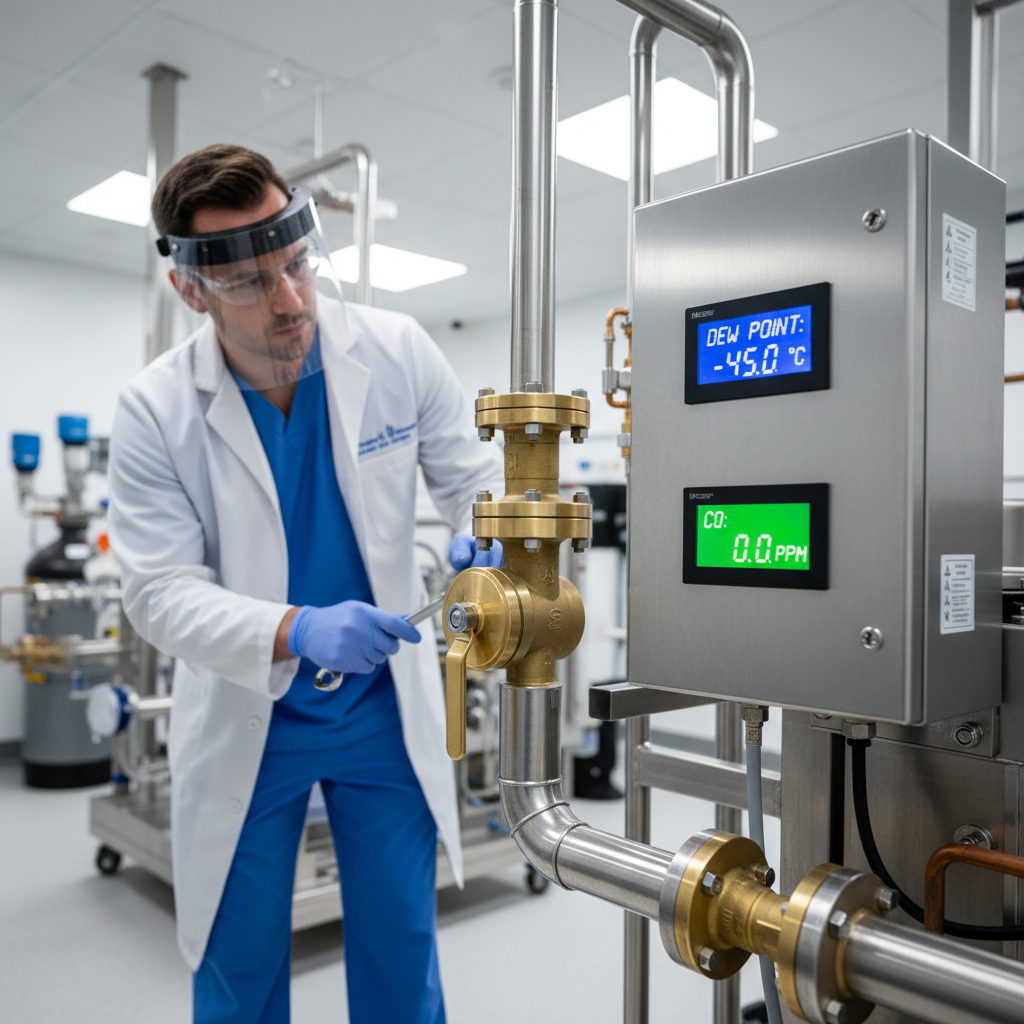
When a nurse pulls the Emergency Shutoff Valve box door in an intensive care unit corridor during a mock fire drill and the quarter-turn ball valve will not budge, you have a severe operational liability on your hands. Valves that sit untouched in static positions for five or ten years frequently suffer from PTFE seat cold-flow, stem packing seizure, or internal particulate buildup. In high-humidity Gulf Coast environments, exterior actuator mechanisms and non-stainless trim components also face accelerated oxidation if mechanical rooms lack strict climate control. Addressing medical gas maintenance Mobile AL healthcare engineers encounter requires disciplined, code-driven execution rather than waiting for an alarm panel to annunciate a pressure drop.
Under NFPA 99, Health Care Facilities Code, hospital pipeline networks and central supply rooms are life safety utilities that demand documented preventive maintenance programs. Your facility cannot treat medical gas piping like domestic cold water infrastructure. Every compressor stroke, vacuum pump cycle, manifold switchover, and zone valve seal requires scheduled attention by credentialed personnel to ensure uninterrupted delivery at the patient bedside.
What ASSE 6040 Requires for Facility Maintenance Personnel
Chapter 5 of NFPA 99 (specifically Section 5.1.14 and 5.1.15 in recent editions) requires healthcare facilities to establish a formal maintenance program for all piped medical gas and vacuum systems. More importantly, NFPA 99 mandates that anyone performing preventive maintenance, repair, or component replacement on these systems holds formal qualification under the ASSE 6000 Professional Qualifications Standard.
Specifically, the ASSE 6040 Medical Gas Systems Maintenance Personnel credential establishes the baseline competency for technicians working on active clinical pipelines. While an ASSE 6010 installer builds new pipelines and an ASSE 6030 verifier performs third-party commissioning tests, an ASSE 6040 specialist focuses on keeping live systems operating within design tolerances without contaminating the gas stream or dropping line pressure to critical care areas.
An uncertified physical plant mechanic who attempts to rebuild a medical air compressor unloader valve or replace a leaking DISS oxygen wall outlet using standard plumbing lubricants introduces immediate catastrophic risk. Hydrocarbon greases in an oxygen-enriched environment rated at 50 to 55 psi can cause adiabatic compression ignition. ASSE 6040 maintenance protocols ensure technicians use only oxygen-clean components cleaned for oxygen service in accordance with CGA G-4.1 and maintain positive pipeline hygiene throughout every maintenance evolution.
Why this matters for compliance: During surveys conducted by The Joint Commission, DNV, or the Alabama Department of Public Health (ADPH), surveyors routinely cross-reference your medical gas maintenance logs against technician credential files. If your preventive maintenance records lack current ASSE 6040 certification numbers for the individuals turning the wrenches, your facility faces direct citations under CMS Conditions of Participation for physical environment safety.
Preventive Valve Cycling Protocols Across the Pipeline
Shutoff valves are the primary defensive boundaries during a clinical fire, pipeline rupture, or remodeling project. If a valve fails to close, or closes only 85 percent of the way and allows high-pressure oxygen to leak past the seat, staff cannot isolate a hazard. Conversely, if a valve stem shears while being reopened, an entire patient wing loses life support gas.
A structured valve exercising and inspection regimen prevents stem seizure and identifies internal seat bypass before an emergency occurs. However, cycling valves in an active hospital requires meticulous coordination between facility engineering and clinical leadership.
Source Valves and Main Line Valves
Source valves sit immediately downstream of your bulk oxygen pad, manifold room, medical air compressor package, and medical vacuum skid. Main line valves isolate the primary riser or distribution trunk entering the building. Because cycling these valves cuts off supply to the entire hospital or massive structural wings, you cannot simply close them on a Tuesday morning.
During routine quarterly and annual inspections, ASSE 6040 technicians inspect source and main valves for external stem leaks, proper labeling, handle integrity, and physical clearance. Actual mechanical exercising of source and main valves must be scheduled during planned maintenance windows, typically in coordination with temporary back-feeding setups or dual-path bypass valving, so clinical pressure never dips below minimum alarm thresholds.
If your engineering team needs qualified support to audit valves, rebuild central supply machinery, or establish compliant schedules, explore our medical gas maintenance services to keep your plant survey-ready.
Riser, Service, and Zone Valve Boxes
Zone valve boxes sit in patient corridors directly outside the rooms they control. While you cannot shut off oxygen to a ventilated patient in an occupied ICU bay just to exercise a ball valve, maintenance teams must coordinate with nursing directors during unit cleans, census shifts, or scheduled wing closures to cycle zone valves through a full 90-degree travel arc.
During a valve maintenance check, the technician verifies several physical parameters:
- Smooth mechanical torque: The handle must rotate cleanly from fully open to fully closed without excessive mechanical binding or grinding.
- Gauge integrity and accuracy: Pressure and vacuum gauges integrated into zone valve boxes must read accurately within normal operating ranges (50–55 psi for positive pressure gases, 190–200 psi for nitrogen/instrument air, and 15–29 inHg for medical vacuum).
- Tubing and purge port tightness: Compression fittings and gauge ports inside the rough-in box are leak-tested with oxygen-compatible leak detection solution.
- Window and pull-ring accessibility: The removable frangible cover or pull-ring door latch must operate smoothly without catching on drywall trim or aftermarket wall guards.
- Updated room labeling: Room numbers listed on the valve label must exactly match current architectural door signage following any unit renumbering.
Source Equipment Maintenance in Gulf Coast Climates
Operating central supply equipment in coastal Alabama presents distinct environmental challenges compared to arid inland regions. High ambient humidity and warm summer intake temperatures directly impact the workload and wear intervals of medical air compressors and vacuum systems. When facilities across the state, from major academic centers like UAB Medicine and Huntsville Hospital Health System to regional acute care hospitals along Mobile Bay, manage their mechanical rooms, ambient moisture is the primary adversary.
Medical Air Compressors and Dryer Packages
Medical air compressors (typically oil-less reciprocating, claw, or scroll configurations per NFPA 99 Section 5.1.3.6) draw ambient outdoor air, compress it, and pass it through desiccant or refrigerated dryers to hold the pipeline dew point below +32°F (0°C) at 50–55 psi gauge pressure. When Gulf Coast summer humidity saturates the intake stream, condensate traps and dryer purge valves work overtime.
If an automatic float drain or electronic solenoid drain sticks closed on the receiver tank or aftercooler, liquid water pushes directly into the desiccant towers. Once liquid water floods activated alumina desiccant beads, the desiccant fractures into fine white powder, losing its adsorption capacity and sending high-moisture air, and particulate dust, straight toward the pipeline filters and dew point sensor.
Routine ASSE 6040 source maintenance prevents this cascade by focusing on five critical checkpoints:
- Condensate drain actuation: Manually testing and cleaning automatic receiver drains and moisture separators every check cycle.
- Desiccant dryer switching and purge rates: Verifying tower regeneration cycles, replacing muffler elements, and recalibrating dew point hygrometers against NIST-traceable reference standards.
- Carbon monoxide (CO) monitor calibration: Challenging the local CO monitor with certified span gas (typically 10–20 ppm CO balance air) and zero gas to ensure it alarms accurately at 10 ppm per NFPA 99.
- Intake filtration and belt tension: Replacing micron intake elements before pressure drop overheats the compressor heads, and checking V-belt tension and alignment.
- Alternator and lag pump cut-in: Dropping system pressure under controlled conditions to verify the lag compressor automatically starts and the local lag-in-use alarm activates on the master alarm panel.
Medical Vacuum Pumps and Bacterial Filtration
Medical surgical vacuum pumps (lubricated rotary vane, dry claw, or liquid ring) ingest biohazardous aerosols, residual fluid vapor, and cellular debris from patient suction canisters. NFPA 99 requires duplex or triplex pump configurations sized to handle 100 percent of peak calculated demand with the largest single unit out of service.
Preventive maintenance on vacuum skids prioritizes exhaust filtration, bacterial trap hygiene, and check valve seating. If a pump discharge check valve wears out and fails to seat when the pump cycles off, vacuum draws backward through the idle pump, causing it to spin in reverse and forcing pump oil or atmospheric air into the receiver tank. Technicians regularly inspect bacterial filter differential pressure gauges, drain liquid collection flasks using biohazard protocols, change synthetic hydrocarbon or PFPE oils at manufacturer-specified run-hour intervals, and test exhaust line drains for blockages.
Manifold Rooms and Bulk Cryogenic Systems
High-pressure cylinder manifolds for nitrous oxide, carbon dioxide, nitrogen, and reserve oxygen rely on automatic changeover regulators and pneumatic or electronic pressure switches. Over time, regulator diaphragms fatigue and high-pressure pigtail check valves develop micro-leaks.
During scheduled maintenance, technicians soap-test every high-pressure CGA connection and pigtail assembly, verify heater elements on nitrous oxide and carbon dioxide headers (which prevent regulator freeze-up during high-draw surgery schedules), and simulate a primary bank depletion. Simulating bank depletion confirms the secondary reserve bank seamlessly picks up the building load at the proper pressure differential and triggers the "Reserve in Use" signal at both the master alarm Panels.
Recommended Preventive Maintenance Schedule by Component
While NFPA 99 instructs facilities to follow manufacturer specifications alongside risk-based schedules derived from their Maintenance Management Program, industry best practices follow structured quarterly, semi-annual, and annual intervals. The table below outlines standard ASSE 6040 maintenance tasks and their corresponding code references.
| System Component | Primary Maintenance Task | Recommended Interval | Applicable Standard / Reference |
|---|
| Medical Air Compressor Package | Test condensate drains; calibrate CO & dew point monitors; check lag cut-in; inspect intake filters | Quarterly & Semi-Annual | NFPA 99 Sec. 5.1.3.6 / ASSE 6040 |
| Desiccant Air Dryers | Inspect purge mufflers; verify regeneration cycle; check final line filter differential pressure | Quarterly (Media every 2–3 yrs) | NFPA 99 Sec. 5.1.3.6.1 |
| Medical Vacuum Skid | Check oil levels/condition; inspect bacterial filter DP; test pump alternation & check valves | Quarterly & Semi-Annual | NFPA 99 Sec. 5.1.3.7 |
| Cylinder Manifolds | Leak-test pigtails and check valves; simulate bank changeover; verify Master Alarm signal | Semi-Annual & Annual | NFPA 99 Sec. 5.1.3.5 |
| Zone Valve Boxes | Inspect gauge accuracy; verify corridor access & room labeling; exercise ball valve when clinical census permits | Annual Inspection (Cycle per downtime schedule) | NFPA 99 Sec. 5.1.4 / 5.1.14 |
| Patient Terminal Outlets / Inlets | Measure mechanical push/pull retention force; check dynamic flow rate & pressure drop; replace worn O-rings | Annual | NFPA 99 Sec. 5.1.5 / 5.1.14 |
| Master & Area Alarms | Test transducer calibration; verify audible/visual actuation; inspect backup power integration | Annual | NFPA 99 Sec. 5.1.9 |
Coordinating Maintenance, Repairs, and ASSE 6030 Verification
A common compliance failure in hospital plant management occurs when routine maintenance crosses the line into system modification or major breach repair without triggering appropriate recertification. Understanding the boundary between ASSE 6040 maintenance and ASSE 6030 verification keeps your facility out of regulatory trouble.
Under NFPA 99, routine replacement of expendable wear parts, such as replacing a poppet or O-ring inside a patient wall outlet where the rough-in body remains untouched, changing compressor intake filters, or swapping out a pressure gauge on a zone valve box, falls within the scope of an ASSE 6040 maintenance technician conducting functional checks.
However, whenever the pipeline is breached for new tie-ins, zone valve replacements, compressor skid swaps, or manifold replacements, the work requires ASSE 6010 medical gas installation procedures (including nitrogen-purged silver brazing per Section 5.1.10) followed by independent third-party ASSE 6030 medical gas verification before clinical staff put the system back on patient load.
Medical Testing Solutions bridges this operational gap by providing both genuine replacement parts through our medical gas equipment catalog and certified field specialists. Whether you need routine annual medical gas inspections to satisfy accreditation surveyors or full medical gas certification following a mechanical room upgrade, having a single qualified partner eliminates finger-pointing between mechanical contractors and facility compliance officers.
How Medical Testing Solutions Supports Alabama Healthcare Facilities
Headquartered in Fort Lauderdale, Florida, Medical Testing Solutions coordinates scheduled regional service routes across the Southeast, including comprehensive coverage throughout Alabama. Because preventive maintenance and annual testing are predictable calendar events, our scheduling team consolidates regional site visits for hospitals, ambulatory surgery centers, and specialty clinics around Mobile Bay and statewide to minimize mobilization overhead while delivering national-level technical rigor.
When our ASSE-certified technicians arrive at your facility, we do not just walk down halls checking boxes on a clipboard. We actively repair leaking terminal outlets on the spot, calibrate dew point and carbon monoxide monitors with certified reference gases, verify master and area alarm setpoints, and deliver digital, binder-ready compliance reports mapped directly to NFPA 99 paragraphs.
If your facility needs to establish a defensible valve cycling program, catch up on overdue source equipment service, or schedule an upcoming annual compliance audit, request a quote online or call Medical Testing Solutions directly at (754) 315-1078 to coordinate your next service window.