Skip to content
    New: Medical Gas Outlet Retrofit & Rebuild Matrix — cross-reference legacy Chemetron, Ohio Diamond, Puritan-Bennett & more →
    ASSE Certified 24/7
    Medical Gas Service
    Compliance & Standards
    Veterinary

    Veterinary Medical Gas Installation in Winston-Salem NC: A Complete Guide

    Medical Testing SolutionsAugust 23, 20268 min read
    Share
    Veterinary Medical Gas Installation in Winston-Salem NC: A Complete Guide

    Veterinary Medical Gas Installation in Winston-Salem, NC: A Complete Guide for Modern Clinics

    Properly installed medical gas systems are the lifeblood of a modern veterinary surgical suite. For clinic owners and facility managers in Winston-Salem, ensuring these systems are safe, reliable, and compliant isn't just good practice, it's a requirement for patient and staff safety. An improperly designed or installed system can lead to catastrophic failures, compromising patient outcomes and putting your staff at risk. This guide provides a comprehensive overview of the components, codes, and processes involved in a compliant veterinary medical gas installation, from initial design to final verification.

    You will learn the critical requirements for installing oxygen, nitrous oxide, medical air, vacuum, and waste anesthetic gas disposal (WAGD) systems. We'll explore the specific codes from the National Fire Protection Association (NFPA) and the American Society of Sanitary Engineering (ASSE) that apply to veterinary facilities, and outline the steps for a successful installation and verification process.

    Key Components of a Veterinary Medical Gas System

    A compliant veterinary medical gas system is more than just pipes and outlets. It's an integrated network of sources, distribution pipelines, and terminal units, each with a specific function. Understanding these components is the first step in planning your installation.

    1. Gas Sources

    • Oxygen (O2): Typically supplied via high-pressure cylinders (H-tanks) or a bulk cryogenic liquid vessel. For most veterinary clinics, a manifold of H-tanks is common. The system must have a primary supply and a secondary reserve, with an automatic switchover manifold to ensure an uninterrupted supply, as specified by NFPA 99.
    • Nitrous Oxide (N2O): Similar to oxygen, N2O is supplied in high-pressure cylinders and managed through a manifold system.
    • Medical Air: While less common in veterinary-only facilities compared to human hospitals, medical air for driving surgical tools may be required. This is supplied by a dedicated air compressor system with specialized filters and dryers to ensure purity.

    2. Distribution System

    • Piping: All medical gas pipelines must be constructed from seamless, medical-grade copper (Type K or L), cleaned for oxygen service, and brazed by a qualified ASSE 6010 Certified installer. Brazing, not soldering, is required to withstand the high pressures and prevent the introduction of contaminants.
    • Valves: Zone valves are installed to isolate specific areas of the clinic (e.g., a single operating room) for maintenance or emergencies without shutting down the entire facility.
    • Alarms: Master and area alarms are critical safety components. They provide audible and visual alerts for changes in line pressure, an essential requirement under NFPA 99. Medical Testing Solutions can help you select and install the right alarm system for your clinic's needs.

    3. Terminal & User Equipment

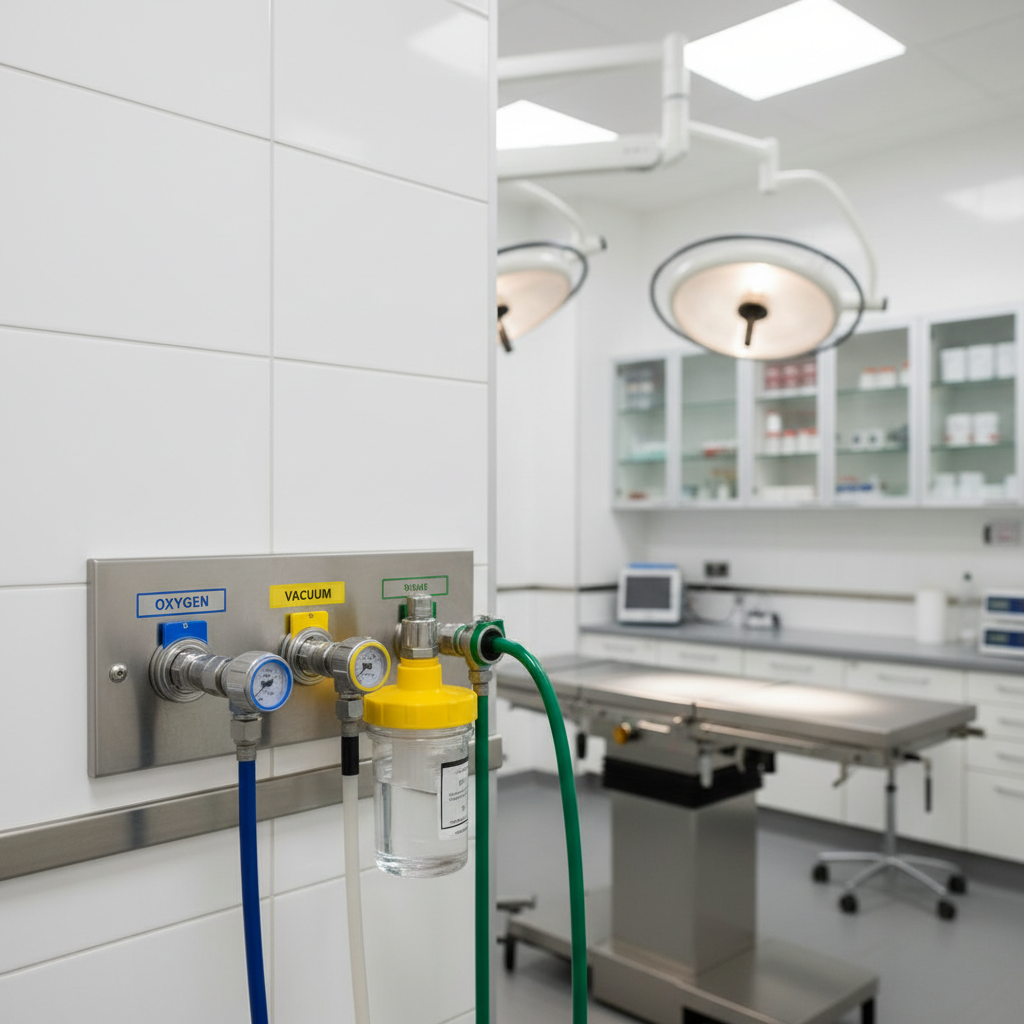
    • Outlets: Station outlets are gas-specific, using a unique pin-indexing system (DISS) to prevent accidental cross-connection of gases.
    • Scavenging Systems (WAGD): A dedicated Waste Anesthetic Gas Disposal system is essential for removing waste gases like nitrous oxide and halogenated agents from the surgical suite, protecting your staff from chronic exposure.
    • Vacuum Systems: A medical/surgical vacuum system, powered by dedicated pumps, is used for suction during procedures.

    Why this matters for compliance: NFPA 99 outlines strict requirements for the separation and design of medical gas and vacuum systems. For instance, the vacuum pump's exhaust must be vented outdoors, away from public areas and fresh air intakes, to prevent recirculation of potentially contaminated air.

    Navigating Codes and Standards: NFPA 99 & ASSE 6000

    Compliance is non-negotiable. The two primary sets of standards governing your installation are NFPA 99 (Health Care Facilities Code) and the ASSE 6000 series for personnel certification. While many associate these with human hospitals, they are the established benchmark for veterinary facilities aiming for the highest standard of care and safety.

    NFPA 99 Requirements for Veterinary Facilities

    As of the 2012 edition, NFPA 99 officially includes a dedicated chapter (Chapter 15) for veterinary facilities. The code categorizes systems based on a risk assessment. For a facility using anesthetic gases, the systems are almost always Category 1, meaning their failure is likely to cause major injury or death to patients or staff.

    Key NFPA 99 mandates include:

    • System Verification: A new or modified system cannot be used until it has been rigorously tested by an ASSE 6030 Certified verifier. This is a crucial final step after installation is complete.
    • Brazing & Purging: All joints must be brazed with a continuous nitrogen purge to prevent internal oxidation, which could otherwise introduce harmful particulates into the gas stream.
    • Labeling: All pipes, valves, and outlets must be clearly and correctly labeled with the gas name and direction of flow.

    ASSE 6000 Series: The Mark of a Qualified Technician

    The American Society of Sanitary Engineering (ASSE) provides the national standard for certifying the individuals who work on medical gas systems. For your Winston-Salem installation, you must ensure your team holds the right credentials:

    • ASSE 6010 Certified Installer: The credential required to physically install the pipeline system.
    • ASSE 6030 Certified Verifier: The credential required for third-party testing and verification of the system after the 6010 installer is finished.
    • ASSE 6040 Certified Maintenance Personnel: The credential for ongoing service and repairs.

    Medical Testing Solutions employs ASSE Certified professionals across these disciplines, ensuring a seamless and compliant process from start to finish.

    Medical Gas System Installation & Verification Process

    Here’s a step-by-step look at what to expect during your veterinary clinic's medical gas installation project.

    1. Design & Planning: The process begins with a detailed design that maps out the source equipment, pipeline routing, and outlet locations. This plan must be developed in consultation with your veterinary team to ensure it meets your clinical workflow.
    2. Installation (by ASSE 6010 Technician):
      • Piping is run, and all joints are brazed with a nitrogen purge.
      • Manifolds, alarms, and source equipment are positioned and secured.
      • Outlets, zone valves, and gauges are installed.
    3. Third-Party Verification (by ASSE 6030 Technician): This is where a company like Medical Testing Solutions comes in to perform a battery of critical tests. The system CANNOT be used on patients until it passes verification.
      • Piping Purge & Pressure Tests: The system is pressure-tested (typically at 150 psi) to ensure it is leak-free.
      • Particulate & Purity Tests: Gas samples are taken to ensure the gas at the outlet is the same as the source and free of contaminants.
      • Cross-Connection Test: Each outlet is tested to confirm the correct gas is flowing and only that gas.
      • Alarm Testing: All master and area alarms are tested to confirm they activate at the correct pressure set-points.
    4. Documentation & Certification: Upon successful verification, the ASSE 6030 verifier provides a comprehensive report. This document is your proof of compliance and must be kept for your records and for review by regulatory authorities.

    Cost Considerations for Veterinary Gas Installation

    The cost of a medical gas installation in Winston-Salem can vary widely based on several factors. A simple system with one O2 and one WAGD outlet in a single surgical room will be significantly less expensive than a multi-room installation with oxygen, nitrous oxide, and vacuum.

    FactorDescriptionImpact on Cost
    Number of OutletsThe total quantity of gas outlets needed.High
    Gases RequiredO2 only vs. O2, N2O, Vacuum, WAGD.High
    Clinic Size & LayoutThe length of piping required and complexity of the routing.Medium
    Source EquipmentCylinder manifold vs. more complex bulk or compressor systems.Medium
    Compliance LevelAdhering strictly to NFPA 99 vs. a less formal approach (not recommended).Low (investing in compliance saves money long-term)

    While it may be tempting to cut corners to save on initial costs, the risks associated with a non-compliant system, patient safety, staff exposure, and legal liability, are far too great. Investing in a professional, ASSE-compliant installation is a long-term investment in the safety and success of your practice.

    Finding a Qualified Installer in Winston-Salem, NC

    When selecting a partner for your medical gas installation, expertise and certification are paramount. Look for a company that specializes in medical gas systems and can provide proof of ASSE certification for their technicians. Ask for references from other veterinary clinics.

    Medical Testing Solutions is a leading provider of medical gas services in the Southeast, including Winston-Salem. We offer a full suite of services, from system design and ASSE 6010 installation to annual inspections and ASSE 6030 verification. Our team of certified professionals ensures your project is completed safely, on budget, and in full compliance with NFPA and ASSE standards.

    Get Your Installation Right: Contact Us for a Quote

    A compliant, professionally installed medical gas system is a foundational element of a safe and effective veterinary practice. Don't leave this critical infrastructure to chance. If you are building a new clinic, renovating an existing space, or upgrading your systems in the Winston-Salem, NC area, our team is here to help.

    Contact the certified experts at Medical Testing Solutions today for a no-obligation consultation and quote. Call us at +1 (754) 315-1078 or request a quote online to ensure your project is done right, the first time.


    Frequently Asked Questions

    Yes, NFPA 99 is the nationally recognized standard and includes specific guidance for veterinary facilities. Adherence is considered the standard of care and is often expected by local authorities, insurance providers, and accreditation bodies like AAHA.

    Absolutely not. You must use seamless copper tubing (Type K or L) that has been specifically cleaned for oxygen service. Using standard plumbing materials can introduce dangerous contaminants and is a major code violation.

    An ASSE 6010 Installer is certified to physically build and braze the pipeline system. An ASSE 6030 Verifier is a separate, independent party certified to test and validate that the installed system is safe, pure, and functions as designed. The verification step is mandatory before the system can be used.

    After the initial verification, it is best practice to have your veterinary anesthesia equipment and medical gas systems inspected annually. This includes checking for leaks, testing alarm function, and ensuring overall system integrity.

    WAGD stands for Waste Anesthetic Gas Disposal. It's a scavenging system that actively removes waste anesthetic gases from the operating room environment. This is critical for protecting your staff from the health risks associated with long-term exposure to agents like nitrous oxide and isoflurane.

    This article is provided for educational purposes and reflects industry standards as of publication. Always verify against current NFPA 99, CGA, and AHJ requirements. Medical Testing Solutions is ASSE-certified and ready to help — contact us for facility-specific guidance.

    Request a quote for your facility

    Talk with Medical Testing Solutions about your next inspection, repair or equipment request.

    Get a quote in 1 business day

    I agree to receive text messages from Medical Testing Solutions, L.L.C. at the phone number provided, including informational and marketing messages. Consent is not a condition of purchase. Message frequency varies. Message & data rates may apply. Reply STOP to opt out or HELP for help. See our Privacy Policy and Messaging Terms.

    Prefer to talk? Call (754) 315-1078

    Related articles