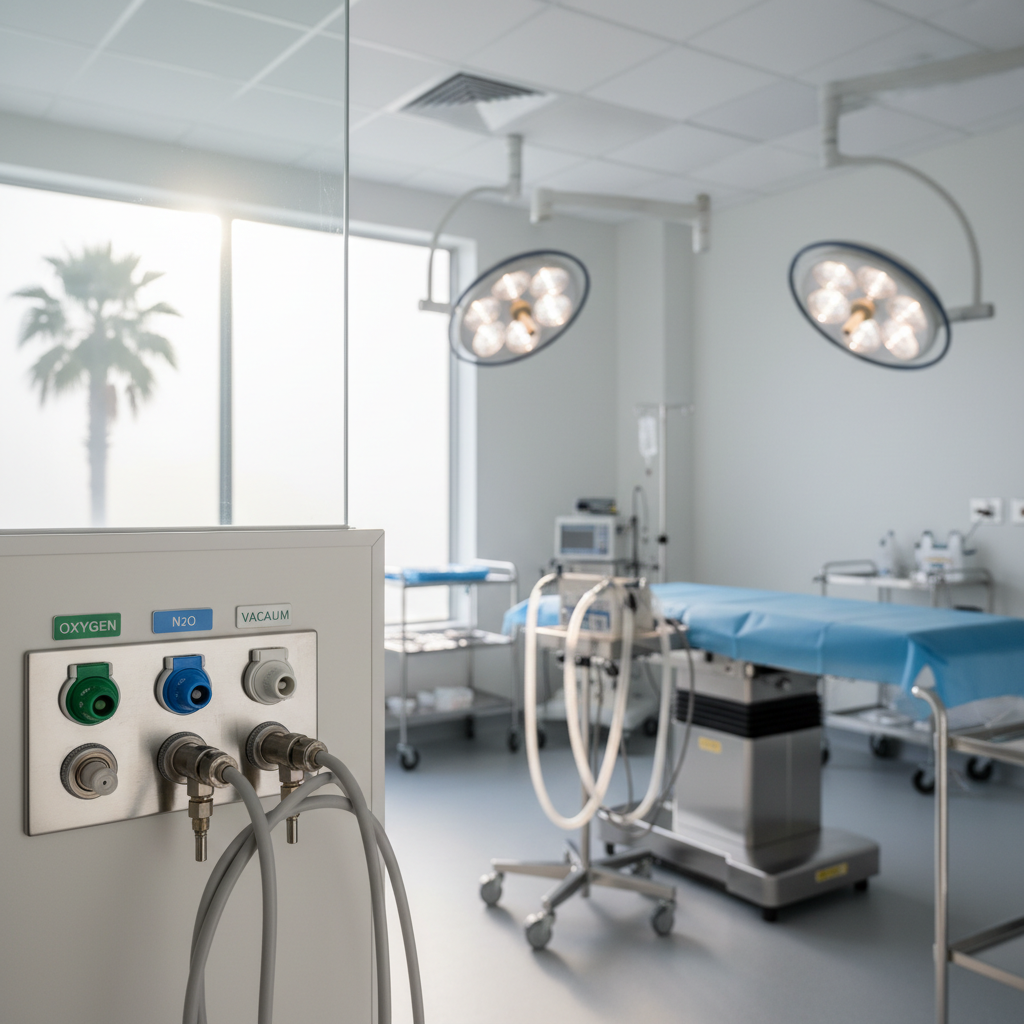
Veterinary Medical Gas Installation in Tampa, FL: An NFPA 99 Guide
Medical Testing SolutionsJune 20, 20267 min read
Share
For veterinary practices in Tampa, Florida, a properly installed medical gas system is not a luxury, it's the lifeblood of your surgical suite. It ensures patient safety during procedures and is a cornerstone of regulatory compliance. From oxygen and nitrous oxide to medical vacuum and waste gas scavenging, every component must be installed to exacting standards. An improper installation risks patient harm, staff exposure, and significant legal and financial liability.
This comprehensive guide walks you through the critical aspects of veterinary medical gas installation. You will learn about the essential system components, the step-by-step installation process guided by ASSE 6010 standards, and the unique compliance landscape in Florida, including requirements from the AHCA and what to do after a hurricane. We will cover why choosing a local, certified provider like Medical Testing Solutions is your most reliable and cost-effective option.
Why Professional Med Gas Installation is Non-Negotiable
While DIY solutions might seem tempting for cutting costs, medical gas systems are strictly regulated for a reason. The American Veterinary Medical Association (AVMA) guidelines and the National Fire Protection Association (NFPA) 99 Health Care Facilities Code provide a rigid framework for installation. Adhering to these standards is mandatory for ensuring safety and functionality.
Key reasons to insist on a certified installation include:
Patient Safety: Cross-connections, improper pipe joining, or system contamination can lead to the delivery of the wrong gas or no gas at all, with catastrophic consequences for an anesthetized animal.
Staff Safety: Leaks in anesthetic gas or scavenging systems can expose your team to hazardous waste anesthetic gases (WAGs), posing long-term health risks.
Compliance & Insurability: A non-compliant system will fail its verification inspection, putting your facility's accreditation and ability to operate at risk. In Florida, this includes satisfying the Florida Agency for Health Care Administration (AHCA).
Cost Savings with Local Experts: Medical Testing Solutions is headquartered at 501 East Las Olas Blvd, Ste 300, Fort Lauderdale, FL 33301. By using our local Florida-based team, Tampa-area veterinary clinics save 10-25% on average compared to out-of-state companies. We charge NO travel fees, NO lodging, and NO per-diem anywhere in the state, from Pensacola to Key West.
Core Components of a Veterinary Surgical Gas System
A compliant veterinary gas system is more than just pipes in the wall. It’s an integrated network of sources, monitors, and delivery points designed for reliability and safety. Here are the four primary subsystems.
Oxygen (O2) Systems
Oxygen is typically stored in high-pressure cylinders or a bulk liquid tank. The system uses a manifold to regulate pressure and ensure an uninterrupted supply. All piping must be medical-grade Type K/L copper, cleaned for oxygen service, and brazed by a qualified ASSE 6015 technician.
Nitrous Oxide (N2O) Systems
Similar to oxygen, nitrous oxide is delivered from high-pressure cylinders through a dedicated manifold and piping system. Strict labeling and distinct DISS (Diameter Index Safety System) connectors at the wall outlets are mandatory to prevent accidental cross-connection with oxygen or other gases.
Medical Vacuum & Suction
Surgical suction doesn't come from a portable unit but from a central medical vacuum pump. This pump creates negative pressure throughout a dedicated piping network, providing consistent and reliable suction at wall inlets in operating and procedure rooms. It is a critical component for fluid management and maintaining a clear surgical field.
Waste Anesthetic Gas Disposal (WAGD) / Scavenging
Properly scavenging waste anesthetic gases is a major safety focus. A WAGD system actively removes exhaled gases like sevoflurane and isoflurane from the anesthesia machine and vents them safely outside the building. This is essential for protecting your staff from the health effects of chronic low-level exposure. Learn more about veterinary anesthesia equipment and safety.
The Installation Process: An ASSE 6010 Framework
A compliant installation follows a meticulous, documented process performed by an ASSE 6010 certified installer. This isn't just construction; it's a specialized technical trade.
System Design & Planning: The process begins with designing a system tailored to your clinic's specific needs, number of operating rooms, and future growth plans.
Piping Installation: All pipes are medical-grade copper, purchased sealed and clean. An ASSE 6010 installer uses a nitrogen purge while brazing every joint. This prevents oxidation (scaling) inside the pipe, which could otherwise break loose and contaminate the gas stream or damage equipment.
Component Installation: Manifolds, master alarms, area alarms, and wall outlets/inlets are installed and connected to their respective pipelines.
Initial Pressure & Standing Tests: Before walls are closed, the installer performs pressure tests on the piping to ensure there are no leaks.
Final Verification: After the full system is installed and the walls are closed, the project is handed over for independent, third-party testing. A certified ASSE 6030 medical gas verifier performs a series of rigorous tests on the entire system to confirm identity, purity, and flow for every single outlet. This is the final step before the system can be used on patients.
Why this matters for compliance: The separation of installation (ASSE 6010) and verification (ASSE 6030) is a core principle of NFPA 99. You cannot have the same company or individual perform both the installation and the final sign-off. Medical Testing Solutions has certified professionals for both medical gas installation and verification, but we ensure different credentialed individuals perform these roles on a project to maintain compliance.
Operating in Florida presents unique regulatory and environmental challenges that veterinary facilities in Tampa must address.
Meeting AHCA Requirements
Verification reports for new installations or modifications must satisfy the guidelines set by the Florida Agency for Health Care Administration (AHCA), specifically referencing OPS Form 3110 and Chapter 59A of the Florida Administrative Code. Working with a verifier who understands AHCA's documentation requirements is critical for a smooth project completion.
For facilities accredited by The Joint Commission, such as large animal hospitals like those in the BayCare or AdventHealth systems, annual medical gas inspections are mandatory to maintain NFPA 99 compliance and accreditation status.
Hurricane Re-verification (NFPA 99 5.1.12)
NFPA 99 section 5.1.12 requires re-verification of a medical gas system if it is breached, if a major component is replaced, or if the source gas is lost. For Florida clinics, this is most commonly triggered after a hurricane or major tropical storm causes system damage or a required shutdown. Our South Florida-based crews can mobilize quickly to Tampa and across the state post-storm to get your facility re-verified and safely back online.
Medical Gas System Components: A Comparison
When planning your system, understanding the materials and requirements is key. Here's a simple comparison:
Attribute
Medical Gas Piping
Standard Plumbing Copper
Material
Type K or L Copper
Type M or DWV Copper
Cleanliness
Cleaned for oxygen service, capped & sealed
May contain residual oils or particulates
Joining Method
Brazing with nitrogen purge (always)
Soldering (common)
Certification
Requires ASSE 6010 Certified Installer
General plumber
Pressure Rating
Higher rating for medical gas pressures
Lower pressure rating
The MTS Advantage: Local, Certified, and Cost-Effective for Tampa
Choosing the right partner for your veterinary medical gas installation in Tampa is a critical decision. Medical Testing Solutions provides a unique combination of certified expertise, local presence, and cost-efficiency that out-of-state competitors can't match.
Florida-Based, Florida-Focused: Our headquarters is in Fort Lauderdale, not another state. We understand the local codes, AHCA requirements, and the urgency of hurricane season. We are proud to serve the entire state, with deep experience in Tampa and the surrounding communities. Explore our Florida service areas.
Guaranteed Cost Savings: Because we dispatch from within Florida, we eliminate the travel, lodging, and per-diem fees that competitors bake into their quotes. This typically saves our clients 10-25% on their projects.
One-Stop for Compliance: We provide the full spectrum of services, including ASSE 6010 installation, ASSE 6030 verification, ASSE 6040 maintenance, and annual inspections.
For a fully compliant, safe, and cost-effective veterinary medical gas system, trust the local experts who serve clients like Baptist Health and Cleveland Clinic Florida. Call our Fort Lauderdale office for a free consultation and quote.
Your Partner for Compliant Veterinary Gas Systems in Tampa
Ensuring your medical gas delivery system is installed correctly is one of the most important investments you can make in your practice. It protects your patients, your staff, and your business. The team at Medical Testing Solutions has the certified expertise and local Florida knowledge to ensure your project is done right, on time, and on budget.
Ready to get started? Contact us today to discuss your project or call our Fort Lauderdale office at +1 (754) 315-1078 for a free, no-obligation quote.
'''
Frequently Asked Questions
An ASSE 6010 credential certifies a professional to perform the physical installation of the medical gas piping and components. An ASSE 6030 credential certifies a different, independent professional to test and verify that the completed system is safe, pure, and functions exactly as designed per NFPA 99 standards.
For most veterinary clinics, annual inspections are the standard to ensure ongoing safety and functionality. For facilities accredited by TJC or another authority, annual inspections are typically mandatory to maintain compliance with NFPA 99.
Absolutely not. NFPA 99 strictly requires the use of medical-grade Type K or L copper pipe that has been specially cleaned for oxygen service to remove contaminants. Using standard plumbing pipe is a serious code violation and safety hazard.
Yes. Medical Testing Solutions is a statewide provider. From our base in Fort Lauderdale, we service veterinary clinics and hospitals throughout Florida, including Miami, Orlando, Jacksonville, and the entire Gulf Coast, with no travel fees.
If a system fails verification, the ASSE 6030 verifier will provide a detailed report of the deficiencies. The installation team must then correct all issues—such as leaks, cross-connections, or purity failures—before the verifier will return to re-test the system until it passes.
Request a quote for your facility
Talk with Medical Testing Solutions about your next inspection, repair or equipment request.