Properly installed medical gas systems are a critical life-support component in any modern veterinary surgical suite. For clinics in Myrtle Beach, South Carolina, designing and implementing a system that delivers oxygen (O2), nitrous oxide (N2O), medical vacuum, and safely scavenges waste anesthetic gas (WAG) is a matter of patient safety, staff health, and regulatory compliance. This guide provides a definitive overview of the components, codes, and processes involved in a veterinary medical gas installation, explaining what your clinic needs for a safe, compliant, and efficient system from the ground up.
Medical Gas Service
Compliance & Standards
Veterinary
Veterinary Medical Gas Installation in Myrtle Beach SC: A Complete Guide
Medical Testing SolutionsAugust 24, 20267 min read
Understanding the Core Components of a Vet Medgas System
A veterinary medical gas system is more than just pipes; it's an integrated network of sources, pipelines, and outlets designed to deliver specific gases on demand and remove others safely. Each component must be specified and installed correctly to meet the stringent demands of veterinary medicine.
Gas Sources: Cylinders vs. Manifolds
The heart of your system is the gas source. For most veterinary clinics, this means high-pressure cylinders.
- Oxygen (O2): Typically supplied in H-cylinders. A single cylinder may suffice for a low-volume practice, but the standard is a manifold system. An automatic changeover manifold ensures an uninterrupted gas supply by switching from the primary bank of cylinders to the secondary bank when pressure drops. This is a crucial safety feature for lengthy procedures.
- Nitrous Oxide (N2O): Also supplied in cylinders and connected via a manifold.
- Medical Air: While some facilities use compressors, smaller vet clinics may use synthetic air from cylinders for specific applications.
The Pipeline: The System's Vascular Network
The pipeline distribution system carries the gases from the source to the points of use. Per NFPA 99, all medical gas piping must be Type K or L seamless copper, cleaned for oxygen service (ACR), and installed using a brazing technique with nitrogen purging to prevent internal oxidation.
Why this matters for compliance: The nitrogen purge during brazing is a critical step outlined in the ASSE 6000 series standards. Failure to do so can introduce harmful particulates into the pipeline, which can compromise patient safety and damage sensitive anesthesia equipment. A certified medical gas installation technician will perform this correctly.
Terminal Units: Where Gas is Delivered
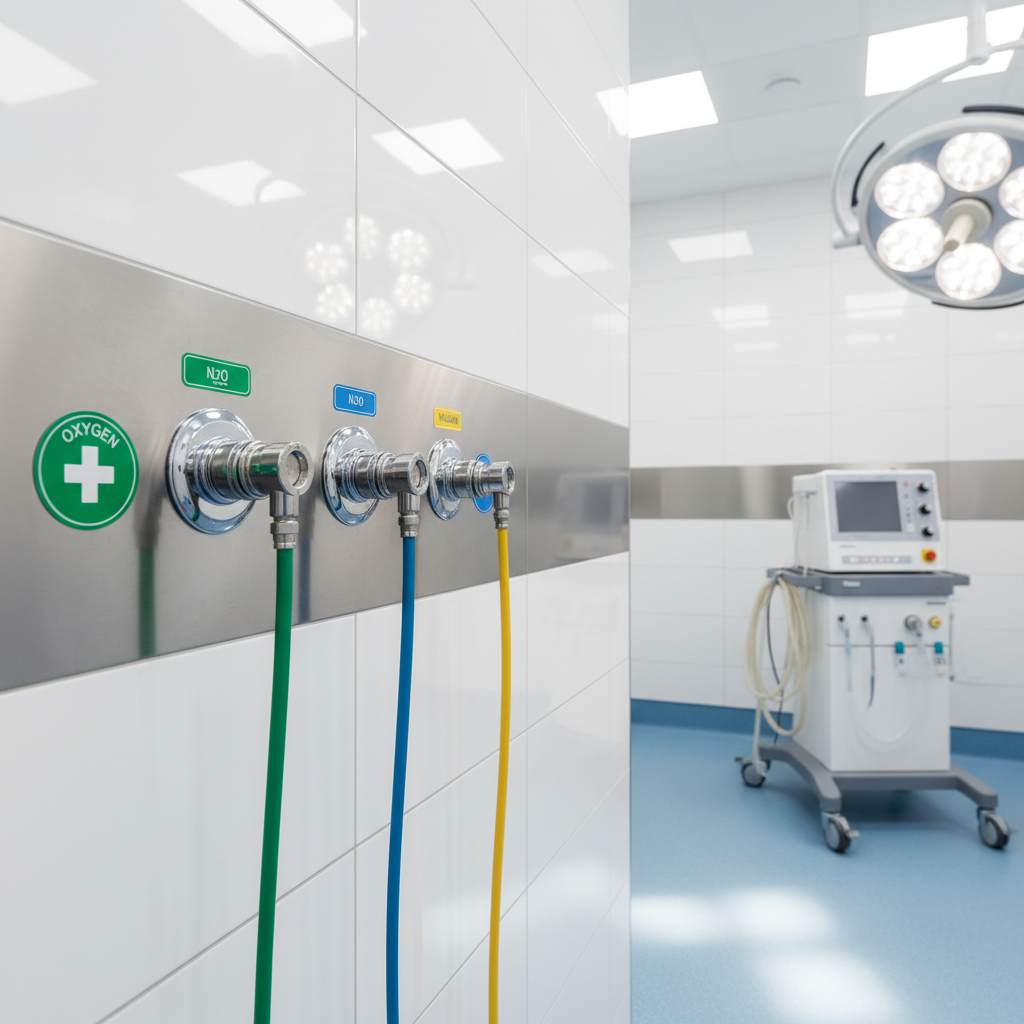
At the patient-facing end, terminal units (outlets) provide quick-connect access to the gases. These outlets are gas-specific, using a Diameter Index Safety System (DISS) or other proprietary keyed shapes to prevent accidental cross-connection. Common locations include:
- Surgical suites
- Treatment areas
- Induction and recovery bays
- Dental tables
Each location must be planned based on workflow to ensure convenient and safe access for anesthesia machines and other equipment.
Anesthetic Gas Scavenging (WAGD): Protecting Your Staff
Waste Anesthetic Gas Disposal (WAGD) is arguably as important as the gas delivery system. Exposure to unscavenged waste anesthetic gases like isoflurane or sevoflurane can lead to serious long-term health effects for your staff. A proper WAGD system actively or passively removes these gases from the surgical environment.
Active vs. Passive Systems
- Active Systems: An active system uses a dedicated vacuum producer (pump) to draw waste gas from the anesthesia machine's scavenging interface. This is the most effective and common method, ensuring consistent and adequate removal.
- Passive Systems: A passive system vents waste gas to the exterior of the building through a dedicated line, relying on the positive pressure from the anesthesia machine. These are less common and may not be sufficient for all scenarios.
Medical Testing Solutions provides comprehensive WAG chemical vapor monitoring to ensure your scavenging system is effective and your facility meets OSHA exposure limits.
Key Codes and Standards: NFPA 99 and ASSE 6000 Series
Compliance is non-negotiable. For veterinary facilities, several codes dictate the standards for installation, testing, and maintenance. While veterinarians are given some latitude compared to human healthcare facilities, adherence to these codes is a best practice and often required by local authorities and insurance carriers in Myrtle Beach, SC.
NFPA 99 Health Care Facilities Code
NFPA 99 is the foundational code for medical gas systems. For veterinary clinics, it establishes the minimum criteria for:
- System Categorization: Vet facilities are typically classified as Category 3, which has less stringent requirements than a Category 1 human hospital but still demands a high level of safety.
- Installation Practices: Specifies materials (copper piping), joint brazing techniques, and labeling requirements.
- Testing and Verification: Requires a full system verification by an ASSE 6030 Certified Verifier before the system is put into service.
ASSE 6000 Series: Personnel Certification
The American Society of Sanitary Engineering (ASSE) 6000 series provides professional qualifications for individuals working with medical gas systems.
- ASSE 6010 Certified Installer: The credential required for the person physically installing the system.
- ASSE 6030 Certified Verifier: The credential for the third-party inspector who tests and verifies the system post-installation.
Hiring an ASSE 6010 certified installer is your primary assurance that the work will be done correctly and will pass the final verification.
Code Comparison for Veterinary Facilities
| Standard | Requirement for Veterinary Clinics (Typical) |
|---|---|
| NFPA 99 | Governs overall design, installation, and testing. Usually applied as Category 3. |
| ASSE 6010 | Required for Installer. Ensures installer is qualified to braze, purge, and build the system. |
| ASSE 6030 | Required for Verifier. Ensures an independent, qualified party confirms system integrity and purity. |
| AVMA | Provides guidelines for anesthetic machine use and safety, complementing NFPA 99. |
The Installation and Verification Process: A Step-by-Step Overview
Partnering with a qualified company like Medical Testing Solutions simplifies the installation process. We handle both the ASSE 6010 installation and can coordinate the third-party ASSE 6030 verification.
- Design and Planning: We work with you and your architect/builder to design a system that meets your clinical needs, ensuring proper placement of sources, alarms, and outlets.
- Installation (ASSE 6010): Our certified technicians install all piping, manifolds, alarms, and outlets according to the approved design and NFPA 99 code.
- All copper is brazed with a continuous nitrogen purge.
- Piping is meticulously labeled with gas type and flow direction.
- Initial Installer Testing: We perform initial pressure tests and other checks to ensure the system is ready for formal verification.
- Third-Party Verification (ASSE 6030): An independent ASSE 6030 verifier performs a battery of tests to confirm the system's integrity and safety. This is a crucial step before any animals can be connected to the system.
- Cross-connection testing
- Purity testing (for O2, N2O, etc.)
- Particulate testing
- Pressure and flow tests
- Alarm functionality tests
- Certification and Handover: Once the system passes verification, you receive a formal certificate, and the system is ready for use. We provide your staff with training on its proper operation.
For a deep dive into the verification process, see our guide on medical gas verification.
Choosing the Right Partner in Myrtle Beach SC
When selecting a company for your veterinary medical gas installation, expertise and certification are paramount. You need a partner who understands both the construction/engineering side and the clinical application.
Key Questions to Ask a Potential Installer:
- Are your technicians ASSE 6010 Certified for medical gas installation?
- Do you provide documentation of all materials used and tests performed?
- Can you assist in coordinating the final ASSE 6030 verification?
- Do you also offer ongoing annual medical gas inspections and maintenance?
Medical Testing Solutions meets all these criteria, offering a turnkey solution for veterinary practices in Myrtle Beach and across South Carolina. Our deep experience with NFPA 99 ensures your facility is built for safety and long-term compliance.
Get Your Myrtle Beach Veterinary Clinic Installation Right the First Time
Your veterinary clinic's medical gas system is a long-term investment in patient safety and staff well-being. Don't leave it to chance. Ensure your Myrtle Beach, SC, practice is built on a foundation of quality and compliance by partnering with true experts.
At Medical Testing Solutions, our ASSE 6010 certified installers have the experience to design and execute a flawless installation that will pass its ASSE 6030 verification with flying colors. Contact us today for a comprehensive consultation and a no-obligation quote for your project.
Ready to build a safe and compliant surgical environment? Request a quote online or call us at +1 (754) 315-1078 to discuss your veterinary medical gas installation needs.
Frequently Asked Questions
For a new construction or major renovation of a typical 2-3 operating room veterinary clinic, the installation can take 5-10 business days, followed by a day for third-party verification. The timeline depends heavily on the facility's size and readiness.
Costs vary widely based on the number of outlets, type of source equipment (e.g., manifold vs. single cylinder), and the complexity of the pipe runs. A basic system might start in the $10,000-$15,000 range, while more complex systems can exceed $30,000. It's best to get a detailed quote.
Absolutely not. You must use seamless, rigid copper tubing (Type K or L) that has been cleaned for oxygen service. This prevents contamination and ensures the pipe can handle the pressures involved.
While not strictly required by code in all jurisdictions, a central medical/surgical vacuum system is a best practice for any facility performing surgery. It is far more reliable and effective than portable suction units and is essential for proper WAGD.
Yes. Per NFPA 99 for a Category 3 system, you must have source alarms to indicate when your secondary cylinder bank is in use. Area alarms at the point of use are also a best practice to alert staff to pressure drops or failures.
Specialized technicians are needed. Medical Testing Solutions provides expert service for veterinary anesthesia machines and flowmeters. We offer repair and calibration for major brands, a service you can learn more about on our dental flowmeter repair and calibration page, which covers similar technology.
Request a quote for your facility
Talk with Medical Testing Solutions about your next inspection, repair or equipment request.