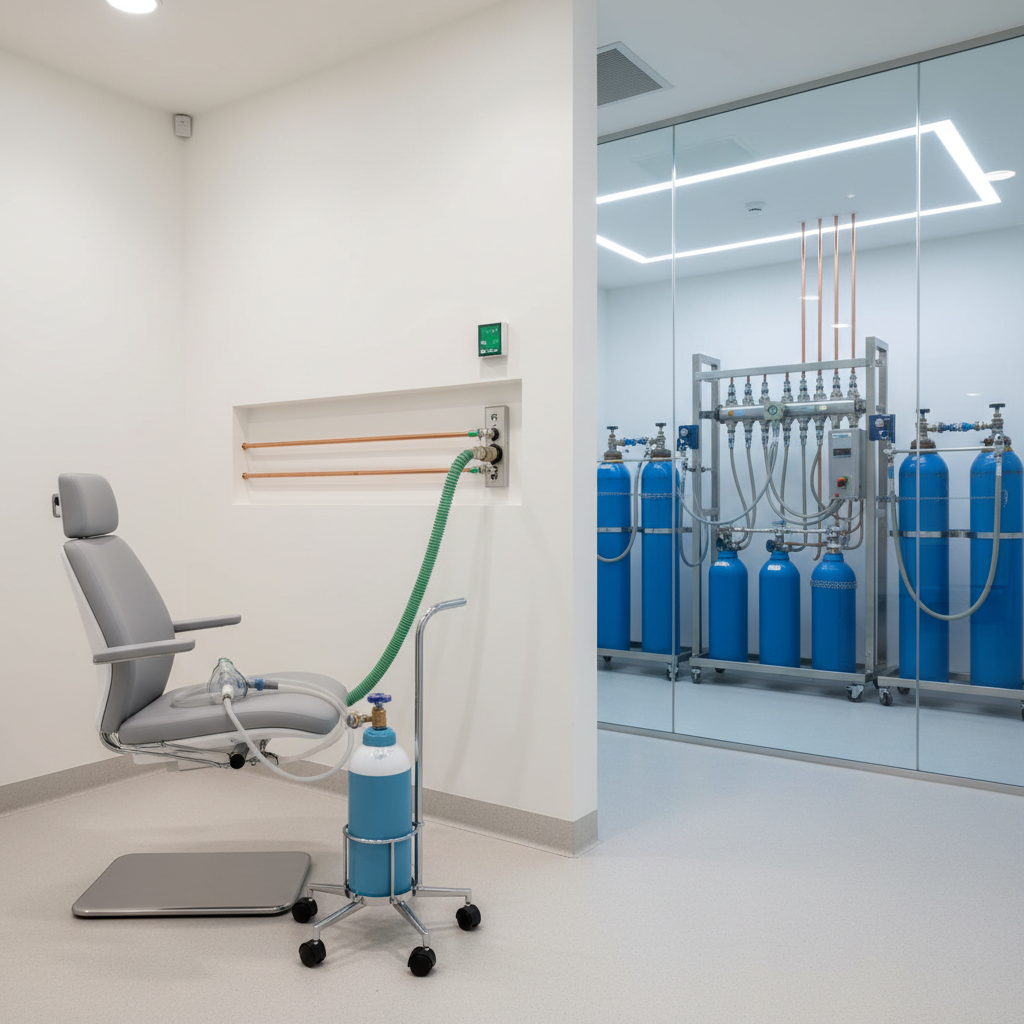
Portable vs. Piped Nitrous Oxide: Understanding the Regulatory Divide
Nitrous oxide is a staple in many healthcare facilities, particularly in dental and obstetrical settings, for its effective analgesic and anxiolytic properties. However, the method of its delivery, whether through a portable unit or a centralized piped system, dictates vastly different regulatory, safety, and certification requirements. Many facility managers are unclear on a critical question: at what point does a setup of interconnected cylinders become a piped system, legally requiring professional verification?
This post provides a definitive answer. We will explore the National Fire Protection Association (NFPA) 99 standards that define these systems, clarify when an ASSE 6030 certification by a qualified verifier is non-negotiable, and compare the operational differences. You will learn the specific triggers that classify a system as "piped," the responsibilities associated with each system type, and how to ensure your facility remains compliant and safe.
What Constitutes a "Piped" Medical Gas System?
The core of the issue lies in the definition of a medical gas system as outlined in NFPA 99, Health Care Facilities Code. A system isn't defined by the size of the cylinders, but by how they are connected and used.
According to NFPA 99 (2021 edition), a Level 1, 2, or 3 piped gas and vacuum system begins at the source equipment (like cylinders or a bulk tank) and terminates at the station outlets located throughout the facility. The key element is the network of fixed piping that distributes the gas from a central source to various points of use.
Conversely, a portable cylinder is typically a standalone unit, often mounted on a yoke or cart (like a "E" cylinder), and connected directly to the patient delivery apparatus. The confusion arises with "portable" setups that use larger "H" cylinders or link multiple cylinders together.
The Manifold: The Official Dividing Line
The clearest line of demarcation is the presence of a manifold. A manifold is an apparatus that connects two or more gas cylinders to a common outlet, often for the purpose of providing a continuous, uninterrupted supply.
- Single Cylinder: A single cylinder connected via a regulator and hose to an administration device (e.g., a dental flowmeter) is considered portable.
- Multiple Cylinders & Manifolds: As soon as you connect two or more cylinders together using a manifold, even if it's just two H-cylinders linked by a hose, you have created a central supply source. According to NFPA 99, this configuration is no longer "portable" but is, in fact, the beginning of a piped medical gas system. This is the critical trigger for requiring formal certification.
Why this matters for compliance: The moment a manifold is used to connect multiple cylinders, the entire system falls under the stringent requirements for piped medical gas systems. This includes design, installation, and, most importantly, verification by an ASSE 6030 Certified Medical Gas Verifier before the system is placed into service. Failure to comply can result in citations, invalidated insurance, and significant patient safety risks.
Certification Requirements: ASSE 6030 Verification
When your nitrous oxide setup qualifies as a piped system, a comprehensive verification process is mandatory. This isn't just a suggestion; it's a fundamental requirement of NFPA 99 for ensuring the safety of patients and staff.
This verification must be performed by a party that is technically competent and experienced in the field of medical gas system inspection and testing, and credentialed to the ASSE 6030 Medical Gas Verifier standard. The verifier cannot be the same company that installed the system to avoid conflicts of interest.
The medical gas verification process is exhaustive and includes:
- Component Checks: Ensuring all components (pipes, manifolds, alarms, valves, outlets) are correctly installed and meet code.
- Purity & Gas Concentration: Verifying that the gas being delivered is the correct gas (N2O) and is free from contaminants (particulate, moisture, halogenated hydrocarbons).
- Pressure & Flow Tests: Confirming that the system maintains the correct operational pressures and flow rates at each outlet.
- Alarm Testing: Functionally testing all warning and alarm systems (e.g., changeover alarms, high/low pressure alarms).
- Labeling & Documentation: Ensuring all pipelines, outlets, and source equipment are properly labeled.
Only after passing all tests will the verifier issue a formal certification, allowing the system to be used for patient care. Medical Testing Solutions provides ASSE 6030 verification services to ensure your system is safe, compliant, and ready for operation.
Portable vs. Piped Systems: A Head-to-Head Comparison
To clarify the differences, let's compare the two approaches across several key factors. This table breaks down the primary distinctions that facility managers need to understand.
| Feature | Portable Nitrous Oxide System | Piped Nitrous Oxide System |
|---|---|---|
| Definition | A single cylinder (e.g., E- or H-cylinder) connected directly to an administration device. | Two or more cylinders connected via a manifold, or a bulk tank, distributing gas through fixed piping. |
| Primary Regulation | General safe handling practices (CGA), OSHA requirements for cylinder storage and handling. | NFPA 99, Chapter 5. Governs design, installation, testing, and maintenance. |
| Certification Trigger | No formal system certification required before use. Regular equipment maintenance is still necessary. | Mandatory ASSE 6030 verification by a certified third party before patient use. |
| Best For | Low-volume users, single-operatory clinics, facilities where structural modification is impossible. | Hospitals, multi-operatory clinics, birth centers, facilities with moderate to high N2O usage. |
| Infrastructure | Minimal. Requires secure storage area for full and empty cylinders. | Significant. Requires a dedicated, properly vented source equipment room, brazed copper piping, zone valves, and alarms. |
| Safety Concerns | Cylinder handling injuries, leaks from regulators/yokes, exposure to staff during cylinder changes. | System cross-connection, contamination, incorrect pressure, leaks within walls. Mitigated by verification. |
| Maintenance | Regular inspection of regulators, hoses, and administration device (e.g., flowmeter). | Requires a documented maintenance program per NFPA 99. Includes annual inspections and ongoing monitoring. |
This table should make it clear that while a piped system represents a greater initial investment and regulatory burden, it offers significant advantages in terms of continuous supply and centralized safety management for higher-volume users.