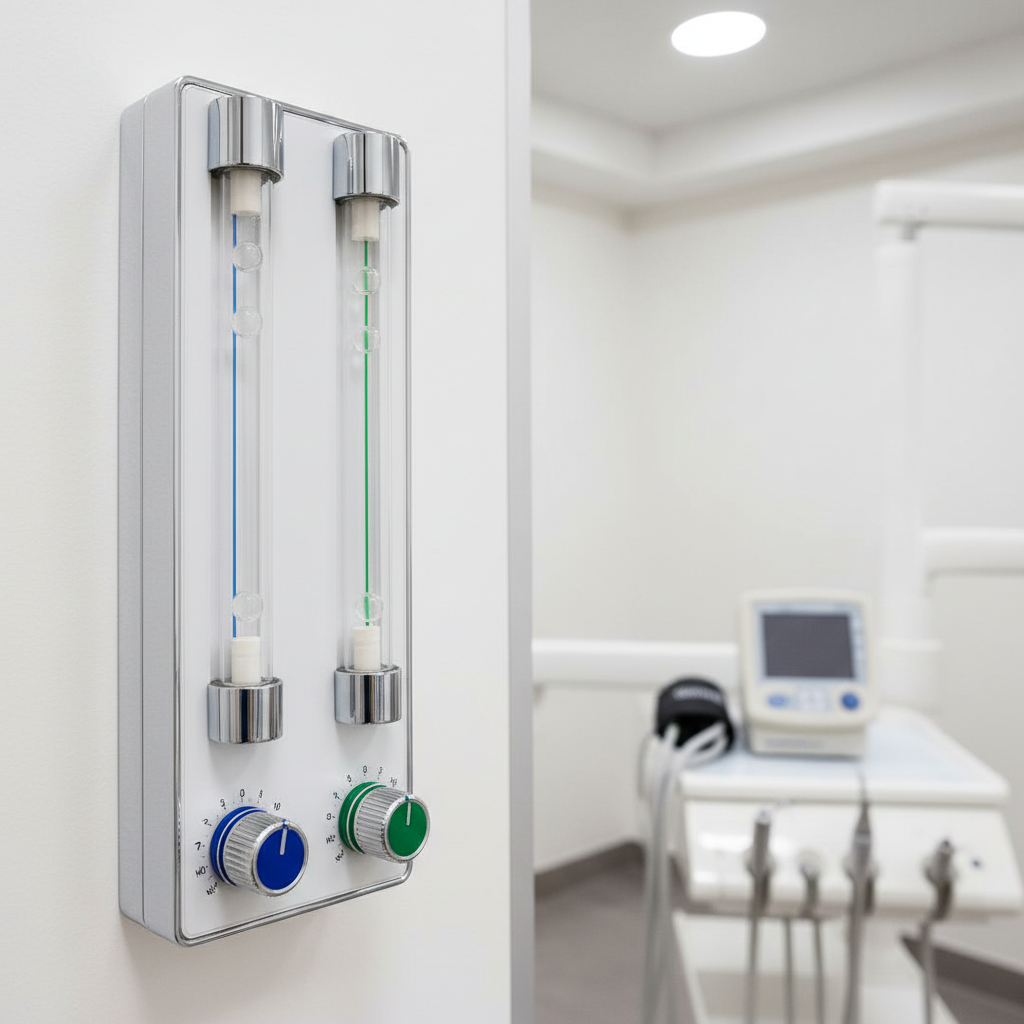
Dental Flowmeter Calibration Buffalo NO: $450 NIST Service
Nitrous oxide sedation delivery systems require absolute precision to ensure patient safety and regulatory compliance in Western New York dental practices. When delivering minimal or moderate inhalation analgesia, any drift in the gas ratio can lead to sub-therapeutic sedation, unintended deep sedation, or dangerous patient hypoxia. For clinics in Buffalo, NY, regular equipment testing is not just a best practice, it is a mandatory standard dictated by national and local health codes.
Medical Testing Solutions (MTS) provides certified, NIST-traceable dental flowmeter repair and calibration for dental practices across Erie County and the broader Buffalo metropolitan area. For a flat rate of $450 per unit, our factory-trained and ASSE-certified technicians execute comprehensive functional evaluations, leak testing, safety interlock checks, and gas mixture accuracy calibrations within a guaranteed 5-day lab turnaround. In this guide, you will learn the regulatory standards governing dental flowmeters, the risks of out-of-spec devices, how the NIST calibration procedure works, and how to maintain total compliance.
The Regulatory Framework: Why Calibration Matters in Buffalo Dental Clinics
Dental offices administering nitrous oxide-oxygen ($\text{N}_2\text{O}/\text{O}_2$) sedation fall under strict regulatory mandates designed to protect both patients and clinical staff. In New York State, the Department of Health (NYSDOH), the State Board for Dentistry, and local health inspectors enforce standards rooted in national safety codes.
NFPA 99 Health Care Facilities Code (Chapter 15)
The National Fire Protection Association (NFPA) 99 classifies dental facilities under Chapter 15 ("Dental Gas and Vacuum Systems"). Under NFPA 99 (2021 and 2024 editions), dental clinics using Category 1 or Category 2 piped gas systems or portable gas distribution units must maintain documented maintenance logs. Inhalation analgesia delivery units must feature:
- An active fail-safe mechanism that prevents the delivery of pure nitrous oxide.
- A mandatory minimum delivery of 30% oxygen (or a maximum delivery of 70% nitrous oxide).
- Annual mechanical verification and leak integrity testing.
ASSE 6000 Professional Qualifications Standard
The American Society of Sanitary Engineering (ASSE) Series 6000 establishes qualification standards for medical and dental gas personnel. Routine pipeline inspections fall under ASSE 6030 verification standards, while maintenance and internal calibration of critical gas-mixing devices require ASSE 6040 medical gas maintenance personnel or certified calibration technicians utilizing certified reference standards. Integrating regular flowmeter service alongside routine annual medical gas inspections keeps facilities fully prepared for unannounced accreditation inspections.
OSHA and NIOSH Exposure Limits
The Occupational Safety and Health Administration (OSHA) enforces workplace environmental safety through the General Duty Clause (Section 5(a)(1)). Nitrous oxide exposure in dental operatories must remain below the National Institute for Occupational Safety and Health (NIOSH) Recommended Exposure Limit (REL) of 25 ppm as a time-weighted average (TWA) during administration. An uncalibrated, leaking flowhead, worn internal diaphragm, or degraded needle valve directly introduces ambient nitrous oxide into the operatory, placing hygienists, assistants, and clinicians at chronic health risk. Incorporating regular operatory checks alongside professional waste anesthetic gas (WAG) chemical vapor monitoring mitigates this liability.
Why this matters for compliance: Failure to produce up-to-date NIST-traceable calibration certificates during an OSHA or state licensing board audit can result in administrative citations, mandatory suspension of sedation privileges, and malpractice exposure in the event of an adverse patient event.
Technical Failure Modes: What Happens When Flowmeters Drift
Nitrous oxide flowmeters, whether analog rotameters or digital electronic consoles, are precision pneumatic instruments. Over months of clinical operation, mechanical stress, thermal fluctuations, particulate contamination from pipeline manifolds, and elastomer degradation alter gas mixing accuracy. | Diagram text | |, |
1. Oxygen Fail-Safe Valve Breakdown
Analog units (such as the Porter MXR or Matrx MDM) utilize a mechanical proportioning valve connected to an internal pressure balance system. If the oxygen supply pressure drops below approximately 30–40 PSI, the fail-safe must shut off the flow of nitrous oxide completely. If internal diaphragms stiffen or O-rings degrade, this cutoff may lag or fail entirely, introducing severe hypoxic risks.
2. Needle Valve Erosion and Gas Creep
Rotameter flow tubes rely on micro-machined needle valves to seat against internal orifices. Repeated over-tightening by clinic staff deforms these metal needle tips. Over time, gas continues to bypass the seat even when dialed to zero (known as "creep"), venting gas into operatories or distorting dialed percentages.
3. Digital Sensor Decalibration
Modern digital units (such as the Accutron Digital Ultra or Porter Digital MDM) rely on mass flow sensors, solenoid valves, and digital microprocessors. Electronic transducers experience calibration drift over time due to humidity, power fluctuations, and mechanical vibration. A digital screen indicating "30% $\text{N}_2\text{O}$ / 70% $\text{O}_2$" may deliver an actual ratio of 45% $\text{N}_2\text{O}$ if flow sensors lose factory baseline reference.
The MTS $450 NIST-Traceable Calibration Protocol
At Medical Testing Solutions, calibration is an exhaustive rebuilding and verification process performed inside our controlled testing laboratory. We do not perform superficial external checks; every unit undergoes deep benchtop testing using equipment calibrated directly against standards maintained by the National Institute of Standards and Technology (NIST).
Our streamlined mail-in depot service is specifically optimized for Buffalo and Western New York dental practices that cannot afford weeks of downtime. | Diagram text | |, | | MTS 5-Day Turnaround NIST Flowmeter Calibration Flow |
Step 1: Secure Intake and Decontamination
Upon arrival at our technical depot, your device is logged by serial number and visually inspected for physical casing damage, stripped mounting brackets, or missing controls. The flowmeter is moved to an isolation station where high-level surface disinfection is completed according to CDC infection control guidelines for dental devices.
Step 2: Internal Pneumatic Teardown and Seal Replacement
Technicians access the internal pneumatic manifold. All internal seals, viton O-rings, check valves, and filter discs subject to operational friction are inspected and replaced as needed. Tubing lines are checked for embrittlement, oil contamination from dirty compressor sources, and particulate ingress.
Step 3: NIST-Traceable Mass Flow Calibration
The unit is plumbed to our primary calibration bench using ultra-pure medical grade test gases (USP Oxygen and USP Nitrous Oxide) regulated to standard pipeline pressures (50–55 PSI).
- Technicians verify delivery accuracy across increments ranging from 10% to 70% $\text{N}_2\text{O}$ concentration at varied total flow rates (1 to 10 LPM).
- Reference mass flow meters with active NIST-traceable certificates measure true delivered volumetric output.
- Discrepancies exceeding $\pm 5%$ of indicated flow are mechanically adjusted or electronically reprogrammed to manufacturer specifications.
Step 4: Safety Interlock and Fail-Safe Stress Testing
The oxygen supply pressure is intentionally bled down from 50 PSI toward 0 PSI. Technicians monitor the nitrous oxide delivery cut-off threshold. The unit must abruptly shut off nitrous oxide delivery when oxygen line pressure drops below manufacturer-specified levels (typically 25–35 PSI). The emergency oxygen flush mechanism is also tested to ensure instantaneous delivery of $\ge 30\text{ LPM}$ pure oxygen.
Step 5: Leak Decay Testing and Scavenging Verification
The assembled device undergoes a static pressure decay test at 1.5 times normal working pressure (75 PSI) for a minimum of 10 minutes to verify internal manifold gas-tightness. If the unit includes an integrated vacuum scavenger control, the suction flow rate is measured with an analog/digital manometer to confirm proper evacuation performance (minimum 45 LPM evacuation capacity).
Step 6: Certification and Return Shipping
Every successfully calibrated flowmeter receives a tamper-evident calibration sticker displaying the technician's ASSE ID, date serviced, calibration standard serial number, and next calibration due date. A formal NIST-Traceable Certificate of Calibration is provided for your facility's safety records. After final sign-off, the unit is securely packaged and dispatched back to your Buffalo clinic.