For hospital administrators and facility managers, ensuring a reliable, compliant, and cost-effective medical oxygen supply is a paramount concern. The choice of a central supply system directly impacts patient safety, operational budgets, and logistical complexity. Traditionally, bulk liquid oxygen (LOX) tanks and high-pressure cylinder banks have been the standard. However, Pressure Swing Adsorption (PSA) oxygen concentrators, also known as oxygen generators, are emerging as a powerful alternative for on-site production. This definitive guide compares these three systems, PSA oxygen concentrators, bulk LOX tanks, and cylinder reserves, examining them through the critical lenses of cost and ROI, NFPA 99 compliance, and operational reliability for a modern healthcare facility. You will learn the core differences in technology, the long-term financial implications, and the strategic considerations for selecting the right system for your hospital's unique needs.
Oxygen Concentrator vs Tank: A Hospital's Guide to Supply Systems
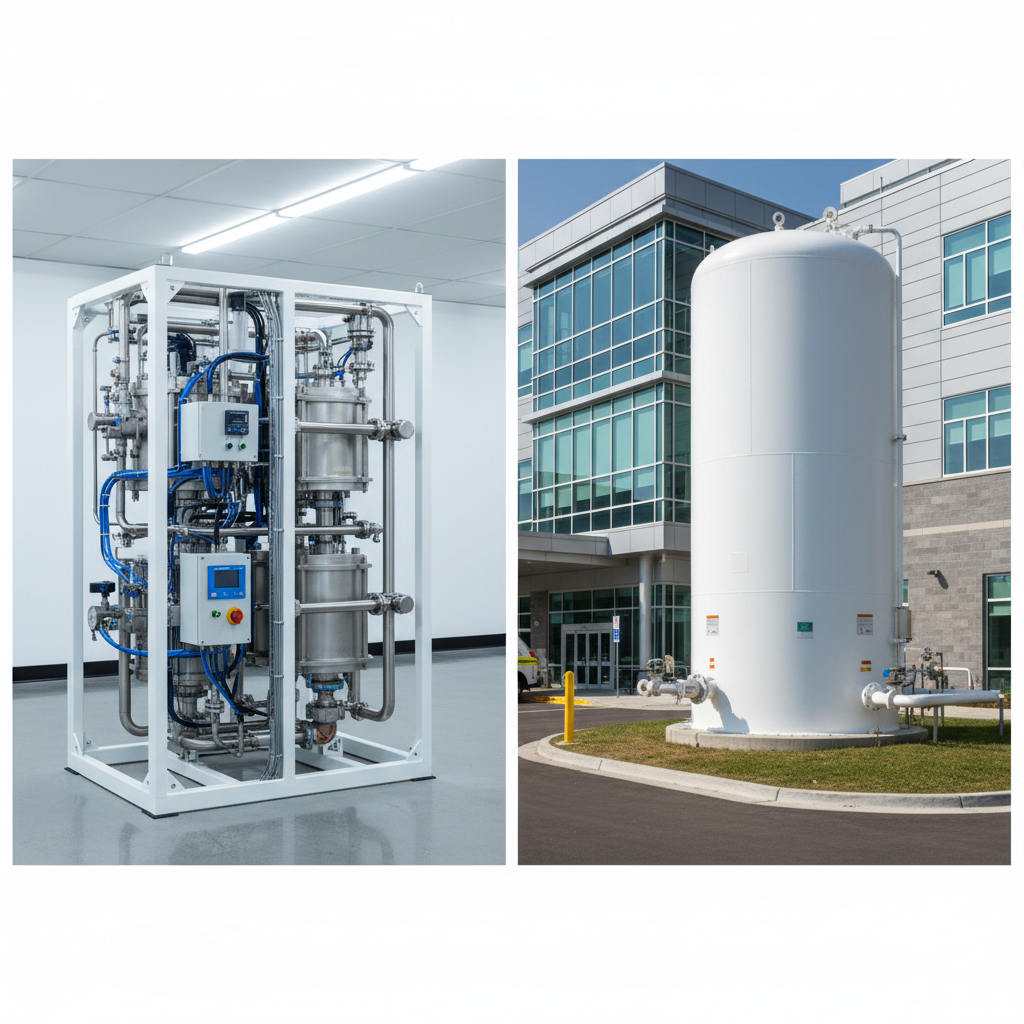
What Are the Main Oxygen Supply Options for Hospitals?
According to NFPA 99, Health Care Facilities Code, a hospital's medical gas system is composed of a primary supply, a secondary supply for emergencies, and a reserve supply. The choice of technology for these components is a major strategic decision.
Pressure Swing Adsorption (PSA) Oxygen Concentrators
A PSA oxygen generator is essentially a miniature oxygen factory for your facility. It draws in ambient air (which is 21% oxygen, 78% nitrogen) and separates the oxygen using a molecular sieve material called Zeolite. The process "adsorbs" nitrogen under pressure, allowing concentrated oxygen (typically 93% +/- 3% purity, which meets the USP monograph for "Oxygen 93 Percent") to pass through to a storage tank, ready for distribution through the hospital's piping network. These systems are sized to meet a facility's peak demand and produce oxygen on-demand.
Bulk Liquid Oxygen (LOX) Tanks
Bulk liquid oxygen systems consist of a large, cryogenic storage tank (often called a "Dewar") located outside the hospital. Oxygen is produced at an industrial gas facility, liquefied by cooling it to -297°F (-183°C), and transported to the hospital by tanker truck. The liquid is stored on-site and passes through a vaporizer to convert it back into a gas before it enters the piped distribution system. Hospitals contract with a gas supplier for regular deliveries, making this a utility-style, opex-heavy model.
High-Pressure Gas Cylinders
These are the most traditional form of oxygen supply. Steel or aluminum cylinders are filled with compressed oxygen gas at very high pressures (around 2200 psi). They are typically manifolded together in banks to serve as a primary supply for smaller facilities or, more commonly, as the emergency reserve supply for larger systems that use LOX or PSA generators as their primary source. Managing cylinders is labor-intensive, requiring staff to monitor pressures and swap empty cylinders for full ones.
The Cost Equation: Capital vs. Operational Expenditure (CapEx vs. OpEx)
Choosing an oxygen system is a significant financial decision. While PSA generators have a higher upfront cost, they can deliver substantial savings over the long term by eliminating the recurring expense of oxygen deliveries.
Upfront Capital Expenditure (CapEx)
- PSA Concentrators: Highest CapEx. The cost includes the generator itself, compressors, filters, a receiving tank, and professional installation. However, this is a one-time investment in an asset.
- LOX Tanks: Lower CapEx. The gas supplier often owns the tank itself, leasing it to the hospital. The primary capital costs are the concrete pad for the tank and the final line connection to the building, a service provided by certified firms like Medical Testing Solutions during the medical gas installation phase.
- Cylinders: Lowest CapEx. The initial cost is primarily for the manifold, regulators, and alarm systems. The cylinders themselves are rented from a supplier.
Ongoing Operational Expenditure (OpEx)
- PSA Concentrators: Lowest OpEx. The main costs are electricity to run the system and periodic preventative maintenance (filter changes, etc.). There are no delivery fees or market price fluctuations for the gas itself.
- LOX Tanks: Highest OpEx. This model is entirely operational expenditure. The hospital pays for the oxygen consumed, delivery fees, hazardous material charges, and tank rental. These costs are subject to market volatility and contract escalations.
- Cylinders: High OpEx. Costs include cylinder rental fees and the price of the gas, which is the most expensive way to purchase oxygen on a per-cubic-foot basis.
Comparison: Estimated Lifecycle Costs
| Cost Factor | PSA Oxygen Concentrator | Bulk LOX Tank System | High-Pressure Cylinder Manifold |
|---|---|---|---|
| CapEx | High | Low-Moderate | Low |
| OpEx (Gas Cost) | Very Low (Electricity) | High & Variable | Very High |
| Delivery Fees | None | High | Moderate-High |
| Maintenance | Moderate (Annual Service) | Low (Supplier Responsibility) | Low (Staff Labor) |
| Typical ROI | 3-5 Years | N/A (Rental Model) | N/A (Rental Model) |
NFPA 99 Compliance: System Design and Redundancy
NFPA 99 is the foundational code governing medical gas systems in the United States. Adhering to it is not optional; it is essential for patient safety and facility accreditation.
Why this matters for compliance: NFPA 99 (Chapter 5: Gas and Vacuum Systems) sets forth strict requirements for the design, installation, and testing of medical oxygen systems. A non-compliant system can lead to catastrophic failures, loss of accreditation, and significant liability. Proper system selection and medical gas verification by an ASSE 6030 certified verifier are crucial steps to ensure your facility meets all legal and safety standards.
Central Supply System Requirements
NFPA 99 defines a central supply system as one that serves an entire facility. It mandates a three-tiered structure:
- Primary Supply: The main source of oxygen during normal operation (e.g., a PSA generator or LOX tank).
- Secondary Supply: An automatically activated backup that comes online if the primary supply fails. It must be equal to the average daily demand.
- Reserve Supply (or Emergency Supply): A third source, typically cylinders, that can be manually activated to supply the system during a larger failure or while the secondary supply is in use. It must equal one average day's supply.
PSA generators are explicitly permitted as a primary or secondary source of supply (NFPA 99-2021: 5.1.3.3.3). When a PSA system is the primary source, the secondary supply could be a smaller LOX tank or a bank of cylinders sized appropriately. The key is uninterrupted redundancy.
Redundancy and Reliability: Ensuring Uninterrupted Patient Care
The fundamental goal of the NFPA 99 three-tiered system is to guarantee that there is never a moment when medical oxygen is unavailable to patients.
- PSA Reliability: Modern PSA systems are highly reliable, with robust compressors and durable sieve beds. They provide independence from external supply chains, which is a significant advantage during natural disasters or logistical disruptions that could delay LOX deliveries.
- Integrated Systems: The most robust strategy often involves integration. A facility might use a PSA generator as the primary supply to control costs and gain autonomy, with a smaller bulk LOX tank serving as the secondary backup, and a smaller cylinder manifold as the final reserve. This combines the OpEx savings of on-site generation with the high-flow, high-purity backup of liquid oxygen.
Installation and Maintenance Considerations
The long-term performance of any medical gas system hinges on proper installation and diligent maintenance. This work must be performed by certified professionals.
- Installation: The installation of a medical gas system, whether it's a new PSA generator or a LOX tank, is governed by strict codes. Technicians certified to the ASSE 6010 Medical Gas Systems Installer standard are required for this work. Medical Testing Solutions provides expert, ASSE 6010 certified installation services to ensure your system is built correctly from day one.
- Maintenance: Both PSA and LOX systems require regular upkeep. For PSA generators, this involves a program of annual medical gas inspections and filter changes. For LOX systems, it involves ensuring vaporizer function and alarm integrity. All maintenance on medical gas systems must be performed by personnel credentialed to ASSE 6040 Medical Gas Maintenance Personnel standards.
Make the Right Choice for Your Facility
Both PSA oxygen generators and bulk liquid oxygen tanks are viable, compliant solutions for supplying hospital oxygen. The choice between investing in an on-site generation (CapEx) model versus a delivery-based (OpEx) model is a strategic one.
- PSA generators offer long-term cost savings, operational autonomy, and protection from supply chain disruptions.
- LOX tanks offer a lower barrier to entry financially and are a proven, reliable technology managed by an external supplier.
The right decision depends on your facility's size, oxygen demand, budget, and strategic goals. A thorough analysis of your consumption patterns and a detailed ROI projection are essential.
Ready to evaluate your hospital's oxygen supply system? The ASSE-certified experts at Medical Testing Solutions can help you analyze your needs, design a compliant system, and provide a detailed ROI analysis to guide your decision. Contact us today for a comprehensive quote at +1 (754) 315-1078 or request a quote online to secure your facility's oxygen future. '''
Frequently Asked Questions
Request a quote for your facility
Talk with Medical Testing Solutions about your next inspection, repair or equipment request.