Medical Testing SolutionsNovember 16, 20269 min read
Share
At 9:14 AM during a routine laparoscopy, the nurse station master alarm panel chirps. The red indicator next to "Oxygen Reserve in Use" illuminates. The circulating nurse hits the silence button, assumes facilities will see the alert, and returns to the operating room. Nobody checks the cylinder room. Nobody knows that the facility’s primary bank of H-cylinders just emptied, or that the secondary bank already has two partially depleted tanks because someone cracked the reserve valves open during a delivery three weeks ago.
When Medical Testing Solutions technicians perform annual medical gas inspections in ambulatory surgery centers (ASCs), this exact communication gap is the single most common vulnerability we uncover. Your mechanical switchover regulator might function exactly as engineered, dropping from the primary bank at 50–55 psig down to the reserve bank without a blip in line pressure. Yet if your clinical and facilities teams treat the master alarm as background noise, a routine bank switchover turns into a total loss of pipeline oxygen.
Running an ASC oxygen manifold switchover drill as a structured tabletop and walk-through exercise bridges the gap between mechanical code compliance and actual clinical readiness.
How Oxygen Manifold Switchover Works Under NFPA 99
Ambulatory surgery centers almost universally rely on Category 1 medical gas systems when general anesthesia or deep sedation is administered. Under NFPA 99 (Health Care Facilities Code), Section 5.1.3.5.10, cylinder manifolds for Category 1 facilities must consist of two banks of cylinders, a primary supply and a secondary (reserve) supply, each containing at least an average day's supply, and never fewer than two cylinders per bank.
The manifold control header uses pressure differential to manage the transition automatically. While exact setpoints vary by manufacturer (such as Amico, BeaconMedæs, or Ohio Medical), the primary regulator is typically set higher than the secondary regulator. When the primary bank depletes and its internal pressure drops below the switchover threshold, the secondary regulator opens automatically to maintain the standard 50 to 55 psig mainline delivery pressure.
The instant that mechanical or dome-loaded switchover occurs, a dry-contact pressure switch or transducer inside the manifold cabinet trips the master alarm panel. Under NFPA 99 Section 5.1.9.2, the master alarm must illuminate a visual indicator and sound an audible alert for "Changeover to Secondary Supply."
Why this matters for compliance: Accreditation surveyors from AAAHC, The Joint Commission, and CMS routinely ask ASC clinical staff what a specific master alarm light means and what their immediate next action is. Answering "I call the administrator" without knowing where the manifold room is or how to read bank pressures can trigger an immediate life-safety citation.
Why Tabletop Switchover Drills Outperform Live Valve Manipulation
Facility directors occasionally ask if they should simulate a switchover by closing the main primary bank header valve during clinical hours to watch the staff react. Our ASSE 6030 verifiers strongly advise against untrained staff manipulating live manifold valves for drill purposes. Closing the wrong isolation valve on an older manual-reset duplex header, or failing to properly re-sequence an automatic dome-loaded manifold, can accidentally starve the pipeline or blow a relief valve.
Instead, combine a 20-minute tabletop exercise at the master alarm panel with a physical walk-through of the cylinder storage room. If you want to verify that the pressure switches, transducers, and master alarm relays actually trigger at the exact PSI setpoint, schedule that physical simulation during routine medical gas maintenance with an ASSE 6040 maintenance specialist or ASSE 6030 verifier.
If your center has not verified its manifold switchover setpoints or master alarm wiring in the past 12 months, schedule annual medical gas inspections with Medical Testing Solutions to test the physical switches safely.
Designing Your ASC Oxygen Manifold Switchover Drill
An effective drill tests three distinct checkpoints: alarm recognition at the nurse station, physical inspection at the manifold header, and vendor escalation logistics. Gather your OR charge nurse, anesthesia lead, materials manager, and facility coordinator for the exercise.
Phase 1: Master Alarm Recognition at the Nurse Station
Start the exercise directly in front of your master alarm panel (and area alarm panels, if your master signal is mirrored at the main control desk). Present the scenario: It is Tuesday morning with three ORs running. The master alarm sounds, and the "Oxygen Reserve in Use" (or "Secondary Supply in Use") indicator lights up. The area alarm in the OR corridor still reads 52 psig.
Walk your clinical staff through the exact distinction between a master alarm and an area alarm. Many nurses see 52 psig on the OR corridor area alarm and assume the master alarm is a false positive. Clarify that the area alarm monitors pipeline pressure heading into the surgical suite, while the master alarm monitors the source equipment inside the manifold room. When the switchover alarm trips, line pressure is supposed to stay at 50–55 psig, the alarm is warning you that you are now breathing off your backup bank and the clock is ticking.
Phase 2: The Cylinder Room Walk-Through
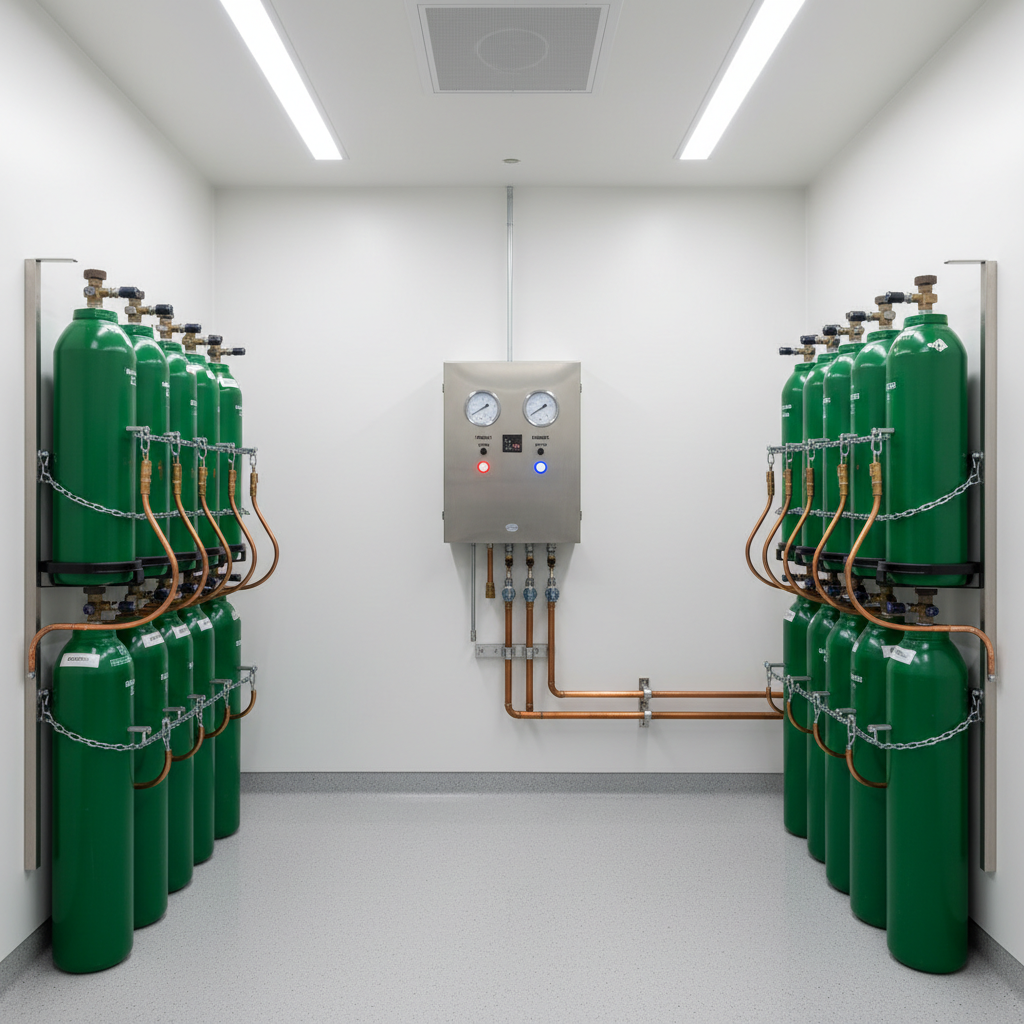
Move the team to the medical gas storage room. Have the person responsible for daily cylinder logs point out the following components without touching the valves:
Primary and Secondary Bank Gauges: Identify which side is currently designated "In Use" and which is "Reserve." Full USP medical oxygen H-cylinders (or K-cylinders) read approximately 2,000 to 2,200 psig at room temperature.
Delivery Line Pressure Gauge: Confirm it reads between 50 and 55 psig.
Header Pigtails and Check Valves: Inspect the copper or stainless-steel flexible pigtails connecting each cylinder to the header bar. Under NFPA 99 Section 5.1.3.5.5, each lead must have a check valve to prevent a single leaking pigtail from draining the entire bank.
Cylinder Inventory Segregation: Verify that full and empty cylinders are clearly segregated and racked properly in accordance with NFPA 99 Chapter 11 and CGA (Compressed Gas Association) P-1 guidelines.
Phase 3: Calculating Remaining Runtime and Escalation
Once the primary bank switches to the secondary bank, how much time does the ASC have before mainline pressure drops? During your tabletop drill, work through a realistic calculation based on your manifold size.
A standard H-cylinder contains roughly 6,900 to 7,000 liters of oxygen at 2,200 psig. If your ASC has a 4x4 manifold (four cylinders on the primary bank, four on the secondary bank), your secondary bank holds roughly 28,000 liters of gas. Because the manifold regulator requires at least 100 to 150 psig of cylinder pressure to maintain a 50 psig line pressure, you cannot use the very bottom of the tank.
Ask your anesthesia provider to estimate total liters per minute (LPM) across all active ORs and PACU bays, including ventilator drive gas (which often consumes 10 to 15 LPM per anesthesia machine when oxygen is used as the pneumatic driving gas). In a busy three-OR center, four reserve cylinders can deplete in less than a single surgical day.
Switchover Scenarios vs. Emergency Escalation Triggers
Use the table below during your tabletop exercise to train staff on how to differentiate a standard manifold switchover from an active pipeline emergency.
Alarm Condition
Manifold Gauge Readings
OR Area Alarm Reading
Immediate Staff Action
Normal Operation
Primary: >500 psig Reserve: ~2,200 psig
50–55 psig (Normal)
Log cylinder pressures on daily checklist. No action required.
Replace depleted primary bank cylinders immediately; reset manifold header direction per manufacturer instructions.
Reserve Low / Imminent Depletion
Primary: <150 psig Reserve: <500 psig
50–55 psig (Normal)
Alert anesthesia and OR charge nurse. Connect spare E-cylinders to anesthesia machines. Call gas supplier for emergency drop.
Mainline Pressure Low (<40 psig)
Primary: Depleted Reserve: Depleted or Valve Closed
<40 psig (Red / Audible)
Initiate emergency oxygen loss protocol. Open E-cylinder yokes on anesthesia carts. Halt elective inductions; call medical gas certification service if regulator failure is suspected.
Common Failure Modes Uncovered During Drills
When Medical Testing Solutions helps facilities audit their medical gas readiness, we consistently find three physical or procedural errors during cylinder room walk-throughs:
Valves Closed on the "Active" Reserve Bank: A staff member swaps out empty tanks, connects the pigtails, and forgets to slowly crack open the cylinder post valves on the reserve side. When the primary side empties at 11:00 AM, the manifold switches to a closed reserve bank, and the OR area alarms drop to zero instantly.
Missing Wrench or Wrong Pigtail Washers: Staff cannot swap out the depleted primary bank during the drill because the CGA 540 wrench is missing, or someone used Teflon tape on a CGA 540 bullnose fitting. Teflon tape must never be used on high-pressure oxygen cylinder connections due to ignition hazards; CGA 540 connections seal metal-to-metal.
Unlabeled Zone Valve Boxes Along the Route: While walking from the manifold room to the ORs, test your staff on where the emergency zone valve boxes are located. If a switchover is caused by a massive downstream pipeline leak rather than normal consumption, staff must know which zone valve isolates which room.
If your manifold header check valves leak when cylinders are disconnected, or if your digital manifold display no longer matches your analog gauges, our ASSE 6010 installers and ASSE 6030 verifiers provide turnkey medical gas installation and medical gas verification across Florida and the Southeast. You can also source replacement pigtails, gauges, and alarm components directly through our medical gas equipment catalog.
Documenting Your Drill for Accreditation Surveyors
An undocumented drill never happened in the eyes of a surveyor. Keep a dedicated section in your medical gas compliance binder alongside your annual ASSE 6030 verification reports and line isolation monitor testing logs. Your drill record should capture:
Date, Time, and Participants: List names and roles across nursing, anesthesia, and facilities.
Simulated Trigger: Note the specific master alarm indicator reviewed ("Oxygen Secondary Supply in Use").
Cylinder Room Audit Findings: Record actual primary and reserve bank PSI readings at the time of the walk-through, plus confirmation that all reserve cylinder valves are open.
Vendor Escalation Verification: Confirm the current 24/7 emergency phone number for your bulk/cylinder gas supplier and your medical gas service provider.
Corrective Actions Taken: Document any missing wrenches, burnt-out alarm LEDs, or staff training gaps resolved during the session.
Need an ASSE-certified team to inspect your manifold, verify your master alarms, or upgrade an aging changeover header? Request a quote online from Medical Testing Solutions or call our Fort Lauderdale office at (754) 315-1078 to schedule service.
Frequently Asked Questions
When the primary cylinder bank depletes to the manifold's switchover setpoint, the manifold automatically begins drawing from the secondary (reserve) bank to maintain 50–55 psig line pressure. Simultaneously, a pressure switch trips the master alarm panel to illuminate the "Reserve in Use" or "Changeover to Secondary Supply" indicator.
No. Untrained clinical or facility staff should not manipulate live manifold header valves or bleed down lines to trigger alarms during clinical hours, as improper valve sequencing can interrupt pipeline flow. Run a tabletop and visual walk-through with staff, and have an ASSE 6030 verifier or ASSE 6040 maintenance technician test the physical pressure switches during scheduled inspections.
Under NFPA 99 Section 5.1.3.5.10, Category 1 medical gas cylinder manifolds must have two banks of cylinders (primary and secondary), with each bank containing at least an average day's supply and never fewer than two cylinders per bank.
No. All cylinder valves on both the primary ("In Use") and secondary ("Reserve") banks must remain fully open during normal operation. The manifold regulator assembly holds the reserve bank in standby using pressure differential; if the reserve tank valves are closed, the pipeline will lose pressure the moment the primary bank empties.
While NFPA 99 requires annual functional testing of medical gas master alarms and manifold switchover switches by qualified personnel, conducting an internal staff tabletop drill and cylinder room walk-through semi-annually or quarterly ensures new nurses and anesthesia staff know how to respond when the reserve alarm sounds.
Request a quote for your facility
Talk with Medical Testing Solutions about your next inspection, repair or equipment request.