OSHA Grade D Breathing Air Requirements: A Complete Guide
Medical Testing SolutionsJune 19, 20267 min read
Share
For any industrial application requiring workers to use airline respirators, from sandblasting and painting to welding in confined spaces, the air supplied must be safe, clean, and breathable. It's not enough to simply use a standard air compressor; the air must meet stringent quality standards set by the Occupational Safety and Health Administration (OSHA). This is where OSHA Grade D breathing air comes in.
Understanding and complying with these regulations is not optional. It is a fundamental requirement for protecting your team from hazardous airborne contaminants, preventing serious injury, and avoiding costly regulatory penalties. This definitive guide explains the core components of OSHA 29 CFR 1910.134, detailing the specific contaminant limits, testing requirements, and documentation needed to ensure your breathing air is compliant and safe.
What is OSHA Grade D Breathing Air?
OSHA Grade D Breathing Air refers to a specific quality standard for compressed air used to supply atmosphere-supplying respirators, such as airline respirators, hoods, and self-contained breathing apparatus (SCBA) units. The official regulation is found in OSHA 29 CFR 1910.134, the Respiratory Protection standard.
This standard doesn't exist in a vacuum. It directly references the specifications outlined in the Compressed Gas Association (CGA) Commodity Specification for Air, G-7.1. In essence, OSHA mandates that any compressed air for respiration must, at a minimum, meet the requirements specified for Grade D in CGA G-7.1. This ensures a consistent, verifiable benchmark for air quality across all industries.
The primary purpose of Grade D air is to prevent workers from inhaling contaminated air in environments where the ambient atmosphere is hazardous. This includes atmospheres that are oxygen-deficient or contain harmful dusts, fogs, fumes, mists, gases, smokes, sprays, or vapors.
Key Contaminants and Their Limits: The Grade D Specification
The core of the Grade D standard is its list of maximum allowable contaminant levels. Your compressed air system must be filtered and maintained to ensure the air delivered to the respirator user stays within these limits at all times. The table below outlines the specific requirements per CGA G-7.1.
Component
Maximum Allowable Content
Why It's Critical
Oxygen
19.5% - 23.5%
Essential for life. Below 19.5% is considered oxygen-deficient, leading to cognitive impairment and asphyxiation. Above 23.5% creates a dangerous fire and explosion risk.
Carbon Monoxide (CO)
10 parts per million (ppm)
A toxic gas that interferes with the body's ability to absorb oxygen. It is odorless, tasteless, and can be produced by oil-lubricated compressors if they overheat.
Carbon Dioxide (CO2)
1,000 parts per million (ppm)
At high concentrations, CO2 can cause shortness of breath, dizziness, and asphyxiation.
Condensed Hydrocarbons (Oil Mist)
5 milligrams per cubic meter (mg/m³)
Inhaling oil mists can cause respiratory irritation, lipid pneumonia, and other lung diseases. Oil can also foul respirator components.
Odor
No noticeable or pronounced odor
Odor often indicates the presence of other, unmeasured contaminants, serving as a warning sign that the air purification system may be failing.
Water Content
No specific limit, but a low dew point is required
Excess moisture can cause respirator valves to freeze or rust and can create a breeding ground for bacteria within the system. A pressure dew point of -50°F or lower is a common best practice.
Why This Matters for Compliance: OSHA requires employers to ensure the quality of breathing air for supplied-air respirators. Failure to test and document air quality that meets these specific limits can result in significant fines, project shutdowns, and, most importantly, severe worker injury or fatality. Proper medical gas certification is the only way to be sure.
Industries and Applications Requiring Grade D Air
Any work environment where an employee is required to wear an airline respirator falls under this standard. Key applications include:
Sandblasting and Abrasive Blasting
Abrasive blasting generates high levels of hazardous dust, most notably crystalline silica, which can cause silicosis, a fatal lung disease. Workers must be protected by a continuous-flow, loose-fitting hood respirator supplied with Grade D air.
Industrial Painting and Coating
Automotive and industrial painting involves isocyanates, solvents, and other volatile organic compounds (VOCs) that are highly toxic when inhaled. Grade D air provides a safe breathing source, preventing chemical exposure.
Welding and Hot Work
Welding fumes can contain manganese, hexavalent chromium, and other toxic metal particulates. In confined or poorly ventilated areas, welders rely on airline respirators to prevent metal fume fever and long-term neurological damage.
Confined Space Entry
Workers entering tanks, vessels, sewers, or other confined spaces may face oxygen-deficient atmospheres or the presence of toxic gases. Airline respirators are a critical piece of life-support equipment in these scenarios.
Breathing Air System Components and Filtration
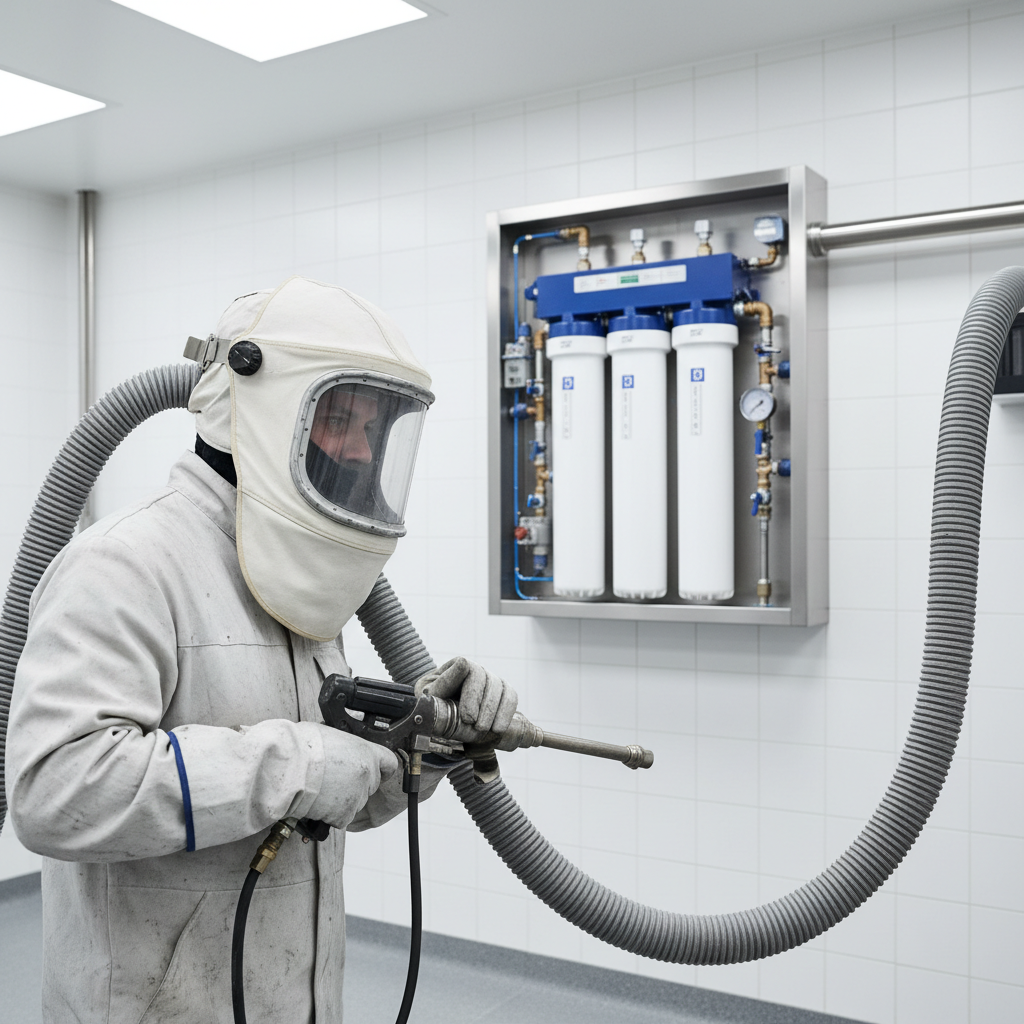
Achieving Grade D quality requires more than just a compressor; it demands a multi-stage purification system. A typical setup includes:
Air Compressor: Can be oil-lubricated or oil-free. If oil-lubricated, high-temperature alarms and carbon monoxide monitors are essential safety measures to prevent CO generation.
Aftercooler/Moisture Separator: Cools the hot compressed air to condense water vapor, which is then removed.
Coalescing Filter: Removes fine oil mists and aerosols that get past the initial separator.
Activated Carbon Filter: Adsorbs hydrocarbon vapors and unpleasant odors.
Particulate Filter: A final filter that removes any remaining solid particulates before the air goes to the distribution manifold.
In-line Carbon Monoxide Monitor: A critical safety device that continuously monitors the air stream for CO and triggers an alarm if levels exceed the 10 ppm limit.
Medical Testing Solutions can help you specify and source the right filtration equipment from our extensive products catalog to ensure your system is built for compliance from the ground up.
The Critical Role of Air Quality Testing and Frequency
Your breathing air system is only compliant if you can prove it. OSHA mandates that employers ensure their breathing air meets Grade D specifications, and the best practice is to establish a regular testing schedule.
CGA G-7.1 recommends that air quality be tested at a frequency sufficient to prevent excessive contaminant levels, a common interpretation is quarterly testing. However, tests should also be performed immediately if:
A new compressor or filtration system is installed.
The system undergoes significant maintenance or repair.
Workers report odors or suspected contamination.
Testing must be performed by a qualified person using specialized equipment capable of measuring particulates, oil mist, CO, CO2, and oxygen levels. The most reliable way to ensure this is done correctly is to partner with a firm whose technicians are ASSE 6030 Certified Medical Gas Verifiers. At Medical Testing Solutions, our ASSE-certified technicians perform this critical verification, providing the expertise and documentation you need to be confident in your system's safety. Our comprehensive annual medical gas inspections can incorporate Grade D breathing air checks to streamline your compliance efforts.
How to Document Your Grade D Compliance
Thorough documentation is the cornerstone of a compliant respiratory protection program. For every breathing air test, you must maintain a certificate of analysis that includes:
The date and time of the test.
The specific location and identification of the air source (e.g., "Compressor #2, Paint Booth Manifold").
The measured results for Oxygen, Carbon Monoxide, Carbon Dioxide, and Hydrocarbons.
A pass/fail determination for odor and water content.
The name, signature, and credentials of the certified individual who performed the test.
This record, known as a Certificate of Analysis, is your proof of compliance. A professional testing company like Medical Testing Solutions provides comprehensive, audit-proof documentation as part of our service, protecting both your workers and your business. Proper medical gas verification is not just about a report; it's about a documented state of safety.
Ensure Your Compliance with MTS
Meeting OSHA Grade D breathing air requirements is a complex but non-negotiable part of ensuring worker safety. It demands the right equipment, rigorous testing protocols, and meticulous documentation. Don't leave your team's safety or your company's compliance to chance.
Ready to ensure your breathing air meets OSHA Grade D requirements? Contact the experts at Medical Testing Solutions for a free quote on air quality testing, system certification, or professional medical gas installation and maintenance. Our ASSE-certified team is ready to help.
OSHA requires employers to ensure air quality is maintained. The industry best practice, based on CGA guidelines, is quarterly (every 3 months) or whenever a system is modified or contamination is suspected.
No, not without a dedicated, multi-stage purification system specifically designed for breathing air. A standard compressor can introduce deadly contaminants like carbon monoxide.
Grade E air has stricter limits for carbon dioxide (500 ppm) and hydrocarbons. It is typically used for different applications like SCBA (Self-Contained Breathing Apparatus) fills.
Yes, OSHA requires a CO monitor or a high-temperature alarm for any oil-lubricated compressor used for breathing air. It is a critical safety device.
A qualified person with proper training and calibrated equipment. The most reliable credential is an ASSE 6030 Certified Medical Gas Verifier, who specializes in testing compressed gas systems.
Request a quote for your facility
Talk with Medical Testing Solutions about your next inspection, repair or equipment request.