O2 Tank Sizes: A Complete Chart & Guide for Medical Facilities
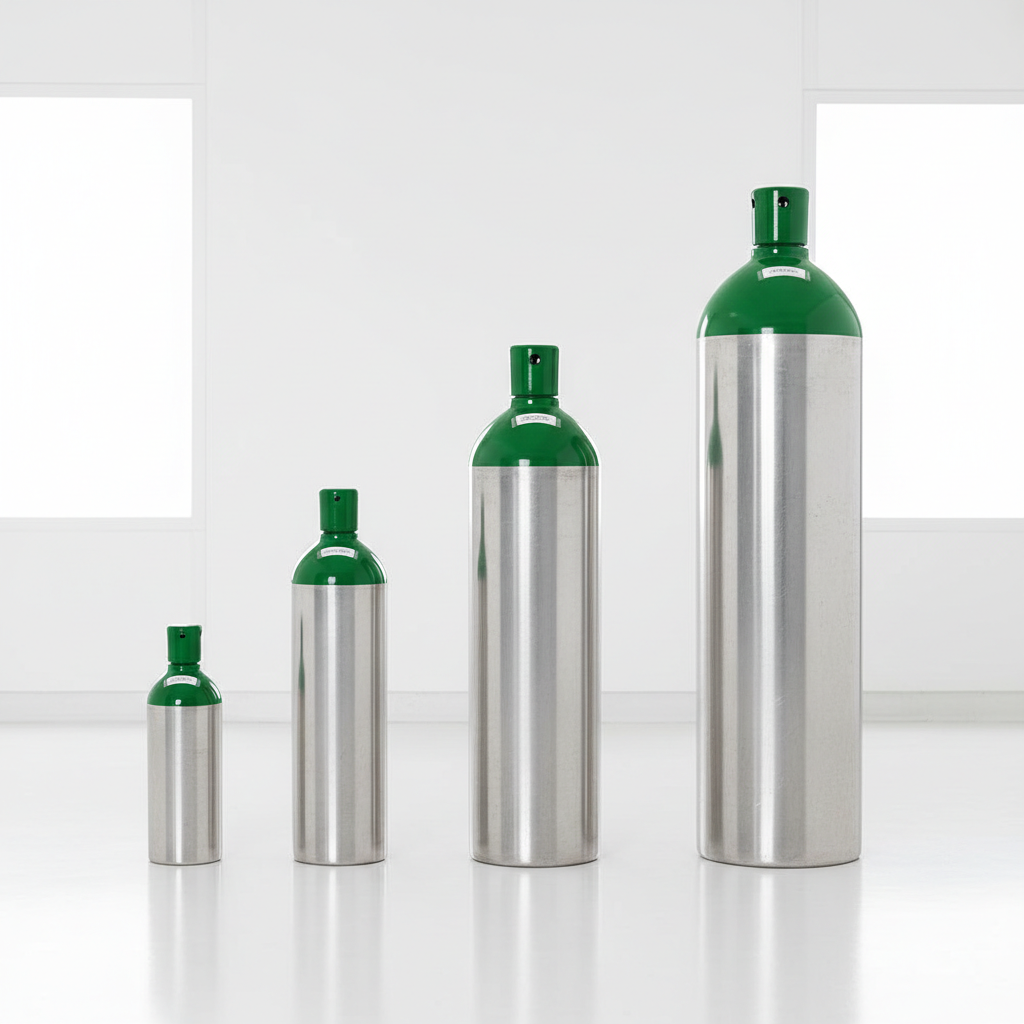
Choosing the right medical oxygen cylinder is a critical decision for any healthcare facility, from large hospitals to small dental offices. The size of an O2 tank directly impacts portability, supply duration, and patient care logistics. An undersized tank can run out unexpectedly during a procedure, while an oversized one can be inefficient and create unnecessary physical strain on staff. This guide provides a definitive overview of standard O2 tank sizes, their specifications, and their applications, empowering you to make informed decisions for your facility's medical gas needs.
In this comprehensive pillar post, you will learn how to differentiate between common oxygen cylinder sizes (D, E, M, G, H, and T), understand their capacity and weight, calculate supply duration, and navigate the essentials of safe handling, storage, and compliance according to key industry standards.
Understanding Medical Oxygen Cylinder Designations
Medical oxygen cylinders are high-pressure containers regulated by the Department of Transportation (DOT) and the Compressed Gas Association (CGA). They are typically made from steel or aluminum. The "size" of a tank is designated by a letter code, such as "D" or "H," which corresponds to a specific volume, weight, and physical dimension.
- Material: Aluminum cylinders are lighter and more resistant to corrosion, making them ideal for patient transport and portable use. Steel cylinders are heavier but more durable and cost-effective for stationary, high-volume applications.
- Valves: Cylinders are fitted with specific CGA valve connections depending on the gas type to prevent accidental administration of the wrong gas. For oxygen, CGA 870 is the standard for small cylinders (E and smaller), while CGA 540 is used for large cylinders (M and larger).
O2 Tank Sizes Comparison Chart
Selecting the appropriate cylinder requires balancing capacity with portability. A small, portable "E" tank is perfect for patient transport, while a large "H" tank is better suited as a primary source for a facility's medical gas pipeline system. Here’s a detailed comparison of the most common medical O2 tank sizes.
| Size | Style | Volume (Liters) | Approx. Weight (lbs, Full) | Approx. Dimensions (H x D in) | Common Use Cases |
|---|---|---|---|---|---|
| D | Portable | 425 | 8-10 lbs | 20" x 4.3" | Patient transport, short-duration needs, home care. |
| E | Portable | 680 | 10-12 lbs | 29" x 4.3" | Most common for patient transport, emergency backup, ambulance use. |
| M | Stationary | 3,450 | 75-85 lbs | 47" x 7.25" | Small facilities, backup for central supply, long-term care. |
| G | Stationary | 5,300 | 120-130 lbs | 55" x 8.5" | High-demand institutional use, backup supply for manifold systems. |
| H/T | Stationary | 6,900 / 7,800 | 140-160 lbs | 55-60" x 9.25" | Primary supply for central gas systems, high-volume applications. |
How to Calculate Oxygen Cylinder Duration
Knowing how long a tank will last is crucial for uninterrupted patient care. You can calculate the duration with a simple formula:
Duration (in minutes) = (Tank Pressure (psi) - Safe Residual Pressure) x Conversion Factor / Flow Rate (LPM)- Tank Pressure: A "full" cylinder is typically pressurized to 2000-2200 psi.
- Safe Residual Pressure: Always leave 200 psi in the tank to prevent contamination. Never run a tank completely empty.
- Conversion Factor: This constant varies by tank size:
- D Tank: 0.16
- E Tank: 0.28
- M Tank: 1.56
- G Tank: 2.41
- H/T Tank: 3.14
- Flow Rate: The prescribed liters per minute (LPM) set on the regulator.
An E tank at 2000 psi with a flow rate of 2 LPM.
- (2000 psi - 200 psi) x 0.28 / 2 LPM = 1800 x 0.28 / 2 = 252 minutes (or 4.2 hours).
Accurate duration calculation is a key part of maintaining patient safety and is a focus of our annual medical gas inspections.
Portable vs. Stationary O2 Tanks: Matching Size to Application
Portable Cylinders (D and E)
These lightweight aluminum tanks are designed for mobility. The "E" size is the workhorse of hospitals, clinics, and EMS for transporting patients or providing a temporary oxygen source. The smaller "D" tank is often used for shorter trips or in settings where space and weight are at a premium.
Stationary Cylinders (M, G, H, T)
These large, heavy steel tanks are built for high-capacity, stationary use.
- An "M" tank can serve as a standalone supply for a small clinic or as a backup for a liquid oxygen system.
- "G" and "H/T" tanks are the standard for central supply systems in hospitals and surgical centers. They are often connected to a manifold that feeds the facility's entire medical gas pipeline, which must be installed and verified by certified professionals. Medical Testing Solutions provides expert ASSE 6010 medical gas installation and ASSE 6030 verification services to ensure these complex systems are safe and compliant.
Why This Matters for Compliance: NFPA 99 (Health Care Facilities Code) outlines strict requirements for the storage, handling, and use of medical gas cylinders. Per NFPA 99, all storage areas must be clean, dry, well-ventilated, and secured against unauthorized access. Full and empty cylinders must be stored separately. Adherence to these standards is not optional—it's essential for patient and staff safety and is a core part of any facility's risk management.
Oxygen Tank Refill, Cost, and Ownership
Facilities can either own their cylinders or lease them from a gas supplier. Owning tanks can be cheaper long-term but requires managing hydro-static testing (every 5-10 years). Leasing is more common, with the supplier handling all maintenance and refilling.
Refill costs vary based on your location, supplier contract, and the size of the cylinder. A "swap" model is common, where the supplier takes your empty tank and provides a pre-filled, certified replacement. For a precise cost estimate, it's best to request a quote from a qualified medical gas supplier.
Choose MTS for Equipment and Compliance
At Medical Testing Solutions, we not only supply and service a wide range of medical gas equipment but also ensure your facility remains compliant and safe. Our ASSE-certified technicians can help you select the right O2 tank sizes, design a compliant storage solution, and perform the necessary testing and verification to meet NFPA 99 and ASSE 6000 series standards.
If you need to equip a new facility or upgrade your existing oxygen supply system, contact the experts. We ensure the job is done right, from the source equipment to the patient outlet.
Frequently Asked Questions (FAQs)
Q: What is the difference between G, H, and T oxygen tanks?A: G, H, and T are all large, high-capacity steel cylinders. The primary difference is their volume. An H tank holds approximately 6,900 liters of oxygen, while a T tank holds around 7,800 liters. The G tank is slightly smaller than both, at about 5,300 liters. They share similar heights and applications but offer different supply capacities.
Q: How much does it cost to refill a medical oxygen tank?A: Refill costs depend on the tank size, your gas supplier, your location, and your contract terms (leasing vs. owning). A small E tank might cost $20-$40 for a swap, while a large H tank could be $50-$100 or more. Bulk contracts significantly lower the per-cylinder cost. It's best to get a direct quote.
Q: How do I know how long my oxygen tank will last?A: You can use the formula: Duration (minutes) = (Pressure - 200) x Conversion Factor / Flow Rate (LPM). You need to know the tank's size (to find its conversion factor), the current pressure (from the gauge), and the flow rate your patient requires.
Q: Are steel and aluminum oxygen tanks different?A: Yes. Aluminum tanks are lighter and are the standard for portable cylinders like sizes D and E. Steel tanks are heavier and more durable, making them suitable for large, stationary cylinders (M, G, H) that are not moved frequently.
Q: What are the main regulations for storing O2 tanks?A: NFPA 99 is the primary code. Key rules include storing cylinders in a dedicated, well-ventilated area, securing them to prevent falling, separating full and empty tanks, and prohibiting storage near flammable materials or heat sources. Proper storage is a critical part of medical gas system verification.
Ready to Equip Your Facility?
Choosing the right O2 tank sizes and ensuring a compliant setup is fundamental to operational safety and efficiency. Contact Medical Testing Solutions today for a comprehensive quote on medical gas equipment, installation, or annual testing. Call us at +1 (754) 315-1078 or request a quote online.
'''
This article is provided for educational purposes and reflects industry standards as of publication. Always verify against current NFPA 99, CGA, and AHJ requirements. Medical Testing Solutions is ASSE-certified and ready to help — contact us for facility-specific guidance.
Need Medical Gas Services?
Contact our certified team for inspections, verifications, installations, and more.
Get a Free Quote