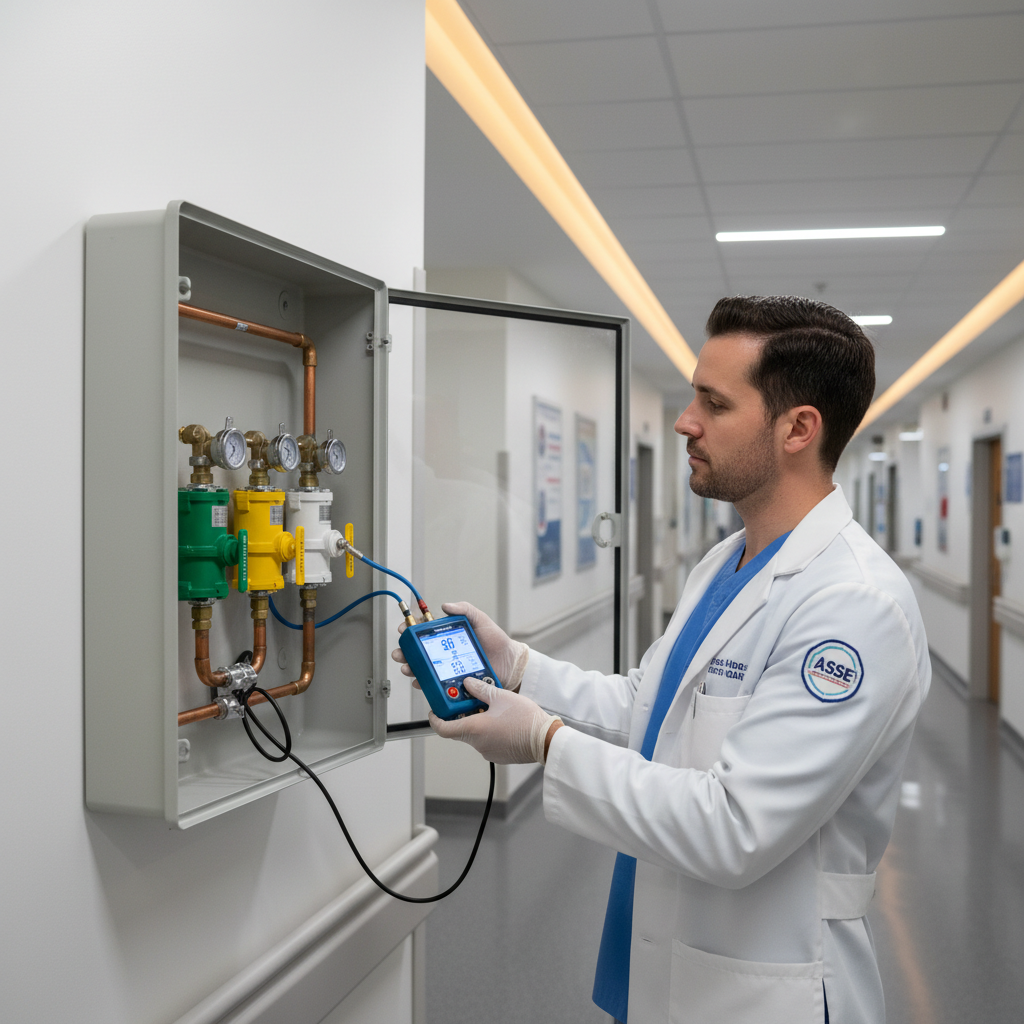
Medical Gas Zone Valve Testing Procedure: Step-by-Step Guide
Medical Testing SolutionsNovember 8, 202615 min read
Share
Medical gas zone valve box assemblies (ZVBAs) are among the most critical life-safety checkpoints in any healthcare facility. These valves provide local emergency shutoff capabilities to isolate specific wings, patient rooms, critical care suites, and operating theaters during fires, catastrophic line ruptures, or scheduled facility maintenance. When an emergency strikes, clinical personnel must have absolute certainty that closing a zone valve will immediately and safely isolate the target gas service without interrupting supply to neighboring life-support areas.
Executing a proper medical gas zone valve testing procedure ensures that every shutoff valve operates smoothly, seals bubble-tight, features accurate labeling, and interfaces seamlessly with the facility's area alarm panels. In this definitive guide, Medical Testing Solutions breaks down the regulatory requirements established under NFPA 99 and ASSE 6000, walking facility managers and clinical engineers through the step-by-step physical inspection, leak testing, labeling verification, and operational operational workflows required for full regulatory compliance.
Why Zone Valve Testing Matters for Healthcare Compliance
Zone valve boxes do not simply act as passive plumbing fixtures; they are active life-safety barriers. If a fire breaks out in an operating room, the anesthesiologist or circulating nurse must shut off the medical oxygen and nitrous oxide supply immediately to eliminate oxidizers feeding the flame. If the valve stem is seized due to packing degradation, or if the labeling is incorrect and isolates the adjacent recovery room instead, the consequences can be catastrophic.
Why this matters for compliance: Joint Commission (TJC) Environment of Care standard EC.02.05.09 and NFPA 99 (Health Care Facilities Code) require that piped medical gas shutoff valves remain accessible, properly labeled, and mechanically verified. Surveyors routinely cite facilities for obstructed zone valve boxes, illegible or inaccurate room numbering on valve placards, and lack of documented annual exercising or operational verification.
Enforcing an uncompromising medical gas zone valve testing procedure prevents:
Cross-Connection Disasters: Mislabeled valves causing accidental shutoff to occupied patient spaces during clinical interventions or construction.
Seat Leakage: Gas continuing to bleed through closed valves into a fire zone or a construction tie-in.
Stem Packing Failures: High-pressure medical gases leaking behind the wall cavity or into corridor ceilings.
Operational Seizure: Quarter-turn ball valves binding up due to decades of non-actuation or particulate accumulation.
To maintain continuous audit readiness, healthcare facilities rely on scheduled annual medical gas inspections to document and certify every component in their pipeline infrastructure.
Governing Standards: NFPA 99 and ASSE 6000 Mandates
The testing and maintenance protocols for zone valves are strictly governed by consensus standards designed to protect patient safety.
| Diagram text |
|, |
| REGULATORY FRAMEWORK OVERVIEW |
| NFPA 99 (Chapter 5) → Establishes installation, performance, and maintenance |
| criteria for Category 1 through Category 4 piped systems. |
| ASSE 6010 → Sets qualifications for medical gas system installers. |
| ASSE 6030 → Sets qualifications for medical gas system verifiers. |
| ASSE 6040 → Governs maintenance personnel testing & servicing pipes. |
NFPA 99 Code Requirements
Under NFPA 99 (2024 edition, Section 5.1.4.6 and Section 5.1.14.2):
Accessibility: Zone valve boxes must be installed in accessible corridor locations, visible and unblocked by carts, furniture, or architectural barriers.
Emergency Shutoff Function: Valves must be quarter-turn, full-port ball valves with visual open/close indication (typically a lever handle aligned with piping when open, perpendicular when closed).
Placarding & Labeling: Every valve must clearly identify:
The specific medical gas or vacuum service (using standardized CGA color-coding).
The specific rooms, suites, or zones controlled by that valve.
Physical Placement: Valves must be placed on the room side of any riser take-offs and arranged so that closing the valve for one area does not cut off supply to any other area.
Periodic Inspection: Section 5.1.14 requires healthcare facilities to establish operational and testing protocols to ensure valves operate correctly and labels remain updated whenever architectural spaces are reconfigured.
ASSE Professional Qualifications
Testing, maintenance, and verification must only be performed or supervised by individuals certified under the ASSE Series 6000 standard:
ASSE 6030: Certified medical gas verifiers who perform baseline acceptance testing on new or retrofitted installations (see our dedicated medical gas verification services).
ASSE 6040: Certified maintenance personnel who perform routine physical inspections and operational exercising.
Pre-Testing Protocols & Clinical Coordination
You cannot treat a medical gas zone valve test like a standard commercial plumbing shutoff. Closing a medical gas zone valve immediately depressurizes downstream patient terminal units. Therefore, pre-testing preparation requires rigorous planning and multidisciplinary communication.
1. Multi-Department Notification
Before touching a valve handle, the testing team must coordinate with:
Clinical Nursing Leadership: Confirm patient census and verify that no critical procedures are scheduled in the target zone.
Respiratory Therapy: Arrange for portable cylinders and regulators for any patient dependent on continuous oxygen, medical air, or suction.
Facility Safety / Security: Notify personnel that local area alarm panels will trip when pressure thresholds drop.
Anesthesia & Surgery: Ensure operating rooms are entirely idle; never perform intrusive shutoff testing in active or on-call surgical suites.
2. Clinical Risk Assessment
Review whether the zone valve box controls critical care areas (Category 1) or general exam rooms (Category 2). If Category 1 spaces are involved, backup medical gas cylinders must be staged bedside before testing downstream shutoff integrity.
3. Equipment & Tool Checklist
Your ASSE-certified technician will require calibrated testing instrumentation:
Calibrated digital pressure gauges with quick-connect adapters (DISS or Chemetron/Ohmeda).
Comprehensive Step-by-Step Zone Valve Testing Procedure
The testing procedure consists of four integrated phases: visual inspection, operational exercising, bubble-tight seat shutoff testing, and pressure drop monitoring.
| Diagram text |
|, |
| ZONE VALVE TESTING WORKFLOW SEQUENCE |
| Step 1: Visual & Accessibility Inspection |
| Check clearance, windows, hinges, and labeling |
| Step 2: Operational Exercising & Stem Integrity |
| 90-degree throw check, packing leak evaluation |
| Step 3: Positive Shutoff & Seat Leakage Testing |
| Downstream depressurization and hold verification |
| Step 4: Area Alarm Interface Verification |
| Pressure switch activation and sensor trip points |
| Step 5: Restoration, System Purge & Documentation |
| Slow repressurization, outlet purge, sign-off |
Step 1: Visual and Accessibility Inspection
Begin at the exterior of the zone valve box assembly:
Corridor Clearance: Measure unobstructed clearance in front of the box. Ensure a minimum of 36 inches of clear floor space. Verify that wall-mounted equipment, crash carts, or janitorial supplies do not impede instant access.
Enclosure Integrity: Verify that the box frame is securely anchored into the wall structure. Inspect the access door, hinges, latches, or sliding transparent faceplate. NFPA 99 requires that the box cover be secured to prevent tampering while remaining readily accessible in an emergency without special tools (e.g., using a breakable ring or pull tab).
Gauge Verification: Confirm that each valve is fitted with an operational pressure or vacuum gauge downstream of the valve. Check that gauge face scales correspond to the gas service (e.g., 0–100 psig for standard pressure gases; 0–300 psig for high-pressure nitrogen/instrument air; 0–30 inHg for medical vacuum).
Zone Mapping: Compare the engraved or printed placard against current architectural floor plans. Every room number, bed number, or clinical suite served by that specific valve must be legibly and accurately listed. If renovations have occurred, trace lines to ensure no terminal units were re-routed without updating the placard.
Valves that remain stationary for years are prone to seizing or developing stem seal degradation:
Handle Throw: Disengage the lock pin or safety latch and rotate the valve handle through a smooth 90-degree arc from the fully open position (parallel to piping) to the fully closed position (perpendicular to piping).
Resistance Evaluation: The handle should operate with firm, uniform resistance. Binding, metal-on-metal grinding, or excessive play indicates internal ball or seat galling.
Stem Packing Leak Inspection: Apply an approved oxygen-compatible leak detection solution (conforming to ASTM G93 / CGA guidelines) around the valve stem packing nut and body joints. Inspect with a high-intensity light for bubbling. Ultrasonic leak detectors can also be utilized for precision acoustics.
Step 4: Bubble-Tight Positive Shutoff Testing
Verifying that a valve mechanically closes does not guarantee it stops the flow of gas. An internal seat leak will continue feeding gas downstream.
Safety Notice: Coordinate closely with clinical teams before isolating lines. Never close a valve to an active patient space.
Downstream Gauge Connection: Attach a calibrated digital test gauge to the furthest downstream terminal unit (or use the test port within the zone valve box if equipped with downstream isolation test ports).
Valve Closure: Rotate the zone valve to the fully closed position.
Downstream Depressurization: Bleed downstream line pressure to 0 psig (or 0 inHg for vacuum) via an approved vent tool fitted with an exhaust filter.
Hold Period: Close the downstream bleed port. Observe the test gauge for a minimum of 10 to 15 minutes.
Evaluation Criteria:
Pressure Systems (Oxygen, Medical Air, N2O): The downstream gauge must remain at 0 psig. Any rise in pressure indicates seat leakage across the ball valve.
Vacuum Systems: Seal the vacuum outlet. After drawing to zero, monitor for vacuum creep.
NFPA Standard: The valve must provide a completely bubble-tight seal. Any detectable creep requires immediate valve servicing or rebuilding.
Step 5: Area Alarm Interface Verification
Zone valves work in tandem with local area alarm panels to notify clinical staff when pressure deviates outside safe operating parameters (typically ±20% from nominal line pressure).
While the zone valve is isolated, observe the corresponding area alarm panel.
As downstream pressure drops past 40 psig (for a nominal 50–55 psig system) or vacuum falls below 12 inHg, verify that the area alarm triggers:
Audible alarm sounds.
Visual red LED indicator flashes for that specific gas service.
Confirm that the alarm panel accurately identifies the matching physical zone.
Step 6: System Restoration & Purge
Slow Pressurization: Crack open the zone valve slowly. Opening a quarter-turn ball valve rapidly can generate an adiabatic compression heat spike in high-pressure oxidizers (Oxygen/N2O), posing an ignition risk. Slowly equalize pressure until the downstream gauge matches mainline system pressure, then rotate to the fully open position.
Terminal Unit Purge: Quickly purge the terminal outlets to clear any trace particulates stirred up during flow restoration.
Reseal Enclosure: Reinstall the transparent window or secure the emergency pull-latch. Apply a tamper-evident seal indicating the inspection date and technician ID.
Notification: Advise clinical units and respiratory therapy that the system is fully pressurized, stable, and returned to active service.
When evaluating valve box performance, field engineers must understand the specific operating pressures and testing parameters across different medical gas systems:
Gas Service
Nominal Pipeline Pressure
Low Pressure Alarm Trip Point (NFPA 99)
High Pressure Alarm Trip Point (NFPA 99)
Seat Leakage Allowance
Quarter-Turn Operating Torque (Nominal)
Medical Oxygen ($O_2$)
50 – 55 psig
40 psig (-20%)
66 psig (+20%)
0 psig rise (Bubble-Tight)
15 – 35 in-lbs
Medical Air (MedAir)
50 – 55 psig
40 psig (-20%)
66 psig (+20%)
0 psig rise (Bubble-Tight)
15 – 35 in-lbs
Nitrous Oxide ($N_2O$)
50 – 55 psig
40 psig (-20%)
66 psig (+20%)
0 psig rise (Bubble-Tight)
15 – 35 in-lbs
Medical Vacuum (Vac)
15 – 22 inHg
12 inHg
N/A
0 inHg drop across valve
18 – 40 in-lbs
Waste Anesthetic Gas (WAGD)
15 – 20 inHg
12 inHg
N/A
0 inHg drop across valve
18 – 40 in-lbs
Instrument Air / Nitrogen
160 – 185 psig
128 psig (-20%)
222 psig (+20%)
0 psig rise (Bubble-Tight)
30 – 60 in-lbs
Note: In dedicated dental or surgical specialty suites utilizing sedation equipment, nitrous oxide and oxygen delivery lines must be calibrated and tested according to clinical delivery thresholds; see our specialized dental flowmeter repair and calibration protocols.
Common Failures Encountered During Zone Valve Testing
Through thousands of hospital audits, Medical Testing Solutions technicians consistently encounter several recurring zone valve failures. Understanding these common failure modes helps facility teams intervene before accreditation surveys.
| Diagram text |
|, |
| [42%] Inaccurate / Outdated Room Placards |
| [26%] Obstructed Valve Box Access (Carts, Cabinets) |
| [18%] Broken / Missing Transparent Breakaway Windows |
| [9%] Stem Packing Leaks Detected via Ultrasonic/Fluid |
| [5%] Internal Seat Bypass (Failure to Isolate) |
1. Inaccurate Labeling After Renovation
Hospital wings undergo frequent structural alterations. Patient rooms become storage areas, single rooms become split doubles, or ICU bays are converted into isolation suites. If the zone valve box placard still displays room numbering from a 1998 blueprint, clinical personnel will shut off the wrong valve during a crisis. Whenever wall configurations change, a formal zone mapping audit must be completed.
2. Stem Seal Deterioration
The PTFE or Teflon packing around the valve stem dries, shrinks, or takes a compression set over decades of thermal cycling. When a technician exercises the valve for the first time in several years, the stem may begin leaking gas into the wall cavity. Performing routine medical gas maintenance services allows technicians to tighten packing glands or replace elastomeric seals before leaks manifest.
3. Missing or Broken Windows
Zone valve boxes utilize breakable polycarbonate, acrylic, or pull-ring covers to prevent accidental handle strikes while keeping them accessible during fires. In high-traffic corridors, these covers are frequently cracked by stretchers or mobile imaging units. Operating with an exposed or unlatched cover violates NFPA 99.
4. Obstructed Access
Zone valve boxes mounted at corridor junctions often end up obscured by mobile linen hampers, crash carts, computer workstations on wheels (WOWs), or wall decorations. Surveyors from The Joint Commission, CMS, and DNV issue immediate citations for any obstruction within 36 inches of the valve assembly.
Documentation and Record-Keeping Protocols
Testing without thorough documentation is non-compliant in the eyes of regulatory surveyors. Under NFPA 99 Chapter 5, healthcare facilities must retain verified testing logs for the life of the pipeline infrastructure.
Every zone valve testing report generated by your ASSE 6040 or ASSE 6030 technician must record:
Unique Valve Identifier: Tag number, floor number, corridor location, and zone served.
Specific Gas Service: Gas type, nominal operating pressure, and pipe diameter.
To maintain unified, defensible records, many health networks integrate their zone valve records into full-facility medical gas certification binders, ready for immediate inspection by visiting authorities having jurisdiction (AHJs).
When to Repair vs. Replace a Zone Valve Box
If a valve fails bubble-tight isolation, binds during rotation, or displays heavy body corrosion, facility directors face a decision: rebuild the valve in place or replace the entire assembly.
| Diagram text |
|, |
| REPAIR VS. REPLACE MATRIX |
| REPAIR IN PLACE FULL BOX REPLACEMENT |
| Minor stem packing leakage Severe body casting porosity or internal cracking |
| Loose handle or missing latch Obsolete 3-piece valve where parts are unavailable |
| Cracked polycarbonate faceplate Riser reconfiguration or line diameter up-sizing |
| Outdated room placard Severe brazing joint damage or internal corrosion |
| Out-of-calibration dial gauge Conversion from legacy non-code conforming valves |
When replacements or retrofits are unavoidable, facilities must source high-performance, NFPA-compliant components. Medical Testing Solutions stocks and distributes an extensive lineup of clinical assemblies through our medical gas products catalog, including modular 1-to-8 valve box assemblies with integrated digital gauges and transducer monitoring sensors.
Protect Your Facility with Medical Testing Solutions
Zone valve testing is a life-safety imperative that requires technical precision, specialized diagnostic equipment, and strict adherence to NFPA 99 and ASSE standards. Incomplete or skipped valve tests expose clinical staff and patients to severe risks during emergencies.
Medical Testing Solutions (MTS) is an industry-leading ASSE-certified medical gas service provider headquartered in Fort Lauderdale, Florida. Whether you need comprehensive zone valve leak testing, alarm system calibration, annual compliance audits, or complete pipeline verification, our ASSE 6030, 6035, and 6040 specialists deliver unmatched technical expertise.
Ensure your medical gas shutoff systems are dependable, accessible, and audit-ready. Call Medical Testing Solutions today at (754) 315-1078 or contact us online to schedule your zone valve inspection or request a quote for your facility.
Frequently Asked Questions
NFPA 99 requires healthcare facilities to maintain an ongoing maintenance and testing schedule for piped medical gas systems. Visual inspections of zone valve accessibility, structural condition, and gauge accuracy should occur at least annually. Full operational exercising and positive shutoff verification are conducted annually or during scheduled system modifications and ASSE 6030 verifications.
Yes. NFPA 99 specifically dictates that zone valve boxes must remain accessible in public corridors and patient wings so that clinical staff (such as charge nurses, surgeons, or anesthesiologists) can immediately shut off gas lines during an active fire or major rupture without waiting for engineering personnel or requiring special keys.
A source shutoff valve isolates the primary central supply equipment (such as a bulk oxygen farm or vacuum pump) at the plant room. A zone valve is installed downstream along the pipeline distribution network to isolate a specific floor, patient wing, or surgical suite without interrupting gas supply to the rest of the hospital.
Because downstream clinical spaces must not be depressurized while occupied, positive shutoff testing is coordinated during planned downtime. A technician attaches a calibrated digital test gauge downstream of the closed valve, bleeds downstream line pressure to 0 psig, and monitors for 10 to 15 minutes. Any rise in pressure confirms internal seat leakage.
An inaccurate zone valve placard represents an immediate life-safety hazard and will trigger a citation from Joint Commission or CMS surveyors. Facility engineers must perform a line-tracing audit to confirm downstream terminal units, then immediately update the placard with permanent, tamper-resistant labeling.
Request a quote for your facility
Talk with Medical Testing Solutions about your next inspection, repair or equipment request.