Medical Gas Verification in Jacksonville: An ASSE 6030 Guide
Medical Testing SolutionsMay 30, 20268 min read
Share
Medical gas verification is one of the most critical safety procedures a healthcare facility will undertake. For hospitals, surgery centers, and dental offices in Jacksonville and throughout Duval County, ensuring that piped medical gas systems are safe, pure, and functioning correctly is not just a best practice, it's a requirement mandated by state and national codes. This guide explains the medical gas verification process, clarifies the role of the ASSE 6030 Verifier, and outlines the specific requirements for facilities in Florida, including how to save significantly on costs.
Whether you're overseeing a new construction project, a renovation, or ensuring ongoing compliance, this article will walk you through the essentials of NFPA 99, AHCA regulations, and what to look for when hiring a certified verification firm. You will learn what the process entails, why local expertise matters, and how to ensure your facility meets the stringent standards set by The Joint Commission and other regulatory bodies.
What is Medical Gas Verification?
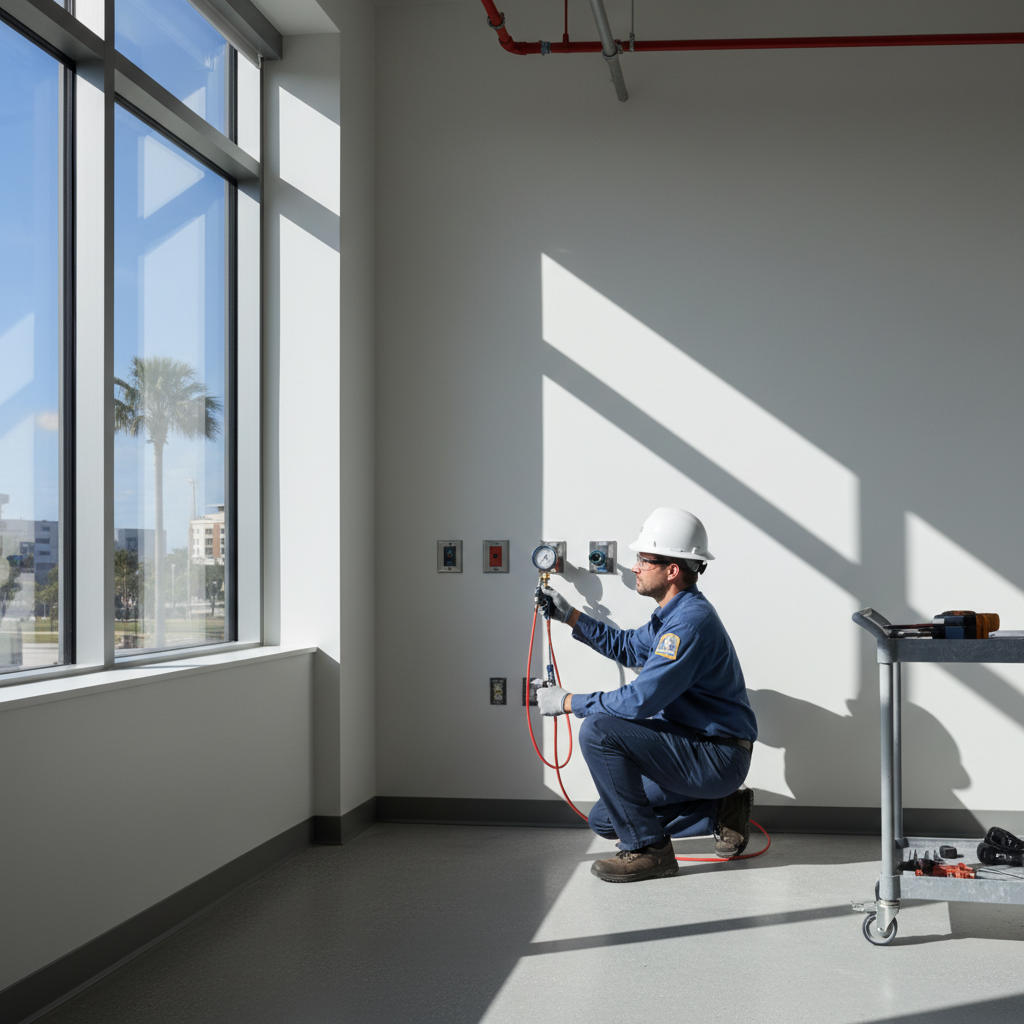
Medical gas verification is the comprehensive process of testing and documenting a newly installed or modified piped medical gas and vacuum system to confirm its integrity, safety, and readiness for patient use. It is performed by a credentialed ASSE 6030 Medical Gas Verifier. This is not a simple inspection; it is an exhaustive series of tests required by NFPA 99, Health Care Facilities Code, before a system can be put into service.
Verification ensures that:
The correct gas is flowing from each outlet.
The gas is pure and meets the requirements of the United States Pharmacopeia (USP).
The system can maintain proper pressure and flow rates.
All warning and alarm systems are functioning correctly.
The system is free of leaks and contaminants.
This process is distinct from an annual inspection. Verification is a one-time, in-depth certification for new, altered, or expanded systems, while annual medical gas inspections are periodic checks on existing, operational systems.
When is Medical Gas Verification Required?
According to NFPA 99 (2021 edition), a full system verification is mandatory under several circumstances:
New Construction: Any new healthcare facility with a piped medical gas system.
Additions or Renovations: When an existing system is extended, modified, or has new components added.
Major Repairs: After any significant repair, such as a mainline breach or component replacement.
Loss of Source Pressure: Following a catastrophic event like a hurricane that disrupts the system, re-verification may be required to ensure safety before reuse.
Why this matters for compliance: The Florida Agency for Health Care Administration (AHCA) requires documented proof of medical gas verification to satisfy its licensure and inspection requirements. Your verification reports, including AHCA OPS Form 3110, must be complete and accurate to avoid costly project delays or findings during a survey.
The ASSE 6030 Standard: Qualifying the Verifier
The American Society of Sanitary Engineering (ASSE) 6000 series provides the nationally recognized credentials for everyone who works on medical gas systems. The ASSE 6030 credential specifically qualifies an individual to perform system verification. An ASSE 6030 Verifier is a third-party agent responsible for independently testing and certifying that a system is compliant with NFPA 99 standards.
They are not the installer (who is typically an ASSE 6010 credentialed professional) or a maintenance person. The verifier must be an unbiased party with no conflicts of interest related to the system's installation. At Medical Testing Solutions, our team includes ASSE 6030 certified verifiers to conduct this critical work, in addition to our ASSE 6010 certified installers and maintenance technicians.
Medical gas certification is the ultimate outcome of a successful verification process. It provides the facility with the official documentation needed to prove compliance and-most importantly-to ensure patient safety.
The Verification Process: A Step-by-Step Overview
A full medical gas verification is a multi-stage process. While the exact procedures are detailed in NFPA 99, Chapter 5, here is a general overview of what a facility manager in Jacksonville can expect:
Initial System Inspection: The verifier first inspects the installed components, valves, alarms, and outlets, to ensure they match the design drawings and are correctly labeled.
Pressure Testing: The entire piping system is subjected to a high-pressure nitrogen test (typically 1.5 times the working pressure) for a set duration to check for leaks.
Cross-Connection Testing: This is a crucial test to confirm that each gas-specific outlet is connected to the correct source manifold. The verifier ensures that, for example, oxygen lines are not mistakenly connected to the medical air source.
Piping Purge Test: The lines are purged with high-volume nitrogen to remove any debris or contaminants left over from installation.
Particulate Testing: The verifier tests the gas at each outlet to ensure it is free from particulate matter.
Purity Testing: Samples are taken from each source and representative outlets to confirm the gas meets USP purity standards for identity, concentration, and freedom from contaminants.
Alarm & Warning System Testing: Every master alarm, area alarm, and local alarm is tested to ensure it activates under the correct fault conditions and reports accurately.
Final Documentation: The ASSE 6030 Verifier compiles a comprehensive report detailing the results of every test. This documentation is the official record that the system is ready for patient use and must be kept for the life of the system.
Florida-Specific Considerations for Jacksonville Facilities
Healthcare facilities in Jacksonville and across Florida face unique regulatory and environmental challenges. Partnering with a verifier who understands the local landscape is a significant advantage.
The AHCA and Joint Commission Factor
Florida facilities are primarily governed by the Agency for Health Care Administration (AHCA). Verification reports must be meticulously prepared to satisfy AHCA requirements, including Chapter 59A of the Florida Administrative Code. A verifier unfamiliar with these specific forms and standards can cause significant delays in getting your facility licensed and operational. Furthermore, The Joint Commission (TJC) places heavy emphasis on NFPA 99 compliance during its surveys of hospitals like UF Health Jacksonville or Baptist Medical Center Jacksonville.
Hurricane Re-Verification
NFPA 99 section 5.1.12 mandates system re-verification after any event that breaches the system, including storm damage or loss of source pressure. As a Florida-based company, Medical Testing Solutions understands this risk intimately. Our South Florida crews can mobilize quickly post-hurricane to assess and re-verify systems anywhere in the state, ensuring facilities can safely come back online as soon as possible.
The Cost Advantage of a Florida-Based Verifier
Choosing a local, Florida-based verification firm provides a distinct financial advantage. Most firms from outside the state must pass on significant travel-related costs to their clients.
As a company headquartered right here in Florida, Medical Testing Solutions eliminates those extra charges for clients anywhere in the state, from Jacksonville to Miami. Our Fort Lauderdale office is located at 501 East Las Olas Blvd, Ste 300, Fort Lauderdale, FL 33301.
Cost Comparison: In-State vs. Out-of-State Verifier
Cost Factor
MTS (Florida-Based)
Out-of-State Verifier
Travel Fees
$0 - No charge for vehicle mileage or travel time.
Often $1.00 - $2.50 per mile, plus travel hours.
Airfare
$0
Billed to client, often with administrative markup.
Lodging
$0
Billed to client for multi-day projects.
Per-Diem
$0 - No charges for meals or incidental expenses.
Billed to client at a fixed daily rate.
Typical Savings
Clients Save 10-25%
N/A
By choosing MTS for your medical gas verification, you are partnering with a local expert that provides premier service without the inflated cost. Explore our full range of services on our /florida/ hub.
Choosing the Right Verifier in Jacksonville
When selecting a partner for medical gas verification, look for:
Credentials: Ensure they employ currently certified ASSE 6030 Verifiers. Ask to see credentials.
Experience: The firm should have a long track record of verifying systems in facilities similar to yours.
Insurance: Verify they carry adequate liability and errors & omissions insurance.
Reputation: Check references and ask for examples of their documentation.
Local Knowledge: A firm that understands AHCA, hurricane protocols, and the Florida healthcare landscape, like our Fort Lauderdale-based team, will be a more effective partner.
Medical gas verification is a non-negotiable step in ensuring patient safety and regulatory compliance in any Jacksonville healthcare facility. The process, governed by NFPA 99 and ASSE 6030 standards, demands meticulous attention to detail and expert knowledge. By partnering with a certified, experienced, and Florida-based verifier, you not only guarantee compliance with AHCA and TJC but also achieve significant cost savings by eliminating travel expenses.
Ensure your next construction, renovation, or repair project is completed on time and on budget with a verification process you can trust.
Ready to ensure your facility is compliant, safe, and cost-effective? Call our Fort Lauderdale office today at +1 (754) 315-1078 or request a free quote online for your Jacksonville medical gas verification project.
Frequently Asked Questions
The duration depends on the size and complexity of the project. A small dental office renovation might take a day, while a new hospital wing could take a week or more. The verifier can provide a time estimate after reviewing the project scope.
Verification is the *process* of testing the system. Certification is the *outcome*—the final report and documentation that attest the system has passed all verification tests and is compliant with NFPA 99.
Only a credentialed ASSE 6030 Medical Gas Verifier who is a third party to the installation can perform the verification. The installer of the system cannot verify their own work.
If a system fails any part of the verification, the verifier will document the deficiency. The installer is then responsible for correcting the issue, after which the verifier will re-test that portion of the system until it passes.
NFPA 99 requires an independent, third-party verifier to prevent conflicts of interest. This ensures an unbiased assessment of the system's safety and compliance before it is used for patient care. Your in-house team is vital for ongoing maintenance, but the initial verification must be done by a certified third party.
Request a quote for your facility
Talk with Medical Testing Solutions about your next inspection, repair or equipment request.