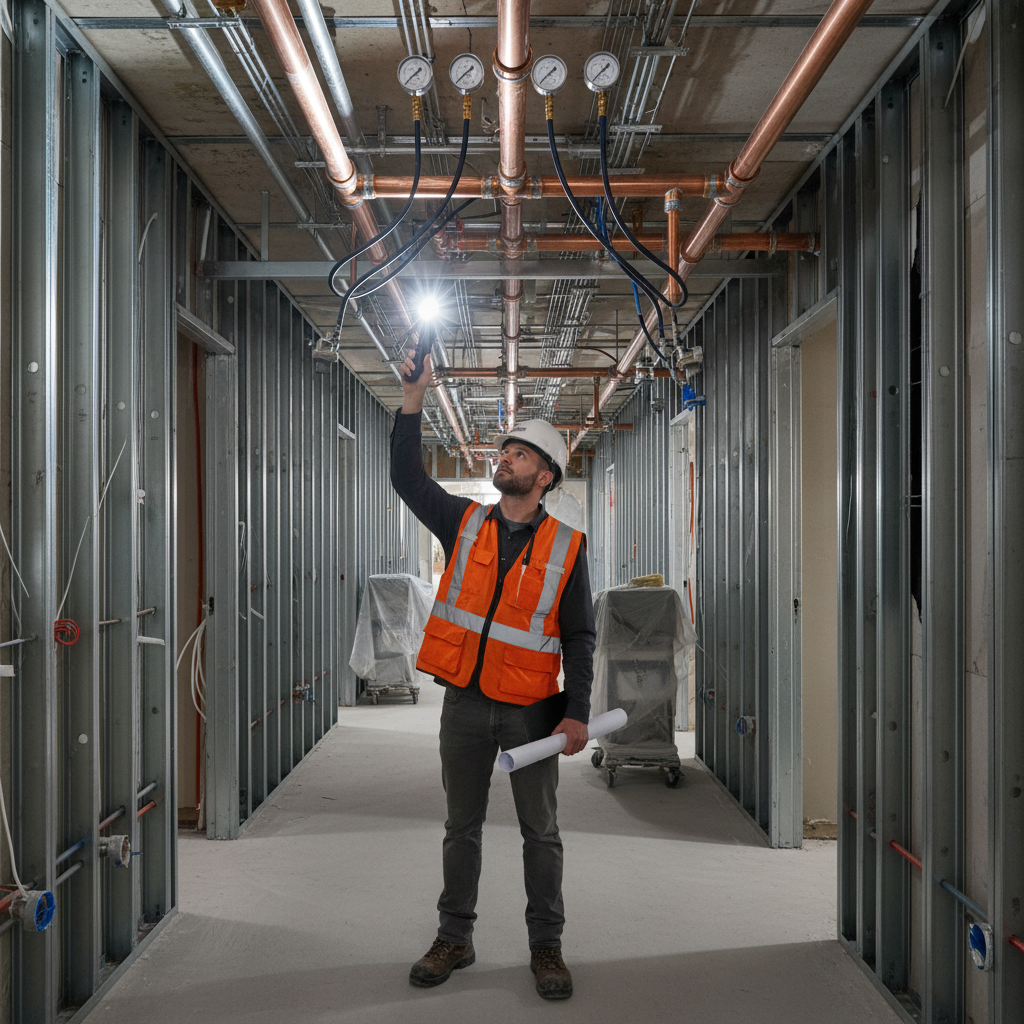
Walk onto a hospital expansion jobsite forty-eight hours before the drywall crew arrives, and you will often see a municipal building inspector staring up at an open ceiling plenum with a flashlight and a set of stamped mechanical drawings. Two bays over, the mechanical contractor is holding a calibrated test gauge at 150 psi on a newly brazed nitrogen riser, waiting for a signature so the general contractor can close the walls. If that municipal inspector pulls out their own pressure gauge, hooks up an oxygen analyzer to a zone valve port, or starts flowing nitrogen to check particulate levels, the project has already jumped the tracks of NFPA 99 compliance.
Confusion over ASSE 6020 medical gas inspector duties causes costly construction delays, failed state Department of Health surveys, and dangerous gaps in accountability. Facility directors and project managers frequently blur the line between a code enforcement inspection and a system verification. When you understand what an ASSE 6020 inspector is legally authorized to review, witness, and sign off on, and where their authority stops, you prevent finger-pointing between the plumber, the Authority Having Jurisdiction (AHJ), and the third-party verifier before the ceiling tiles ever drop into place.
The Regulatory Boundary: ASSE 6020 vs. ASSE 6030
The American Society of Sanitary Engineering (ASSE) 6000 Professional Qualifications Standard divides medical gas responsibilities into distinct silos for a reason: no single entity should grade its own homework, and code officials should not assume liability for dynamic life-safety testing. Under the ASSE/IAPMO/ANSI Series 6000 standard, an ASSE 6020 Medical Gas Systems Inspector is a person who is qualified to inspect the installation of medical gas and vacuum distribution systems to ensure compliance with plans, specifications, and adopted codes.
Typically, an ASSE 6020 credential is held by municipal plumbing or mechanical inspectors, state health department surveyors, commissioning agents, or owner-representative clerks of the works. Their primary mandate is visual, administrative, and observational. They review submittals, verify material markings before concealment, check hanger spacing, and witness the installer's initial tests.
They do not perform the final functional and analytical testing required to put a patient-care pipeline into clinical service. Under NFPA 99 Health Care Facilities Code (2021 and 2024 editions), Section 5.1.12.4, final system testing must be performed by an ASSE 6030 Medical Gas Systems Verifier employed by a party other than the installing contractor or system manufacturer. While an ASSE 6020 inspector checks that the copper tubing is properly supported and labeled, an independent firm performing ASSE 6030 medical gas verification connects calibrated analyzers, flowmeters, and transducers to certify gas identity, purity, pressure dew point, and cross-connection integrity at every terminal outlet.
| Scope Attribute | ASSE 6010 Installer | ASSE 6020 Inspector | ASSE 6030 Verifier |
|---|
| Primary Role | Physical assembly, brazing, and initial installer testing | Code enforcement, submittal review, and test witnessing | Final analytical, functional, and purity certification |
| Typical Employer | Mechanical / Plumbing Contractor | Municipality (AHJ), State DOH, or Owner's Rep | Independent Third-Party Testing Agency |
| NFPA 99 Section | 5.1.10 (Installation) & 5.1.12.2 (Installer Tests) | Adopted Building Code & AHJ Oversight | 5.1.12.4 (System Verification) |
| Hands-On Testing | Performs initial blowdown, pressure, and standing tests | None (Witnesses installer tests and checks gauges) | Performs cross-connection, purge, purity, and outlet flow tests |
| Brazing Qualification | Required (ASSE 6010 + ASME Section IX continuity) | Not required to braze; inspects completed joints and logs | Not required to braze; tests downstream particulate and purity |
Why this matters for compliance: If a project manager relies on a municipal ASSE 6020 rough-in sign-off as proof that a medical gas pipeline is safe for patient use, the facility violates NFPA 99 Section 5.1.12.1. Joint Commission and CMS surveyors require documented ASSE 6030 verification reports before granting accreditation or licensing a new clinical wing.
Pre-Construction Submittal and Credential Review
Long before a stick of copper tubing arrives on the loading dock, an ASSE 6020 inspector begins work at the plan review desk. A thorough submittal review stops non-compliant materials from ever entering the building. The inspector compares the mechanical engineer's stamped construction documents against the contractor's product data sheets to ensure every component meets the specific category requirements of NFPA 99 Chapter 5.
During this phase, the inspector verifies that all pressure piping materials specified are seamless, hard-drawn Type K or Type L copper tubing conforming to ASTM B819 (Standard Specification for Seamless Copper Tube for Medical Gas Systems). Standard ASTM B88 plumbing copper is strictly prohibited for positive-pressure medical gases because it lacks the strict internal cleanliness limits (maximum 0.0035 grams of carbon residue per square foot of internal surface area) required to prevent hydrocarbon ignition in high-pressure oxygen service. For vacuum and WAGD (Waste Anesthesia Gas Disposal) systems, the inspector checks whether ASTM B819, ASTM B88, or approved stainless steel tubing is permitted by the engineered specification and NFPA 99 Section 5.1.10.2.
Checking Installer Qualifications and Brazing Continuity
Material submittals are only half of the pre-construction gatekeeping. The ASSE 6020 inspector also audits the human credentials of the crew performing the medical gas installation. Under NFPA 99 Section 5.1.10.11.10, only qualified ASSE 6010 Medical Gas Systems Installers may assemble and braze medical gas piping.
The inspector requests and reviews three specific documents for every technician on the crew:
- A current ASSE 6010 wallet card or certificate verifying completion of the 32-hour training and examination.
- A Welding Procedure Specification (WPS) and Procedure Qualification Record (PQR) compliant with ASME Boiler and Pressure Vessel Code Section IX or AWS B2.2.
- Brazing continuity logs proving the installer has brazed with the qualified BCuP (copper-phosphorus) or BAg (silver) filler metal within the past six months without a lapse in certification.
If an installer's continuity log expired seven months ago, the ASSE 6020 inspector has the authority to bar that technician from touching a torch on the jobsite until they complete a new visual and mechanical bend or sectioning test Coupon per NFPA 99 Section 5.1.10.11.11. Catching an expired continuity log before rough-in prevents the nightmare scenario where an AHJ orders the contractor to cut out hundreds of linear feet of completed piping.
Jobsite Material Receiving and Storage Audits
Once submittals pass and materials arrive on site, the ASSE 6020 inspector conducts receiving and storage inspections. ASTM B819 copper tubing arrives from the mill cleaned, degreased, purged, and plugged or capped at both ends to maintain oxygen cleanliness. In the chaos of a multi-trade construction site, bundles of medical gas copper frequently get stacked near muddy laydown yards, Diesel lifts, or drywall sanding stations.
When walking the laydown area, the inspector looks for intact factory end caps on every length of tubing and bagged, factory-sealed boxes of wrought copper fittings (ASME B16.22). If a bundle of Type L copper has missing end caps, torn packaging, or visible drywall dust and moisture inside the bore, the ASSE 6020 inspector will reject the material on the spot. Under NFPA 99 Section 5.1.10.11.1, contaminated tubing cannot simply be wiped out with a rag; it must be either discarded or recleaned on-site strictly following CGA G-4.1 (Cleaning Equipment for Oxygen Service) protocols, which is rarely cost-effective for standard pipe runs.
The inspector also checks the valves staged for installation. Zone valves, riser valves, and service valves must arrive factory-sealed and labeled for oxygen service, featuring three-piece brass or bronze bodies that allow in-line maintenance, along with purge ports on both sides of the ball where specified. At Medical Testing Solutions, we supply facilities and contractors with compliant medical gas equipment and replacement parts that arrive pre-cleaned and packaged to pass these exact ASSE 6020 receiving audits without delay.
Rough-In Piping Inspection: What the 6020 Looks For
The open-wall rough-in inspection is the backbone of ASSE 6020 medical gas inspector duties. Once the drywall goes up and the hard ceilings are taped, the physical architecture of the piping network disappears for the next thirty years. An ASSE 6020 inspector walks every foot of the distribution network before concealment to verify compliance with NFPA 99 Section 5.1.10.
First, the inspector checks pipe routing and physical protection. Medical gas piping cannot be installed in kitchens, elevator shafts, electrical switchgear rooms, or areas with open flames. Where piping passes through masonry walls or floors, it must be sleeved cleanly so the copper does not bear structural loads or contact corrosive mortar. In concealed wall spaces where tubing runs vertically toward headwalls or zone valve boxes, the inspector verifies that steel striker plates protect the copper wherever it passes within 1.5 inches of the stud face.
Hanger Spacing and Dissimilar Metal Protection
Next, the inspector pulls a tape measure to check pipe supports and hangers against NFPA 99 Table 5.1.10.11.4.6. Improperly supported copper sags over time, creating low spots where moisture can accumulate in medical air lines and putting mechanical stress on brazed joints.
- 1/2-inch nominal pipe size (NPS) tubing requires supports every 6 feet (1.83 m).
- 3/4-inch and 1-inch NPS tubing require supports every 8 feet (2.44 m).
- 1-1/4-inch NPS and larger horizontal tubing require supports every 10 feet (3.05 m).
- All vertical risers must be supported at every floor, not to exceed 15 feet (4.57 m) between supports.
Just as critical as the spacing is the interface between the hanger and the copper tube. If a contractor hangs bare copper tubing directly inside a galvanized steel clevis hanger or steel unistrut clamp in a damp interstitial space, galvanic corrosion will eventually pit the outer wall of the pipe. The ASSE 6020 inspector verifies that copper-plated hangers, plastic inserts, or approved dielectric isolators separate the medical gas tubing from dissimilar metals.
Inspecting Brazed Joints and Nitrogen Purge Execution
During active installation, an ASSE 6020 inspector will often drop in unannounced to observe the brazing operation itself. Under NFPA 99 Section 5.1.10.4.5, every medical gas joint must be brazed while the interior of the tubing is continuously purged with oil-free, dry nitrogen NF. The nitrogen displaces ambient oxygen inside the heated pipe, preventing the formation of dark, flaky copper oxide scale on the interior walls. If copper oxide forms inside the pipe, it will later flake off under high-velocity gas flow and lodge in zone valve seats, anesthesia machines, or neonatal ventilators.
An experienced ASSE 6020 inspector does not take the installer's word that nitrogen is flowing. They walk to the open end of the pipe run being brazed to verify that a flow control device is discharging a gentle, steady stream of nitrogen (noticeable against the skin or via a flow indicator) and that the cylinder feeding the line is regulated down properly. They also check the brazing filler metal rods in the installer's pouch:
- Copper-to-copper joints must use BCuP series filler metal (typically 15% silver, such as BCuP-5) applied without flux.
- Copper-to-brass or copper-to-bronze joints (such as attaching tubing to a brass zone valve body or outlet rough-in assembly) require BAg series silver brazing alloy applied with a tiny amount of approved flux, avoiding any flux intrusion into the inside of the pipe.
After the joint cools, the inspector examines the exterior circumference. The outside of every fluxed BAg joint must be washed clean with warm water and a stainless-steel wire brush so residual flux does not corrode the metal, and the inspector looks for a smooth, complete fillet around the full 360 degrees of the socket without pinholes, cracks, or overheated base metal.
Zone Valve Boxes and Alarm Sensor Placement
Before approving rough-in, the ASSE 6020 inspector checks the placement of zone valve boxes and area alarm rough-in backboxes against NFPA 99 Section 5.1.4.6. This is one of the most frequent causes of failed inspections during healthcare renovations.
Zone valves for patient rooms and critical care areas must be located on the same floor they serve, immediately outside the vital life-support, critical care, or anesthetizing location. The inspector verifies that the zone valve box is not hidden behind a door swing (when the door is open or closed), is not installed inside a locked closet or medication room, and is positioned where a nurse can reach it in an emergency without entering the room where a fire is occurring. For category 1 anesthetizing locations (operating rooms), each room must have its own dedicated zone valve assemblies located immediately outside that specific OR. Furthermore, the inspector confirms that the pressure/vacuum gauge and area alarm sensor are tapped on the patient side (downstream) of the zone valve, whereas master alarm line-pressure sensors are tapped upstream of the main line valve.
Witnessing Installer-Performed Tests (NFPA 99 5.1.12.2)
Here is where the boundary between the ASSE 6010 installer, the ASSE 6020 inspector, and the ASSE 6030 verifier becomes crystal clear. Before any walls are closed and before the ASSE 6030 verifier is allowed to begin final verification, the installing contractor must perform a series of preliminary installer tests under NFPA 99 Section 5.1.12.2.
The ASSE 6020 inspector's duty is to witness these installer tests and sign the rough-in inspection logs. The inspector does not bring the nitrogen cylinders, does not operate the manifolds, and does not attach the test rigs. Instead, the 6020 inspector observes the 6010 installer performing the tests, inspects the calibration dates on the installer's gauges, and verifies the test parameters:
- Initial Blowdown (5.1.12.2.2): The installer purges the piping network with oil-free, dry nitrogen NF at a high flow rate to blow out any dust or construction debris before outlets and gauge components are installed.
- Initial Pressure Test (5.1.12.2.3): With rough-in station outlets capped and zone valves open, the installer pressurizes positive-pressure piping with oil-free, dry nitrogen NF to 1.5 times the system working pressure, but never less than 150 psi (1035 kPa). The ASSE 6020 inspector walks the entire exposed pipe run with the installer while every single brazed joint is coated with a leak-detecting solution that is safe for oxygen service and ammonia-free. Not a single bubble is permitted.
- Initial Cross-Connection Test (5.1.12.2.4): The installer pressurizes one pipeline system at a time to 50 psi (345 kPa) with oil-free, dry nitrogen while all other systems are vented to atmosphere, checking every rough-in outlet across all systems to confirm gas only flows from the intended system.
- Initial Piping Purge Test (5.1.12.2.5): The installer intermittently purges each outlet with high-velocity nitrogen until the discharge produces no discoloration or particulates on a clean white cloth held over the adapter.
- Standing Pressure Test for Positive Pressure (5.1.12.2.6): After station outlet bodies, zone valve gauges, and alarm sensors are installed, the installer pressurizes the system to 20% above normal operating line pressure for 24 hours. The ASSE 6020 inspector checks the gauge at the start of the 24-hour clock and again at the end; aside from pressure variations caused strictly by documented ambient temperature changes (roughly 0.3 psi per degree Fahrenheit), the gauge reading must hold steady at zero leakage.
- Standing Vacuum Test (5.1.12.2.7): For medical-surgical vacuum and WAGD networks, the installer subjects the piping to a 24-hour standing vacuum test at not less than 12 in. HgV (inches of mercury vacuum), or at the source operating vacuum, while disconnected from the vacuum pumps. At the end of 24 hours, the vacuum level inside the piping cannot have dropped past the allowable threshold (remaining at or above 12 in. HgV).
Why this matters for compliance: An ASSE 6030 verifier cannot legally perform final verification until they review the signed installer test logs witnessed by the ASSE 6020 inspector or AHJ. If those 24-hour standing pressure logs are missing or un-witnessed, the project stops cold until the documentation is satisfied.
Central Supply Systems and Source Equipment Inspection
Beyond the copper in the walls, the ASSE 6020 inspector evaluates the central supply rooms housing medical air compressors, medical vacuum pumps, cylinder manifolds, and bulk liquid oxygen (EOSC and main bulk) pads. During source room inspections, the 6020 focuses heavily on environmental, architectural, and mechanical code requirements found in NFPA 99 Section 5.1.3.
For manifold rooms storing nitrous oxide, carbon dioxide, or oxygen cylinders, the inspector verifies fire-resistance ratings of the walls, door swing direction, and locking hardware. Under NFPA 99 Section 5.1.3.3.2, indoor manifold enclosures must have dedicated mechanical or natural ventilation engineered to meet specific air intake and exhaust elevations (exhaust taken within 1 foot of the floor for heavier-than-air gases). The inspector also verifies room temperature controls: rooms housing nitrous oxide or carbon dioxide manifolds must be climate-controlled so ambient temperatures never drop below 20°F (-7°C) or rise above 125°F (51.6°C) for general cylinder storage, keeping liquefied compressed gases from losing vapor pressure or lifting relief valves.
In the medical air compressor room, the ASSE 6020 inspector traces the medical air intake pipe all the way to its outdoor termination point. Per NFPA 99 Section 5.1.3.6.3.12, the medical air intake must be located a minimum of:
- 25 feet (7.6 m) from any ventilating system exhaust, vehicle exhaust, loading dock, or vacuum system discharge.
- 20 feet (6.0 m) above ground level.
- 10 feet (3.0 m) above any roof, door, or window that opens.
The inspector also checks that the intake is turned downward and screened with corrosion-resistant mesh no Coarser than 1/4 inch to prevent birds and debris from entering the suction line. While the 6020 inspector verifies these physical clearances and confirms that duplex or multiplex compressors are wired to the essential electrical system (life safety or equipment branch as required), they leave the dew point hygrometer calibration, carbon monoxide monitor testing, and gaseous hydrocarbon ppm analysis to the ASSE 6030 verifier during medical gas certification.
Coordinating the Hand-Off to the ASSE 6030 Verifier
Once the walls are finished, headwalls are mounted, trim plates are snapped onto the station outlets, and source equipment is wired, the project transitions from the rough-in inspection phase to final verification. An ASSE 6020 inspector often remains involved during this hand-off, either as the municipal AHJ required for the Certificate of Occupancy (CO) or as the hospital's commissioning representative.
Understanding what the 6020 does during the 6030's visit prevents jobsite friction. When Medical Testing Solutions dispatches an ASSE 6030 verifier to a facility, our technician brings NIST-traceable analyzers, digital manometers, calibrated flowmeters, and gas-specific adapters to execute the tests mandated by NFPA 99 Section 5.1.12.4. An ASSE 6020 inspector may choose to walk alongside the 6030 verifier to witness portions of the final verification, such as master alarm signal trips, area alarm high/low pressure simulations, or source valve labeling checks.
However, the 6020 inspector does not dictate test methodologies that contradict NFPA 99, nor do they sign the ASSE 6030 verification affidavit as the verifier. Instead, the 6020 inspector reviews the completed ASSE 6030 verification binder to confirm that every outlet, valve, alarm, and source unit passed all analytical parameters (such as confirming oxygen concentration is $\ge$ 99.0% USP, medical air dew point does not exceed +35°F at operating pressure, and outlet flow rates hold at 100 L/min or 3.5 SCFM with less than 5 psi pressure drop for positive pressure gases). Once the 6020 confirms the 6030 verification report is clean and complete, the municipal inspector signs off on the final plumbing/mechanical permit so the building official can issue the Certificate of Occupancy.
Common Oversteps and Field Pitfalls to Avoid
Across hospitals, ambulatory surgery centers (ASCs), and dental surgery suites, three recurring mistakes derail inspections when stakeholders misunderstand ASSE 6020 duties:
1. The "Combo" Conflict of Interest
Some individuals hold multiple ASSE credentials, for example, both an ASSE 6010 Installer card and an ASSE 6020 Inspector or 6030 Verifier card. While holding multiple certifications shows deep technical expertise, NFPA 99 Section 5.1.12.4.1.2 explicitly forbids the installing contractor from performing the final verification on their own work. Similarly, an internal contractor supervisor holding an ASSE 6020 card cannot act as the independent AHJ inspector to waive code requirements on their company's installation.
2. Closing Walls Before the 6020 Rough-In Sign-Off
Fast-track healthcare renovations frequently push weekend drywall hangers into corridors before the municipal ASSE 6020 inspector has witnessed the 150 psi soap-bubble joint test or checked hanger spacing. When an ASSE 6020 inspector arrives on Monday morning to find freshly mudded drywall concealing un-inspected brazed joints, they have every legal right under the building code to order the general contractor to tear down the drywall along the entire pipe run. No amount of installer photos on a smartphone substitutes for a live rough-in inspection.
3. Skipping Ongoing Inspections After Occupancy
Many facility managers assume that once the ASSE 6020 inspector signs the building permit and the ASSE 6030 verifier certifies the new pipeline, regulatory scrutiny ends. In reality, NFPA 99 Chapter 5 requires ongoing periodic testing and preventive maintenance throughout the life of the building. State health inspectors and accreditation surveyors (who often hold ASSE 6020 credentials) will audit your facility's historical documentation every one to three years. Scheduling routine annual medical gas inspections and documented medical gas maintenance services with an ASSE 6030 and 6040 qualified team ensures your alarm panels, zone valves, outlets, and source equipment remain survey-ready long after the construction crew leaves.
Partnering with ASSE-Certified Experts
Keeping a healthcare construction or renovation project on schedule requires crystal-clear coordination between your installing contractor, your municipal or third-party ASSE 6020 inspector, and your independent ASSE 6030 verifier. At Medical Testing Solutions, our credentialed technicians work alongside facility directors, mechanical contractors, and municipal inspectors across Florida and nationwide to provide code-compliant installations, third-party ASSE 6030 verifications, annual inspections, and certified medical gas equipment.
If you have an upcoming hospital expansion, ASC build-out, or compliance audit and need independent verification or system support, request a quote online or call Medical Testing Solutions directly at (754) 315-1078 to speak with our ASSE-certified team.