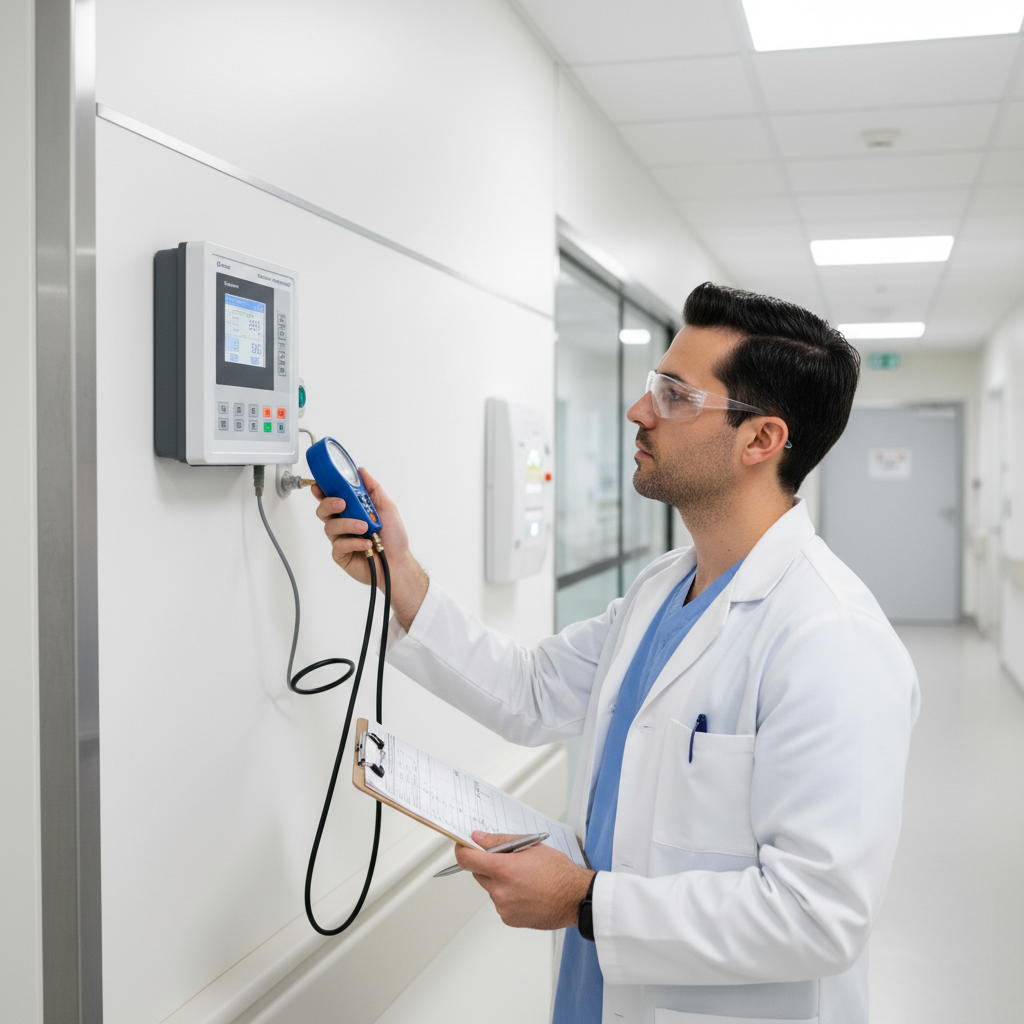
Master Alarm Panel Testing Jupiter FL: Inspection & Upgrades
Medical gas alarm panels serve as the sensory nervous system of any healthcare pipeline network. When source equipment drops pressure, reserve manifolds deplete, or surgical suite pipeline pressures fluctuate outside life-safety thresholds, alarm panels provide the critical audible and visual warnings staff need to intervene before patient safety is compromised. For healthcare facilities, outpatient surgical centers, and clinical laboratories in Jupiter, Florida, staying compliant with state and national codes requires rigorous, specialized oversight.
Medical Testing Solutions provides ASSE-certified master alarm panel testing in Jupiter, FL, serving regional facilities from Jupiter Medical Center to private specialty surgical practices along Military Trail and Indiantown Road. In this comprehensive guide, you will learn the exact testing protocols dictated by NFPA 99 (2024 edition), the operational differences between master and area alarm systems, how major equipment brands like BeaconMedaes, Amico, and Tri-Tech compare, and what our certified ASSE 6030 and ASSE 6040 technicians evaluate during functional compliance testing.
The Regulatory Framework: NFPA 99 Mandates for Jupiter Facilities
In the State of Florida, healthcare facilities are regulated under the Florida Agency for Health Care Administration (AHCA) and municipal fire prevention authorities. These entities enforce NFPA 99: Health Care Facilities Code, NFPA 101: Life Safety Code, and the Florida Building Code. When evaluating pipeline distribution, compliance hinges on strict adherence to NFPA 99 Chapter 5 (Gas and Vacuum Systems).
Under NFPA 99 Section 5.1.9, every Category 1 (deep sedation/general anesthesia) and Category 2 (moderate sedation) piped medical gas system must maintain continuous monitoring via dual master alarm panels and localized area alarm panels.
Why this matters for compliance: AHCA physical plant surveys and Joint Commission inspections routinely cite facilities for untracked alarm sensor drift, missing secondary panel communication, or failure to perform annual functional testing under NFPA 99 Section 5.1.14. A failed alarm signal during an audit can result in immediate conditional citations or delay the sign-off of newly renovated operating suites.
Annual testing is not simply a matter of pressing the "push-to-test" button on the front fascia. NFPA 99 requires true operational verification: simulating actual field conditions at the source switch or transducer, confirming physical signal transmission across building wiring, testing audible and visual alarm parameters, and ensuring the primary and secondary master panels mirror signals precisely. Our team executes these protocols as part of comprehensive annual medical gas inspections to keep Jupiter providers code-compliant year-round.
Master Alarm Panels vs. Area Alarm Panels: Core Differences
A frequent point of confusion among facility directors and clinical engineers is the operational distinction between master alarm panels and area alarm panels. While both units report system anomalies, they serve entirely different functions and protect different zones of care. | Diagram text | |, | | CENTRAL MEDICAL GAS SOURCES | | (Bulk O2, N2O Manifold, Med Air Compressors, Vacuum Pumps) | | MASTER PANEL 1 MASTER PANEL 2 | | (Engineering / (Security / 24/7 | | Boiler Plant) Control Desk) | | ZONE VALVE BOXES & RISERS | | AREA ALARM PANEL AREA ALARM PANEL | | (ICU / PACU) (OR Suite 1-4) |
Master Alarm Panels (NFPA 99, Section 5.1.9.2)
Master alarm panels monitor the central supply sources and main distribution lines. Every Category 1 facility must have at least two master alarm panels located in separate, monitored locations:
- One panel in the principal facility engineering office or boiler plant control room.
- The second panel in an area under continuous 24-hour observation (such as a 24/7 security dispatch, telephone switchboard, or central nurse monitoring station).
Master alarms monitor high/low main line pressures, bulk liquid oxygen supply levels, liquid cylinder reserve transitions, manifold bank switchovers, medical air dew point, medical air carbon monoxide (CO) levels, compressor reserve status, and medical vacuum system reserve operation.
Area Alarm Panels (NFPA 99, Section 5.1.9.5)
Area alarms monitor local pipeline pressures serving specific critical care zones, including:
- Operating rooms and surgical suites
- Post-anesthesia care units (PACU)
- Intensive care units (ICU/CCU)
- Emergency departments
- Endoscopy suites and cardiac catheterization labs
Area alarms must be installed within view and hearing distance of the main nursing station or monitoring point for that clinical zone. Sensors are tied directly to the pipeline on the patient side of the zone valve boxes. If pressure fluctuates by more than ±20% from normal line pressure (e.g., dropping below 40 psig or rising above 60 psig on a standard 50-psig system), the area alarm triggers immediately.
Leading Alarm Panel Manufacturers: BeaconMedaes, Amico, and Tri-Tech
At Medical Testing Solutions, our technicians service, inspect, calibrate, and install all primary medical gas alarm manufacturers. While all compliant panels meet NFPA 99 baselines, their architecture, sensor modularity, communication protocols, and replacement lifecycles differ considerably.
| Feature / Metric | BeaconMedaes (MegaSystem / TotalAlert) | Amico Corporation (Alert-2 / Mirage) | Tri-Tech Medical (Gen III / MedTouch) |
|---|---|---|---|
| Transducer Architecture | Digital, module-integrated, remote-capable | D-Sub connector-based, digital modular | Multi-variable digital, high-noise immunity |
| Display Technology | Color touchscreen LCD (TotalAlert) | High-contrast LED / Color Touchscreen | Color touchscreen with interactive menus |
| BMS Integration | Ethernet, BACnet IP, Dry Contacts | BACnet, Modbus, Dry Contacts | Ethernet, BACnet, Modbus, Remote Email |
| Field Reconfigurability | High (firmware/software configurable) | High (modular plug-and-play board upgrades) | Very High (simple field-swappable boards) |
| Common Failure Modes | Aging power supply capacitors, LCD dead zones | Sensor module drift, membrane button wear | Board-level fuse failures, ribbon cable wear |
| Retrofit Versatility | Fits Beacon backboxes; adapts to legacy | Excellent drop-in retrofit faceplates | Universal retrofit frame assemblies |
1. BeaconMedaes (TotalAlert Infinity Series)
BeaconMedaes is a legacy fixture across South Florida hospital networks. Their modern TotalAlert Infinity series features advanced networking capabilities, allowing master alarms to communicate across local area networks via BACnet to building automation systems (BAS). Testing these systems requires specialized knowledge of their digital communication protocols to ensure sensor loops do not generate false network interrupts during verification.
2. Amico Corporation (Alert-2 Series)
Amico's Alert-2 microprocessor-based panels are common in both ambulatory surgery centers and acute care hospitals in Palm Beach County. Amico panels utilize compact pressure transducers that can be mounted locally inside the panel backbox or remotely near zone valves. Common service issues include power supply module fatigue and calibration drift on older pressure sensor boards.
3. Tri-Tech Medical (MedTouch Series)
Tri-Tech systems are widely favored for their rugged construction and straightforward digital touchscreen interfaces. Their MedTouch series provides integrated email/text notifications for system alerts. During testing, verifying dry contact relay operation alongside active network triggers ensures that facilities with hybrid monitoring stay fully covered.
Whether your Jupiter facility utilizes legacy analog systems or modern Ethernet-connected touchscreen panels, our field inventory at Medical Testing Solutions includes replacement parts, transducer boards, and complete assemblies from all major brands available through our medical gas products catalog.
Step-by-Step Functional Testing Protocols: The ASSE 6040/6030 Procedure
True master and area alarm testing requires hands-on physical verification. NFPA 99 Section 5.1.14 explicitly prohibits relying purely on the internal board diagnostic button ("test" or "lamp test") to prove pipeline compliance. The lamp test verifies only that the panel's LEDs and audible buzzer illuminate and sound; it does not verify that the pipeline transducer, the wiring run, or the physical threshold trigger is functional. | Diagram text | |, | | PHYSICAL TESTING SEQUENCE | | [Step 1: Baseline Review] → [Step 2: Signal Isolation] → [Step 3: Source Depletion Test] | | [Step 6: AHCA Report] → [Step 5: Visual/Audio Check] → [Step 4: Transducer Calibrate] | Our technicians follow a systematic procedure aligned with ASSE 6040 (Maintenance Personnel) and ASSE 6030 (Medical Gas Systems Verifier) standards:
1. Pre-Testing Site Coordination and Notification
Prior to manipulating any signal, our technicians coordinate with clinical engineering, nursing supervisors, and central security dispatch. In critical care environments, unexpected audible alarms cause clinical alarm fatigue and unnecessary panic. We verify the facility's active procedures before applying test signals.
2. Physical Signal Simulation at Source Equipment
For master alarms, each monitored source signal is triggered at the actual mechanical device:
- Liquid Cylinder Reserve Transition: We manipulate the source manifold differential pressure control to simulate primary bank depletion, confirming that the "Reserve in Use" signal activates at both master panels within the specified delay.
- Bulk Cryogenic Low Liquid Level: We actuate the float sensor or verify differential pressure transmitter outputs.
- Medical Air Dew Point & CO: We introduce zero/span test gases or calibrate sensor loop signals to verify high dew point (> -22°F / -30°C) and elevated carbon monoxide (> 10 ppm) visual and audible enunciations.
- Compressor and Vacuum Lag Operation: We cycle mechanical lead/lag switches to confirm that "Lag Pump Running" conditions trip master annunciator lights.
3. Transducer Pressure and Vacuum Calibration
Using NIST-traceable calibrated digital test gauges, we verify pipeline pressure readings:
- For 50-psig systems (Oxygen, Medical Air, Nitrous Oxide, Carbon Dioxide), we bleed and pressurize test ports to ensure low-pressure alarms trip at 38–40 psig and high-pressure alarms trip at 60–62 psig.
- For 160–185 psig systems (Instrument Air and Medical Nitrogen), we verify operational triggers at ±20% deviation.
- For Medical Vacuum, we verify the alarm triggers when system vacuum drops below 12 in-HgV.
4. Dual Annunciation and Mute Function Auditing
NFPA 99 mandates that canceling an audible alarm on Master Panel 1 must not silence Master Panel 2. Both stations require independent audible re-enunciation if a second, unrelated fault occurs while the first condition is still muted. We confirm independent muting, audible decibel levels (minimum 80 dBA at 10 feet), and visual indicator latches.
5. Wiring Integrity and Ground Fault Auditing
We evaluate wiring between remote transducers and panel central processing boards. In operating environments where isolated power systems are installed alongside medical gas panels, our team coordinates with facility engineers on line isolation monitor (LIM) testing to verify that no electrical leakage currents or grounding loops interfere with digital signal accuracy.