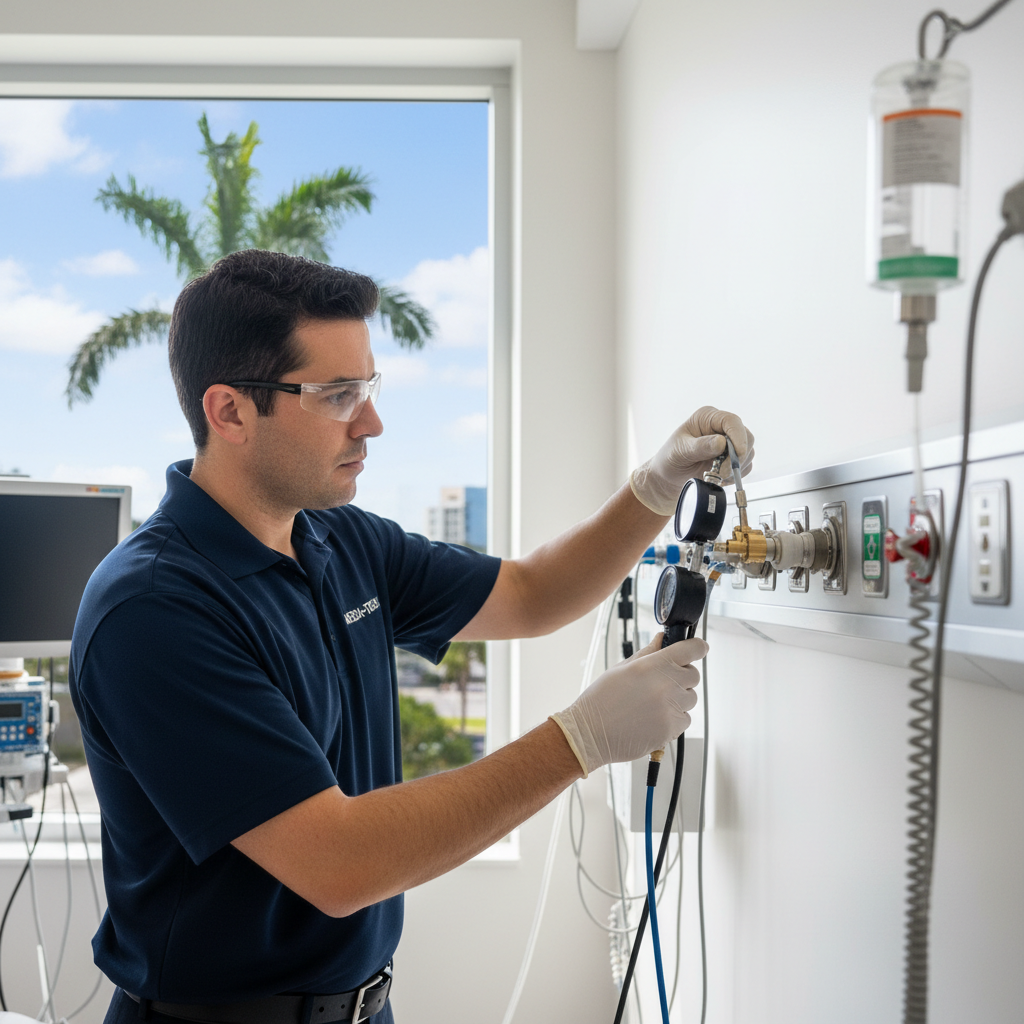
Medical Gas Testing in Miami, FL: Your Guide to NFPA 99 Compliance
Medical Testing SolutionsJune 1, 20265 min read
Share
Medical gas systems are the lifeblood of a modern healthcare facility. From oxygen and medical air to nitrogen and nitrous oxide, these systems are critical for patient care, surgical procedures, and life-support applications. Ensuring their safety, purity, and proper function is not just a best practice, it's a stringent legal requirement. For hospitals, ambulatory surgery centers (ASCs), and dental clinics in Miami-Dade County, this means rigorous adherence to national and state codes. This guide explains the critical requirements for medical gas testing in Miami, FL, and how a local, certified partner can ensure your facility remains safe, compliant, and always ready for inspection.
At Medical Testing Solutions (MTS), our ASSE-certified technicians provide comprehensive verification, inspection, and maintenance services across South Florida. We will cover the specific codes you must meet, the types of testing required, and the significant advantages of working with a Florida-based expert.
Why Local, ASSE-Certified Expertise Matters for Miami Facilities
When choosing a partner for medical gas services, proximity and certification are paramount. Medical Testing Solutions is headquartered at 501 East Las Olas Blvd, Ste 300, Fort Lauderdale, FL 33301, placing us right in your backyard. This isn't just a point of pride; it's a direct financial and logistical benefit for your facility.
Out-of-state verifiers must pass on their travel costs to clients. For facilities in and around Miami, this means paying for flights, hotels, and per-diem expenses. Most MTS clients save 10–25% on medical gas services precisely because we eliminate these overheads. With MTS, you get world-class expertise with no attached travel fees, anywhere in Florida.
Our local presence also means rapid response. When a system requires emergency service or post-hurricane re-verification, our South Florida crews can be on-site the same day, minimizing downtime and ensuring patient safety.
Meeting Florida's Strict Regulatory Standards: AHCA and The Joint Commission
Florida’s healthcare landscape is governed by a robust set of regulations. Two key bodies have specific requirements for medical gas systems: the Florida Agency for Health Care Administration (AHCA) and The Joint Commission (TJC).
AHCA Compliance
For any new medical gas installation or modification, AHCA requires a complete system verification. The results must be documented on AHCA Office of Plans and Construction (OPC) Form 3110. This form is a detailed checklist confirming that every component of your medical gas system, from the source equipment to the patient terminal, has been tested and passed according to Chapter 59A of the Florida Administrative Code and NFPA 99 standards.
Why this matters for compliance: Failure to provide a properly completed AHCA Form 3110 can delay your facility's licensure or certificate of occupancy. Working with a verifier who intimately understands Florida's specific documentation is non-negotiable.
The Joint Commission (TJC) Annual Requirements
TJC conducts rigorous surveys of healthcare facilities to ensure patient safety. Their standards defer to the NFPA codes. For medical gas systems, this means TJC surveyors will look for documentation of annual medical gas inspections to ensure ongoing safety and functionality. A complete, well-organized binder of testing reports from a certified provider like MTS is critical for a successful survey.
A full medical gas verification is a comprehensive battery of tests performed by an ASSE 6030 Certified Verifier. These tests confirm that the system is safe for patient use after construction or modification. Key tests include:
Purity Testing: Ensures the gas being delivered is the correct type and meets USP purity standards (e.g., Oxygen >99%).
Particulate Testing: Verifies the gas is free of solid contaminants by filtering a large volume of gas through a fine filter.
Piping Purge: Confirms high-volume, oil-free nitrogen has been used to purge any contaminants from the pipes after installation.
Initial Pressure Test: Confirms the piping has no leaks before wallboard is installed.
Standing Pressure Test: A 24-hour test that verifies the system is leak-free under pressure.
Cross-Connection Test: A critical test to ensure that gases cannot mix between different pipelines (e.g., ensuring you can't get nitrogen from an oxygen outlet).
Alarm Testing: Verifies that all master alarms, area alarms, and local alarms function correctly, warning staff of pressure drops or system changes.
Labeling and Valve Inspection: Confirms all pipes, valves, and outlets are correctly labeled according to the gas type.
These procedures are the foundation of patient safety, relied upon by major hospital systems like Jackson Memorial Hospital and Baptist Health South Florida.
The scope of testing differs significantly between a new installation and a routine annual inspection. A full verification is required after any new construction or system modification, while inspections are periodic checks.
South Florida is no stranger to hurricanes. NFPA 99, Section 5.1.12, mandates that a medical gas system must be re-verified if it is breached or loses pressure, which can easily happen during a severe storm or if the source is compromised. Having a local team is critical in these situations. Our crews at Medical Testing Solutions can mobilize quickly from our Fort Lauderdale office to facilities across Miami and South Florida to perform the necessary tests and get your systems back online safely. This rapid response is essential for maintaining care continuity after a natural disaster.
From initial construction and verification to ongoing maintenance and annual inspections, Medical Testing Solutions is the premier, Florida-based partner for healthcare facilities. We combine deep knowledge of NFPA, ASSE, and AHCA standards with the practical advantages of a local company. We serve all of Florida, with a heavy concentration in the South Florida region.
Ready to ensure your facility is compliant, safe, and cost-efficient? Contact our team today for a free, no-obligation quote.
Call our Fort Lauderdale office at +1 (754) 315-1078 or request a quote online to get started.
Frequently Asked Questions
Medical gas testing, also known as verification, is a series of tests performed on a facility's medical gas system to ensure it meets the safety, purity, and performance standards of NFPA 99. It is performed by an ASSE 6030 Certified Verifier and is required for new installations or modifications.
A full verification is required after any new pipeline installation or modification. Additionally, The Joint Commission and other accrediting bodies require annual inspections of the source equipment, warning systems, and patient outlets to ensure continued safe operation.
According to NFPA 99, medical gas verification must be performed by a party that is technically competent and experienced in the field of medical gas system testing and holds an ASSE 6030 "Medical Gas Verifier" credential.
If a system fails any part of the verification, the issue must be identified and corrected by the ASSE 6010 certified installer. The verifier will then re-test that portion of the system until it passes. The system cannot be used for patient care until it passes all required tests.
Yes. While we have a strong presence in Miami, our headquarters is in Fort Lauderdale, and we serve clients throughout Florida, including West Palm Beach, Orlando, Tampa, and Jacksonville. Because we are Florida-based, our clients across the state save money by avoiding travel fees.
An ASSE 6030 verifier is a professional who has completed a rigorous training program and passed an exam demonstrating their expertise in the complex testing procedures required by the NFPA 99 Health Care Facilities Code. This certification is the industry standard for medical gas system testers.
Request a quote for your facility
Talk with Medical Testing Solutions about your next inspection, repair or equipment request.