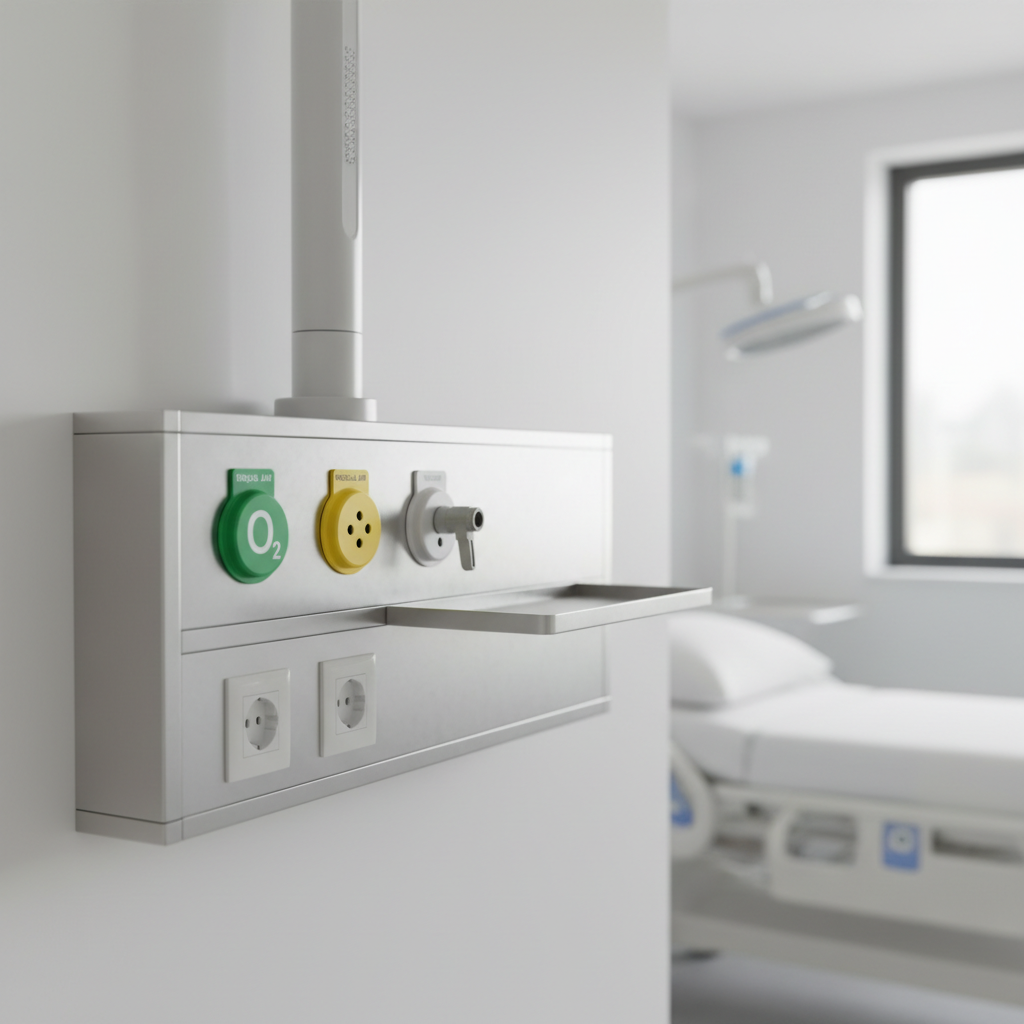
Medical Gas System Installation Cost 2026: A Full Breakdown
Medical Testing SolutionsAugust 25, 20267 min read
Share
Medical Gas System Installation Cost 2026: A Full Financial Breakdown
Installing or upgrading a medical gas system is a significant capital investment for any healthcare facility, from a multi-story hospital to a single-operatory dental clinic. Understanding the associated costs is critical for accurate budgeting, planning, and ensuring long-term compliance. This guide provides a definitive breakdown of medical gas system installation costs expected in 2026, covering everything from per-outlet pricing and permitting to the essential final certification.
Average cost ranges on a per-bed and per-outlet basis.
The financial impact of source equipment (manifolds, air compressors, vacuum pumps).
Budgeting for NFPA 99-required permitting, testing, and certification.
How factors like brazing and project complexity affect the final price.
Key Cost Drivers: What Influences Your Final Price?
The total cost of a medical gas installation isn't a single line item. It's a complex calculation based on several interdependent factors. The size and type of your facility are the most significant drivers, but system complexity, equipment choices, and labor are also major components.
Facility Type: A large, multi-story hospital has vastly different needs than a standalone surgical center or dental office. Hospitals require a wider range of gases (Oxygen, Medical Air, Vacuum, WAGD, Nitrogen, Nitrous Oxide) and have a much higher outlet count.
Outlet & Inlet Count: The single biggest variable. Every terminal outlet (e.g., for oxygen) and inlet (e.g., for vacuum) adds material and labor costs.
Source Equipment: The "heart" of your system. This includes manifolds for high-pressure cylinders, medical air compressors, and vacuum pumps. The size and redundancy required by NFPA 99 directly impact price.
Pipe Material & Size: The majority of piping is Type L or K copper, which has seen significant price volatility. The total linear footage and diameter of the pipe required are major material costs.
Labor & Expertise: Installation must be performed by certified ASSE 6010 credentialed technicians. Labor rates for these specialists are a significant portion of the budget. Medical gas installation requires a high degree of precision.
Permitting & Certification: Local permits and final system verification by an ASSE 6030 credentialed verifier are non-negotiable costs required for occupancy.
Cost Per Outlet vs. Cost Per Bed: 2026 Projections
Budgeting for a medical gas system is often done using "per outlet" or "per bed" metrics. These are useful for preliminary estimates but can vary widely.
Cost Per Outlet
This metric isolates the cost of adding a single medical gas connection point. It includes the outlet itself, a portion of the copper piping, and the labor to install it.
Typical Range: $900 - $2,500 per outlet.
What it includes: Rough-in (piping in the walls), the terminal outlet (DISS, Chemetron, Ohmeda, etc.), and initial pressure testing.
What it excludes: Source equipment, alarm panels, zone valve boxes, and final verification.
For example, a simple dental office needing only Oxygen and Nitrous Oxide might fall on the lower end, while an ICU room requiring multiple gases per headwall will be on the high end.
Cost Per Bed
This is a broader metric used for hospitals and larger facilities. It averages the total project cost over the number of patient beds.
Typical Range: $3,000 - $12,000+ per bed.
Factors Influencing the Range:
Low End: A standard patient room with one Oxygen and one Vacuum outlet.
High End: An operating room or ICU bed with multiple gases, high flow rates, and complex alarm requirements.
Why this matters for compliance: NFPA 99, Chapter 5 dictates the minimum gas services required for different patient care locations. For example, a Category 1 (critical care) space has more stringent requirements than a Category 3 (basic care) space, directly impacting the number of outlets and thus the cost per bed.
Source Equipment Costs: The System's Engine
Source equipment is the most expensive component of your medical gas system. These are not off-the-shelf items; they are specialized, NFPA 99-compliant machines designed for continuous, life-sustaining operation.
Equipment Type
Typical Cost Range (2026 Estimates)
Key Considerations
Duplex Medical Air Compressor
$25,000 - $80,000+
Sized based on peak demand (SCFM). Must be oil-free/oil-less.
Duplex Medical Vacuum Pump
$20,000 - $75,000+
Sized based on simultaneous use factor.
Automatic Changeover Manifold
$8,000 - $30,000+
For Oxygen, N2O, etc. Ensures uninterrupted supply from cylinder banks.
Master Alarm Panels
$3,000 - $10,000 per panel
Required by NFPA 99 to monitor system status.
Zone Valve Boxes
$1,500 - $5,000 per box
Allows individual areas to be isolated for maintenance or emergency.
Note: These prices are for equipment only and do not include installation labor, rigging, or electrical work.
As a leading provider of medical gas equipment, Medical Testing Solutions can help you select and source fully compliant machinery for your project. Explore our products catalog for more details.
The "Hidden" Costs: Permitting, Brazing, and Testing
Beyond pipe and pumps, several other critical activities contribute to the final invoice. These are often categorized under labor but involve specialized skills and processes.
Permitting
Before any work begins, plans must be submitted to the local Authority Having Jurisdiction (AHJ). Permit fees can range from a few hundred to several thousand dollars, depending on the project's scale.
Brazing (and the ASSE 6015 Certification)
NFPA 99 requires that all copper-to-copper connections in a medical gas system be brazed, not soldered. This process uses a filler metal (Brazing Filler Metal - BCuP series) at high temperatures and requires a continuous nitrogen purge to prevent internal oxidation, which could otherwise be catastrophic for patients.
Specialized Labor: Only ASSE 6015 certified braziers are qualified to perform this work.
Cost Impact: This specialized labor is more expensive than standard plumbing and is a significant cost factor. Every joint and fitting adds to the total labor time.
Verification & Certification (and the ASSE 6030 Verifier)
This is the final step before the system can be used for patient care. It is a comprehensive, multi-point inspection and testing process performed by a third-party ASSE 6030 certified verifier. Medical Testing Solutions specializes in providing this crucial medical gas verification service.
The verification process includes:
Initial piping purge and pressure tests.
Cross-connection tests to ensure gas lines were not mixed.
Purity analysis (particulate and gas concentration) for each gas.
Alarm and valve functionality testing.
Labeling verification.
The cost for this service can range from $3,000 to $20,000+, depending entirely on the system's size and complexity.
Putting It All Together: A Sample Project Estimate
Let's estimate a hypothetical 10-bed surgical center to illustrate how these costs combine:
Per-Outlet Cost (Rough-in): 50 outlets x $1,500/outlet = $75,000
Source Equipment:
Medical Air Compressor: $40,000
Medical Vacuum Pump: $35,000
Oxygen Manifold: $15,000
Alarms & Valves: ~$20,000
Final Verification (ASSE 6030): ~$10,000
Permits & Incidentals: ~$5,000
Estimated Total:$200,000 (or $20,000 per bed)
This is a simplified estimate. Real-world costs will vary. For a precise budget, it's essential to get a detailed quote based on your architectural plans.
Get an Accurate Quote for Your 2026 Installation
Budgeting for a medical gas system installation requires precision. While these figures provide a strong baseline for 2026, the only way to get a firm cost is to have your plans reviewed by certified professionals.
At Medical Testing Solutions, our ASSE 6010 certified team provides expert installation services, and our ASSE 6030 verifiers ensure your system is compliant from day one. Contact us today for a detailed, no-obligation quote based on your facility's unique needs.
NFPA 99 mandates annual inspections for all medical gas systems. These checks ensure ongoing safety, performance, and compliance. Medical Testing Solutions provides comprehensive annual medical gas inspections to keep your facility compliant.
An ASSE 6010 certification is for installers; these are the professionals who physically build the system. An ASSE 6030 certification is for verifiers; they are the independent third-party inspectors who test and certify that the system is safe and ready for patient use.
No. You must use specific medical-grade Type K or Type L copper tubing that has been cleaned for oxygen service by the manufacturer. All joints must be brazed, not soldered, by an ASSE 6015 certified individual.
Yes. Any facility that uses medical gases, including dental offices using Nitrous Oxide and Oxygen for sedation, must comply with the relevant sections of NFPA 99. This includes proper installation, storage, and system maintenance.
WAGD stands for Waste Anesthetic Gas Disposal. It is a vacuum system specifically designed to scavenge waste anesthetic gases from operating rooms to protect staff from exposure. It is required in any location where inhalational anesthetic agents are administered.
Request a quote for your facility
Talk with Medical Testing Solutions about your next inspection, repair or equipment request.