Medical Gas System Commissioning in Pompano Beach FL: Your NFPA 99 Guide
For any new healthcare facility construction in Pompano Beach, Florida, the proper commissioning of your medical gas and vacuum systems isn't just a line item on a punch list, it's a critical, non-negotiable step for patient safety and regulatory compliance. Commissioning is the final, intensive validation that ensures your newly installed piping is clean, correct, and ready for patient use. This guide will walk you through the essential requirements for medical gas system commissioning as outlined in NFPA 99, focusing on the critical tests for particulate, purity, and cross-connection that every Pompano Beach healthcare facility must pass.
What is Medical Gas System Commissioning?
Medical gas system commissioning is the comprehensive process of testing and documenting that a newly installed or modified medical gas system meets the stringent requirements set by the National Fire Protection Association (NFPA). Specifically, for new constructions, this process is governed by NFPA 99, Health Care Facilities Code, section 5.1.12. This isn't a simple "pass/fail" inspection; it's a detailed verification performed by an ASSE 6030 certified third-party, like Medical Testing Solutions. The goal is to ensure that the medical gas delivered to patient outlets is precisely what it's supposed to be, and nothing else.
Why This Matters for Compliance: Failure to properly commission a medical gas system can result in catastrophic patient harm and immediate facility shutdown by regulatory bodies like the AHCA in Florida. Proper commissioning is your final sign-off that the system is safe and compliant before the first patient is seen.
The Three Pillars of Commissioning: Particulate, Purity, and Cross-Connection
NFPA 99 lays out a specific sequence of tests to validate the integrity of the piping system. Think of these as the three pillars of a safe system. Before any of these tests begin, the system must undergo an initial pressure test and a standing pressure test to ensure there are no leaks.
1. Particulate Testing
The first flow test performed on the system is the particulate test. The goal is to ensure the piping is free from construction debris.
- Procedure: A high flow of nitrogen (NF) is used to purge the system. At the outlet or use point furthest from the source, a white 1.0-micron filter is placed. A minimum of 1000 liters of nitrogen is flowed through the filter.
- Passing Criteria: The filter must show no discoloration and no more than a few specks of debris. Any significant contamination indicates a failed test and requires the system to be re-cleaned and re-tested.
- Relevance: This test confirms that the medical gas installation was performed correctly, with proper purging and brazing techniques to prevent introducing contaminants.
2. Purity Testing
Once the system is proven to be free of particulates, the next step is to test for the purity of the gas. This ensures that no contaminants were introduced during the construction process.
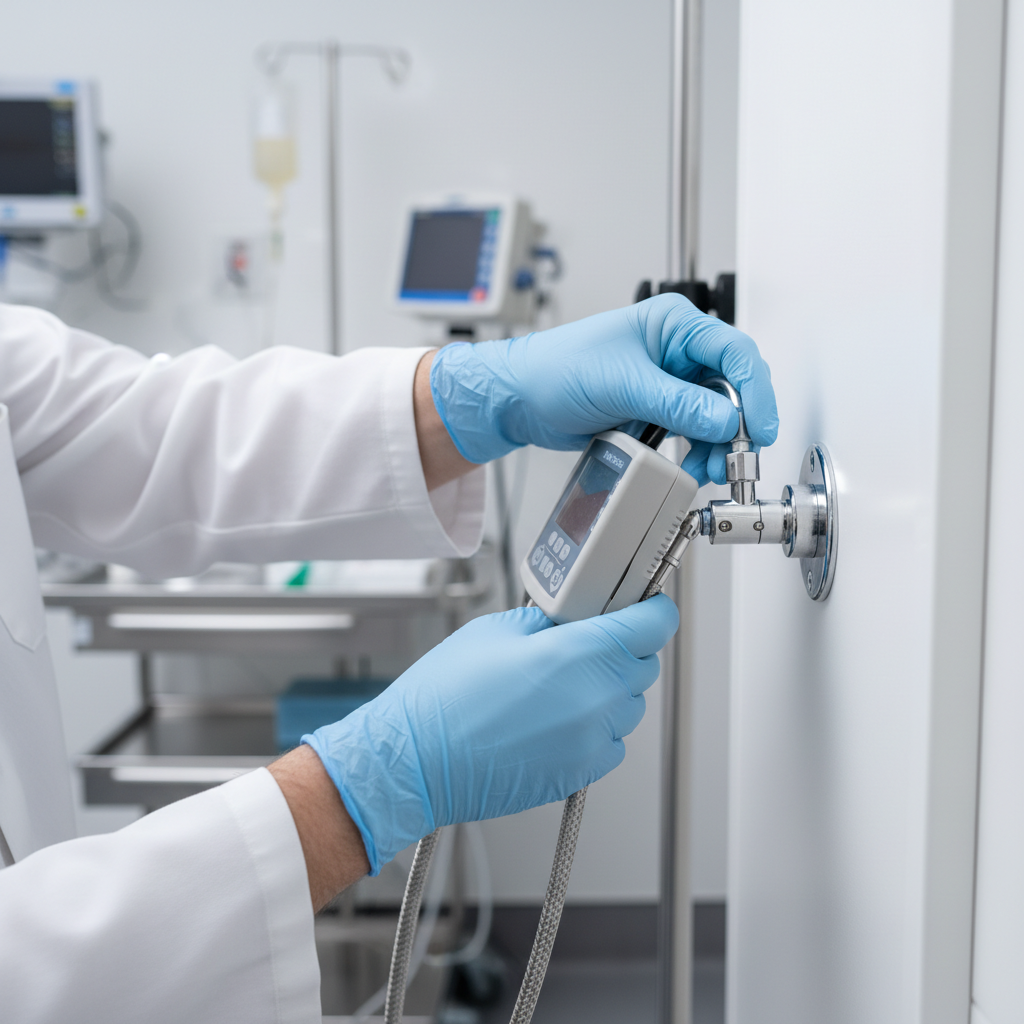
- Procedure: An instrument known as a gas analyzer is used to sample the nitrogen from each source gas outlet. The test measures the concentration of contaminants.
- Passing Criteria (per NFPA 99):
- Dew Point: < -20°C (4°F) or 500 ppm
- Total Hydrocarbons (as methane): < 25 ppm
- Halogenated Hydrocarbons: < 2 ppm
- Carbon Monoxide: < 10 ppm
- Importance: This step verifies that the system is clean and that there are no residual oils, fluxes, or other harmful substances from the installation process.
3. Cross-Connection Testing
This is arguably the most critical test in the entire commissioning process. A cross-connection could mean delivering the wrong gas to a patient, for example, nitrogen instead of oxygen, with fatal consequences.
- Procedure: The test is performed by systematically pressurizing each gas system (Oxygen, Medical Air, Nitrous Oxide, etc.) one at a time with nitrogen. While one system is pressurized, all other systems are open to the atmosphere at the source. The technician then checks every single outlet in the facility with a gas-specific adapter to ensure that gas is only coming from the intended outlet.
- Example: When the oxygen system is pressurized with nitrogen, the technician will confirm that pressure is felt only at the oxygen outlets. They will simultaneously confirm there is no flow from the medical air, vacuum, or any other outlet. This process is repeated for every single gas and vacuum line in the facility.
- Final Verification: After the individual tests, a final verification is done with the actual source gases to ensure 100% certainty. For this, Medical Testing Solutions uses a calibrated gas analyzer to confirm the identity and concentration of the gas at each outlet.