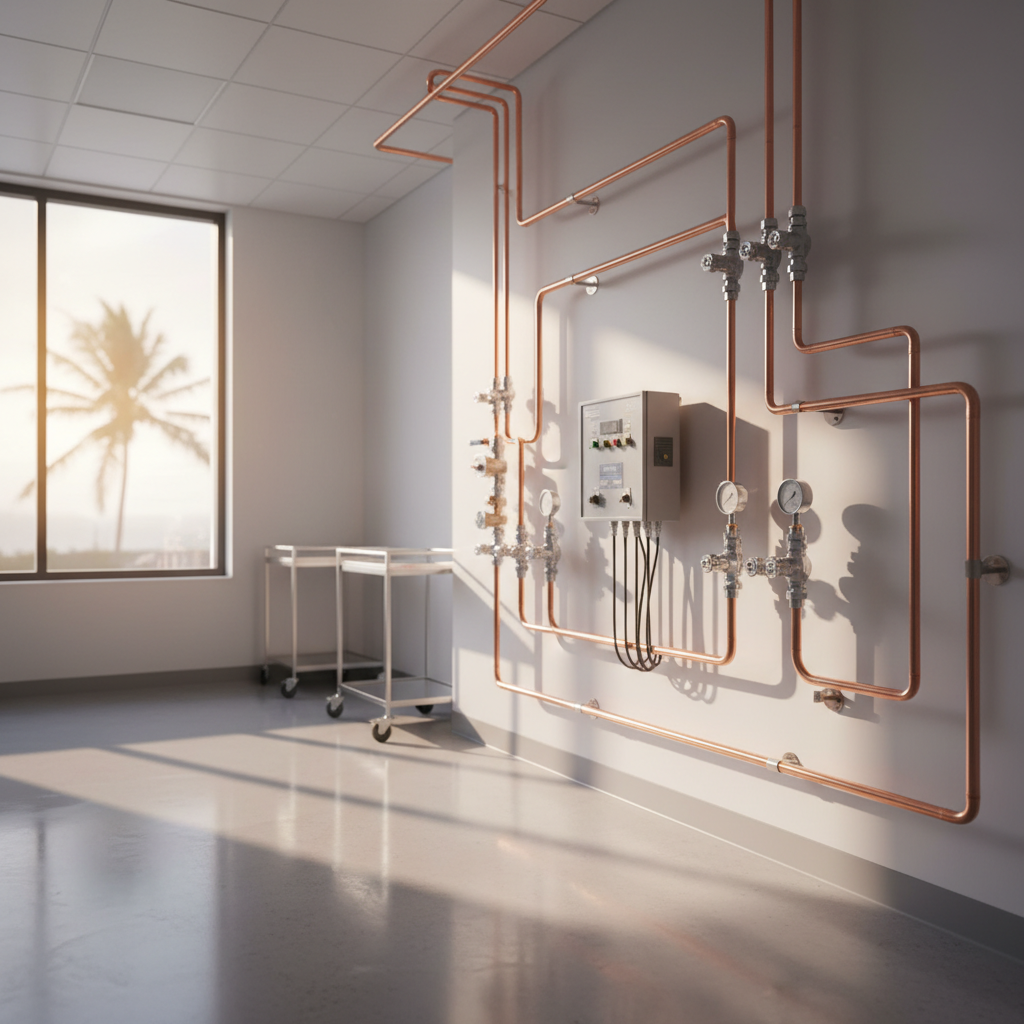
Medical Gas System Commissioning in Miami FL: Your NFPA 99 Guide
Medical Testing SolutionsJune 4, 20266 min read
Share
New construction or a major renovation of a healthcare facility in Miami is a complex undertaking. Among the myriad of systems that need to be expertly installed and checked, the medical gas system is arguably the most critical for direct patient life support. Before a single patient can be connected, the system must undergo a rigorous validation process known as commissioning. This final step ensures the system is not only safe and leak-free but also compliant with stringent national and state regulations.
This definitive guide walks you through the medical gas system commissioning process as it applies to facilities in Miami and throughout Florida. You will learn what NFPA 99 requires, understand Florida-specific compliance rules from AHCA, and discover how partnering with a local, ASSE-certified firm like Medical Testing Solutions can save you time, money, and significant compliance headaches.
What is Medical Gas System Commissioning?
Medical gas system commissioning is the comprehensive process of testing and documenting a newly installed or modified piped medical gas system to ensure it is safe, effective, and ready for patient use. It's the final quality control check performed by a third-party ASSE 6030 Certified Verifier after the ASSE 6010 installer has completed their work. The entire process is meticulously outlined in NFPA 99, Health Care Facilities Code, Section 5.1.12, "Final Verification of Piped Gas and Vacuum Systems."
This is not a simple pressure check. Commissioning involves a battery of tests to confirm piping integrity, gas purity, and component functionality. It serves as the ultimate guarantee that the oxygen outlet in a patient room delivers pure oxygen and not nitrogen, and that the vacuum system provides suction without contamination. For facilities in Miami-Dade, from a large campus like Jackson Memorial Hospital to a new surgical center in Aventura, this process is non-negotiable.
The NFPA 99 5.1.12 Commissioning Process: A Step-by-Step Breakdown
An ASSE 6030 Verifier follows a strict protocol to ensure every component of the medical gas system is safe and functional. While every project is unique, the core tests are standardized by NFPA 99.
Initial System Verification (Piping Integrity)
The first step is to ensure the pipes themselves are sound and correctly connected.
Cross-Connection Test: This is the most critical test of the entire process. The verifier individually pressurizes each gas system (e.g., Oxygen) with nitrogen and checks all other gas systems to ensure no pressure registers. This confirms that a construction error has not connected, for example, the oxygen pipeline to the nitrogen pipeline. A failure here could be catastrophic.
Piping Purge: High-volume, oil-free nitrogen is blasted through the pipes to remove any debris or contaminants left over from the medical gas installation process.
Standing Pressure Test: The system is pressurized and held for a set period (typically 24 hours) to verify there are no leaks in the piping network. This ensures the system is gas-tight and efficient.
Particulate, Purity, and Final Tie-In Tests
Once the piping integrity is confirmed, the focus shifts to the quality of the gas itself.
Particulate Testing: The verifier flows gas through a filter at every outlet to test for solid contaminants. This ensures the pipes are clean inside and won't deliver harmful debris to a patient.
Purity Testing: Using specialized analyzers, the verifier confirms the concentration and identity of the gas at each outlet. They ensure Oxygen is ≥99% pure, Nitrogen is ≤1% oxygen, and so on for every gas in the system.
Final Tie-In Verification: After confirming the new piping is clean and correct, the verifier oversees the physical connection of the new system to the facility's existing source equipment.
Alarm and Component Verification
Finally, the verifier tests all the warning and safety systems.
Alarm Testing: This involves testing every master alarm, area alarm, and local alarm to ensure they activate at the correct high/low pressure setpoints. This is crucial for alerting staff at Baptist Health or Broward Health to potential system issues before they become critical.
Source Equipment Verification: The verifier confirms that all compressors, vacuum pumps, manifolds, and other source equipment function according to NFPA 99 specifications.
Why this matters for compliance: Proper commissioning generates a meticulous, multi-page report that serves as legal proof of compliance. This documentation is mandatory and will be scrutinized by accrediting bodies like The Joint Commission (TJC) and the Florida Agency for Health Care Administration (AHCA).
Florida-Specific Commissioning Requirements
While NFPA 99 is the national standard, healthcare facilities in the Sunshine State have additional layers of regulatory oversight. As a Florida-based company, Medical Testing Solutions is intimately familiar with these local requirements.
Our verification reports are specifically designed to satisfy AHCA OPS Form 3110 and the stringent requirements of Chapter 59A of the Florida Administrative Code. We understand what Florida regulators look for and provide the exact documentation needed for a smooth approval process.
Hurricane Re-Verification: The South Florida Reality
NFPA 99 (5.1.12) also mandates system re-verification after a catastrophic event, such as a hurricane that causes widespread power loss or potential damage to source equipment. For hospitals in Miami, Fort Lauderdale, and West Palm Beach, this is a critical preparedness plan. Our South Florida crews can be dispatched rapidly post-storm to re-verify your systems, ensuring you can safely re-open and serve the community. This local presence is a significant advantage when time is of the essence.
The MTS Advantage: Why Local Matters for Miami Hospitals
For years, Florida facilities often had to hire verifiers from Georgia, the Carolinas, or even further afield. This invariably added significant costs and delays. Medical Testing Solutions was founded to solve this problem. Our headquarters is right here in Florida, at 501 East Las Olas Blvd, Ste 300, Fort Lauderdale, FL 33301.
Significant Cost Savings
By choosing a local Florida-based verifier, you eliminate major expenses from the budget. Most of our clients save 10-25% on commissioning costs. Here's how:
Cost Category
Out-of-State Verifier
Medical Testing Solutions (Local)
Travel Fees (Airfare, Rental Car)
$500 - $1000
$0
Lodging (Hotel)
$800 - $1500+
$0
Per-Diem (Meals)
$350 - $700+
$0
Total "Soft" Costs
$1650 - $3200+
$0
These savings go directly to your bottom line, allowing you to allocate resources to other critical areas. We offer expert medical gas verification services across the state, from Miami to Jacksonville and Tampa to Orlando.
Your Partner for Compliant Medical Gas Systems in Miami
Ensuring your new medical gas system is ready for patient care is a responsibility that cannot be taken lightly. The commissioning process is the final, vital step in guaranteeing safety and compliance. By partnering with a local, ASSE-certified team that understands Florida's unique regulatory and environmental landscape, you protect your patients, your facility, and your budget.
Ready to schedule your NFPA 99 commissioning in the Miami area or anywhere in Florida? Call our Fort Lauderdale office today for a same-day quote.
Contact Medical Testing Solutions at +1 (754) 315-1078 or request a quote online to ensure your new construction is safe, compliant, and ready for patient care.
'''
Frequently Asked Questions
The duration depends on the size and complexity of the project. A small dental office might take a single day, while a new hospital wing in Miami could take a week or more. We provide a detailed time estimate with every quote.
If a deficiency is found, such as a leak or a cross-connection, we immediately notify the on-site installer and facility manager. The installer must correct the issue, and then we re-test that specific part of the system until it passes.
Yes. According to NFPA 99, any new construction or modification to an existing medical gas system requires verification by an ASSE 6030 certified professional before being put into service.
NFPA 99 requires the system to be verified by a party other than the installer to ensure unbiased, third-party validation. This prevents conflicts of interest and ensures the highest level of safety. An installer is typically ASSE 6010 certified, while a verifier is ASSE 6030 certified.
You will receive a comprehensive, multi-page report detailing the results of every test performed on every outlet and component. This report is your proof of compliance for AHCA, TJC, and your internal records, often referenced during annual medical gas inspections.
Costs vary based on project size (number of outlets, zones, and sources). However, by using a local Florida verifier like MTS, you are guaranteed to save on travel, lodging, and per-diem costs, which can reduce the total price by 10-25%.
Request a quote for your facility
Talk with Medical Testing Solutions about your next inspection, repair or equipment request.