Medical Gas Manifold Sizing, Redundancy & NFPA 99 Guide
Medical Testing SolutionsAugust 4, 20268 min read
Share
Medical Gas Manifold Sizing, Redundancy & NFPA 99: A Definitive Guide
The medical gas manifold is the heart of a healthcare facility's gas delivery system, a critical component ensuring the uninterrupted flow of life-sustaining gases to patient areas. Yet, its complexity is often underestimated. Improper sizing, inadequate redundancy, or non-compliance with NFPA 99 standards can pose significant risks to patient safety and leave a facility vulnerable to operational disruptions and legal liability. For hospital administrators, facility managers, and clinical staff, understanding the principles of manifold design and function is not just a technical matter, it's a fundamental aspect of patient care.
This comprehensive guide provides a definitive overview of medical gas manifolds from an ASSE-certified perspective. We will dissect the core requirements of NFPA 99, explain how to approach sizing calculations, compare different manifold configurations, and detail the necessary alarm and redundancy features. By the end of this article, you will have a robust understanding of how to ensure your facility's manifold system is safe, compliant, and always reliable.
What is a Medical Gas Manifold and Why is it Critical?
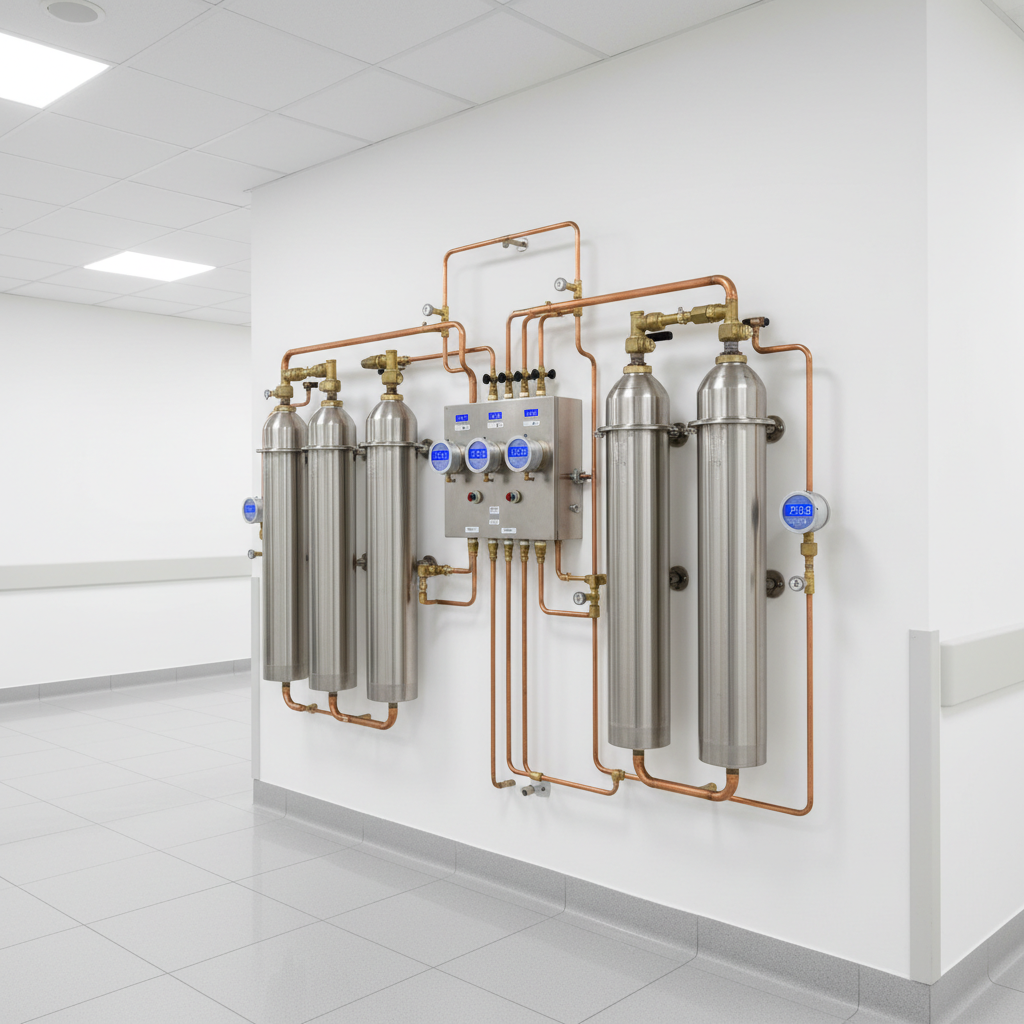
A medical gas manifold is an engineered system designed to deliver a specific medical gas from high-pressure cylinders to the facility's piped gas distribution system. It acts as the primary supply source, regulating the pressure from the cylinders (which can exceed 2200 PSI) down to a standard, safe line pressure (typically 50-55 PSI). Think of it as the central hub that manages the transition from bulk storage to the point of use, whether it's a ventilator in the ICU or an anesthesia machine in the operating room.
Its criticality cannot be overstated. A failure in the manifold system means a complete shutdown of the gas supply. For patients dependent on medical oxygen or nitrous oxide, such a failure can be catastrophic. This is why NFPA 99 and other regulatory standards place such a heavy emphasis on their design, installation, and ongoing maintenance.
Decoding NFPA 99: Core Manifold Requirements
The National Fire Protection Association's standard, NFPA 99, Health Care Facilities Code, is the preeminent code governing medical gas systems in the United States. It outlines specific, legally enforceable requirements for the design, installation, testing, and maintenance of manifolds.
According to NFPA 99, Chapter 5, "Gas and Vacuum Systems," a manifold must:
Be located in a dedicated room or enclosure: This area must be constructed of noncombustible materials and be properly ventilated. Its access must be restricted to authorized personnel.
Have two independent sources of supply (redundancy): For any central supply system, there must be a primary supply, a secondary supply, and often a reserve supply. The manifold is key to managing these.
Incorporate specific safety features: This includes pressure relief valves, check valves to prevent backflow, and source valves to isolate banks for service.
Connect to the master alarm system: The manifold must trigger alarms for specific events, such as when it changes over to the secondary supply.
Why this matters for compliance: Failure to adhere to NFPA 99 is not just a safety issue; it's a compliance violation that can lead to costly fines, loss of accreditation (e.g., from The Joint Commission), and severe legal consequences in the event of an adverse patient event. Regular, certified inspections are essential to verify and document compliance.
Critical Considerations for Manifold Sizing
Sizing a medical gas manifold is a complex calculation, not a one-size-fits-all estimate. An undersized manifold can lead to pressure drops during peak demand, while an oversized one is an unnecessary capital expense. Sizing must be performed by a qualified engineer or an ASSE 6010 certified professional who can accurately calculate the facility's peak flow demand.
Key factors in this calculation include:
Facility Type: A large, trauma-designated hospital will have a vastly different demand than a small dental surgery center.
Number and Type of Terminals: The total count of gas outlets and inlets for each specific gas.
Diversity Factor: A crucial variable that accounts for the fact that not all terminals will be used simultaneously. NFPA 99 provides guidance on applying diversity factors based on the number of stations.
Specialty Areas: Operating rooms, ICUs, and emergency departments have higher and more critical gas demands than standard patient rooms.
Accurate sizing ensures the manifold can handle the "worst-case scenario" peak demand without failing, providing a continuous and stable gas supply.
Types of Medical Gas Manifolds: A Head-to-Head Comparison
Medical gas manifolds are categorized based on their method of switching between cylinder banks. The three primary types are single header, duplex, and automatic changeover. Each has distinct applications, benefits, and limitations.
Single Header Manifolds
A single header is the most basic configuration, consisting of a single bank of cylinders. It has no redundancy. When the cylinders are depleted, the gas supply is interrupted until they can be manually replaced. For this reason, NFPA 99 strictly limits their use to situations where immediate replacement is possible and a loss of supply would not have critical consequences.
Duplex Manifolds
A duplex manifold provides a higher level of safety and is a common configuration. It consists of two separate cylinder banks: a "primary" and a "secondary" (or reserve) bank. When the primary bank is depleted, the system must be switched over to the secondary bank. This can be a manual process (requiring a staff member to physically turn valves) or a semi-automatic one. While it provides redundancy, it still requires human intervention, which introduces a potential delay.
Fully Automatic Changeover Manifolds
This is the gold standard for healthcare facilities and is required for all life-support gases like oxygen. An automatic changeover manifold automatically detects the drop in pressure as the primary bank depletes and seamlessly switches to the secondary bank, with no interruption in service. Simultaneously, it triggers a "changeover" alarm at the master alarm panel, notifying facility staff that the primary bank needs to be replaced. This provides continuous, uninterrupted gas flow without relying on immediate human action.
Manifold Configuration Comparison
Feature
Single Header
Duplex (Manual)
Automatic Changeover
Redundancy
None
Yes (Primary + Secondary)
Yes (Primary + Secondary)
Switchover
Manual (interrupts flow)
Manual (interrupts flow)
Automatic (no interruption)
NFPA 99 Compliance
Very limited use
Limited use; not for life support
Required for life support gases
Use Case
Small labs, non-critical applications
Small clinics, dental offices
Hospitals, surgical centers
Safety Level
Low
Moderate
High
Cost
Low
Moderate
High
Redundancy: The Unfailing Guardian of Patient Safety
Redundancy is the single most important concept in medical gas supply. NFPA 99 mandates that the central supply system be designed so that the facility does not run out of gas. For a cylinder manifold system, this means having a primary supply and a secondary (or reserve) supply. The automatic changeover manifold is the mechanism that makes this redundancy functional.
Primary Supply: The bank of cylinders currently in use.
Secondary Supply: An identical bank of cylinders that is full and ready for use.
When the automatic manifold switches from primary to secondary, the secondary bank becomes the new primary. This gives facility staff ample time to schedule a delivery and have the depleted cylinders replaced, long before the new primary supply runs low. This cycle ensures the gas supply is virtually endless, provided proper procedures for cylinder replacement are followed. Facilities may even have a third "in-house reserve" of cylinders stored on-site as an additional layer of protection.
ASSE-Certified Installation and Verification
The complexity and critical nature of manifold systems demand expert installation. NFPA 99 requires that anyone who works on medical gas systems, including installers, be certified to the appropriate ASSE 6000 series standard. A certified ASSE 6010 medical gas installation ensures that the manifold, piping, and all related components are assembled, brazed, and connected correctly, preventing leaks and ensuring system integrity.
After installation or any modification, a thorough ASSE 6030 verification is required before the system can be used for patient care. This process, performed by a separate, independent party like Medical Testing Solutions, involves a battery of tests to confirm gas purity, correct pressure, and the proper function of all alarms and safety features. This third-party validation is a critical step to guarantee patient safety.
A medical gas manifold is not a "set it and forget it" device. Like any critical piece of equipment, it requires regular preventative maintenance and inspection to ensure its long-term reliability. Rubber components like O-rings and regulator diaphragms can degrade over time, and pressure switches can drift out of calibration.
Medical Testing Solutions provides comprehensive medical gas maintenance services designed to keep your manifold and entire distribution system in optimal condition. Furthermore, NFPA 99 mandates a complete system review as part of an annual medical gas inspection. This inspection verifies that pressures are correct, alarms are functional, and the equipment continues to meet code requirements, providing peace of mind and documented proof of compliance.
Your Partner in Medical Gas Compliance and Safety
Understanding the nuances of medical gas manifold sizing, redundancy, and NFPA 99 compliance is essential for ensuring patient safety and operational stability. From selecting the right equipment from our extensive products catalog to professional installation and long-term maintenance, a compliant system requires certified expertise at every step.
At Medical Testing Solutions, our ASSE-certified technicians provide the expertise to design, install, verify, and maintain your medical gas manifold systems. We ensure your facility not only meets but exceeds the highest standards of safety and compliance.
Don't leave patient safety to chance. Contact our experts today at +1 (754) 315-1078 or request a quote online to discuss your manifold and medical gas system needs.
Frequently Asked Questions
A duplex manifold has two banks of cylinders but requires manual intervention to switch from the primary to the reserve bank. An automatic changeover manifold switches from the primary to the reserve bank automatically when the pressure drops, ensuring a continuous supply without human intervention.
According to NFPA 99, medical gas systems, including manifolds, must undergo a comprehensive inspection annually. Medical Testing Solutions provides [annual medical gas inspections](/medical-gas-testing-and-service/annual-medical-gas-inspections) to ensure your facility remains compliant and safe.
Medical gas manifolds typically manage high-pressure cylinder sources for Oxygen (O2), Nitrous Oxide (N2O), Medical Air, Carbon Dioxide (CO2), and Nitrogen (N2) used for powering surgical tools.
No. NFPA 99 requires that all medical gas system installations, including manifolds, be performed by a qualified ASSE 6010 certified technician. This ensures the system is installed correctly, tested, and safe for patient use.
The reserve bank, or secondary bank, provides a backup supply of medical gas. It's a critical redundancy feature required by NFPA 99 to ensure that if the primary supply is depleted or fails, there is an immediate, uninterrupted flow of gas available for patient care.
Request a quote for your facility
Talk with Medical Testing Solutions about your next inspection, repair or equipment request.