Medical Gas Installation Tampa: A New Construction Playbook
Medical Testing SolutionsMay 30, 20267 min read
Share
For any new healthcare construction project in Tampa, a compliant medical gas system is not just a critical component, it's the lifeblood of the facility. From operating rooms at AdventHealth Tampa to patient rooms at BayCare's St. Joseph's Hospital, the safe, reliable delivery of medical gases like oxygen, medical air, and vacuum is paramount. This guide provides a definitive playbook for general contractors and facility managers overseeing new builds in Hillsborough County, ensuring your medical gas installation in Tampa is seamless, compliant, and cost-effective from the ground up.
This pillar post will walk you through the four key phases of a new construction medical gas installation, detailing the codes, standards, and personnel required at each stage. You will learn how to navigate Florida-specific regulatory requirements, including those from the Agency for Health Care Administration (AHCA), and how partnering with a local, ASSE-certified expert like Medical Testing Solutions (MTS) can protect your project timeline and budget.
Phase 1: Pre-Construction Planning & System Design
Before a single pipe is laid, meticulous planning is essential. The architectural plans must incorporate a comprehensive medical gas system design, specifying gas types, outlet locations, pipe sizing, and source equipment placement (e.g., manifolds, vacuum pumps, air compressors). This phase requires close collaboration between architects, engineers, and a medical gas specialist.
Key considerations during this phase include:
Clinical Needs Assessment: Determining the specific gas requirements for each area of the facility, from general patient rooms to specialized surgical suites and critical care units.
Code Compliance Review: Ensuring the design adheres strictly to the latest edition of NFPA 99, Health Care Facilities Code. This includes pipe sizing calculations, material specifications, and alarm system requirements.
Future-Proofing: Planning for potential future expansions or changes in service lines. Upsizing main lines or planning extra zone valve boxes during initial construction is far more economical than retrofitting later.
Why this matters for compliance: A flawed design is the root of most long-term compliance headaches. Getting the design right ensures the system can pass the final verification and meet the annual inspection requirements of The Joint Commission (TJC) and other accrediting bodies.
Phase 2: Rough-In & Brazing (ASSE 6010)
This is where the physical installation begins. All piping must be installed by qualified individuals who hold a current ASSE 6010 Medical Gas Systems Installer certification. This isn't just a recommendation; it's a core requirement of NFPA 99.
Piping and Brazing Integrity
The installer's primary job is to run the copper piping from the source equipment location to every specified outlet location. All joints must be brazed, not soldered. During the brazing process, a continuous purge of oil-free, dry nitrogen must be maintained through the piping to prevent the formation of copper oxides on the interior surface. These oxides can flake off, contaminating the gas stream and posing a significant risk to patients.
Materials: All piping must be Type K or L copper, cleaned for oxygen service, and clearly labeled with the gas type and flow direction.
Support: Piping must be appropriately supported and secured per code to prevent sagging or damage.
Zone Valve Boxes: These are installed to isolate specific zones or rooms for maintenance or emergencies without shutting down the entire facility.
Medical Testing Solutions provides ASSE 6010 certified medical gas installation services, ensuring every joint is brazed to standard and every pipe is placed correctly according to your approved design.
Phase 3: Setting Source Equipment & Terminals
Once the piping is in place and has passed an initial pressure test, the source equipment and terminal units can be installed. This includes the "business end" of the system that patients and staff interact with daily.
Source Equipment: This includes bulk oxygen tanks, manifolds, medical air compressors, and vacuum pumps. These are typically located in a dedicated, secure room with specific ventilation and electrical requirements.
Alarm Panels: Master, area, and local alarm panels are wired in to monitor gas pressure and vacuum levels, providing audible and visual alerts for any deviation from the norm.
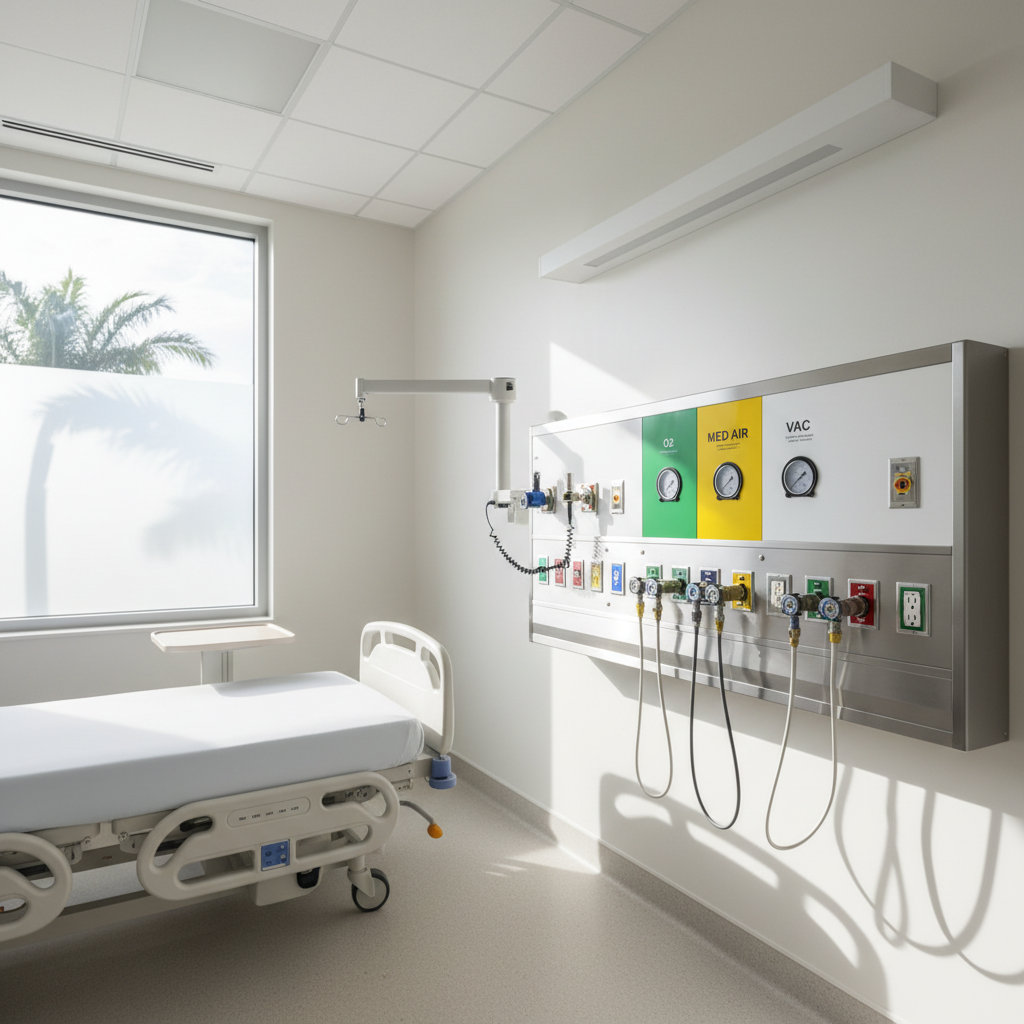
Outlet/Inlet Terminals: The wall-mounted outlets (for gases like O2, N2O, and Med Air) and inlets (for Vacuum) are connected to the pipework. Each outlet is gas-specific, using a unique pin-indexing system to prevent accidental cross-connection.
Installation Phases & Key Standards Overview
Phase
Key Activities
Applicable Standard(s)
Personnel Required
1. Design
System layout, pipe sizing, equipment selection
NFPA 99 (Chapter 4)
Architect, Engineer, Med Gas Specialist
2. Rough-In
Pipe installation, brazing with nitrogen purge
NFPA 99 (Chapter 5), ASSE 6010
ASSE 6010 Certified Installer
3. Equipment Set
Source equipment, alarms, outlets installed
Manufacturer Specs, NFPA 99
ASSE 6010 Installer, Electrician
4. Verification
Full system testing, documentation for AHCA
NFPA 99 (Chapter 5), ASSE 6030
ASSE 6030 Certified Verifier
Phase 4: System Verification (ASSE 6030)
This is the final, and most critical, phase before the system can be put into service. A third-party final verification by an ASSE 6030 verifier is required by NFPA 99. The installer of the system (the ASSE 6010) cannot be the same person or company that performs the final verification. This ensures an unbiased assessment of the system's safety and compliance.
This comprehensive testing process includes:
Standing Pressure Tests: To confirm there are no leaks in the system.
Cross-Connection Test: To ensure that the gas labeled on the outlet is the gas being delivered.
Purity Test: To verify that gas purity meets USP requirements (e.g., Oxygen 99%).
Particulate Test: To check for any contaminants within the piping.
Alarm Testing: To confirm all master, area, and local alarms function correctly.
Florida-Specific Verification Requirements
For facilities in Tampa and across the state, the verification report is not just an internal document. It is a legal record required for occupancy and licensure.
AHCA Compliance: The final report must satisfy the requirements of the Florida Agency for Health Care Administration (AHCA), specifically using OPS Form 3110 (Statement of Medical Gas System Verification). This form, along with the full verification report, must be submitted to AHCA as part of the construction survey process.
Florida Administrative Code: The entire installation and verification process must comply with Chapter 59A of the Florida Administrative Code, which governs healthcare facility licensure.
Your Florida Advantage with Medical Testing Solutions
As a Florida-based company headquartered at 501 East Las Olas Blvd, Ste 300, Fort Lauderdale, FL 33301, Medical Testing Solutions offers a distinct advantage for projects throughout the state. Unlike out-of-state competitors who must fly in their technicians, our local presence provides significant cost and logistical benefits.
No Travel Fees: We charge NO travel fees, lodging costs, or per-diem for any project in Florida, from Tampa to Miami. This typically saves our clients 10-25% on total verification costs.
Rapid Response: Our South Florida crews can be dispatched quickly, which is especially critical for post-hurricane re-verifications. NFPA 99 5.1.12 mandates re-testing after any storm damage or loss of source pressure.
Local Expertise: We have extensive experience working with hospitals across Florida and are intimately familiar with AHCA and Joint Commission requirements.
Whether you need ASSE 6010 installers for the initial build-out or an ASSE 6030 verifier for the final sign-off, our team is ready to ensure your Tampa project succeeds. We also provide annual gas systems inspections to keep you compliant for years to come.
Get Your Tampa Project Started on the Right Foot
A compliant medical gas system is the foundation of patient safety. Don't leave it to chance. Partner with a team that has the local expertise and certified personnel to get the job done right, on time, and on budget.
Call our Fort Lauderdale office today at +1 (754) 315-1078 to discuss your Tampa new construction project or to request a quote for ASSE 6030 verification services. We are Florida's trusted partner for medical gas compliance.
'''
Frequently Asked Questions
According to NFPA 99, all medical gas and vacuum systems must be installed by technicians who hold a current ASSE 6010 Medical Gas Systems Installer certification. This is a mandatory requirement for AHCA and Joint Commission compliance.
An ASSE 6010 Installer physically builds the system—brazing pipes and setting equipment. An ASSE 6030 Verifier is a third-party inspector who performs a series of detailed tests on the completed system to ensure it is safe, pure, and functions as designed before it can be used for patient care.
The best way is to partner with a Florida-based company like MTS. By eliminating the travel, lodging, and per-diem fees charged by out-of-state firms, you can reduce your verification and testing costs by 10-25%. Proper planning and using certified installers also prevent costly rework.
AHCA requires a complete verification of all new medical gas systems by an ASSE 6030 Verifier. The findings must be documented on AHCA's OPS Form 3110 and submitted as part of the licensure and occupancy process, demonstrating compliance with Chapter 59A of the Florida Administrative Code.
The timeline varies greatly depending on the size and complexity of the facility. The rough-in phase is tied to the overall construction schedule. The final verification process typically takes several days to a week for a medium-sized facility. Building in enough time for thorough verification before your planned opening is crucial.
Request a quote for your facility
Talk with Medical Testing Solutions about your next inspection, repair or equipment request.