Proper medical gas installation is not just a construction task, it's a critical component of life support and patient safety. For healthcare facilities in Lynchburg, Virginia, from hospitals to dental clinics, a compliant medical gas system is the backbone of daily operations. This definitive guide covers the entire process of turnkey medical gas installation, from design and code compliance to final verification. You will learn what separates a standard installation from a truly compliant, safe, and efficient system, and understand the critical standards like NFPA 99 and ASSE 6000 that govern this specialized field.
Medical Gas Service
Compliance & Standards
Medical Gas Installation in Lynchburg, VA: A Turnkey Guide
Medical Testing SolutionsJune 23, 20267 min read
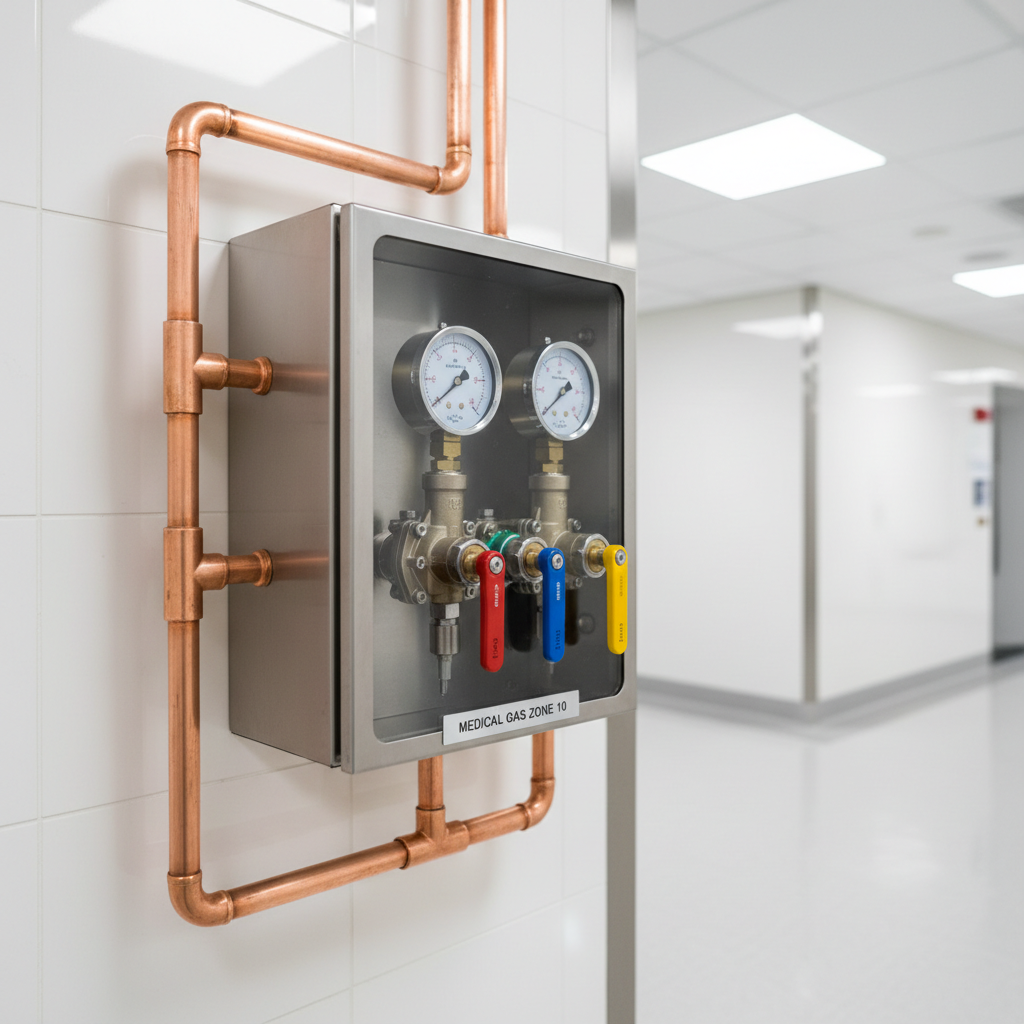
What is a Medical Gas System?
A medical gas pipeline system (MGPS) is a purpose-built network designed to deliver specific gases and vacuum services safely and reliably to various patient care areas in a healthcare facility. Unlike standard plumbing or HVAC, these systems are classified as a patient life-support utility. An outage or contamination can have immediate and severe consequences.
Key gases and services delivered include:
- Oxygen (O2): Used for respiration and life support.
- Medical Air (MA): A purified, compressed air source used for patient respiration, often mixed with oxygen.
- Nitrous Oxide (N2O): Primarily used in dental and minor surgical settings for analgesia and anesthesia.
- Carbon Dioxide (CO2): Used for insufflation during minimally invasive surgeries.
- Nitrogen (N2): Powers surgical tools and equipment.
- Medical Vacuum (VAC): Used to remove fluids and waste from the patient's airway or surgical site.
These systems are complex, involving central supply sources (like bulk oxygen tanks or manifold systems), alarm panels, zone valve boxes, and patient-use station outlets. Every component must work in concert to ensure uninterrupted service.
The Critical Role of NFPA 99 in Medical Gas Installation
The National Fire Protection Association (NFPA) 99, "Health Care Facilities Code," is the cornerstone of medical gas system regulation in the United States. It is not a guideline; it is a code with the force of law in most jurisdictions, including Virginia. Chapter 5, "Gas and Vacuum Systems," provides the explicit requirements for the design, installation, testing, and maintenance of these systems.
Key Mandates from NFPA 99, Chapter 5:
- System Category: The code requires a risk-based assessment to categorize the system (Category 1 through 4). Medical gas systems directly used for life support are almost always Category 1, triggering the most stringent requirements for design, installation, and inspection.
- Material and Components: Only specific materials are permitted. For example, all piping must be hard-drawn seamless copper, either Type K or L, and cleaned for oxygen service (designated ACR/MED). All components, from valves to outlets, must be specifically manufactured and certified for medical gas use.
- Installation Procedures: NFPA 99 dictates precise installation practices. One of the most critical is the requirement for brazing, the process of joining copper pipes. All brazing must be performed using a specific low-temperature technique with a continuous nitrogen purge inside the pipe to prevent oxidation, which could otherwise introduce harmful contaminants into the system.
Why this matters for compliance: Failure to adhere strictly to NFPA 99 can result in failed inspections, costly rework, project delays, and, most importantly, a significant risk to patient safety. Regulatory bodies like The Joint Commission (TJC) and CMS will issue findings for non-compliant systems, potentially jeopardizing a facility's accreditation and reimbursement.
The ASSE 6000 Series: Certifying the Installers
NFPA 99 mandates that personnel involved in medical gas systems are competent. The American Society of Sanitary Engineering (ASSE) 6000 Series provides the nationally recognized standards for training and certifying these professionals. For installation, the key certification is ASSE 6010 Medical Gas Systems Installer.
An ASSE 6010 certified installer has undergone rigorous training and passed a comprehensive exam covering:
- NFPA 99 and other relevant codes
- System design and layout
- Proper pipe joining procedures (brazing)
- System component knowledge
- Practical installation techniques
Hiring a contractor without bonafide ASSE 6010 certified brazers on staff is a major red flag. It violates a core tenet of NFPA 99 and puts the entire project at risk. At Medical Testing Solutions, all our installation professionals hold ASSE 6010 credentials, ensuring every joint is brazed to code.
Our Turnkey Medical Gas Installation Process in Lynchburg
A turnkey approach integrates design, construction, and verification into a seamless project, managed by a single, accountable partner. This is the most efficient way to ensure a compliant medical gas installation. Here’s how Medical Testing Solutions manages the process for facilities in the Lynchburg area:
- Consultation and Design: We start by understanding your facility's specific needs. We review architectural plans, assess clinical requirements, and determine the right system size and type. Our team designs a complete, code-compliant MGPS layout, from the source equipment to the patient room outlets.
- Material Procurement: We source all necessary pipe, fittings, valves, alarms, and outlets from reputable medical gas equipment manufacturers. All materials are certified for medical gas use and properly handled to prevent contamination before installation.
- Installation by ASSE 6010 Professionals: Our certified team gets to work. This phase involves routing the copper piping, installing zone valve boxes and alarm panels, and performing the critical nitrogen-purged brazing on every joint.
- Initial Installer Testing: As required by NFPA 99, once the piping network is complete, the installing personnel conduct initial tests. This includes pressure testing the system to check for leaks and blowing down the lines with nitrogen to remove any particulate matter.
- Coordination with a Third-Party Verifier: The final step before the system can be used is a comprehensive inspection by an independent third-party verifier. This is where ASSE 6030 Medical Gas Verification comes in. Medical Testing Solutions is also certified to perform verification, but to avoid conflicts of interest, the installer and verifier must be from separate companies. We coordinate this entire process to ensure a smooth handoff.
- Final Documentation and Handover: Upon successful verification, we provide you with a complete documentation package, including as-built drawings, material certifications, and the final verification report. We then train your facility staff on the system's operation and requirements for ongoing preventative maintenance.
Design-Build vs. Traditional Installation: What's Right for Your Facility?
| Feature | Traditional (Design-Bid-Build) | Turnkey (Design-Build) | Medical Testing Solutions' Approach |
|---|---|---|---|
| Design | Designed by an independent engineering firm. | Designed by the installing contractor. | Full in-house design capabilities. |
| Accountability | Multiple points of contact; potential for finger-pointing between designer and builder. | Single point of accountability for design and execution. | Single source of responsibility. |
| Timeline | Sequential process; can be slower. | Overlapping design and construction phases; often faster. | Streamlined for faster project completion. |
| Cost | Can lead to change orders if installer finds issues with the design. | Costs are more predictable; design is optimized for constructability. | Reduces change orders and budget overruns. |
| Expertise | Designer may have general MEP knowledge, not specialized medical gas expertise. | The designer is also the installer, ensuring practical, code-compliant solutions. | Deep, specialized expertise in ASSE/NFPA codes. |
The Verification Process: ASSE 6030 Certification Post-Installation
After the last pipe is brazed and the outlets are in the wall, the system is still not ready for patients. NFPA 99 requires a final, independent system verification conducted by an ASSE 6030 certified verifier.
This crucial process confirms that:
- The system is gastight with no leaks.
- The correct gas is flowing to the correct outlet.
- There are no cross-connections between different gas lines.
- The gas purity meets USP standards.
- All alarms and system components function as designed.
The verifier generates a detailed report, which is the final piece of documentation required to certify the system and get the "green light" to introduce it into patient care. This verification is essential for both new installations and any modification or addition to an existing system. It is a mandatory step before connecting the system to any patient.
Why Choose a Certified Installer in Lynchburg, VA?
Choosing a qualified partner for your medical gas installation is one of a facility manager's most important decisions. In Lynchburg and the surrounding Central Virginia region, you need a team that understands not just the pipes and fittings, but the codes, the risks, and the clinical environment.
Medical Testing Solutions (MTS) provides a truly comprehensive service. We are not just an equipment vendor or a mechanical contractor. We are a credentialed, ASSE-certified medical gas service company. Our expertise covers the full lifecycle of your system, from initial design-build and installation to annual medical gas inspections, maintenance, and eventual modification.
Frequently Asked Questions
The ASSE 6010 Medical Gas Systems Installer certification is a credential for professionals who have completed extensive training and passed an exam on the installation of medical gas systems, including in-depth knowledge of NFPA 99 codes and proper brazing techniques.
The timeline depends heavily on the project's scope, whether it's a new build or a renovation, and the size of the facility. A small dental office might take a week, while a new hospital wing could take several months. A turnkey process helps to expedite this timeline.
The primary code is NFPA 99, Health Care Facilities Code. Virginia has adopted this as the state-wide standard. Local building codes in Lynchburg will also apply, but NFPA 99 contains the specific, detailed requirements for the medical gas system itself.
Yes. Medical Testing Solutions offers complete design-build services. We can design your system from the ground up or work with your existing architectural plans to create a compliant and efficient medical gas pipeline layout.
After our ASSE 6010 installers complete their work and initial testing, a separate, ASSE 6030 certified third-party verifier must test and certify the entire system. Once verification is complete and the report is issued, the system is safe to be put into service for patient use.
Request a quote for your facility
Talk with Medical Testing Solutions about your next inspection, repair or equipment request.