Turnkey Medical Gas Installation in Lexington, KY: A Compliance Guide
A compliant medical gas system is the lifeblood of any modern healthcare facility. From delivering life-sustaining oxygen to powering surgical tools, these complex piping networks are critical for patient care and safety. However, their installation is not a standard plumbing job. It is a highly specialized trade governed by stringent codes, requiring certified expertise to ensure the system is safe, pure, and reliable. For facility managers and construction contractors in Lexington, Kentucky, understanding this process is non-negotiable.
This guide provides a definitive overview of turnkey medical gas installation for hospitals, dental clinics, surgery centers, and veterinary practices in the Lexington area. You will learn about the critical codes and standards, the step-by-step installation process from design to verification, the qualifications that define a true professional installer, and the importance of long-term maintenance. We will cover everything you need to know to ensure your next project is a success, safeguarding your patients, staff, and facility accreditation.
The Critical Role of ASSE 6010 Certified Installers
When planning a medical gas project, the single most important decision you will make is who performs the installation. Attempting to cut corners by hiring a standard commercial plumber is a grave mistake that can lead to catastrophic failures, project delays, and immense liability. The only professional qualified to install medical gas piping is an ASSE 6010 Certified Medical Gas Systems Installer.
The American Society of Sanitary Engineering (ASSE) 6000 series provides a framework of qualifications for medical gas personnel. An ASSE 6010 certification signifies that the individual has completed extensive training and passed a rigorous examination covering every aspect of system installation, including the specific procedures for brazing medical gas piping. They understand the "why" behind the codes, not just the "how."
The risks of using an uncertified installer are severe:
- Contamination: Improper brazing techniques can introduce toxic oxides and particulate matter into the piping, which can then be delivered to a patient. Standard plumbing solder and flux are strictly forbidden.
- Leaks: Pinpoint leaks, often undetectable by standard methods, can lead to loss of gas, system failure, and in the case of oxygen, a significant fire hazard.
- Cross-Connections: Incorrectly connecting gas lines can lead to a patient receiving the wrong gas, a potentially fatal error.
- Failed Verification: Every new, modified, or repaired medical gas system must be certified by an independent ASSE 6030 Verifier before it can be used for patient care. A system installed by an uncertified worker will almost certainly fail this verification, leading to expensive and time-consuming rework.
At Medical Testing Solutions, our entire installation team holds ASSE 6010 credentials. We are committed to upholding the highest standards of safety and compliance on every project in the Lexington, KY region.
Navigating the Codes: NFPA 99 and Kentucky State Requirements
The primary standard governing medical gas systems in the United States is NFPA 99, Health Care Facilities Code. This code is not a suggestion; it is a legal requirement adopted by state and local jurisdictions, and it is the standard enforced by accreditation organizations like The Joint Commission.
For medical gas installation, Chapter 5, "Gas and Vacuum Systems," is the most critical section of NFPA 99. It details the minimum requirements for:
- System Design and Sizing: Ensuring the system can meet the peak demands of the facility.
- Piping Materials: Specifying hard-drawn, seamless medical-grade copper tubing (Type K or L) that has been cleaned for oxygen service.
- Installation Procedures: Mandating the use of ASSE 6010 installers and specific brazing techniques, including a continuous nitrogen purge to prevent internal oxidation.
- Testing and Verification: Outlining the series of pressure tests, initial inspections, and the final verification process.
In Kentucky, these codes are enforced by the Kentucky Board of Housing, Buildings and Construction. Working with an installer who is not only familiar with NFPA 99 but also with local enforcement protocols in Lexington is crucial for a smooth project.
Why this matters for compliance: A facility's accreditation and ability to operate depend on adherence to NFPA 99. Non-compliance discovered during an inspection can lead to a finding of "immediate threat to life," resulting in service shutdowns, costly emergency repairs, and damage to a facility's reputation. A compliant installation is the foundation of a safe healthcare environment.
The Turnkey Medical Gas Installation Process: Design to Verification
A turnkey installation provides a seamless, single-source solution. At Medical Testing Solutions, we manage the entire lifecycle of your project, ensuring continuity and accountability from the initial blueprints to the final sign-off.
Step 1: System Design and Engineering
A successful installation begins with a robust design. Our team collaborates with facility owners, architects, and mechanical engineers to develop a comprehensive plan. This phase involves calculating the flow rates and demands for each gas, sizing the pipes accordingly, and strategically placing terminal outlets, zone valve boxes, and master alarm panels. We focus on creating a system that is not only compliant today but is also scalable for future expansions.
Step 2: High-Purity Piping and Component Selection
Medical gas systems require specific, high-purity components. All piping must be ASTM B819 seamless copper tubing, delivered capped and plugged from the manufacturer to maintain cleanliness. We source all components—from manifolds and compressors to alarms and outlets—from trusted manufacturers that meet or exceed NFPA 99 standards. You can explore our catalog of medical gas equipment to see the quality components we trust.
Step 3: The Art and Science of Brazing (ASSE 6010)
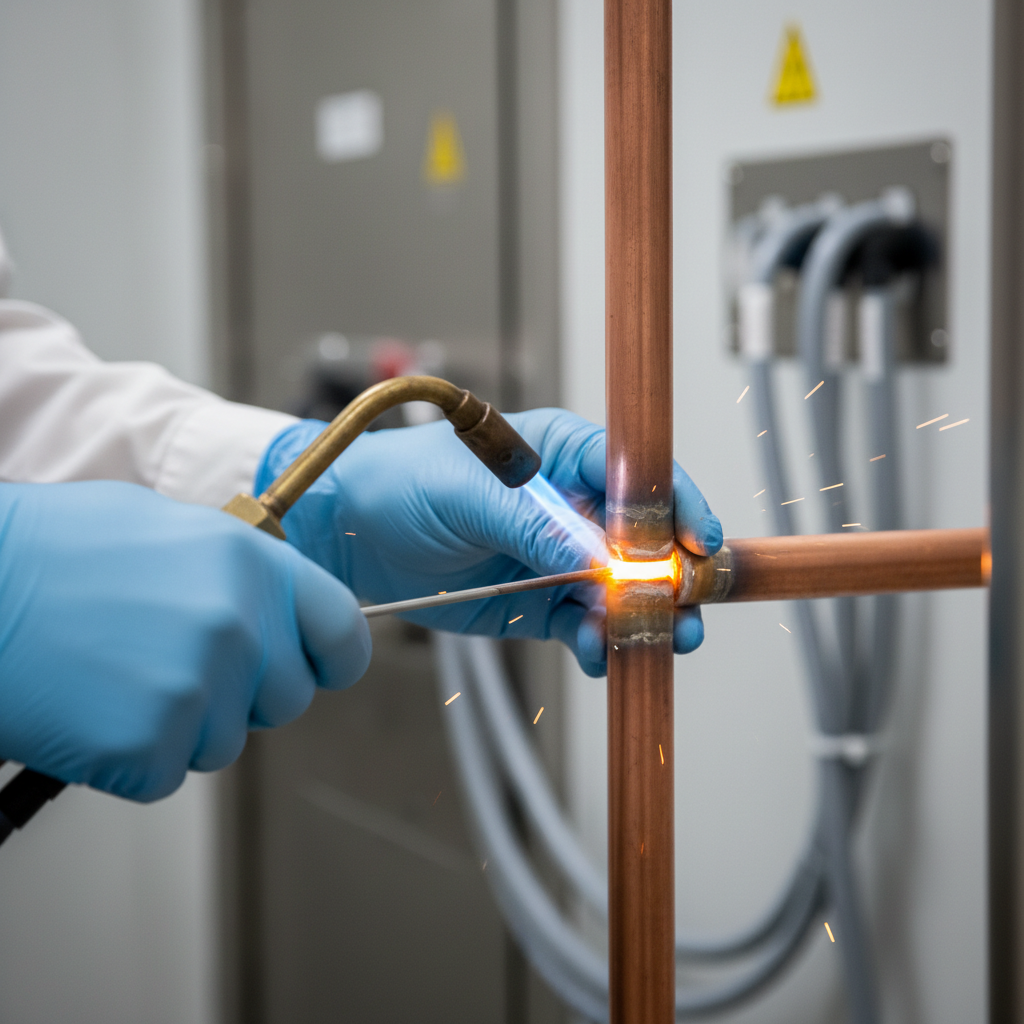
This is where the expertise of an ASSE 6010 installer truly shines. Every joint in a medical gas pipeline must be brazed, a process that joins metals at high temperatures. To prevent the formation of toxic copper oxides on the interior pipe surface, brazing must be performed while a continuous, low-velocity flow of dry nitrogen is passed through the pipe. This "nitrogen purge" is a non-negotiable requirement of NFPA 99 and is the hallmark of a correct medical gas installation.
Step 4: Initial Piping Tests and Inspection
Once the piping is in place, but before the final connections are made and walls are closed, the installer performs initial pressure tests. The system is filled with high-pressure nitrogen and monitored for 24 hours to ensure there are absolutely no leaks. This is a critical hold point in the construction process.
Step 5: Final Verification by an ASSE 6030 Verifier
After all components are installed and the system is ready, the final and most crucial step is third-party verification. An ASSE 6030 Certified Medical Gas Verifier—who must be independent of the installation company—conducts a battery of tests to confirm the system is safe for patient use. These tests include:
- Confirming no cross-connections exist.
- Testing every alarm system for proper function.
- Verifying correct pressure and flow at each outlet.
- Performing gas concentration and purity tests.
Medical Testing Solutions provides comprehensive ASSE 6030 medical gas verification services, offering the unbiased, expert sign-off required by code. This is a core part of our complete medical gas certification process.
Comparing Medical Gas Piping Materials and Joining Methods
Understanding the specific requirements of NFPA 99 is key to appreciating the specialized nature of this work. A standard plumber's methods are not just different; they are explicitly forbidden.
| Feature | Type K or L Copper (NFPA 99) | Brazing (ASSE 6010) | Soldering (Not Allowed) |
|---|---|---|---|
| Material | Hard-drawn seamless copper tube, cleaned for oxygen service | BCuP series filler metal | Tin-lead or lead-free solder |
| Process | Must be installed clean and remain clean | Performed with a continuous internal nitrogen purge | Uses corrosive flux, introduces contaminants |
| Temp. Range | N/A | > 1000°F (538°C) | < 840°F (450°C) |
| Strength | High tensile strength | Creates a strong, permanent bond | Results in a much weaker joint |
| Compliance | Required by NFPA 99 | Required by NFPA 99 | Prohibited by NFPA 99 |
Beyond Installation: Long-Term Maintenance and Support
The installer's job may end at verification, but the facility's responsibility for the system is perpetual. NFPA 99 mandates a regular maintenance and inspection schedule for all medical gas components, from source equipment to alarms. Establishing a partnership with a qualified service provider is the best way to ensure long-term compliance and reliability.
Protect your investment and ensure patient safety with a proactive maintenance plan. We recommend, at minimum, a program of annual medical gas inspections to identify and address potential issues before they become critical failures. Furthermore, our comprehensive medical gas maintenance services can provide the ongoing support your Lexington facility needs to keep its systems in peak condition. Anesthesia and sedation facilities must also consider safety in the working environment; WAGD systems are crucial for staff safety, and we offer comprehensive testing to ensure they are functioning correctly.
FAQs about Medical Gas Installation
Q1: How long does a medical gas installation take?A1: The timeline varies significantly based on the project's scope. A small renovation in a dental office might take a few days, while installing the system for a new hospital wing can take several months. A detailed project timeline is always established during the design and planning phase.
Q2: What is the cost of medical gas installation in Lexington?A2: Costs are entirely project-specific, influenced by the number and type of gas outlets, the size of the facility, the complexity of the design, and the source equipment required. We provide detailed, transparent quotes after an initial consultation. Contact us for a custom estimate.
Q3: Do you handle renovations and additions, or only new construction?A3: We manage all scopes of work. Our team is highly experienced in performing system installations for new construction, major renovations, and small additions or modifications to existing systems throughout the Lexington, KY area.
Q4: What qualifications should I look for in an installer?A4: The absolute most important qualification is an active ASSE 6010 credential for the individual performing the installation. You should also verify that the company is properly licensed and insured to perform work in Kentucky.
Q5: Can you connect the new piping to our existing system?A5: Yes. Safely tying into a facility's existing medical gas system is a common procedure. This requires careful planning, a scheduled shutdown of the affected area, and a complete re-verification of the system before it is returned to service.
Q6: Who is responsible for the final system certification?A6: An independent, third-party ASSE 6030 Certified Medical Gas Verifier is responsible for the final certification. According to NFPA 99, the installation company is not permitted to verify its own work, ensuring a crucial layer of unbiased quality control and safety.
Your Partner for Compliant Medical Gas Installation in Lexington
Choosing the right partner for your medical gas installation is a decision that impacts patient safety, regulatory compliance, and your facility's operational future. The codes are complex, the risks are high, and the margin for error is zero. You need a team with the credentials, experience, and commitment to do the job right the first time.
Medical Testing Solutions is your local expert for turnkey medical gas services in Lexington and across Kentucky. Our ASSE-certified team is ready to manage your project from design to certification, delivering a safe, reliable, and fully compliant system.
Ready to start your project? For a transparent quote on turnkey medical gas installation in Lexington, KY, contact our team today or call us directly at +1 (754) 315-1078.
'''
This article is provided for educational purposes and reflects industry standards as of publication. Always verify against current NFPA 99, CGA, and AHJ requirements. Medical Testing Solutions is ASSE-certified and ready to help — contact us for facility-specific guidance.
Need Medical Gas Services?
Contact our certified team for inspections, verifications, installations, and more.
Get a Free Quote