Medical gas installation is one of the most critical infrastructure projects in any healthcare facility. These complex systems are the lifeline for patients, delivering essential gases like oxygen, medical air, and vacuum for life support and clinical applications. A properly installed system, compliant with stringent safety standards, is non-negotiable for patient safety and facility accreditation. This guide provides a definitive overview of the medical gas installation process, from understanding the core NFPA 99 requirements to the final verification. You will learn about the crucial phases of installation, the technical requirements for brazing and purging, the ASSE 6010 certification necessary for installers, and the steps to ensure your system is safe, compliant, and reliable.
The Complete Guide to Medical Gas Installation
The Foundation: NFPA 99 and ASSE 6000 Standards
Compliance is the backbone of medical gas installation. Two sets of standards are paramount: the National Fire Protection Association (NFPA) 99, Health Care Facilities Code, and the American Society of Sanitary Engineering (ASSE) 6000 series, Professional Qualifications Standard for Medical Gas Systems Personnel.
NFPA 99 is the primary code that governs the design, performance, installation, testing, and maintenance of medical gas and vacuum systems. Chapter 5, "Gas and Vacuum Systems," is the core of these requirements. The code categorizes systems based on risk to patients:
- Category 1: Systems where failure is likely to cause major injury or death to patients. (e.g., Operating rooms, ICUs)
- Category 2: Systems where failure is likely to cause minor injury. (e.g., Patient rooms)
- Category 3: Systems where failure is not likely to cause injury but rather patient discomfort. (e.g., certain labs)
The installation requirements, particularly for brazing, purging, and testing, are most stringent for Category 1 systems.
Why this matters for compliance: Failure to comply with NFPA 99 can result in project delays, costly rework, failed inspections, and, most importantly, a significant risk to patient safety. Accrediting organizations like The Joint Commission (TJC) survey for NFPA 99 compliance.
ASSE 6000 Series defines the qualifications for individuals working on medical gas systems. A facility must ensure that only certified personnel perform installation and verification.
| ASSE Credential | Role & Responsibility |
|---|---|
| ASSE 6010 | Medical Gas Systems Installer: The individual who physically installs the piping, source equipment, and components. They must be certified to perform this work. |
| ASSE 6020 | Medical Gas Systems Inspector: An individual (often a municipal inspector) who inspects the installation for compliance with codes. |
| ASSE 6030 | Medical Gas Systems Verifier: A third-party agent who performs the final, comprehensive tests on the system to ensure it is safe for patient use. |
| ASSE 6040 | Medical Gas Systems Maintenance Personnel: An individual certified to maintain and repair the systems. |
The Medical Gas Installation Process: A Phased Approach
A successful medical gas installation project follows a strict, phased approach to ensure quality control and compliance at every step. While specifics vary by project scope, the general flow is consistent.
- Phase 1: Planning and Design Review: The process begins long before the first pipe is laid. ASSE 6010 certified installers review mechanical drawings, confirm system categories, and coordinate with other trades.
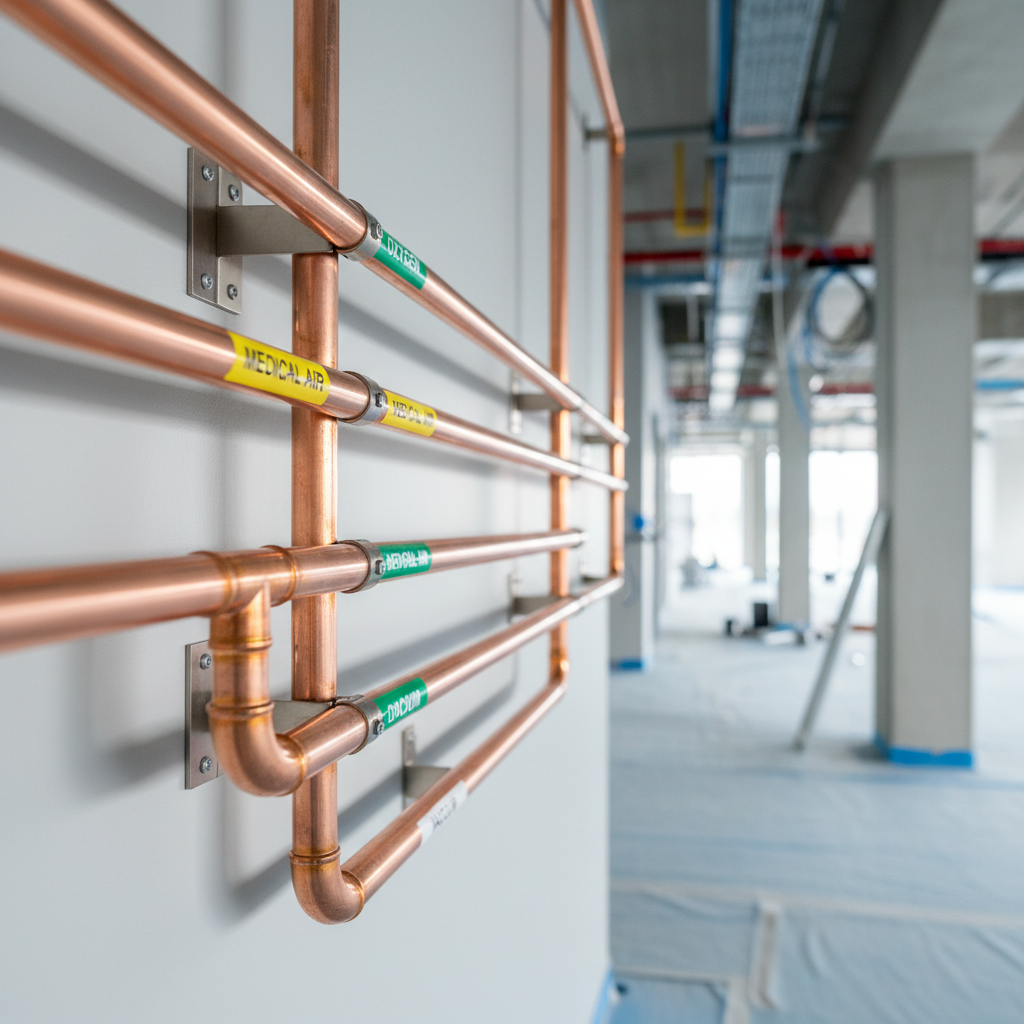
- Phase 2: The Rough-In: This is where the core piping network is installed. All piping must be medical-grade, hard-drawn seamless copper (Type K or L), and clearly labeled.
- Phase 3: Brazing and Purging: All joints in the copper pipeline must be brazed, not soldered, using a filler metal with a melting point above 1,000°F. During brazing, the pipe is continuously purged with oil-free, dry nitrogen to prevent the formation of carbonaceous scale (copper oxide) on the interior surface, which could otherwise contaminate the gas stream.
- Phase 4: Pressure Testing & Cross-Connection Test: After brazing, the system undergoes an initial pressure test (typically with nitrogen) to check for leaks. A cross-connection test is then performed to ensure that gas-specific connections are not mixed up between pipelines.
- Phase 5: Component Finalization: With the pipeline integrity confirmed, the team installs the final components: source equipment (manifolds, compressors, pumps), master and area alarms, zone valve boxes, and station outlets/inlets.
- Phase 6: Final Verification: Once the installer's work is complete, the project is handed over to an independent ASSE 6030 Verifier. This is a crucial final step mandated by NFPA 99.
Brazing and Purging: The Critical Steps for Pipeline Integrity
Brazing is the most critical hands-on skill in medical gas installation. Unlike soldering, brazing creates a much stronger, high-temperature bond suitable for the pressures and demands of a medical gas system.
The Process:
- Preparation: The copper tube and fitting must be meticulously cleaned and deburred.
- Nitrogen Purge: A low-flow purge of nitrogen is started and maintained throughout the entire brazing process. This displaces oxygen from inside the pipe.
- Heating and Filler Application: The joint is heated evenly with a torch. The brazing alloy (typically a copper-phosphorus or copper-phosphorus-silver alloy) is applied, melting and flowing into the joint via capillary action.
- Cooling: The joint is allowed to cool while the nitrogen purge continues to flow until the pipe is no longer hot.
Failure to properly purge is a common but serious installation error. The resulting internal oxidation can flake off, contaminating the gas stream, damaging equipment, and posing a direct risk to patients.
Who Can Install Medical Gas Systems? ASSE 6010 Certification Explained
NFPA 99 explicitly requires that medical gas systems be installed by personnel who are qualified and credentialed to do so. The industry standard for this qualification is the ASSE 6010 Medical Gas Systems Installer certification.
To earn this credential, an individual must typically have a minimum amount of experience in the plumbing or mechanical trades and complete a rigorous 32-hour training course. The course covers:
- NFPA 99 and other relevant codes
- System and component terminology
- Proper installation practices
- The science of brazing and purging
- System testing procedures
A written exam and a practical brazing exam must be passed to achieve certification. Employing only ASSE 6010 certified installers is a mandatory requirement for healthcare facilities to ensure their systems are built to the highest standard. Medical Testing Solutions employs a team of certified and experienced installers capable of handling projects of any scale.
Essential Equipment in a Medical Gas System
A complete medical gas system is more than just pipes. It includes a range of specialized medical gas equipment that must also be installed and commissioned correctly.
- Source Equipment: This is the "heart" of the system. It includes high-pressure cylinder manifolds for gases like oxygen and nitrogen, medical air compressors, and medical vacuum pumps.
- Alarm Systems: NFPA 99 mandates master alarms, area alarms, and local alarms to provide audible and visual indication of system status, pressure changes, or failures.
- Zone Valve Boxes: These are strategically placed shut-off valves that allow specific areas or "zones" of the facility to be isolated for maintenance or in an emergency without shutting down the entire facility.
- Station Outlets/Inlets: These are the patient-facing connection points. They are gas-specific, using a unique pin-indexing system (DISS) to prevent accidental cross-connection of gases.
From Installation to Operation: The ASSE 6030 Verification Process
An installer cannot certify their own work. Once the ASSE 6010 installer has completed the project and performed their own initial tests, an independent, third-party ASSE 6030 Certified Medical Gas Verifier must be brought in. This crucial step ensures an unbiased and comprehensive evaluation of the system before it is placed into service.
The verifier, such as the certified team at Medical Testing Solutions, performs a battery of tests outlined in NFPA 99, including:
- Verifying no cross-connections exist.
- Testing for system purity and particulate a contamination.
- Confirming pressure and flow rates at each outlet.
- Functionally testing all alarm systems.
Only after the system passes every test will the verifier sign off, and the facility can be confident in placing the system into patient use. This verification is not a one-time event; facilities should implement a program of annual medical gas inspections and preventive maintenance to ensure ongoing safety and reliability.
Your Trusted Partner for Medical Gas Installation
Medical gas installation is a highly specialized field where expertise and compliance are not just recommended, they are required. From the initial design review to the final ASSE 6030 verification, every step must be executed with precision and a deep understanding of NFPA 99 standards. Medical Testing Solutions provides end-to-end services, from installation and equipment sales to testing and certification, ensuring your facility's medical gas systems are built safely and correctly the first time.
If you are planning a new construction or renovation project, ensure you partner with certified experts. Contact our team today for a consultation or to request a quote for your medical gas installation project. Call us at +1 (754) 315-1078. '''
Frequently Asked Questions
Request a quote for your facility
Talk with Medical Testing Solutions about your next inspection, repair or equipment request.