Medical gas systems are a fundamental component of patient care, not an optional feature. They are as critical as electricity and water, providing life-sustaining gases like oxygen, medical air, and nitrous oxide, as well as essential surgical and laboratory gases. For healthcare facilities in Durham, North Carolina, ensuring these systems are installed correctly is a matter of patient safety, regulatory compliance, and operational integrity. A faulty installation can have catastrophic consequences. This comprehensive guide explains the entire process, from initial design and code considerations to the final verification, ensuring your facility meets the stringent requirements of NFPA 99 and the ASSE 6000 series.
Medical Gas Service
Compliance & Standards
Medical Gas Installation Durham NC: An ASSE 6010 Guide
Medical Testing SolutionsJune 21, 20267 min read
The Critical Role of NFPA 99 in Medical Gas System Design
The National Fire Protection Association's NFPA 99, Health Care Facilities Code, is the foundational document governing medical gas and vacuum systems in the United States. It is not a suggestion; it is the standard to which all healthcare facilities are held, and it's adopted into law in most jurisdictions, including North Carolina. The code provides a risk-based approach, ensuring the level of system precaution and robustness matches the potential risk to patients.
Understanding NFPA 99 Risk Categories
NFPA 99 moves away from a one-size-fits-all approach based on building type. Instead, it requires a risk assessment to classify systems into one of four categories:
- Category 1: The highest risk level. System failure is likely to cause major injury or death to patients or caregivers. This applies to operating rooms, ICUs, and critical care areas where patients are dependent on the gas systems for life support.
- Category 2: System failure is likely to cause minor injury. This might include inhalation sedation areas where patients are not fully dependent on the system.
- Category 3: System failure is not likely to cause injury but could cause patient discomfort. This often applies to laboratory settings or certain outpatient procedure rooms.
- Category 4: System failure would have no impact on patient care. This is rare for piped medical gas systems but may apply to certain support spaces.
The determined category dictates everything from the type of source equipment required to the level of monitoring and testing necessary. For any new medical gas installation in Durham NC, this risk assessment is the mandatory first step.
Key Design & Planning Considerations
Once the risk category is established, the design phase begins. A compliant design must meticulously plan for:
- Source Equipment: Location and sizing of medical air compressors, vacuum pumps, and gas manifolds. These must be in a dedicated, secure, and properly ventilated space.
- Piping Distribution: The layout of the piping network, ensuring it is properly sized to maintain pressure at the furthest outlet. The design must be free of dead ends and allow for future expansion.
- Valves & Alarms: Strategic placement of source valves, main line valves, and zone valve boxes is critical for emergency shut-offs and maintenance. Master alarms, area alarms, and local alarms must be located as prescribed by NFPA 99 to provide immediate warnings of system issues.
Why this matters for compliance: A design that fails to meet NFPA 99 standards from the outset guarantees a failed project. It will not pass the mandatory third-party verification, leading to costly and time-consuming rework, project delays, and potential legal liability.
Design-Build vs. Traditional Bid-Build: Which is Right for Your Durham Facility?
When commissioning a medical gas installation, facilities generally have two contracting models to choose from. The design-build model, which Medical Testing Solutions specializes in, offers a streamlined, turnkey solution that is often superior for complex, code-heavy projects.
| Feature | Design-Build (Turnkey) | Traditional Bid-Build |
|---|---|---|
| Single Point of Contact | Yes (The Design-Builder) | No (Architect/Engineer & Contractor are separate) |
| Project Timeline | Generally faster | Can be longer due to separate bidding phases |
| Collaboration | High, from start to finish | Segmented, potential for communication gaps |
| Accountability | Singular, simplifies problem-solving | Divided, can lead to disputes |
| Cost Control | Better cost certainty upfront | Prone to change orders and budget overruns |
For facilities in Durham, the design-build approach centralizes responsibility, ensuring the team that designs the system is the same team that installs it. This eliminates the communication gaps and finger-pointing that can plague traditional projects, leading to a faster, more cost-effective, and compliant installation.
The Core of Quality: ASSE 6010 Certified Medical Gas Installation
NFPA 99 is explicit: medical gas and vacuum systems shall be installed by qualified, certified personnel. The industry standard for this qualification is the ASSE 6010 Certified Medical Gas Systems Installer credential. This is not a "nice-to-have"; it's a fundamental requirement for a compliant and safe installation.
The Art and Science of Brazing
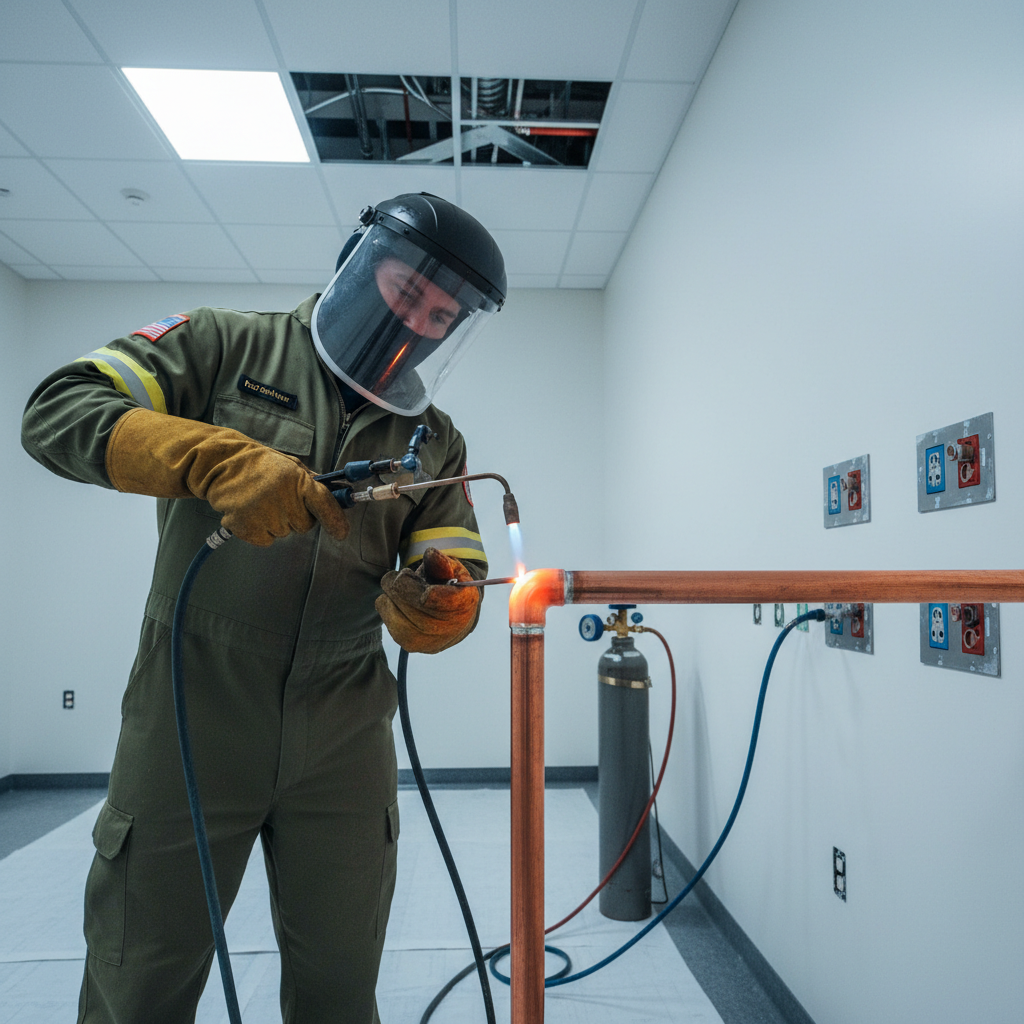
Installing medical gas piping is not plumbing. The joining method used is brazing, a high-temperature process that creates a strong, leak-proof bond. Crucially, NFPA 99 Section 5.1.10.4.3 requires that during brazing, a continuous flow of inert nitrogen gas be passed through the pipes. This "nitrogen purge" displaces oxygen, preventing the formation of copper oxides on the interior pipe surface. These black, flaky contaminants, if introduced into the gas stream, can destroy downstream equipment and cause severe harm to patients.
An ASSE 6010 installer is trained in this exacting procedure, ensuring every joint is clean, strong, and free of internal contaminants. Our team consists of fully licensed and insured ASSE 6010 certified installers ready to handle projects of any scale.
What ASSE 6010 Certification Entails
The certification process involves a rigorous training course and a comprehensive examination covering all aspects of NFPA 99 related to installation, including:
- System and component requirements
- Proper brazing and purging techniques
- Installer-performed testing and documentation
- Safety protocols
- System and component labeling
Choosing a contractor without certified installers is a serious gamble with patient safety and your facility's accreditation.
Step-by-Step: The Medical Gas Installation Process
A turnkey medical gas installation project follows a structured sequence of events, managed from start to finish.
- 1. Initial Consultation & System Design: We work with your architects, engineers, and clinical staff to perform a risk assessment and design a system that meets your specific needs, budget, and the strict requirements of NFPA 99.
- 2. Material Procurement & Handling: All piping and components must be medical grade. This means they are manufactured to specific standards, and delivered cleaned, capped, and sealed to prevent contamination before installation.
- 3. Piping Installation & Brazing: The ASSE 6010 certified team installs the piping network, meticulously performing the nitrogen-purged brazing process on every joint. All pipes are properly supported and labeled according to the gas they carry.
- 4. Initial Installer Testing: Before the final verifier arrives, the installation team performs a series of its own tests, including initial pressure tests to check for leaks. This is a quality control step to ensure the system is ready for formal verification.
- 5. Final Verification by an ASSE 6030 Verifier: This is the final, crucial step. An independent, third-party ASSE 6030 Certified Verifier performs a battery of tests to confirm the system's compliance and safety. This independent check is not optional. This final step, known as medical gas verification, is the gateway to putting the system into service.
Verification and Certification: The Final Steps to Compliance
The role of the ASSE 6030 Verifier cannot be overstated. They are an impartial inspector whose only job is to confirm that the system installed meticulously follows the design and meets every requirement of NFPA 99. While a company like Medical Testing Solutions can offer both installation and verification, these services are always performed as distinct functions by separate, independently certified personnel to maintain the integrity of the process.
The verifier conducts a series of tests outlined in NFPA 99, including:
- Cross-Connection Test: To ensure that the gas in a specific outlet (e.g., Oxygen) is indeed oxygen and not another gas.
- Purity Test: To confirm there are no contaminants in the gas stream.
- Pressure & Flow Tests: To ensure all outlets and equipment are receiving the correct pressure and flow rate.
- Alarm Testing: To verify that all master, area, and local alarms function correctly when a fault is simulated.
- Labeling and Documentation Review: To confirm all pipes, valves, and outlets are labeled correctly and that the installer has provided the requisite documentation.
Upon successful completion, the verifier provides the full medical gas certification documentation required by regulatory bodies like The Joint Commission and CMS for your facility to be accredited.
Frequently Asked Questions
Any facility where medical gases are piped from a central source to a patient treatment area. This includes hospitals, ambulatory surgery centers, dental offices performing sedation, veterinary clinics, and outpatient care centers in the Durham area.
This varies widely based on the project's scale and complexity. A small dental office renovation might take a few days, while a new hospital wing can take many months. A design-build approach often shortens the overall timeline.
An ASSE 6010 Installer is certified to physically build and install the medical gas system. An ASSE 6030 Verifier is an independent, third-party inspector who is certified to test and confirm that the installed system is compliant with NFPA 99 and safe for patient use. The installer cannot verify their own work.
Absolutely not. NFPA 99 requires copper tubing that is cleaned for oxygen service (Type K or L) and delivered capped and plugged. Using standard plumbing pipe would introduce oils and contaminants into the system, leading to catastrophic failure and patient harm.
NFPA 99 mandates a regular maintenance program. This includes periodic inspections and testing of all system components, including source equipment, alarms, and outlets. We offer comprehensive service agreements and annual medical gas inspections to keep your system compliant and operational.
Choosing a turnkey provider simplifies the process by giving you a single point of accountability for the entire project, from design to final certification. This integrated approach minimizes communication errors, reduces project timelines, and ensures a compliant, cost-effective result without the headache of managing multiple contractors.
Request a quote for your facility
Talk with Medical Testing Solutions about your next inspection, repair or equipment request.