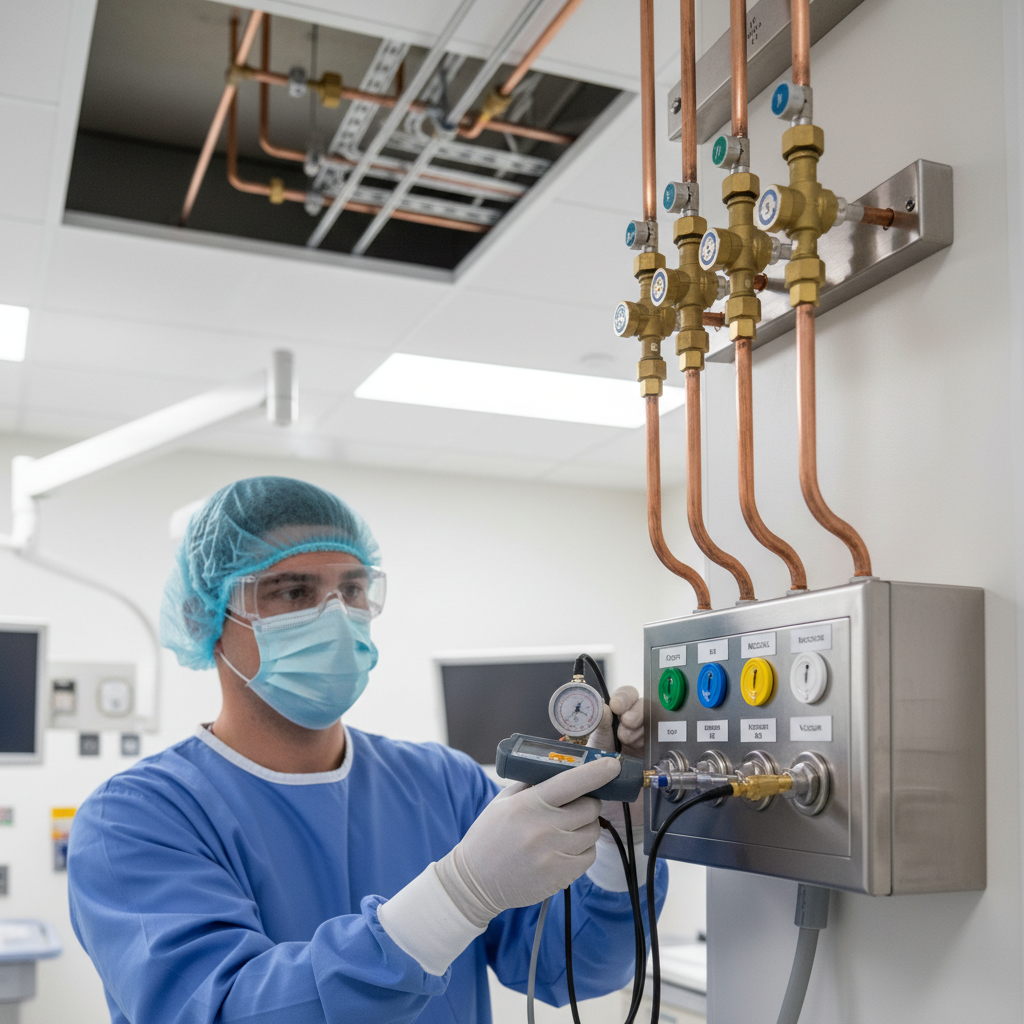
Above the ceiling grid of an operating room renovation, two 1/2-inch Type L copper drops look identical before the color-coded labels go on. One carries USP Oxygen; the other carries USP Medical Air or Nitrous Oxide. If an installer braze-joins those two lines in reverse above the hard lid and installs the matching diameter-index safety system (DISS) rough-in assemblies below, the outlet faceplates will accept the clinical flowmeters without physical resistance. Without a strict medical gas cross connection testing procedure, the first person to discover that pipe reversal is the anesthesia provider or respiratory therapist, and by then, a patient is already on the circuit.
Pipe cross-connections are not theoretical edge cases. They happen when contractors rush ceiling closures, tie new branches into legacy risers with faded labels, or modify zone valve boxes during phased hospital expansions. NFPA 99 (Health Care Facilities Code) treats cross-connection verification as a zero-tolerance life-safety gate. Every single outlet and inlet in a new or renovated pipeline must prove it connects solely to its designated source before a facility places the system into patient service.
What Is the Medical Gas Cross Connection Testing Procedure Under NFPA 99?
The medical gas cross connection testing procedure is the series of diagnostic pressure and gas-identity checks mandated by NFPA 99 Chapter 5 to prove that no two medical gas or vacuum pipelines are interconnected and that every terminal unit delivers only the gas labeled on its faceplate. The code splits this responsibility into two distinct phases: installer-performed initial testing under Section 5.1.12.2 and third-party verifier testing under Section 5.1.12.4.
Both phases share the same objective, yet they use different gas mediums and require different credentials. An ASSE 6010 certified installer conducts the preliminary cross-connection test using oil-free, dry nitrogen NF before closing the walls and before connecting the new piping to existing live systems. Once the central supply sources are active and all outlets, zone valves, and alarms are finalized, an independent ASSE 6030 certified medical gas verifier repeats the cross-connection test, first through individual system pressurization or pressure differential checks, and finally with actual source gases and calibrated concentration analyzers.
Why this matters for compliance: The Joint Commission (TJC), DNV, and state Departments of Health require documented proof of both installer and verifier cross-connection tests before granting occupancy sign-off. Missing or improperly sequenced test logs under NFPA 99 Section 5.1.12 will halt surgical suite openings and trigger immediate accreditation citations.
At Medical Testing Solutions, our field engineers perform both turnkey medical gas installation and third-party medical gas verification. We see firsthand how small shortcuts during construction turn into failed verifications. Understanding the exact mechanics of each test method helps facility managers, mechanical contractors, and clinical engineers avoid costly ceiling tear-outs.
Regulatory Framework: NFPA 99, ASSE 6010, and ASSE 6030 Requirements
NFPA 99 establishes the technical rules for pipeline testing, while the ASSE 6000 Professional Qualifications Standard defines who is legally and technically qualified to hold the gauges. Under NFPA 99 (2021 and 2024 editions), cross-connection testing appears in two critical subsections of Chapter 5:
- NFPA 99 Section 5.1.12.2.4 (Installer Cross-Connection Test): Conducted by the installing contractor (qualified to ASSE 6010) using oil-free, dry nitrogen NF after pressure testing and standing pressure tests are complete.
- NFPA 99 Section 5.1.12.4.2 (Verifier Cross-Connection Test): Conducted by a third-party agency employing ASSE 6030 certified verifiers after final tie-in, checking every outlet and inlet across all pressure and vacuum systems.
- NFPA 99 Section 5.1.12.4.10 (Gas Concentration Testing): The chemical confirmation phase where the ASSE 6030 verifier measures exact oxygen and gas purity percentages at every terminal unit to rule out trace cross-bleeding or mislabeled source manifolds.
- CGA G-7.1 and USP Standards: Compressed Gas Association and United States Pharmacopeia specifications that dictate the allowable purity thresholds for medical air (19.5% to 23.5% oxygen) and USP gases (99.0%+ for oxygen and nitrous oxide).
Why does NFPA 99 require the test to be performed twice? Construction sites are dynamic. Between the week the plumber finishes rough-in brazing and the week the drywall crew finishes the headwalls, other trades work in the plenum. More importantly, the final tie-in to the existing hospital main happens after the installer's nitrogen tests. If a cross-connection occurs at the tie-in point itself, only the ASSE 6030 final verification will catch it.
| Test Parameter | Installer Preliminary Test (ASSE 6010) | Verifier Final Test, Method A (Individual Pressurization) | Verifier Final Test, Method B (Pressure Differential) |
|---|
| NFPA 99 Reference | Section 5.1.12.2.4 | Section 5.1.12.4.2.2 | Section 5.1.12.4.2.3 |
| Required Credential | ASSE 6010 Installer | ASSE 6030 Verifier | ASSE 6030 Verifier |
| Test Medium | Oil-free, dry Nitrogen NF | Oil-free, dry Nitrogen NF or Source Gas | Oil-free, dry Nitrogen NF or Source Gas |
| System Pressure State | One system at 50 psi; all others at atmospheric (0 psig) | One system pressurized; all others at atmospheric (0 psig) | Each system held at a unique pressure (min. 10 psi separation) |
| Vacuum System Handling | Disconnected or held at atmospheric | Checked with vacuum pump running while gases are depressurized | Held at 20 inHg vacuum while positive gases hold staggered pressures |
| Primary Advantage | Catches braze crosses before drywall closes | Zero ambiguity; simplest pass/fail readout | Faster on large multi-gas projects where depressurizing all lines is impractical |
Pre-Test Preparation and Safety Protocols Before Pressurizing Lines
You cannot execute a reliable cross-connection test if the piping network is still open to contamination or if existing patient zones are inadequately isolated. Before introducing test gas or opening source valves, both installers and verifiers must establish a controlled boundary.
First, verify physical isolation from any live clinical pipeline. On renovation projects, NFPA 99 requires that new work remain physically disconnected from existing live mains until all installer tests (initial blowdown, initial pressure test, cross-connection, piping purge, and standing pressure test) are completed and documented. Relying on a closed zone valve to separate a live patient wing from a 150 psi nitrogen test charge violates code and risks back-feeding nitrogen into active patient rooms if the valve seat leaks.
Second, prepare the terminal units and gauges. Every station outlet and vacuum inlet in the test zone must have its rough-in body and check valve installed so test adapters can be inserted. All test gauges must be digital or analog master gauges calibrated within the past 12 months, capable of resolving at least 1 psi increments for positive pressure and 1 inHg for vacuum.
Third, verify that the test gas for any preliminary phase is strictly oil-free, dry nitrogen NF. Never use shop compressed air or uncertified industrial nitrogen cylinders, as hydrocarbon aerosols condense inside copper tubing and create severe combustion hazards once high-pressure USP Oxygen enters the pipeline.
Step-by-Step: The Individual Line Pressurization Method (One-Gas-at-a-Time)
The individual line pressurization method (outlined in NFPA 99 Section 5.1.12.2.4 for installers and Section 5.1.12.4.2.2 for verifiers) is the gold standard for clarity. By pressurizing only one pipeline at a time while leaving every other medical gas and vacuum system open to atmospheric pressure, any cross-connection immediately reveals itself as gas flowing out of the wrong outlet or failing to flow out of the intended outlet.
Step 1: Depressurize All Medical Gas and Vacuum Systems to Atmospheric Pressure
Start by reducing every positive-pressure gas system (Oxygen, Medical Air, Nitrous Oxide, Carbon Dioxide, Nitrogen, Instrument Air) and every vacuum system (Medical-Surgical Vacuum, Waste Anesthetic Gas Disposal) in the test zone to 0 psig (atmospheric pressure). Open the source test valves or insert vent adapters so that no residual trapped pressure remains in any branch line. Verify with a calibrated gauge at the zone valve gauge ports that every system reads zero.
Step 2: Pressurize a Single Pipeline System to 50 psi
Select the first gas system to test, typically USP Oxygen. Close its vent paths and charge the Oxygen pipeline alone to 50 psi (345 kPa) using oil-free, dry nitrogen NF (during pre-tie-in testing) or its dedicated source gas (during final verification after tie-in). Leave all other gas and vacuum systems completely depressurized at atmospheric pressure.
Step 3: Check Every Station Outlet and Inlet Across All Systems
Walk the entire project footprint with a calibrated test adapter and pressure gauge for every gas configuration on the job. At every headwall, ceiling column, boom, and anesthesia manifold location, check every outlet and inlet, not just the oxygen outlets.
When you insert an oxygen DISS or quick-connect adapter into an Oxygen outlet, you should observe a strong flow of gas and a gauge reading of 50 psi. When you insert the appropriate adapters into the Medical Air, Nitrous Oxide, Carbon Dioxide, Vacuum, and WAGD terminals at that exact same bed location, you must read 0 psig and feel zero gas discharge. If an oxygen outlet yields no gas, or if a nitrous oxide outlet suddenly hisses with 50 psi of pressure, you have identified a cross-connection or a dead leg.
Step 4: Vent, Cycle to the Next System, and Test Vacuum Independently
Once every terminal in the facility has been verified with only Oxygen pressurized, bleed the Oxygen system back down to 0 psig. Next, pressurize only the Medical Air system to 50 psi and repeat the physical walk-through at every single outlet and inlet in the building. Continue this one-at-a-time cycle through Nitrous Oxide, Carbon Dioxide, Nitrogen, and Instrument Air.
For Vacuum and WAGD systems, activate the vacuum source so only the vacuum piping draws negative pressure (typically 15 to 20 inHgV) while all positive-pressure gas systems sit at atmospheric pressure. Check every vacuum inlet to confirm suction, and check all positive-pressure outlets to verify that none are pulling a vacuum.
The Pressure Differential Method: When and How Verifiers Use It
On large hospital expansions or tie-ins where shutting down and venting every system to 0 psig multiple times isn't practical, NFPA 99 Section 5.1.12.4.2.3 permits the pressure differential method. Instead of keeping non-tested systems at zero, the verifier establishes a distinct, non-overlapping pressure in each pipeline simultaneously.
To perform the pressure differential method properly, each gas system must maintain at least a 10 psi (69 kPa) separation from every other system, with no two systems set to the same value. A typical verifier test schedule looks like this:
- USP Oxygen: 20 psig
- USP Medical Air: 30 psig
- USP Nitrous Oxide: 40 psig
- USP Carbon Dioxide: 50 psig
- Nitrogen / Instrument Air: 60 psig (or 160 psig normal operating differential)
While those positive-pressure pipelines hold their staggered pressures, the Medical-Surgical Vacuum and WAGD systems are kept in operation at 20 inHgV (or distinct vacuum levels if both exist without shared source equipment).
The ASSE 6030 verifier then inserts a calibrated test gauge assembly into every single terminal unit throughout the facility. If an outlet labeled "Medical Air" reads 30 psig, it matches the Medical Air manifold setting. If that same Medical Air outlet reads 40 psig, or if both the Medical Air and Nitrous Oxide lines equalized to 35 psig, a cross-connection exists between those two pipelines. Notice that pressure regulators and zone valves must be monitored closely during this test so that flowing an outlet briefly does not drop the test header pressure enough to blur the 10 psi buffer.
Gas Concentration and Purity Analysis: The Final Confirmation Barrier
Passing a pressure-based cross-connection test proves that no two pipes are cross-brazed inside the building. However, pressure alone cannot tell you if the bulk cylinder manifold was hooked up to the wrong riser or if a newly tied-in branch was welded into an adjacent active main during a night shutdown. That is why NFPA 99 Section 5.1.12.4.10 mandates gas concentration testing immediately after the pipeline is purged with its actual source gas.
Using calibrated paramagnetic or electrochemical oxygen analyzers and infrared gas analyzers, the ASSE 6030 verifier samples the discharge at every station outlet and compares it to strict USP and NFPA 99 purity specifications:
- USP Oxygen: Must read at least 99.0% oxygen (93% ± 3% for oxygen concentrator supply systems where permitted).
- USP Medical Air: Must read between 19.5% and 23.5% oxygen, with strict dew point, carbon monoxide (<10 ppm), carbon dioxide (<500 ppm), and gaseous hydrocarbon checks.
- Nitrous Oxide, Carbon Dioxide, Nitrogen, and Helium: Each must measure ≥99.0% of the labeled gas (or less than 1% oxygen when tested with an oxygen analyzer during displacement verification, supplemented by specific gas identification).
- Instrument Air: Must read within ambient oxygen concentration (19.5% to 23.5% O2) and meet the -40°F (-40°C) dew point requirement.
Why this matters for compliance: In several documented fatal incidents in healthcare history, the internal room piping was installed correctly, but the main tie-in mechanics crossed Nitrous Oxide and Oxygen at the riser connection in the ceiling corridor. A pressure differential test conducted only on the new branch before tie-in passed. Only a rigorous post-tie-in cross-connection test combined with 100% outlet gas concentration analysis catches a main tie-in reversal.
Common Failure Modes Uncovered During ASSE 6030 Verification
When Medical Testing Solutions dispatches verifiers to surgical centers, dental suites, and acute-care hospitals, we don't just look for passed gauges, we troubleshoot why systems fail. Cross-connections and pseudo-cross-connections usually trace back to four specific field errors.
1. Ceiling Riser Reversals During Hot Tie-Ins
During phased renovations, contractors work above occupied corridors during brief night shutdowns. In dark, congested plenums filled with ductwork and cable trays, 3/4-inch Oxygen and Medical Air mains running parallel can be cut and brazed in reverse. Because both lines normally operate at 50 to 55 psig once the zone valves open, a standard pressure check without creating a differential or testing concentration will show 52 psig on both outlets, masking the reversal until an oxygen analyzer reads 20.9% O2 out of an oxygen outlet.
2. Multi-Gang Rough-In Indexing Errors
Modern headwalls and surgical booms pack six to twelve outlets into tight metal frames. Occasionally, a brazing mechanic connects the copper drop for Nitrous Oxide into the back of the Oxygen rough-in plate before the front latching faceplate is installed. Later, another technician installs the green Oxygen front latching assembly onto that rough-in because the rough-in indexing pins were bent, modified, or mismatched. The outlet accepts an oxygen flowmeter, but delivers nitrous oxide.
3. Leaking Internal Check Valves on Blending Equipment
In NICUs, operating rooms, or facilities using dental flowmeter repair and calibration services, clinical blenders or sedation mixers connect simultaneously to Oxygen and Medical Air (or Oxygen and Nitrous Oxide). If an existing wing remains connected to a defective air-oxygen blender whose internal check valves have failed, higher-pressure oxygen can back-feed into the medical air pipeline during low-flow periods. While technically an equipment back-feed rather than a brazed pipe cross, it shows up during annual medical gas inspections as elevated oxygen concentration (>23.5%) inside the medical air line.
4. WAGD and Medical-Surgical Vacuum Crosses
Installers sometimes tie a Dedicated Waste Anesthetic Gas Disposal (WAGD) inlet into the general Medical-Surgical Vacuum drop above the operating room ceiling, or vice versa, without engineering approval. While NFPA 99 allows combined medical-surgical vacuum/WAGD sources when properly sized and rated for oxygen-enriched atmospheres, crossing dedicated WAGD piping into a standard vacuum branch that lacks a dedicated WAGD zone valve violates system zoning and fails individual vacuum isolation checks.
Special Environments: Operating Rooms, Dental Suites, and Specialized Labs
While the core NFPA 99 cross-connection procedure applies across all Category 1, 2, and 3 spaces, specialized clinical environments introduce unique equipment interfaces that require extra vigilance during verification and routine medical gas maintenance services.
In operating rooms and cardiac catheterization labs, overhead articulating booms contain flexible hose assemblies inside rotating knuckles. When booms are refurbished or hoses are replaced, technicians can accidentally swap two DISS hose ends inside the boom head. Any time a surgical boom hose is replaced, you must perform a localized cross-connection and gas concentration check on every outlet on that boom, along with required electrical safety checks like line isolation monitor testing in wet procedure locations.
In oral surgery and dental clinics, the pipeline is simpler (usually Oxygen and Nitrous Oxide), but the risk is amplified because the tubing often runs concealed inside cabinetry to wall-mounted or mobile sedation flowmeters. Crossed oxygen and nitrous oxide supply hoses or wall lines defeat the flowmeter's fail-safe mechanism: when the practitioner turns up the "oxygen" knob to flush the patient at the end of a procedure, the unit delivers 100% nitrous oxide instead. Similarly, facilities operating veterinary surgical suites must verify their veterinary anesthesia equipment and scavenging connections to protect both animals and staff from anesthetic gas exposure, often pairing verification with WAG chemical vapor monitoring.
Documentation Requirements and Audit Readiness
Under NFPA 99 Section 5.1.12.4, a verification test that isn't documented on an itemized report does not exist in the eyes of an Authority Having Jurisdiction (AHJ). When Medical Testing Solutions completes a medical gas certification or verification project, our final report package includes room-by-room, outlet-by-outlet data sheets showing:
- Exact room number, bed/station identifier, and gas service for every terminal unit tested.
- Recorded test pressures for both the installer preliminary cross-connection test and the verifier final cross-connection test.
- Measured gas concentration percentages (O2%, CO, CO2, dew point, hydrocarbons) at each terminal and source.
- Calibration certificates and serial numbers for all master pressure gauges and gas analyzers used during the procedure.
- ASSE 6030 credential numbers and signatures of the verifying field engineers.
Keep these verification binders permanently in the facility engineering life-safety files. Surveyors from The Joint Commission, AAAHC, and state licensure boards routinely pull construction and renovation packets from the prior 36 months to confirm that no clinical outlet went live without a verified zero-cross-connection sign-off.
If you are planning a hospital addition, ambulatory surgery center build-out, or headwall renovation, bring your verification partner in before the ceilings close. Contact Medical Testing Solutions at (754) 315-1078 or request a quote online to schedule ASSE 6030 verification, ASSE 6010 installation, or comprehensive annual medical gas testing across your facility.