Medical Gas Checklist for Opening a Medspa Surgical Suite in Florida
Medical Testing SolutionsAugust 3, 20268 min read
Share
As the demand for cosmetic and plastic surgery grows, many Florida medspas are expanding their services to include procedures requiring sedation or anesthesia. This transition from a standard medspa to a registered Office-Based Surgery (OBS) suite is a significant undertaking, particularly concerning life-safety systems like medical gas. Navigating the state-specific requirements from the Agency for Health Care Administration (AHCA) and the National Fire Protection Association (NFPA) can be daunting.
This definitive guide provides a comprehensive checklist for practice managers, doctors, and contractors planning a new surgical suite in Florida. We'll cover when your facility crosses the regulatory line, the core gas systems you'll need, the required personnel certifications, the step-by-step inspection process, and realistic timelines and costs. Our goal is to demystify the process, ensuring your project is compliant, on-budget, and, most importantly, patient-safe from day one.
When Does Your Medspa Cross the Line into a Surgical Suite?
In Florida, the type and duration of anesthesia administered dictates whether your facility is considered an office-based surgery suite subject to AHCA regulation. Many medspa owners are surprised to learn that even procedures under conscious sedation can trigger these stringent requirements. The state defines three levels of office surgery, each with escalating standards.
Level I Office Surgery: Involves minor procedures using minimal oral or topical sedation (e.g., anxiolytics). Medical gas systems are generally not required, though having an emergency oxygen supply is always prudent.
Level II Office Surgery: Involves procedures where intravenous, intramuscular, or rectal sedation is used, putting the patient in a state of conscious sedation. This is the level where most expanding medspas fall. A piped medical gas system (Oxygen, Vacuum, WAGD) becomes a requirement at this level.
Level III Office Surgery: Involves procedures requiring general anesthesia, where the patient is unconscious. These suites have requirements similar to a hospital operating room and demand the most robust medical gas and life safety infrastructure.
Here’s a breakdown of the key differences:
Surgery Level
Anesthesia Type
Typical Procedures
Piped Medical Gas System Required?
Level I
Minimal Oral/Topical Sedation
Minor skin procedures, injections
No (Emergency O2 recommended)
Level II
IV Sedation / Conscious Sedation
Liposuction, facelifts, rhinoplasty
Yes (O2, Vacuum, WAGD)
Level III
General Anesthesia, Major Conduction Block
More complex plastic surgery, abdominoplasty
Yes (Full, robust system)
Understanding which level your planned procedures fall under is the critical first step. It dictates the entire scope of your construction, equipment, and certification project.
Core Medical Gas Systems for Florida Medspa Suites
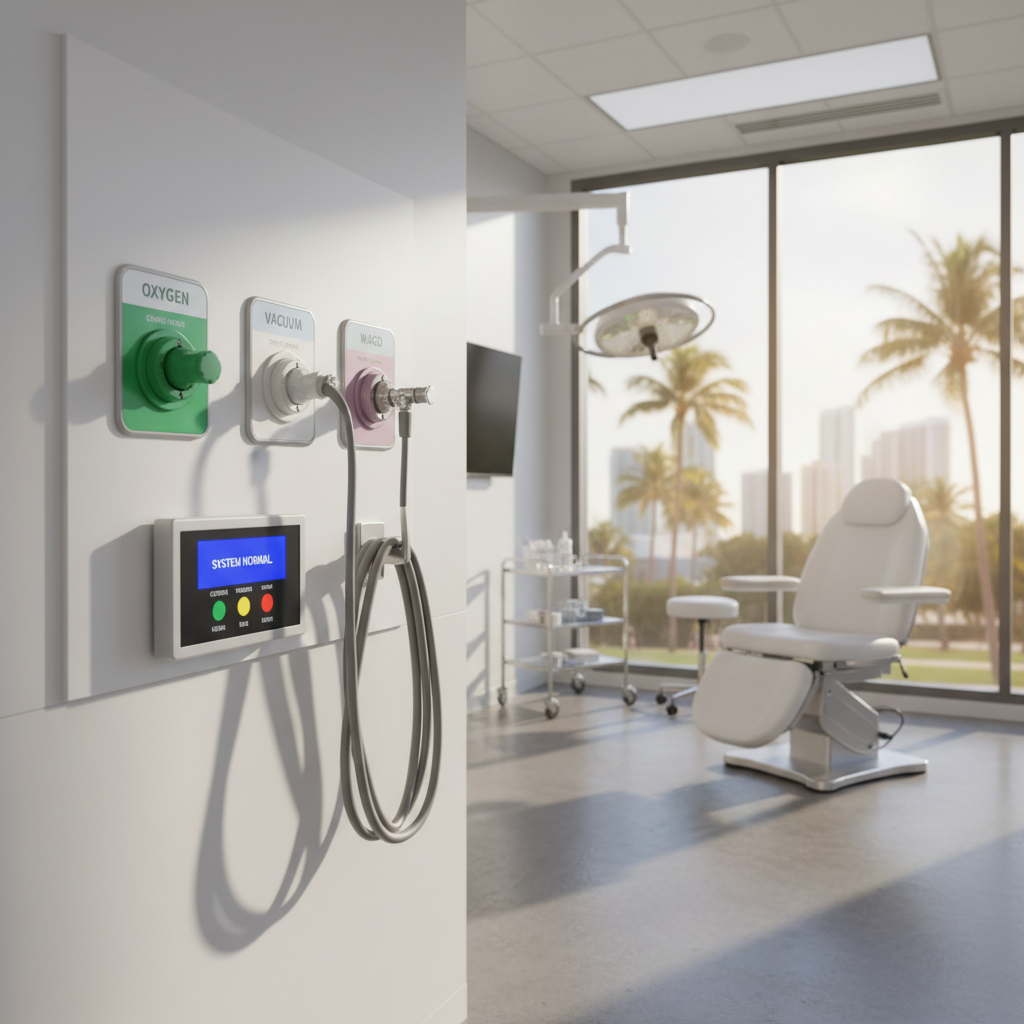
For a Level II or III surgical suite, Florida law requires a professionally installed and verified medical gas system compliant with the latest edition of NFPA 99, Health Care Facilities Code. This typically includes three primary systems:
1. Oxygen (O2)
The most critical life-support gas, oxygen must be delivered from a central source through a network of clean, copper piping to designated outlets in the procedure and recovery rooms. The source is typically a high-pressure cylinder manifold located in a secure, dedicated room. The system includes zone valve boxes to isolate specific areas in an emergency and alarms to signal pressure fluctuations, as required by NFPA 99.
2. Medical-Surgical Vacuum
A medical vacuum system is essential for removing fluids and debris from the surgical site. It is not the same as a standard janitorial vacuum. A medical vacuum system must be a duplexed system with two or more pumps, ensuring redundancy. It requires specific filtration and a dedicated, vented exhaust that terminates away from any public areas or air intakes.
If you administer any inhaled anesthetic agents (like nitrous oxide), a WAGD system is mandatory. This system actively scavenges waste gases exhaled by the patient and vents them safely out of the building. This protects your clinical staff from the long-term health risks of exposure to trace anesthetic gases. Proper WAGD and chemical vapor monitoring is a key component of staff and patient safety.
Navigating Florida's Regulatory Maze: AHCA, FBC, and NFPA 99
The primary governing body for medspa surgical suites in Florida is the Agency for Health Care Administration (AHCA). AHCA requires that all Level II and III office surgery facilities be registered and inspected. The Florida Building Code (FBC) directly adopts NFPA 99 as the standard for all medical gas systems.
To successfully register your facility, you must submit a comprehensive documentation packet, including a final verification report for your medical gas systems. This report, which must conform to AHCA Form 3110-7004 and Chapter 59A of the Florida Administrative Code, can only be produced by an ASSE 6030 Certified Medical Gas Verifier.
Why this matters for compliance: A failed or incomplete medical gas verification is one of the most common reasons for AHCA registration delays. Without a passing verification report from a certified third-party agency like Medical Testing Solutions, you cannot legally perform surgical procedures. This can halt your practice's expansion and lead to significant revenue loss.
For facilities seeking higher credentials, such as accreditation from The Joint Commission (TJC), compliance with NFPA 99 is also a core requirement for their rigorous annual surveys.
Hurricane Preparedness: A Florida-Specific Concern
NFPA 99, Section 5.1.12, has a critical provision for facilities in hurricane-prone areas like South Florida. It requires that if a medical gas system loses pressure for any reason, such as during a storm or a required shutdown, it must be re-verified before being placed back into service. As a local Florida company, Medical Testing Solutions can mobilize crews quickly post-hurricane to perform this essential re-verification, ensuring facilities from Miami to West Palm Beach can safely reopen.
The A-Team: ASSE 6010 Installers and ASSE 6030 Verifiers
You cannot use a standard plumber for your medical gas system. The installation and verification of these life-critical systems must be performed by credentialed professionals.
ASSE 6010 Certified Installer: This is the technician who physically installs the piping system. They are trained in the specific requirements for brazing, pipe cleaning, and component installation unique to medical gas. Using an uncertified installer will guarantee a failed verification. Medical Testing Solutions provides expert ASSE 6010 certified installation services across Florida.
ASSE 6030 Certified Verifier: This is the independent, third-party inspector who tests and certifies the entire system after the installer is finished. The verifier performs dozens of tests to confirm gas purity, system integrity, and proper function of all alarms and valves. This is the final gatekeeper of safety. A comprehensive medical gas verification is non-negotiable for AHCA approval.
The Florida Medspa Inspection Sequence: A Step-by-Step Checklist
While every project is unique, the verification process follows a standardized sequence:
Initial Rough-in Inspection: The ASSE 6030 Verifier inspects the piping before the walls are closed up to ensure proper labeling, brazing techniques, and support.
Pressure Test: The system is filled with high-pressure nitrogen to test for any leaks over a 24-hour period.
Cross-Connection Test: The verifier ensures that gases cannot flow from one system to another (e.g., oxygen cannot flow into the vacuum lines).
Purity Test: Samples are taken from each outlet to ensure the gas is the correct type and meets USP purity requirements (e.g., Oxygen 99% or higher).
Alarm & Valve Testing: Every alarm panel, zone valve, and shut-off valve is tested to ensure it functions as designed.
Source Equipment Inspection: The verifier inspects the manifold, vacuum pumps, and WAGD source to ensure proper installation and code compliance.
Documentation: The verifier compiles all test results into a final report. This comprehensive packet is the document you submit to AHCA for your registration.
Why Choose a Local Florida Verifier like Medical Testing Solutions?
For a project as critical as a surgical suite, choosing the right partners is paramount. Medical Testing Solutions is not an out-of-state company flying in consultants; we are a Florida-based, ASSE-certified firm headquartered right in Fort Lauderdale at 501 East Las Olas Blvd, Ste 300, Fort Lauderdale, FL 33301.
This provides our clients with three distinct advantages:
Significant Cost Savings: We have NO travel fees, NO lodging costs, and NO per-diem charges for projects anywhere in Florida. Our local presence in the state, with deep coverage in Miami, Fort Lauderdale, and West Palm Beach, typically saves our clients 10-25% compared to hiring a verifier from Georgia or Texas.
Local Regulatory Expertise: We work with AHCA inspectors and local building departments every day. We know the specific submission requirements and have built relationships with regulators and hospital systems across the state, from Jackson Memorial and Baptist Health in South Florida to AdventHealth and BayCare in Central Florida.
Speed and Availability: Being local means we can be on-site for phased inspections without delaying your construction schedule. Our rapid-response capabilities are essential for post-hurricane re-verifications or unexpected service needs.
As Florida’s leader in medical gas certification, MTS provides a seamless, end-to-end solution from installation to the final AHCA-ready report.
Frequently Asked Questions
The most common and costly mistake is hiring a standard mechanical plumber for the gas piping installation. This work must be done by an ASSE 6010 certified installer to pass the final verification. Using an unqualified installer will necessitate a complete tear-out and re-installation, causing massive delays and cost overruns.
The on-site testing itself usually takes 1-2 days for a typical medspa suite. However, the verifier is involved at multiple stages of construction. From initial consult to the final AHCA report, it's best to engage your verification company 3-6 months before your planned opening.
If you are a Level II or III facility in Florida, you cannot just use portable E-cylinders at the point of care. AHCA requires a fully piped system from a central source that has been verified by an ASSE 6030 credentialed technician. Portable cylinders are for emergency backup only.
A Waste Anesthetic Gas Disposal (WAGD) system actively captures and vents waste anesthetic gases from the room. Per NFPA 99, it is absolutely required if you administer any form of inhaled anesthetics, including nitrous oxide for sedation.
While your GC oversees the entire project, they will subcontract the medical gas work. It is crucial that you, the owner, ensure their chosen subcontractor holds the proper ASSE 6010 (for installation) and that you hire an independent ASSE 6030 firm (like MTS) for the third-party verification.
Request a quote for your facility
Talk with Medical Testing Solutions about your next inspection, repair or equipment request.