Medical Gas Certification in Estero, FL: Your Guide to ASSE 6030 Compliance
Medical Testing SolutionsJune 22, 20267 min read
Share
Patient safety is the bedrock of any healthcare facility, and the safe, reliable delivery of medical gases is a critical component of that foundation. For hospitals, surgery centers, and dental clinics in Estero, Florida, ensuring these complex systems are installed, tested, and certified correctly is not just a best practice, it's a legal requirement. The process of medical gas certification is a highly technical, multi-step verification that must be performed by a qualified professional to ensure compliance with strict state and national standards.
This comprehensive guide will walk you through the specifics of medical gas certification in Estero. We will explore the governing codes like NFPA 99, the importance of personnel qualifications like the ASSE 6030 Verifier credential, and what the process entails from start to finish. You will learn what it takes to satisfy regulatory bodies like the Agency for Health Care Administration (AHCA) and The Joint Commission (TJC), and how to select a competent partner like Medical Testing Solutions to guarantee your facility's systems are safe, compliant, and ready for patient care.
What is Medical Gas Certification?
First, it's essential to clarify the terminology. While "certification" is the common term, the official and more accurate term for this process is medical gas verification. This verification is performed on new, modified, or extended medical gas and vacuum systems. It is the final, exhaustive set of tests conducted after the system has been installed by a certified ASSE 6010 Installer but before any patients are connected to the system.
This is different from ongoing maintenance or annual medical gas inspections, which are periodic checks on systems already in service. Verification is the ultimate green light, confirming that the system was built to code, is free of contaminants, has no cross-connections, and delivers the correct gas at the specified pressure. It’s the foundational document that proves your system was safe from day one.
The Core Standard: NFPA 99 Health Care Facilities Code
The National Fire Protection Association (NFPA) 99, Health Care Facilities Code, is the master document for medical gas systems in the United States. It outlines the minimum requirements for the design, installation, testing, and maintenance of these critical life-support systems. Florida, via AHCA, has adopted NFPA 99 as a key part of its building and safety regulations for healthcare facilities.
Key Requirements for Category 1 Systems
NFPA 99 uses a risk-based approach, classifying systems into four categories based on the potential outcome if the system fails.
Category 1: Systems where failure is likely to cause major injury or death to patients or staff. This applies to hospitals, ambulatory surgery centers, and facilities where patients are dependent on the gas systems for life support (e.g., oxygen, medical air, vacuum for surgical procedures).
Category 2: Systems where failure is likely to cause minor injury.
Category 3: Systems where failure is not likely to cause injury but could cause patient discomfort.
Category 4: Systems where failure would have no impact on patient care.
For facilities in Estero requiring medical gas certification, the focus is almost always on Category 1 systems. The testing and documentation requirements for Category 1 systems are the most stringent, demanding a comprehensive verification by an ASSE 6030 Verifier.
ASSE 6000 Series: The Certified Professionals Behind the Systems
While NFPA 99 sets the standards for the systems, the ASSE/IAPMO 6000 Series sets the standard for the people who work on them. An ASSE credential is proof that an individual has undergone rigorous training and passed a comprehensive exam. For a medical gas system to be compliant, it must be built, verified, and maintained by appropriately certified personnel.
Here’s a breakdown of the key credentials:
Credential
Title
Scope of Work
ASSE 6010
Medical Gas Systems Installer
Responsible for the physical assembly and installation of medical gas systems. They are trained in proper brazing techniques, pipe joining, and component installation to ensure the system is built according to code.
ASSE 6030
Medical Gas Systems Verifier
An independent third party who performs the final certification testing. This individual cannot be the same person or from the same company that installed the system, ensuring an unbiased assessment. This is the expert who provides the final report for AHCA and TJC.
ASSE 6040
Medical Gas Systems Maintenance Personnel
Trained to perform maintenance, repairs, and service on existing systems that are already in use. They handle tasks like component replacement and managing ongoing medical gas maintenance services.
When you need medical gas certification, you are specifically seeking the services of an ASSE 6030 Verifier.
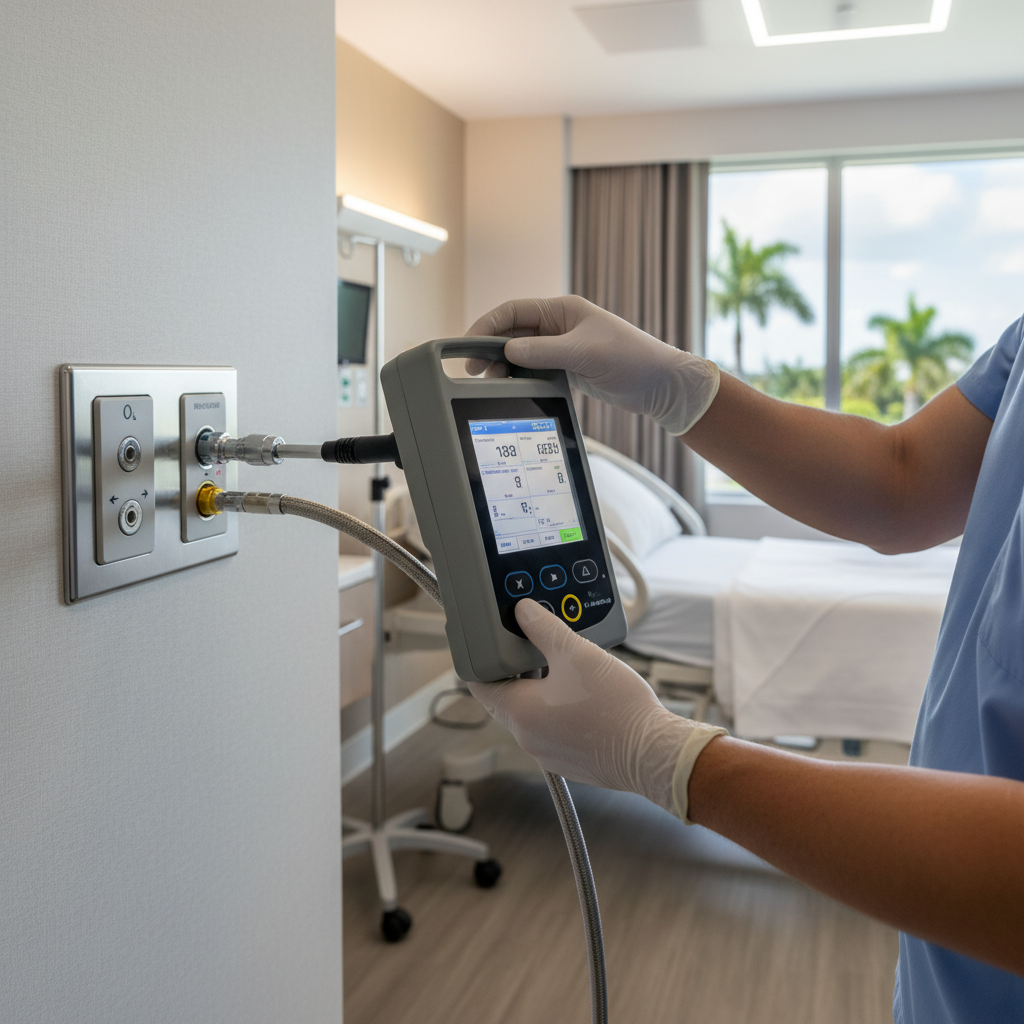
When a verifier from Medical Testing Solutions arrives at a new construction or renovation site in Estero, they follow a systematic process defined by NFPA 99, Chapter 5. This ensures every aspect of the system is checked and double-checked.
Documentation Review: The verifier first reviews the installer's documentation, ensuring the certified ASSE 6010 installers conducted their required initial pressure tests and that all materials used are compliant.
Piping System Purity: The verifier confirms the piping was purged with nitrogen during brazing to prevent the formation of carbonaceous scale inside the pipes, which could later contaminate the gas stream.
Initial Pressure Tests: The verifier performs a 24-hour standing pressure test at a pressure 20% higher than the standard operating pressure. This test is designed to detect even the smallest leaks in the system.
Cross-Connection Testing: This is one of the most critical tests. The verifier pressurizes each individual gas system (e.g., Oxygen) with nitrogen and then checks every other gas outlet in the facility to ensure that the nitrogen has not migrated into another system. This prevents a catastrophic failure where, for example, nitrogen could be delivered from an oxygen outlet.
Purity and Concentration Testing: Once cross-connections are ruled out, the final gas is introduced. The verifier then tests each outlet for gas concentration (e.g., oxygen is >99% pure), purity (checking for contaminants), and dew point (moisture levels).
Alarm and Valve Testing: Every master alarm, area alarm, and zone valve is tested to ensure they function correctly. This includes verifying that alarms trigger at the correct high/low pressure set-points and that valve boxes are correctly labeled for the areas they serve.
Labeling and Outlet Checks: The verifier confirms every outlet, inlet, and valve is correctly and legibly labeled according to NFPA 99 standards.
Final Documentation: Upon successful completion of all tests, the ASSE 6030 Verifier provides a detailed, multi-page report. This signed document is your official proof of compliance and the record you must provide to AHCA and The Joint Commission.
Why this matters for compliance: For facilities in Estero, an AHCA survey is not a matter of 'if' but 'when'. Having complete, accurate, and compliant medical gas certification reports from an ASSE 6030 Verifier is non-negotiable. It's the primary evidence you can provide that your systems were tested and deemed safe for patient use, directly satisfying TJC Environment of Care (EC) standards.
Choosing a Medical Gas Certification Partner in Estero
Not all testing companies are created equal. When selecting a partner for this critical service, your facility’s safety and compliance are on the line. Here’s what to look for:
Current ASSE 6030 Certification: Ask for the verifier's specific credentials. A company-level certification is not enough; the individual performing the tests must be certified.
Experience with Florida (AHCA) Regulations: A provider familiar with AHCA's specific documentation and reporting requirements can save you significant time and headaches during a survey.
Proper Insurance: Ensure the company carries adequate liability and errors & omissions insurance.
Comprehensive Reporting: Ask for a sample report. It should be detailed, clear, and reference the specific sections of NFPA 99 that were tested. Medical Testing Solutions provides industry-leading, compliant reports ready for any audit.
Your Partner for Compliance in Estero, FL
Navigating the complexities of medical gas certification requires a partner with deep expertise, unwavering attention to detail, and a commitment to patient safety. At Medical Testing Solutions, we provide ASSE 6030 verification services across Florida, delivering the compliant, audit-ready documentation your Estero facility needs to operate with confidence.
Don't leave patient safety and regulatory compliance to chance. Contact our team of experts today.
Ready to ensure your facility is compliant? Request a quote online or call Medical Testing Solutions at +1 (754) 315-1078 to discuss your medical gas certification needs.
'''
Frequently Asked Questions
Though often used interchangeably, 'verification' is the technical term for the third-party testing of a new or modified system (per ASSE 6030). 'Certification' is the broader outcome, confirming the system meets all codes. We use the term medical gas certification as it is most commonly understood.
Certification (verification) is required anytime a new medical gas system is installed or an existing one is modified. After that, facilities must have periodic inspections, typically annually, to ensure continued safety and performance.
A certified ASSE 6030 Medical Gas Verifier must perform the verification. This individual must be part of a third-party agency and cannot be the same person or company that performed the installation.
If a system fails any part of the verification, the verifier will document the failure. The original installer (ASSE 6010) must then make the necessary repairs, after which the verifier will return to re-test the failed portion of the system until it passes.
The ASSE 6030 credential ensures that the person testing your life-support systems has the proven expertise to identify potentially life-threatening issues like cross-connections, contamination, or incorrect pressures before the system is ever used for patient care.
Request a quote for your facility
Talk with Medical Testing Solutions about your next inspection, repair or equipment request.