In any healthcare facility, the safe, uninterrupted delivery of medical gases is not just a matter of operational efficiency, it's a matter of life safety. At the heart of this system are the medical gas alarm panels, the vigilant sentinels that monitor pressure, flow, and other critical parameters. Understanding the hierarchy of these alarms, master, area, and local, is fundamental for facility managers, technicians, and clinical staff to ensure both patient safety and regulatory compliance. This post breaks down what you need to know about each type of alarm, their specific roles as defined by NFPA 99, and the requirements for testing and maintenance.
Medical Gas Products
Medical Gas Service
Compliance & Standards
Medical Gas Alarm Panel: Master, Area, & Local Alarms Explained
Medical Testing SolutionsAugust 26, 20267 min read
What is a Medical Gas Alarm Panel?
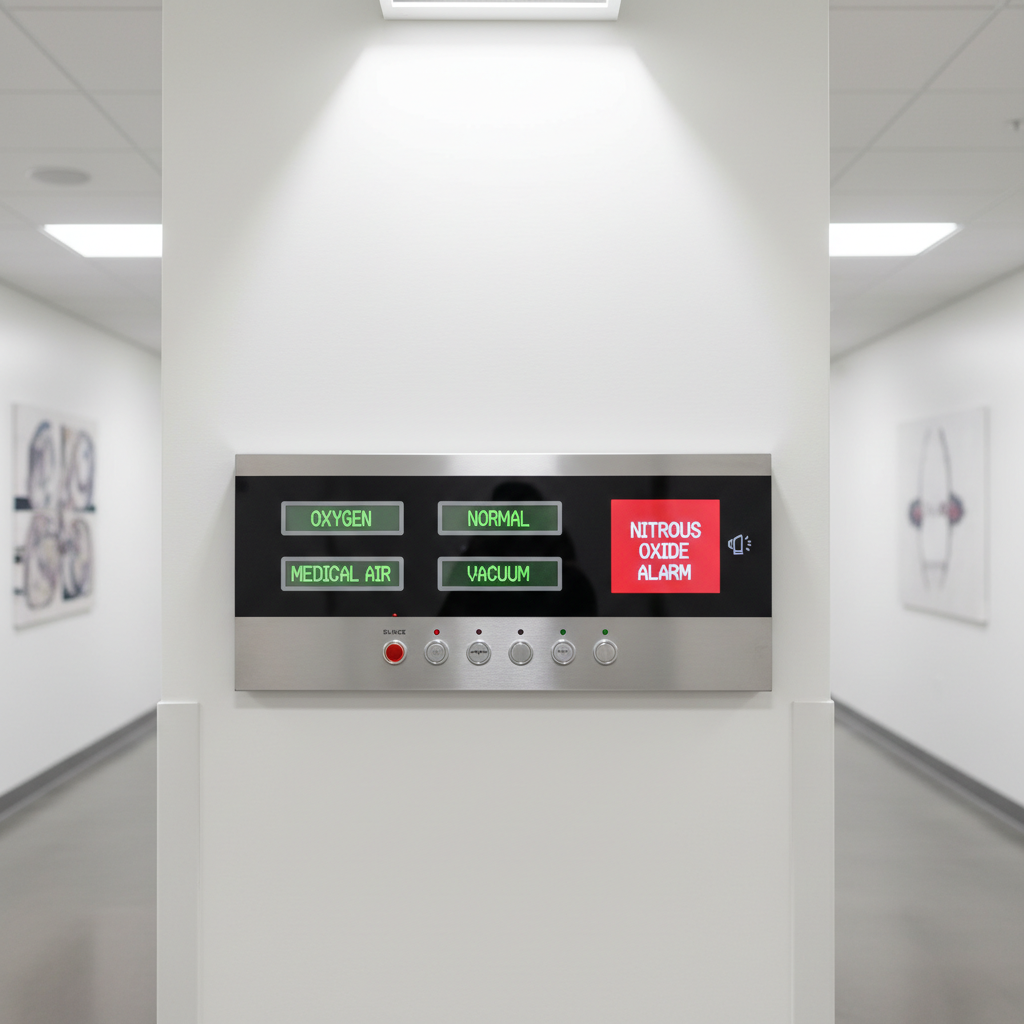
A medical gas alarm panel is a centralized system designed to monitor the medical gas and vacuum systems throughout a healthcare facility. Its primary function is to provide immediate audible and visual alerts to staff when a parameter, such as line pressure, deviates from a predefined normal range. These warnings enable personnel to take corrective action before a developing issue becomes a critical event that could impact patient care. According to NFPA 99, Health Care Facilities Code, these alarm systems are not optional; they are a required component of any Level 1 or Level 2 medical gas system.
The Three Tiers of Alarms: Master, Area, and Local
NFPA 99 establishes a three-tiered hierarchy for alarm panels to ensure that alerts are communicated to the right people at the right time. The three types are:
- Master Alarms: Monitor the primary source of supply and the main distribution lines.
- Area Alarms: Monitor the conditions within a specific zone or area of the facility.
- Local Alarms: Monitor conditions at a specific piece of source equipment.
Understanding the distinction is crucial for proper system design, installation, and daily operation.
Master Alarm Panels: The Central Command
The master alarm system is the highest level of monitoring. Its purpose is to provide a comprehensive, facility-wide overview of the medical gas supply. Per NFPA 99 (Section 5.1.9.2), the master alarm panel must be situated in two locations: one in the principal working area of the individual responsible for the maintenance of the medical gas system (e.g., the engineering office), and a second in a location that is under continuous 24-hour observation (e.g., the main security office or telephone switchboard).
H3>What Master Alarms Monitor
Master alarms are responsible for monitoring the main supply sources. An alert at this level indicates a potential problem that could affect the entire facility or a significant portion of it. Key monitored conditions include:
- Medical Air Compressor Operation: Alert for issues like high temperature or shutdown.
- Vacuum Pump Operation: Similar to compressors, it monitors for operational failures.
- Changeover Signal: Activates when the primary gas source is depleted and the system has switched to the secondary or reserve supply.
- Reserve Supply Low: Indicates that the reserve or "emergency" supply is running low.
- High/Low Line Pressure: Monitors the pressure in the main distribution lines downstream of the source valves.
Why this matters for compliance: NFPA 99 is explicit about master alarm requirements. Failure to have properly functioning master alarms in the correct locations can result in a finding of non-compliance during an inspection and, more critically, can delay response to a system-wide gas failure.
Area Alarm Panels: Zoning in on Patient Care Areas
If master alarms are the "central command," area alarms are the "regional commanders." These panels are located in patient care areas and are designed to be seen and heard by the clinical staff working in those specific zones. NFPA 99 (Section 5.1.9.3) requires area alarms for all Level 1 and Level 2 systems to monitor the pressure in the lateral branches of the piping system that serve those locations.
They are typically installed in nurses' stations or other highly visible locations within critical care and life support areas such as:
- Intensive Care Units (ICUs)
- Operating Rooms (ORs)
- Emergency Departments (ED)
- Post-Anesthesia Care Units (PACUs)
What Area Alarms Monitor
Area alarms provide a more localized warning, alerting staff to issues that might affect their immediate department. They monitor the line pressure for each specific gas service supplied to that zone. An alarm will trigger if the pressure goes above or below the normal operating range, which could indicate a leak, a closed valve, or another problem within that zone's piping.
Medical Testing Solutions offers a range of area alarm panels from leading manufacturers, ensuring that your facility can find a reliable solution that fits your specific needs. Our experts can also perform the ASSE 6030 verification necessary after installation.
Local Alarm Panels: At the Source
Local alarms are the most specific, located directly at the source equipment itself. Unlike master and area alarms that are networked to central panels, local alarms (per NFPA 99, Section 5.1.9.4) provide alerts only at the equipment location. Their audience is the maintenance or engineering staff who work directly with this machinery.
What Local Alarms Monitor
Local alarms are tailored to the specific equipment they serve. For example:
- On a medical air compressor: A local alarm might indicate a high discharge air temperature or excessive moisture content past the dew point monitor.
- On a manifold: An alarm would sound to indicate that one bank of cylinders is depleted and it's time to switch to the other.
- On a vacuum pump: An alarm could signal a lag pump in use, indicating higher-than-normal demand or a problem with the primary pump.
These alarms are crucial for proactive medical gas maintenance services, allowing technicians to address mechanical issues before they escalate and trigger a master alarm.
Alarm Panel Comparison: NFPA 99 Requirements
| Feature | Master Alarm | Area Alarm | Local Alarm |
|---|---|---|---|
| Location | Engineering office & 24/7 monitored site | Nurses' stations, patient care areas | At the source equipment (e.g., manifold, pump) |
| Monitors | Main supply sources, changeover, reserve status, main line pressure | Pressure in specific zones/branches | Equipment-specific faults (e.g., high temp, lag pump) |
| Audience | Facility maintenance & management | Clinical staff (nurses, doctors) | Facility maintenance technicians |
| NFPA 99 Section | 5.1.9.2 | 5.1.9.3 | 5.1.9.4 |
| Purpose | Facility-wide system status | Immediate patient area status | Equipment-specific maintenance alerts |
Testing and Maintenance: Ensuring Reliability
Alarm panels are only effective if they are working correctly. NFPA 99 mandates a strict testing schedule, which should be part of your facility's comprehensive annual medical gas inspections.
ASSE 6040 Certified Technicians are qualified to perform this critical maintenance. The process involves:
- Notification: Informing the clinical staff in the affected area before any testing begins to prevent confusion.
- Signal Actuation: For each monitored parameter, the technician will simulate a fault condition. For example, to test a low-pressure alarm, the gas pressure in that section of the line is safely reduced to trigger the alarm.
- Verification: Confirming that the alarm panel activates both the audible and visual signals correctly and that the signal is received at the master alarm panel if applicable.
- Documentation: Recording the date, the alarm tested, and the outcome of the test for compliance records.
Regular testing ensures that when a real emergency occurs, your alarm system will function as designed. Medical Testing Solutions provides ASSE-certified technicians for all your testing and medical gas certification needs.
Upgrading and Retrofitting Your Alarm System
Many older facilities still operate with legacy alarm systems that may no longer be compliant or offer the robust features of modern panels. Upgrading your alarm panels can provide clearer information, better networking capabilities, and improved reliability. If your facility is planning a renovation or expansion, it is the perfect time to assess your alarm infrastructure.
When considering an upgrade, look for panels from trusted brands and ensure they are installed by an ASSE 6010 certified professional. This ensures the system is installed correctly and verified to meet all code requirements. The full range of modern alarm panels is available in our products catalog.
Frequently Asked Questions
According to NFPA 99, all master and area alarm systems must be tested annually to verify they are functioning correctly. The testing procedure and results must be documented to maintain compliance.
An area alarm monitors the pressure in the pipelines serving a specific zone (like an ICU or operating room) and alerts the clinical staff in that area. A local alarm is located at the source equipment itself (like a compressor or pump) and alerts maintenance personnel to a problem with that specific piece of machinery.
Medical gas alarm panel testing and certification should be performed by an ASSE 6040 Certified Medical Gas Maintenance Person. This certification ensures the individual has the specialized knowledge to work on these critical life-safety systems safely and effectively.
A 'changeover' alarm indicates that the primary source of a medical gas (e.g., the main bank of oxygen cylinders) has been depleted and the system has automatically switched, or 'changed over,' to the secondary or reserve source. It's a critical alert for facility staff to schedule a replacement for the primary supply.
Yes, in many cases. Modern, modular alarm panels are designed to be expandable. You can add new sensor modules to monitor additional gases as your facility's needs grow. However, this work must be done by a qualified technician, and the system must be re-verified (ASSE 6030) afterward.
A recurring area alarm usually points to a persistent issue within that zone. It could be a small but consistent gas leak, a faulty pressure switch, or a problem with the zone valve box. This requires immediate investigation by a certified technician to diagnose and resolve the root cause.
Request a quote for your facility
Talk with Medical Testing Solutions about your next inspection, repair or equipment request.