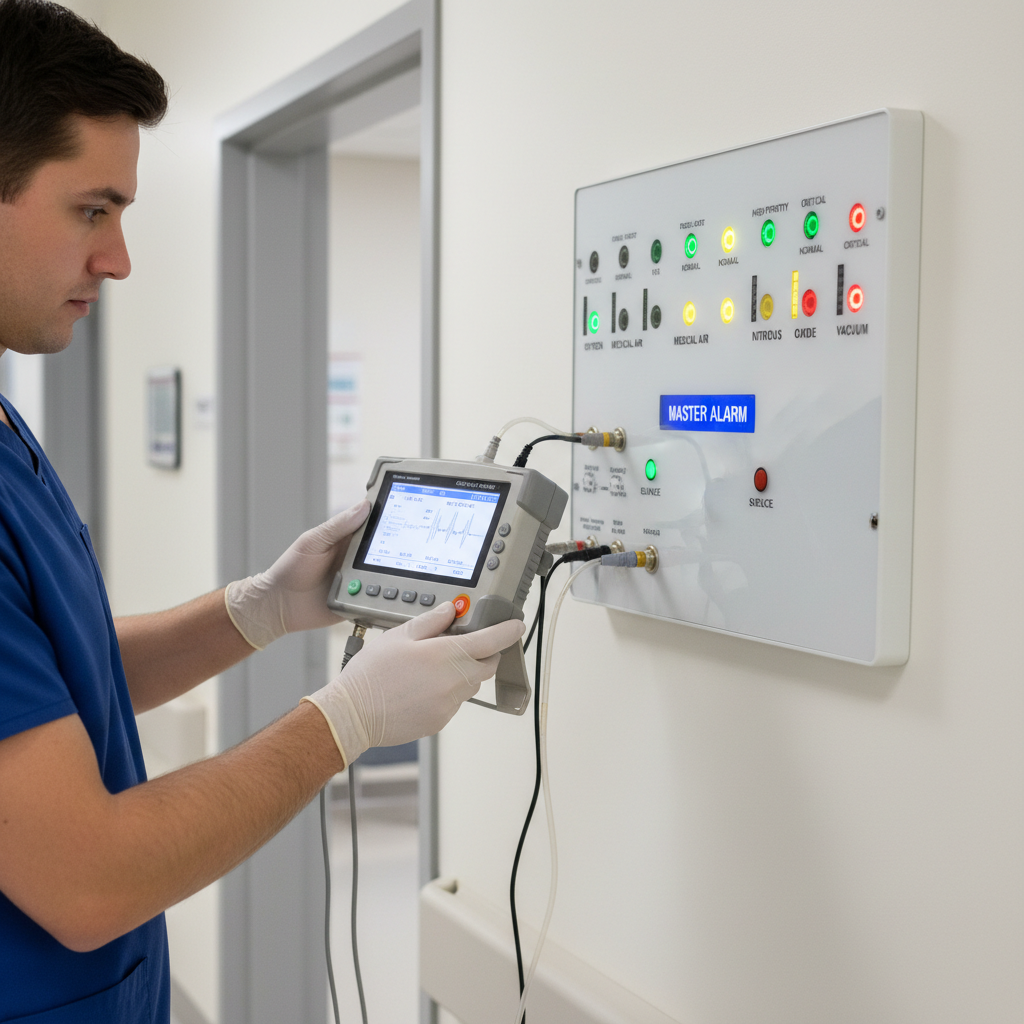
Master Alarm Panel Testing Weston FL: Clinical Safety Guide
Medical gas pipeline networks deliver life-sustaining oxygen, medical air, nitrous oxide, and vacuum directly to patients in operating rooms, critical care suites, and emergency departments. When pipeline pressure drops, bulk cryogenic reserves deplete, or a secondary compressor faults, clinical staff cannot afford a delayed warning. Medical gas master alarm panels and area alarm panels serve as the critical early detection perimeter for healthcare infrastructure.
For facilities in Weston, Florida, from regional hospitals and surgical centers along Royal Palm Boulevard to specialized outpatient clinics near I-75, routine physical inspection and functional verification of these warning systems are mandated life-safety requirements. This guide covers the technical standards, testing protocols, code mandates under NFPA 99 (2024/2021/2012 editions), and replacement options for leading alarm panel brands including BeaconMedæs, Amico Corporation, and Tri-Tech Medical. You will learn the exact steps certified technicians use to verify signal integrity, sensor calibration, and wiring faults to keep your facility compliant, audit-ready, and clinically secure.
The Regulatory Framework: NFPA 99 Alarm Requirements
In healthcare facility engineering, life-safety compliance hinges on clear code distinctions between master alarms, area alarms, and local alarms. In Florida, the Agency for Health Care Administration (AHCA) enforces NFPA 99 (Health Care Facilities Code) alongside local Broward County building codes. Meeting these rules requires thorough documentation of every testing event.
| Diagram text |
|, |
| NFPA 99 ALARM ARCHITECTURE |
| [SOURCE EQUIPMENT] (Bulk O2, Manifolds, Compressors, Vacuum Pumps) |
| ├── Local Equipment Alarms (Operational indicators at source) |
| ▼ |
| [MASTER ALARM PANELS] (Minimum 2 separate locations, e.g., Engineering & Sec.) |
| • Monitored 24/7/365 |
| • Category 1 and Category 2 central source status & pipeline alarms |
| [AREA ALARM PANELS] (Critical clinical zones: ORs, ICUs, PACU, Procedure Rooms) |
| • Local pressure switches/transducers monitoring zone valves |
| • Visual & audible alert for ±20% line pressure variance |
NFPA 99 Chapter 5 Alarm Classifications
NFPA 99 categorizes piping networks into Risk Categories (Category 1 through Category 4). Under Category 1 (where system failure can cause major injury or death), Section 5.1.9 sets rigid requirements for central alarm points:
- Dual Master Alarm Panels (NFPA 99 § 5.1.9.2): Category 1 systems require at least two master alarm panels wired to separate locations. One panel must be located in an office or workspace of the facility's engineering or maintenance personnel. The second panel must be placed in a continuously monitored location, such as a 24-hour security operations center, centralized nurse dispatch, or building automation control room.
- Independent Sensor Wiring (NFPA 99 § 5.1.9.4): Each master alarm panel must receive alarm inputs via independent wiring directly from the source switches, pressure transducers, or isolated relay outputs. Multiplexed or building management system (BMS) data paths can mirror medical gas alarms, but they cannot replace hardwired, supervised alarm connections.
- Area Alarm Panels (NFPA 99 § 5.1.9.3): Area alarms monitor pressures inside specific patient care zones. Placed immediately outside operating rooms, intensive care units, and anesthetizing areas, they warn clinical staff if delivery line pressures drift more than ±20% from normal working pressure.
Why this matters for compliance: AHCA and Joint Commission surveyors frequently check whether master alarms function via hardwired relays rather than shared building network loops. If your secondary master panel is tied to an unmanned nurse station or relies on unverified commercial network drops, surveyors will cite the facility under NFPA 99 Section 5.1.9.2, requiring immediate remediation.
Professional oversight through annual medical gas inspections confirms these dual-path circuits, visual indicators, and audible alerts function correctly before AHCA life-safety surveyors arrive on-site.
Key Differences: Master vs. Area Alarm Panels
Engineering teams and clinical staff often confuse master alarm functions with area alarm functions. Each panel type fulfills distinct operational and clinical roles:
| Feature / Specification | Master Alarm Panels (NFPA 99 § 5.1.9.2) | Area Alarm Panels (NFPA 99 § 5.1.9.3) |
|---|
| Primary Location | Facility engineering office AND 24/7 security/dispatch | Immediate clinical suite entry, nurses' station, or OR corridor |
| Monitored Scope | Entire central supply infrastructure (Bulk O₂, manifolds, pumps) | Specific patient zone downstream of the zone valve box |
| Trigger Mechanism | Source switches, liquid level monitors, vacuum switches | In-line dynamic pressure transducers (±20% variance) |
| Visual Indicators | High/Low indicators, reserve in use, system fault lamps | Digital pressure readouts (PSI/inHg), LED alarm status |
| Audible Decibels | High-decibel audible alarm with acknowledge/mute | Local audible buzzer (>80 dBA at 10 ft) with re-alarm |
| Supervision Circuit | Closed-circuit fail-safe (alarm initiates on wire break) | Closed-circuit fail-safe directly to zone pressure sensor |
| Required Redundancy | Minimum two separate master panels required | Dedicated to individual zone valve boundaries |
Routine medical gas maintenance services must address both panel types. While master alarms safeguard centralized utility distribution across the facility, area alarms directly protect patients receiving respiratory support or surgical anesthesia in specialized suites.
Critical Components Tested During an Inspection
During formal master alarm panel testing in Weston, ASSE 6030-certified verification personnel physically simulate system faults to evaluate the electronic, acoustic, and mechanical responsiveness of every indicator.
| Diagram text |
|, |
| ANNUAL ALARM PANEL TESTING FLOW |
| [1. Visual & Physical Inspection] ──► Check wiring, relays, enclosures |
| [2. Power Interruption Verification] ─► Verify normal to emergency UPS |
| [3. High/Low Line Simulation] ──────► Bleed test valves, log switch trip |
| [4. Audio/Visual Verification] ─────► Measure dBA output, LED operation |
| [5. Digital Readout Calibration] ───► Compare transducers to NIST gauge |
| [6. Secondary Panel Sync] ──────────► Confirm duplicate alarm delivery |
1. Source Signal Actuation (NFPA 99 § 5.1.9.4.4)
Technicians do not simply press the "lamp test" button. True functional testing requires physical simulation of every alarm point at the source:
- Bulk Liquid Oxygen: Simulating liquid level alerts, secondary header switchover, low reserve pressure, and primary vaporizer low line pressure.
- High-Pressure Manifolds: Tripping bank changeover switches to confirm "Reserve in Use" and "Secondary Supply Low" signals.
- Medical Air Compressors: Actuating high discharge temperature, desiccant dryer failure, high dew point (> -4°F at 50 psig), and carbon monoxide (> 10 ppm) alarms.
- Medical Vacuum & WAGD: Testing low vacuum setpoints (typically alarm threshold below 12 inHgV) and pump operational faults.
2. Area Pressure Transducer Calibration
Area alarms rely on electronic transducers tapped downstream of zone shutoff valves. Testing requires calibrated testing blocks equipped with NIST-traceable digital test gauges. Technicians bleed off pressure to confirm the alarm activates when system pressure drops 20% below standard delivery pressure (e.g., dropping below 40 psig on a 50 psig system) or spikes 20% above nominal line values.
3. Audio/Visual and Fail-Safe Power Checks
- Audible Silence and Re-alarm: Testing the cancel and silence circuit. When silenced by an operator, NFPA 99 requires area alarms to re-alert if a secondary alarm condition develops, or re-sound after a pre-set interval if the issue remains unresolved.
- Wiring Integrity (Fail-Safe): Disconnecting a field wire at the terminal strip to verify the panel triggers a system fault condition rather than remaining silent (closed-loop supervisory logic).
- Emergency Power Circuit Transfer: Verifying that panels automatically restart without signal loss or memory corruption when transferring between normal building utility feeds and the emergency generator branch.
In procedure spaces that use isolated electrical distribution, line isolation monitors safeguard the room against stray ground currents. Where facilities inspect alarm panels inside surgical spaces, technicians can also coordinate line isolation monitor testing to prevent interruptions to clinical procedures.
Step-by-Step Procedure: Master and Area Alarm Testing
A structured testing protocol ensures reliable inspection results while preventing disruptions to active operating rooms and patient wards.
| Diagram text |
|, |
Step 1: Pre-Testing Coordination and Notification
Before tripping medical gas relays, technicians notify facility engineering, security personnel, and nurse managers. In-house BMS monitoring alarms must be placed in test mode to prevent false dispatches of municipal emergency services or panic among clinical staff.
Step 2: Physical Source Switch Actuation
Technicians access the primary medical gas source room. For high-pressure cylinder manifolds, technicians close isolation ports and open manual test bleeds to trip the primary switch. The technician notes the precise system pressure at which the electrical contact changes state, checking it against system specifications.
Step 3: Simultaneous Annunciation Verification
While the field sensor is tripped, an inspector checks the primary master alarm panel (engineering) and secondary master alarm panel (security) via two-way radio. Both panels must indicate:
- The correct descriptive legend illuminated (e.g., "OXYGEN LOW RESERVE").
- A flashing or steady red indicator light.
- A distinct, audible alert sounding at the required decibel level.
Step 4: Transducer and Pressure Switch Verification
For area panels, technicians connect a calibrated test rig to the sensor port located inside or adjacent to the zone valve box. By regulating gas pressure up and down, they identify the precise trip points (high and low). Digital panel displays are calibrated to match the reference gauge within ±1%.
Step 5: Electrical Fail-Safe and Ground Verification
Technicians simulate a broken circuit by removing one sensor wire from the panel terminal block. The panel must immediately report an open-circuit fault. Supply voltage from the emergency power panel is measured under load to confirm it meets manufacturer parameters.
Step 6: Documentation and Remediation Logging
All tested parameters are compiled into an NFPA 99-compliant asset report. Any sensor drift, failed audible buzzer, broken relay, or missing indicator label is flagged for immediate maintenance or replacement.
Leading Alarm Panel Brands: Features, Diagnostics, and Upgrades
Weston medical centers, outpatient surgery centers, and private specialty clinics commonly rely on three major medical gas equipment manufacturers: BeaconMedæs, Amico Corporation, and Tri-Tech Medical. Understanding their architectures helps facility managers make informed decisions during facility renovations and panel replacements.
| MANUFACTURER | KEY HARDWARE ATTRIBUTES |
|---|
| BeaconMedæs | • TotalAlert Infinity series with high-res color touchscreens |
| • Embedded Ethernet & web server for direct BMS integration |
| • Live digital trends, continuous sensor diagnostics |
| Amico | • Alert-2 and Master/Area LCD series with modular assemblies |
| • Simple, rugged field retrofits and upgrade bezels |
| • Reliable digital pressure transducers, clear push-button setup |
| Tri-Tech Medical | • Med Touch series with interactive touch displays |
| • Built-in Ethernet, Modbus, and BACnet output modules |
| • Factory pre-mounted transducers for quick field conversions |
BeaconMedæs (TotalAlert Series)
BeaconMedæs systems, notably the TotalAlert Infinity, feature high-resolution color touchscreens and embedded web servers. Each panel functions as a networked smart hub that tracks live pipeline pressures, archives alarm histories, and broadcasts automated email/text alerts to maintenance engineers.
- Common Failure Points: Aging resistive touchscreen digitization layers, power supply module heat failure inside crowded wall back-boxes, and communications bus errors between source transducers and main processors.
Amico Corporation (Alert-2 Series)
Amico's Alert-2 and LCD-based digital alarm panels are widely used across Florida healthcare networks. Their modular architecture features independent display boards for each gas service, simplifying the replacement of individual components without swapping out the entire enclosure.
- Common Failure Points: Aging sensor transducer drift, power supply ribbon cable corrosion, and intermittent failure of audible alarm buzzer components.
Tri-Tech Medical (Med Touch Series)
Tri-Tech Med Touch panels combine digital microprocessor stability with intuitive touchscreen interfaces. They provide native BACnet and Modbus capabilities, allowing direct communication with facility-wide building automation systems without expensive external translation gateways.
- Common Failure Points: External 24V power supply step-down transformers, uncalibrated gas sensor modules, and degraded front membrane buttons on earlier generations.
Alarm Panel Comparison Matrix
| Specification / Capability | BeaconMedæs TotalAlert Infinity | Amico Alert-2 / LCD Series | Tri-Tech Medical Med Touch |
|---|
| Display Technology | High-Res Color LCD Touchscreen | Segmented Digital LED / LCD | Color Graphical Touchscreen |
| Input Capability | Analog Transducer, Dry Contact, Ethernet | Transducer, 4-20mA, Dry Contact | Transducer, Dry Contact, BACnet |
| Network Protocols | Native Web, Ethernet, Modbus, BACnet | Ethernet / BACnet via Gateway | Native BACnet, Modbus, Ethernet |
| Retrofit Ease | High (Custom conversion frames) | Industry Leading (Standard rough-ins) | High (Multi-brand back-box fits) |
| Field Calibration | Digital on-screen menu calibration | Push-button / Potentiometer trim | On-screen touch calibration |
| Typical Lifespan | 10–15 Years | 12–15 Years | 10–14 Years |
| Replacement Hardware Cost | $$$$ (Premium integrated) | $$$ (Modular, budget-friendly) | $$$ (Competitive smart tech) |
When an alarm panel fails certification, Medical Testing Solutions assists facility engineers in evaluating repair versus replacement options, providing compliant parts and factory replacements through our medical gas products catalog.
When to Replace vs. Repair an Alarm Panel
Facilities often struggle to decide whether to repair an older panel or replace the complete assembly. Consider these operational guidelines:
| Diagram text |
|, |
| ALARM PANEL DECISION MATRIX |
| [SYMPTOM] [RECOMMENDED ACTION] |
| • Single sensor drifts slightly ──► RECALIBRATE |
| • Blown modular power supply (parts available) ──► FIELD REPAIR |
| • Failed daughterboard relay (modern brand) ──► COMPONENT SWAP |
| • Obsolete manufacturer parts (Chemetron/legacy) ──► FULL REPLACEMENT |
| • Corroded backplane wiring harness ──► FULL REPLACEMENT |
| • Non-compliant NFPA 99 single-point master ──► DUAL MASTER RETROFIT |
| • Repeated logic board communication crashes ──► UPGRADE TO DIGITAL |
When Field Repair Makes Sense:
- Isolated Transducer Drift: If a single pressure transducer reports 42 psig while line pressure is 50 psig, the sensor can often be recalibrated or replaced without disturbing the main motherboard.
- Modular Power Supply Replacement: Modern Amico and BeaconMedæs panels rely on plug-and-play step-down power supplies. A dead internal transformer can easily be swapped in under an hour.
- Individual Gas Board Swaps: In modular assemblies, a single failing gas module (e.g., Nitrous Oxide display failure) can be replaced while keeping the remaining 5 or 6 gas modules intact.
When Complete Replacement is Required:
- Legacy Obsolete Hardware: Older Chemetron, Ohmeda, or legacy incandescent light boxes lack available replacement parts. Rebuilding these components often costs more than installing a new digital display.
- No Fail-Safe Monitoring: Older panels lacking closed-loop sensor line supervision cannot meet modern NFPA 99 requirements.
- Renovations and Expansions: Adding gas services (such as Waste Anesthetic Gas Disposal or Instrument Air) to an older, fully loaded panel requires upgrading to a larger modular back-box.
- BMS Integration Needs: If your risk management team requires automated digital logging and network monitoring, legacy panels cannot supply the necessary data formats.
When replacing panels, work must be completed by credentialed specialists. Medical Testing Solutions coordinates projects from initial design to certified installation under medical gas installation (ASSE 6010) standards, followed by comprehensive third-party medical gas verification (ASSE 6030) to ensure full regulatory compliance.
Why Choose Medical Testing Solutions in Weston, FL
Medical Testing Solutions (MTS) is a trusted medical gas compliance and service partner for healthcare systems across South Florida. Headquartered locally in Fort Lauderdale, our field technicians provide rapid support to hospitals, surgical centers, and healthcare providers throughout Weston and Broward County.
| Diagram text |
|, |
| THE MEDICAL TESTING SOLUTIONS ADVANTAGE |
| [ASSE 6030 Certified] Inspectors credentialed to NFPA 99 standards |
| [ASSE 6010 Certified] Installations executed by licensed tradespeople |
| [Complete Turnkey Scope] Testing, sensor calibration, replacement & parts |
| [Rapid Local Response] South Florida team (Fort Lauderdale head office) |
| [Audit-Ready Portals] Detailed digital documentation for AHCA & TJC |
Comprehensive Technical Capabilities:
- Dual-Certified Technicians: Our team holds ASSE 6030 (Verifier), ASSE 6035 (Bulk Systems Verifier), ASSE 6040 (Maintenance Personnel), and ASSE 6010 (Installer) certifications.
- Turnkey Sales and Field Support: MTS sells medical gas hardware from top manufacturers, including BeaconMedæs, Amico, and Tri-Tech, and performs on-site installations, calibrations, and formal verifications.
- Audit-Ready Digital Documentation: Following every inspection, you receive clear, cloud-accessible reports detailing every switch, transducer, line voltage, and decibel level for AHCA, Joint Commission, and CMS review.
- Emergency Service Availability: If a master alarm trips unexpectedly or an area transducer fails during weekend surgery prep, our South Florida team is ready to respond.
Our credentials extend through full medical gas certification programs, providing Weston facilities with single-source reliability for all piped gas infrastructure.
Secure Your Facility's Medical Gas Compliance
A failing or uncalibrated medical gas alarm panel exposes your facility to severe clinical risks and immediate accreditation penalties. Whether you need routine ASSE 6030 master alarm panel testing, area transducer calibration, or a complete multi-zone digital replacement in Weston, Medical Testing Solutions delivers the certified expertise your facility demands.
Call our South Florida service office today at (754) 315-1078 or request a quote online to schedule an on-site master alarm inspection. You can also contact us directly to discuss custom replacement panels and code compliance assessments. Protect your patients, maintain continuous AHCA compliance, and keep your life-safety infrastructure fully operational with Medical Testing Solutions.