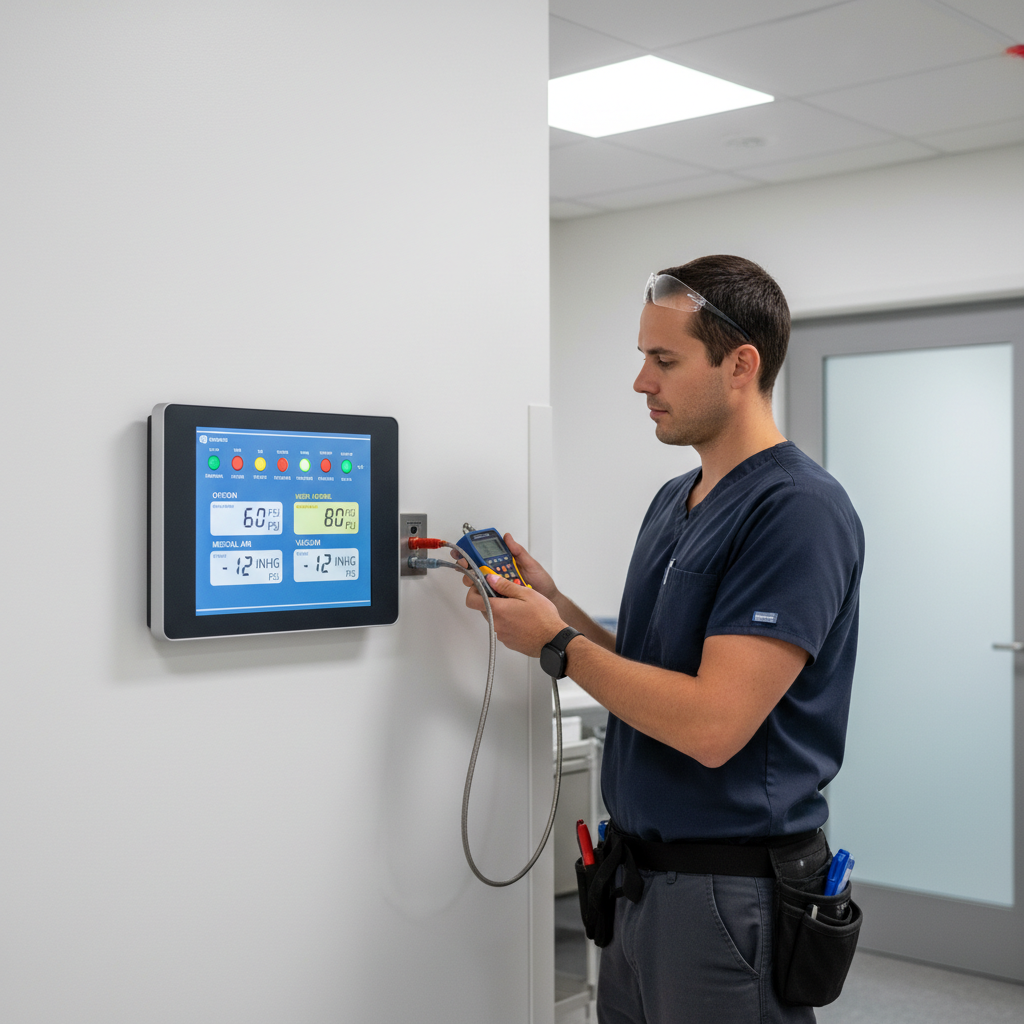
Clinical environments throughout Wellington, Florida rely on uninterrupted medical piped gas systems to support life-critical operations. Behind every delivery of medical air, oxygen, and nitrous oxide stands a vital surveillance network: your master and area alarm panels. Routine, code-mandated master alarm panel testing in Wellington, FL guarantees that when an operational threshold drops or a source pressure fails, your facility receives immediate, unambiguous notification.
Whether you oversee clinical engineering at a surgical hospital near State Road 7, direct operations at an outpatient procedural center along Forest Hill Boulevard, or manage specialized clinical suites in Palm Beach County, maintaining strict compliance with the National Fire Protection Association (NFPA) is critical. In this comprehensive guide, you will learn the exact testing protocols dictated by NFPA 99 for Category 1 and Category 2 facilities, how to differentiate master versus area alarms, how to troubleshoot legacy systems from major manufacturers like BeaconMedaes, Amico, and Tri-Tech Medical, and when to replace outdated infrastructure to ensure life safety.
The Critical Role of Medical Gas Alarm Systems in Clinical Facilities
Medical gas alarms serve as the central nervous system of your facility's life-support delivery infrastructure. Pipelines operating behind drywall and above suspended ceilings cannot be visually monitored for pressure variances or contaminant breaches. Automated alarm panels translate real-time sensor and switch inputs into visual and audible notifications, preventing catastrophic delivery failures during patient ventilation, surgical sedation, and clinical care.
Under modern healthcare facility guidelines, system failures carry severe repercussions, ranging from emergency regulatory citations by the Agency for Health Care Administration (AHCA) to devastating clinical emergencies. Ensuring these panels trigger at exact pressure tolerances is not merely a box to check on an annual survey, it is the baseline protocol protecting patients under general anesthesia or critical care support.
For comprehensive operational protection, facilities must schedule routine annual medical gas inspections performed by credentialed personnel who understand how alarm thresholds interact with your central supply sources.
NFPA 99 & ASSE 6040 Requirements for Alarm Testing
Healthcare code compliance in Wellington and greater Palm Beach County adheres strictly to NFPA 99: Health Care Facilities Code (commonly referenced across the 2012, 2015, 2018, and 2021 editions depending on local authority adoption). Chapter 5 explicitly outlines the operational parameters, wiring redundancy, signal monitoring, and maintenance verification standards for Category 1 and Category 2 piped gas systems.
| Diagram text |
|, |
| Central Supply Source |
| (Bulk O2, Manifold, |
| Compressor, Vacuum) |
| Master Alarm Panel #1 Master Alarm Panel #2 |
| (Engineering/Bldg. (24-Hour Continuous |
| Automation Office) Staffed Location) |
NFPA 99 Chapter 5 Standards
NFPA 99 Section 5.1.9 mandates that Category 1 medical gas piping systems possess two master alarm panels. These panels must be wired independently and placed in separate, strategic locations:
- Primary Location: An office or control space of the individual responsible for the maintenance of the medical gas system (e.g., Clinical Engineering, Facilities Management, or Central Plant).
- Secondary Location: A location with 24-hour continuous surveillance (e.g., Security dispatch, telephone switchboard, emergency department nursing station, or a central nurse management desk).
Why this matters for compliance:
NFPA 99 Section 5.1.14.2 requires periodic testing of alarm systems. Audible and visual indicators must be actuated to prove that every individual switch, sensor, and circuit board operates correctly. A panel with burned-out LEDs, disabled audible buzzers, or bypassed circuits violates state licensure standards and puts patients at risk.
ASSE Series 6000 Qualifications
Inspecting, troubleshooting, or replacing medical gas alarm hardware requires specialized credentials. Under the American Society of Sanitary Engineering (ASSE) Series 6000 Professional Qualifications Standard:
- ASSE 6040: Designates credentialed Medical Gas Maintenance Personnel qualified to perform internal facility checks, preventative maintenance, and filter changes.
- ASSE 6030: Designates Medical Gas Verifiers qualified to run comprehensive third-party baseline testing, commissioning, and annual audits.
- ASSE 6010: Designates certified Medical Gas Installers required when installing new alarm panels or retrofitting junction boxes.
At Medical Testing Solutions, our field specialists hold active ASSE credentials to ensure all evaluations, verifications, and repairs withstand rigorous regulatory oversight. If your system requires new panel additions, our certified technicians execute full medical gas installation services compliant with local building codes.
Master Alarm Panels vs. Area Alarm Panels: Key Differences
Facility teams frequently confuse master and area alarm panels, yet their design, placement, and clinical mandates differ entirely. Understanding these distinctions is foundational when planning annual system validations or budget upgrades.
| Diagram text |
|, |
| ZONE VALVE BOX |
| (Isolates specific clinical area) |
| Pipeline Pressure Sensor |
| AREA ALARM PANEL |
| Monitors local pressure variations (±20%) |
| Located at Nurses' Station inside the critical area |
| (ICU, Operating Rooms, Post-Anesthesia Care) |
Master Alarm Panel Functionality
Master alarm panels monitor the source equipment and main supply piping. They track the operational status of your central bulk oxygen vessel, medical air compressor skids, vacuum pump packages, and cylinder manifolds. Specific conditions tracked by a master alarm panel include:
- Main line high/low pressure (±20% variance from nominal working pressure).
- Liquid level alerts on cryogenic bulk tanks.
- Reserve supply in use or reserve cylinder pressure depletion.
- Air compressor motor run status, high carbon monoxide (CO) levels, and high dew point.
- Vacuum system pump lag or secondary unit engagement.
Area Alarm Panel Functionality
Area alarm panels monitor the critical delivery pressure to specific patient care areas. Positioned immediately adjacent to nursing stations in intensive care units, operating rooms, catheterization labs, and emergency treatment bays, these panels provide local clinicians with rapid awareness of pressure drops.
Unlike master panels that track pump status and tank volumes, area alarm panels monitor local pressure switches situated on the patient side of the zone valve box. If operating room oxygen pressure drops from 50 PSI to below 40 PSI, or spikes over 60 PSI (a 20% variance), the local area alarm sounds immediately, alerting surgical teams prior to patient compromise.
Step-by-Step Protocol: How Master Alarm Panels Are Tested
A proper medical gas panel test does not consist of simply pressing the "Test" or "Acknowledge" button on the front faceplate. That onboard feature merely verifies that the panel's internal LEDs and audible buzzer receive power. Code-compliant field verification requires actuating the actual source sensing device to prove signal transmission from pipe to panel.
Our certified ASSE 6030 verifiers at Medical Testing Solutions follow an exhaustive multi-point testing process:
1. Visual Inspection and Labeling Verification
The technician reviews the physical condition of the enclosure, circuit modules, and wiring harnesses. Every signal indicator must feature clear, permanently embossed or labeled designations identifying the gas service and specific fault condition (e.g., "Medical Air Dew Point High" or "Oxygen Main Line Low Pressure").
2. Sensor and Switch Actuation
Technicians interface directly with the pressure switches, transducers, and dry contact relays located at the source equipment:
- Pressure Switches: Test ports are slowly bled or pressurized using calibrated test gauges to physically trip the pressure switch. The technician documents the exact PSI at which the switch trips to confirm it falls precisely within NFPA tolerance (typically 20% above or below nominal operating pressure).
- Transducers: High-accuracy digital multimeters verify milliamp or voltage output across the entire pressure range.
- Liquid Level Sensors: Differential pressure sensor inputs on bulk tanks are manually simulated to verify low-liquid warning alarms.
3. Signal Validation at Both Master Stations
NFPA 99 requires that every individual alarm condition activates both master alarm panels simultaneously. When a reserve manifold changes over or compressor dew point rises above +35°F (+2°C), technicians verify that Master Panel #1 and Master Panel #2 both annunciate visual and audible warnings without latency.
4. Audio-Visual Functionality and Mute Integrity
- Audible Alert: Sound decibel levels are evaluated to confirm alarms remain clearly audible above surrounding facility background noise.
- Mute/Silence Feature: Actuating the silence switch must deactivate the audible tone while keeping the visual LED or digital display illuminated continuously until the fault condition is cleared at the source.
- Re-Arming Mechanism: If an unacknowledged secondary fault occurs while the first condition is silenced, the panel must immediately break silence and re-sound the audible horn.
Following any maintenance or initial commissioning, facilities must obtain full medical gas certification to validate that all panel wiring and source switches comply with life safety codes.
Common Points of Failure and Diagnostic Troubleshooting
During preventative audits and master alarm panel testing in Wellington, FL, technicians uncover recurring failure modes across regional facilities. Identifying these vulnerabilities early eliminates regulatory write-ups and prevents unexpected clinical disruptions.
1. Drifting Pressure Switches
Mechanical pressure switches rely on internal metal diaphragms and tension springs that degrade over years of continuous static pressure. When springs lose tension, low-pressure alarm thresholds drift downward. A system designed to alarm at 40 PSI may drift down to 32 PSI, delaying critical warning until equipment downstream has already malfunctioned.
2. Microprocessor Board and Power Supply Degradation
Modern digital panels rely on internal switching power supplies and logic processors. Over-voltage spikes, lightning storms (prevalent in South Florida), and continuous operation eventually degrade capacitor arrays. Symptoms include random sensor flickering, display freezing, or phantom alarm conditions that cannot be cleared through the interface.
3. Faulty Communication Wiring
Code mandates that wiring between alarm sensors and the master panels be continuously monitored for integrity (NFPA 99 closed-circuit design). A severed wire, broken conduit connection, or ground fault must initiate an immediate system alarm. Technicians often discover legacy panels wired with open-circuit relays or damaged terminal blocks that fail to register circuit breaks, leaving the facility blind to real-time supply disruptions.
4. Deliberately Defeated Sounders
In busy clinical environments, nuisance alarms generated by faulty sensors are sometimes silenced by staff who disconnect the buzzer wire or tape foam over the horn. This is a severe AHCA violation. Proper diagnostic testing identifies non-responsive audible modules and restores original panel operation.
Routine facility upkeep should always be tied to comprehensive medical gas maintenance services to resolve underlying mechanical issues before they damage sensitive panel electronics.
Alarm Panel Comparison: BeaconMedaes, Amico, and Tri-Tech Medical
When repairing or replacing alarm panels, selecting the proper equipment manufacturer determines long-term reliability, ease of integration, and replacement component availability. Medical Testing Solutions sells, installs, and services all major medical gas alarm manufacturers. Below is a direct comparison of current industry standards:
| Feature / Metric | BeaconMedaes (MegaSystem / TotalAlert) | Amico (Alert-2 / Master Series) | Tri-Tech Medical (Gen III / Vision-Matrix) |
|---|
| Display Technology | High-resolution Color Touchscreen | Backlit Digital LCD / Multi-Color LED | Color Graphic LCD / High-Luminance LED |
| Input Flexibility | Ethernet, Dry Contact, BACnet | Dry Contact, Microprocessor Modular, BACnet | Ethernet, Modbus, Dry Contact, BACnet |
| Self-Diagnostics | Continuous Sensor Health & Loop Checks | Automated Communication Diagnostics | Real-time Transducer & Loop Monitoring |
| Field Upgradeability | Firmware via Ethernet / USB | Swappable Circuit Modules | Swappable Modular Cartridges |
| Retrofit Capability | Excellent retrofit plates for older Medaes boxes | Installs into existing backboxes across legacy brands | Multi-brand conversion bezels and trim rings |
| Network Integration | Direct web interface & hospital BMS connection | Optional IP monitoring & software gateway | Integrated web server; automated email/text alerts |
| Typical Application | Large acute care hospitals & multi-building campuses | Ambulatory centers, outpatient surgery, hospitals | Specialty surgical hospitals & regional clinics |
For facilities seeking replacement hardware or conversion assemblies, explore our certified options in the Medical Testing Solutions our products catalog or consult with an equipment specialist to determine backbox compatibility.
Retrofitting and Replacing Outdated Alarm Panels in Wellington Healthcare Facilities
Many healthcare facilities in Palm Beach County operate on legacy systems installed fifteen to thirty years ago. Aging analog systems, such as legacy Medaes, Chemetron, Puritan Bennett, or early Ohio Medical panels, frequently rely on obsolete components that are no longer manufactured.
When a master or area alarm panel board fails, procuring replacement chips or relays can take weeks, leaving facilities reliant on temporary manual fire watches and constant manual pressure checks.
Assessing Retrofit Compatibility
Modern manufacturers design retrofit panels specifically to prevent tearing open existing drywall. Trim kits, backbox adapters, and programmable input modules allow a certified ASSE 6010 installer to install an advanced digital touchscreen panel into an existing steel backbox.
Maintaining System Continuity During Upgrades
A medical gas system cannot simply be shut down during an alarm panel replacement. The facility must develop an interim life-safety protocol, which may include:
- Pre-testing communication lines between source equipment and the new panel location.
- Implementing continuous manual monitoring logs at the central supply manifolds and bulk tanks during physical wire transfers.
- Completing wire transitions circuit by circuit to minimize dead-time for any single sensor input.
Post-Replacement Validation
Every panel installation or physical replacement must undergo full testing and documentation under ASSE 6030 standards. Following installation, an independent certified verifier must execute complete medical gas verification protocols to certify that every alarm signal trips precisely within code-mandated tolerances before clinical operations resume.
Local Wellington, FL Regulatory Considerations (AHCA & Palm Beach County Fire Rescue)
Healthcare facilities located in Wellington, FL operate within a distinct regulatory ecosystem. In addition to national NFPA codes, clinical engineering directors must satisfy inspection standards enforced by the Florida Agency for Health Care Administration (AHCA) and Palm Beach County Fire Rescue.
| Diagram text |
|, |
| FLORIDA AHCA COMPLIANCE MATRIX |
| Physical Plant Standards Florida Building Code Ch. 4 |
| Piped Medical Gas Specs NFPA 99 (Enforced Edition) |
| Periodic Test Interval Annual Minimum (Documented) |
| Life Safety Paperwork ASSE 6030/6040 Records |
AHCA Joint Commission and Physical Plant Audits
AHCA surveyors inspect hospitals and ambulatory surgical centers in Palm Beach County with an intense focus on medical gas documentation. Surveyors regularly demand:
- The previous 12 to 24 months of master and area alarm test logs.
- Proof of ASSE credentials for the verifying personnel.
- Explicit pass/fail data displaying exact actuation pressures, rather than generic checkboxes stating "panels functional."
Environmental and Infrastructure Pressures in South Florida
South Florida's coastal climate introduces specific physical challenges to medical gas infrastructure:
- High Humidity & Air Quality: Moisture accelerates corrosion across terminal junction strips and wire splices within backboxes.
- Electrical Storms: Heavy lightning activity in Palm Beach County causes transient voltage spikes that burn out sensitive digital transducers and microprocessor boards.
- Generator Transfers: Emergency generator testing and load transfers can interrupt alarm monitoring loops if power supplies lack proper battery backup or failover conditioning.
Medical Testing Solutions is based in South Florida, giving our technicians an intimate understanding of the environmental conditions and AHCA documentation styles required to keep Wellington clinical facilities fully compliant year-round.
Medical Testing Solutions: Certified Equipment, Testing, and Verification
Maintaining life-safety compliance requires an experienced partner capable of addressing both mechanical operations and code paperwork. Medical Testing Solutions is an ASSE-certified medical gas service, testing, and equipment provider headquartered in Fort Lauderdale, Florida.
Our team provides end-to-end support for medical gas infrastructure throughout Wellington, Royal Palm Beach, West Palm Beach, and surrounding communities:
- ASSE 6030 Third-Party Verification: Independent, accredited testing of master panels, area panels, manifolds, and source equipment.
- ASSE 6010 Installation and Retrofit: Professional changeouts of obsolete, failing alarm panels using modern modular equipment from BeaconMedaes, Amico, and Tri-Tech Medical.
- Preventative Maintenance Contracts: Scheduled annual and semi-annual testing plans that satisfy all AHCA, Joint Commission, and NFPA requirements.
- Direct Equipment Sales: Competitive pricing on medical gas alarm panels, valves, outlets, and source components through our direct equipment distribution division.
Whether you are preparing for an impending AHCA inspection or managing unexpected alarm panel board faults, Medical Testing Solutions delivers the expertise and rapid local response your facility demands.
Ensure Your Facility's Medical Gas Systems Are Code-Compliant
Do not wait for an unannounced AHCA survey or an emergency pressure drop to discover an inoperable medical gas alarm circuit. Partner with Florida's leading ASSE-certified medical gas specialists to ensure your life-safety monitoring network performs flawlessly under pressure.
Contact Medical Testing Solutions today to schedule your master alarm panel testing in Wellington, FL, or to discuss retrofit equipment options.