Master Alarm Panel Testing in Vero Beach, FL: A Complete Guide
What is a Medical Gas Master Alarm Panel?
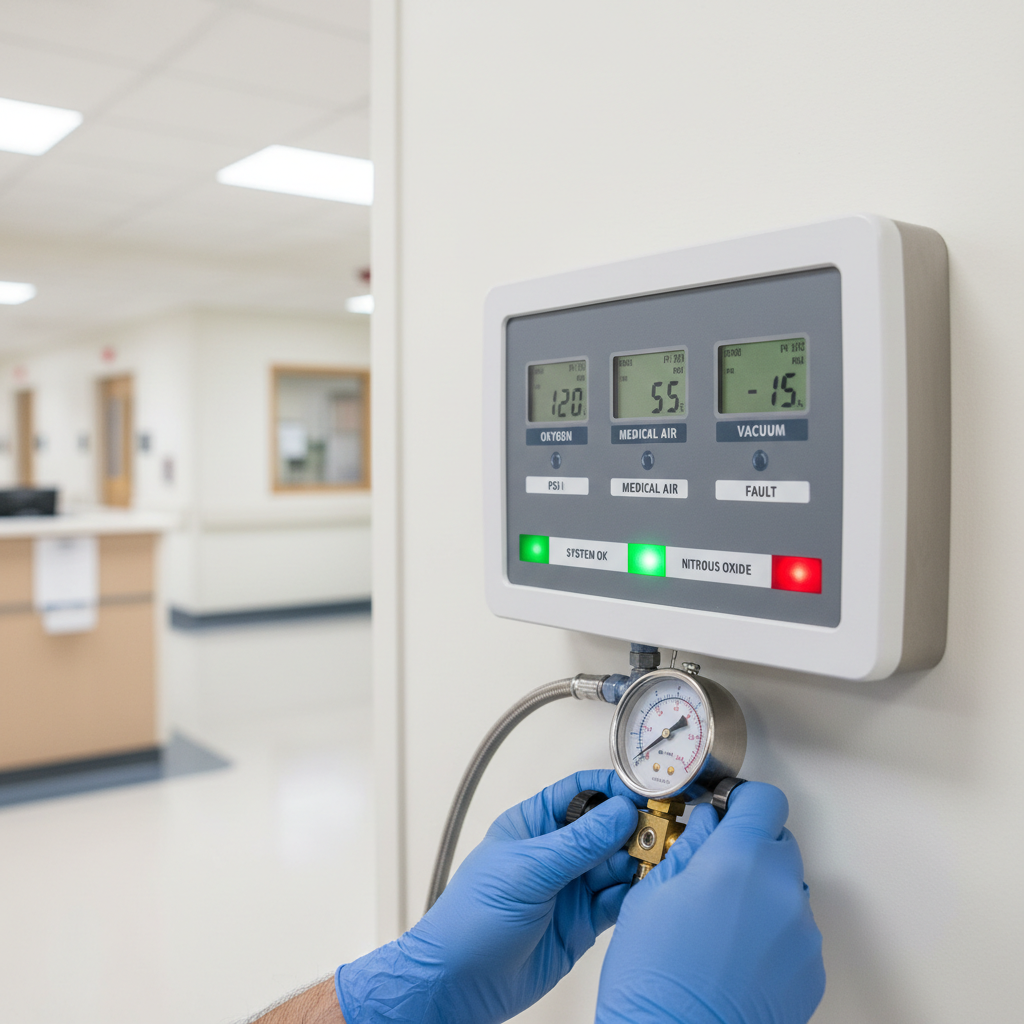
A medical gas master alarm panel is the central nervous system of a hospital's piped gas system. As mandated by NFPA 99-2024, Section 5.1.9, these panels are required to monitor the source of supply, the reserve supply, and the pressure in the main lines of all medical gas systems. Unlike area alarms, which monitor conditions within a specific zone, the master alarm provides a comprehensive, facility-wide overview of the entire medical gas infrastructure.
At a minimum, the master alarm panel monitors critical parameters for each medical gas system (Oxygen, Medical Air, Vacuum, etc.). When a parameter shifts outside a predefined normal range—for instance, if main line pressure drops or the reserve supply is activated—the panel triggers immediate audible and visual alerts. This allows facility personnel to intervene before a potential issue escalates into a patient care crisis.
This guide will explain the importance of regular testing, detail the NFPA 99 requirements, and outline the process for testing and replacing master and area alarm panels from leading manufacturers like BeaconMedaes, Amico, and Tri-Tech.
Why Regular Alarm Panel Testing is Non-Negotiable
Routine testing of your medical gas alarm panels isn't just a best practice; it's a critical safety requirement. A malfunctioning alarm panel is a silent vulnerability. It can fail to report a critical pressure drop, a depleted reserve supply, or a high-temperature condition in a medical air compressor. The consequences of such a failure can be catastrophic, directly impacting patient life support systems.
NFPA 99, Section 5.1.9.1.5, requires that "Master alarm systems, area alarm systems, and local alarm systems shall be tested and the results documented to ensure the systems are functioning as designed prior to being placed into service and on a periodic basis." This "periodic basis" is defined by your facility's risk assessment, but industry standard and best practice dictate at least annual testing by an ASSE 6040 Certified Medical Gas Systems Maintenance specialist.
Why this matters for compliance: A documented history of regular, compliant alarm testing is one of the first things The Joint Commission (TJC) or other AHJs (Authorities Having Jurisdiction) will scrutinize during an inspection. Failing to provide this documentation can lead to citations, fines, and a mandate for immediate corrective action. Regular testing by a certified professional ensures your facility remains compliant and inspection-ready.
Understanding Master vs. Area Alarms
While they function similarly, it's crucial to understand the distinction between master and area alarms. Both are essential components of a compliant medical gas system, serving different monitoring purposes.
| Feature | Master Alarm Panel | Area Alarm Panel |
|---|---|---|
| Scope | Facility-wide; monitors source equipment, main lines, reserves | Zone-specific; monitors pressure in a specific floor, wing, or department (e.g., OR, ICU, ER) |
| Location | Typically in a location with 24/7 surveillance, like engineering or security | Located within the area it monitors, visible to staff in that zone |
| Monitored Points | Source equipment status, main line pressure (high/low), reserve in use, reserve low | Branch line pressure (high/low) for the specific zone |
| NFPA 99 Ref | Section 5.1.9.2 | Section 5.1.9.3 |
The Master Alarm Testing Process: What to Expect
Testing a master alarm panel is a systematic process performed by an ASSE 6040 certified technician. The goal is to verify that every single alarm point functions exactly as designed, from the initiating sensor to the visual and audible indicators on the panel itself.
Here are the typical steps involved:
- Notification: The technician coordinates with hospital staff to ensure they are aware of the testing and to prevent false emergency responses.
- Visual Inspection: The panel is inspected for physical damage, clear labeling (per NFPA 99 5.1.9.1.3), and proper power supply.
- Individual Signal Actuation: Each alarm signal is individually triggered. For a pressure alarm, the technician will use a specialized test manifold to simulate a high or low-pressure condition at the sensor. For source alarms, they will simulate a changeover to the reserve manifold or a low reserve level.
- Panel Verification: For each simulated event, the technician verifies that:
* The correct light on the master panel illuminates (flashing for new alarms).
* The audible alarm sounds (and can be silenced).
* The alarm light remains illuminated (non-flashing) after being acknowledged until the condition is corrected.
* The alarm clears and the light extinguishes once the system returns to normal.
- Documentation: Every function test is meticulously documented—pass or fail. This documentation forms the core of your compliance records.
For expert, ASSE-certified testing services, contact Medical Testing Solutions for a comprehensive inspection in the Vero Beach area.
Common Alarm Panel Brands: Beacon, Amico, Tri-Tech
Our technicians are certified to test, service, and replace all major brands of medical gas alarm panels. The three most common we encounter are BeaconMedaes, Amico, and Tri-Tech.
BeaconMedaes
BeaconMedaes offers a range of alarms, including the popular MEGA series. These are known for their reliability and modular design. Older Beacon panels may require specific testing procedures, and our technicians are equipped with the schematics and knowledge to service both legacy and modern systems.
Amico
Amico alarms are widely used and known for their user-friendly interfaces and digital displays. The Amico Alert-4 series, for example, often uses ethernet connectivity for networking and can monitor a high density of points. We can fully integrate with and test these networked systems.
Tri-Tech Medical
Tri-Tech offers robust and dependable alarm systems that are a staple in many facilities. Their panels are straightforward to test but, like any system, require a technician who understands their specific signal-sending units and wiring configurations.
When is it Time for an Alarm Panel Replacement?
An alarm panel may need to be replaced for several reasons:
- Obsolete Parts: The panel is so old that replacement components (boards, lights, horns) are no longer available.
- System Expansion: Your facility has added new medical gas systems or wings, exceeding the capacity of the existing panel.
- Failed Components: A critical component like the main logic board fails, and repair is not economical or possible.
- NFPA Code Updates: A major update to NFPA 99 may render an older panel non-compliant with new requirements.
As an ASSE 6010 certified medical gas installer, Medical Testing Solutions can not only specify the correct replacement panel for your needs but also perform a turnkey installation, followed by the required ASSE 6030 verification to certify the system for patient use.
FAQs about Master Alarm Panel Testing
Q: How often do my master alarms need to be tested?A: NFPA 99 requires periodic testing. The industry standard and best practice is to have them tested at least annually by an ASSE 6040 certified technician as part of your annual medical gas inspection.
Q: Who is qualified to perform master alarm testing?A: Testing must be performed by a credentialed individual. The ASSE 6040 Medical Gas Systems Maintenance Personnel certification is the industry-standard credential for this work.
Q: Can we perform the testing ourselves?A: Unless your in-house staff holds the proper ASSE 6040 certification and possesses the calibrated equipment and knowledge, it is strongly recommended to use a certified third-party vendor. This ensures unbiased, accurate testing and maintains compliance.
Q: What is the difference between a master alarm and an area alarm?A: A master alarm monitors the main source and supply lines for the entire facility. An area alarm monitors the line pressure only for a specific zone or department, like an operating room or ICU.
Q: My facility is in Vero Beach, FL. How do I schedule an inspection?A: You can schedule a comprehensive medical gas inspection, including master alarm panel testing, by contacting Medical Testing Solutions directly. Request a quote online or call us at (754) 315-1078 to speak with a specialist.
Ensure Your Facility is Safe and Compliant
Your master alarm panel is your first line of defense in a medical gas emergency. Don't let it fall into disrepair. Ensure your facility in Vero Beach, FL, is safe, compliant, and ready for any inspection with annual, certified testing.
Contact Medical Testing Solutions today to schedule your NFPA 99 compliance inspection. Call us at (754) 315-1078 or request a free quote online.
This article is provided for educational purposes and reflects industry standards as of publication. Always verify against current NFPA 99, CGA, and AHJ requirements. Medical Testing Solutions is ASSE-certified and ready to help — contact us for facility-specific guidance.
Need Medical Gas Services?
Contact our certified team for inspections, verifications, installations, and more.
Get a Free Quote