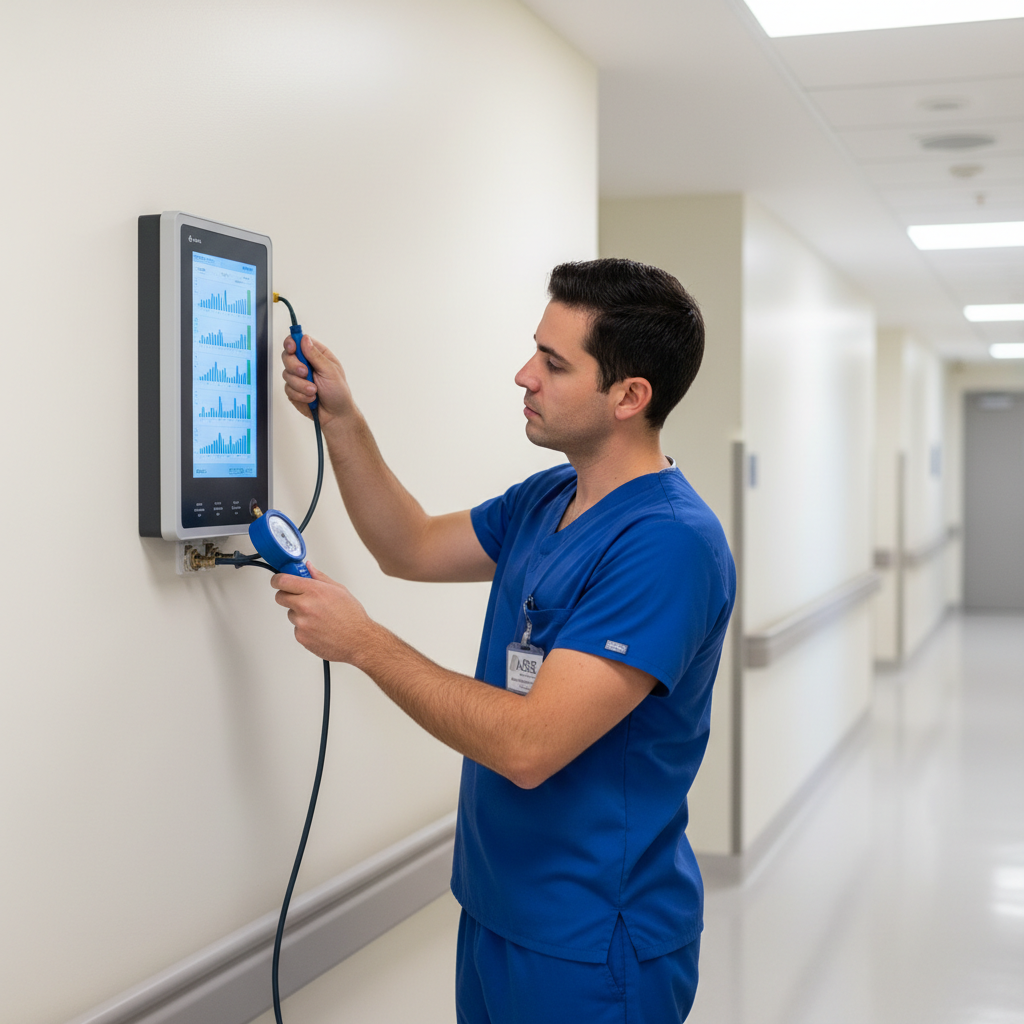
Master Alarm Panel Testing in Port St. Lucie, FL
Healthcare facilities rely on piped medical gases every second of the day. In surgical suites, intensive care units, and emergency departments across the Treasure Coast, life-support gas systems must maintain precise line pressures and continuous bulk supply. At the center of this life-safety infrastructure sits your facility's alarm network. Master and area alarm panels serve as the primary warning system, alerting clinical and facility engineering staff before system pressure drops or a cryogenic bulk tank runs dry.
In this technical guide, you will learn the regulatory standards, operational protocols, and mechanical requirements for master alarm panel testing in Port St. Lucie, FL. We examine the specific mandates of NFPA 99 (Health Care Facilities Code), explain the differences between Category 1 master and area alarm functions, detail testing protocols for leading manufacturers (BeaconMedæs, Amico, and Tri-Tech Medical), and outline when an aging panel requires retrofit or replacement to protect patient safety and maintain AHCA accreditation.
1. The Critical Role of Medical Gas Alarm Systems in Port St. Lucie Healthcare Facilities
Medical gas piping networks operate out of sight, concealed behind drywall and above interstitial ceiling spaces. Because clinicians cannot see pipeline pressures or bulk reservoir levels, they depend entirely on automated monitoring systems. When pressure fluctuates by more than 20% from baseline, or when a secondary manifold bank deploys, alarm panels prevent minor mechanical faults from escalating into catastrophic clinical emergencies.
In Port St. Lucie and across St. Lucie County, healthcare infrastructure has grown rapidly. From regional hospitals and surgical centers to freestanding emergency rooms and specialized procedural clinics, these facilities operate under stringent federal, state, and local safety mandates. Medical gas alarms are life-safety systems equivalent to building fire alarms, demanding continuous operational readiness.
Master Alarms vs. Area Alarms: Structural Distinctions
NFPA 99 establishes distinct functions for master alarms and area alarm panels based on the scope of the piping network they monitor:
- Master Alarm Panels: Monitor the primary and secondary source equipment (bulk liquid oxygen tanks, medical air compressors, medical surgical vacuum pumps, and high-pressure manifold reserves) as well as the main line operating pressures. Every Category 1 facility must maintain at least two master alarm panels located in separate, constantly monitored areas (such as a 24/7 central nurses' station and the facility engineering control room).
- Area Alarm Panels: Monitor pipeline pressures within specific clinical zones, such as an operating room core, critical care unit, post-anesthesia care unit (PACU), or general patient wing. They provide real-time digital readouts and visual/audible alerts directly to local clinical staff if line pressures swing outside acceptable tolerances.
Regular annual medical gas inspections ensure these life-critical networks maintain code compliance and function reliably under sudden system demand.
2. Regulatory Compliance: NFPA 99, ASSE 6000, and Florida AHCA Standards
Navigating code compliance in Florida requires adhering to multiple overlapping authorities having jurisdiction (AHJ). For hospitals and ambulatory surgical centers in Port St. Lucie, the regulatory baseline includes:
- NFPA 99 (Health Care Facilities Code): Sets mandatory performance, testing, and documentation criteria for piped medical gas systems based on system risk categories (Category 1 through Category 4).
- Florida Agency for Health Care Administration (AHCA): Enforces building and operational codes for licensed healthcare facilities throughout Florida, regularly reviewing inspection logs, maintenance documentation, and physical plant compliance.
- ASSE Series 6000 Professional Qualification Standards: Defines credentialing for individuals who install, inspect, verify, and maintain medical gas infrastructure.
Why this matters for compliance:
NFPA 99 Section 5.1.14 mandates that all medical gas warning systems be inspected and tested periodically, with complete operational records retained for inspection by the AHJ. AHCA surveyors and Joint Commission auditors routinely cite facilities that only test audible test buttons on panel faces while failing to physically actuate source switches and pressure transducers at the supply point.
ASSE 6030 Verifiers vs. In-House Maintenance
Under NFPA 99 (2021/2024 editions) and ASSE 6000 standards, testing and certification requirements are precise. While routine monthly testing can be completed by trained in-house personnel (holding ASSE 6040 maintenance credentials), formal periodic inspections, baseline verifications, and post-retrofit certifications must be conducted by credentialed ASSE 6030 medical gas verifiers.
When new alarm panels are installed or existing panels undergo component replacements, an independent verification team must validate every signal drop. Medical Testing Solutions provides credentialed medical gas verification and comprehensive medical gas certification to satisfy all Florida AHCA requirements.
3. NFPA 99 Testing Requirements for Master and Area Alarm Panels
True operational testing of a master or area alarm panel requires verifying the entire signal circuit, from the mechanical sensor at the source or zone valve box to the visual and audible indicator on the panel display. Simulating an alarm using an electronic test button on the faceplate only tests the panel's internal circuit board and LEDs; it does not confirm that the pipeline sensor or wiring loop is functioning.
Comprehensive Master Alarm Testing Protocol (NFPA 99 Section 5.1.9)
During a thorough inspection, field specialists verify that all required source inputs actuate both master panels independently:
- Bulk Liquid Oxygen Reserve: Testing liquid level indicators, low-liquid warnings, reserve in-use signals, and reserve failure thresholds.
- High-Pressure Manifolds: Verifying secondary bank in-use signals, low reserve cylinder pressure, and emergency supply connection status.
- Medical Air Compressors: Testing high carbon monoxide (CO) alarms (tripping at 10 ppm), high-temperature cutoffs, lag compressor operating signals, and desiccant dryer dew-point alarms (tripping above -10°C / 14°F at 50 psig).
- Medical Vacuum Systems: Verifying lag pump in-use warnings and low-vacuum threshold alerts (typically actuating at 12 inches HgV).
- Main Line Pressure Switches: Mechanically bleeding line pressure to prove low-pressure alarms activate when pressure drops 20% below normal line pressure, and high-pressure alarms activate when pressure rises 20% above normal line pressure.
Area Alarm Testing Protocols (NFPA 99 Section 5.1.9.4)
Area alarms require physical verification at the local zone valve box or pressure test port:
- Isolating the local sensor port.
- Bleeding pressure across calibrated digital test gauges.
- Confirming that high and low alarm visual indicators trip precisely at the ±20% threshold.
- Ensuring audible alarms provide a minimum sound pressure level of 80 dBA at a distance of 3 feet (and cannot be permanently silenced without manual reset).
4. Comparing Major Medical Gas Alarm Panel Manufacturers: BeaconMedæs, Amico, and Tri-Tech
When servicing, upgrading, or retrofitting alarm panels in Port St. Lucie facilities, facility managers must evaluate structural differences, sensor integration capabilities, and communication protocols across leading manufacturers.
The three most common panel brands in South Florida healthcare systems are BeaconMedæs, Amico Corporation, and Tri-Tech Medical.
Comparison: BeaconMedæs, Amico, and Tri-Tech Medical Alarm Panels
| Specification / Feature | BeaconMedæs (Mega Systems / TotalAlert Infinity) | Amico (Alert-2 / Mirage / Master Series) | Tri-Tech Medical (Vision-1 / Genesys Series) |
|---|---|---|---|
| Transducer Technology | Digital pressure transducers, Ethernet-enabled source monitoring | Dual-state digital transducers with local calibration dip switches | Removable modular sensor blocks with quick-connect fittings |
| Communication Protocols | BACnet/IP, Modbus, TCP/IP Ethernet built-in | BACnet MS/TP, Ethernet (optional module), Modbus | BACnet MS/TP, dry contacts, Modbus RTU |
| Display Configuration | High-resolution color touchscreen LCD | Multi-colored LED bar graphs with digital readout screens | Color LCD graphical interface with customizable labels |
| Retrofit Versatility | High; accepts universal backbox adapter plates | Extremely high; retrofits easily into existing competitor rough-ins | High; compact backbox footprint ideal for tight structural wall spaces |
| Diagnostic Capabilities | Deep internal event logging, web-server status broadcasts | Direct push-to-test board diagnostics, local calibration | On-screen diagnostic menus, loop current monitoring |
| Signal Input Flexibility | Ethernet/Bus network or conventional dry contacts | Analog 4-20 mA loops, Ethernet, or dry contacts | 4-20 mA or dry-contact switch inputs |
| Typical Use-Case in Florida | Academic medical centers, large hospital towers | Outpatient surgery centers, regional hospitals, clinics | Specialty surgical facilities, veterinary, imaging centers |
At Medical Testing Solutions, our technicians regularly service, calibrate, and program all three equipment lines. Facilities upgrading their alarm infrastructure can view our complete inventory of code-compliant hardware through our products catalog.