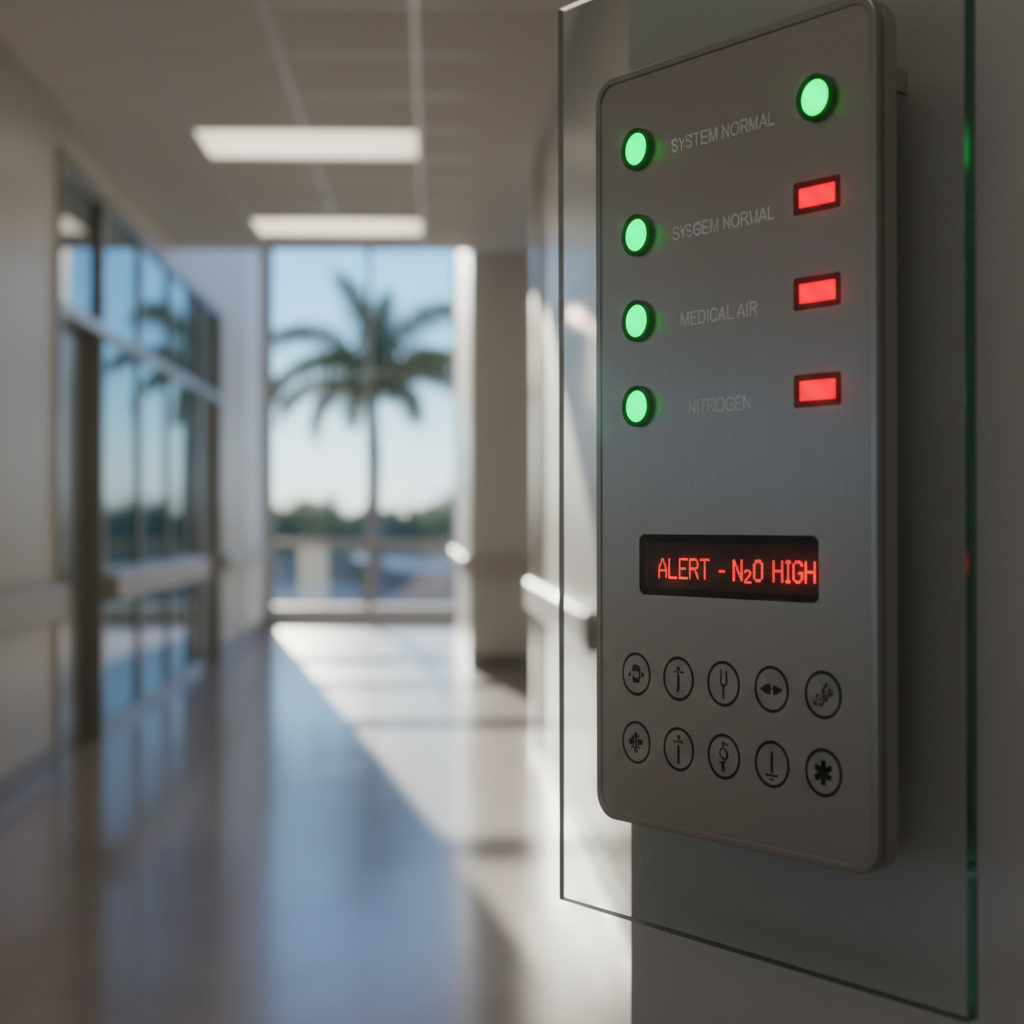
Master Alarm Panel Testing in Pembroke Pines, FL: A Complete Guide
Medical Testing SolutionsJune 4, 20267 min read
Share
For any healthcare facility in Pembroke Pines, from sprawling hospitals to specialized surgical centers, medical gas alarm panels are the silent guardians of patient safety. These systems are the central nervous system of your medical gas infrastructure, providing instant warnings of critical changes in pressure or supply. But what happens when the watchdog itself isn't watched? Annual testing isn't just a recommendation, it's a stringent requirement mandated by NFPA 99 and enforced by bodies like The Joint Commission (TJC) and the Florida Agency for Health Care Administration (AHCA).
This definitive guide walks you through everything you need to know about master and area alarm panel testing. We'll cover the specific NFPA 99 requirements, what to expect during a certified inspection, a comparison of major alarm brands like Beacon, Amico, and Tri-Tech, and why choosing a local, Florida-based testing provider is critical for both compliance and your budget.
What Are Medical Gas Master and Area Alarms?
Medical gas alarm systems are comprised of two primary components: master alarms and area alarms. While they work in tandem, they serve distinct functions within a facility's overall safety framework.
The Role of the Master Alarm Panel
The master alarm panel is the high-level command center for your entire medical gas system. As outlined in NFPA 99, Section 5.1.9, the master alarm system must monitor the source of supply, the reserve supply (if one exists), and the pressure in the main lines of each medical gas system. If your bulk oxygen supply runs low, a pump fails, or the pressure from the manifold drops, the master alarm is what alerts your facilities team to the problem, often before it affects patient care areas.
The Function of Area Alarms
Area alarms, also known as local alarms, are the frontline monitors. These are the panels you see in specific zones, such as an operating room corridor, an ICU wing, or a labor and delivery unit. Their job is to monitor the line pressure of the medical gases being used in that specific area. If the pressure for a gas in one particular zone deviates from the normal operating range, the area alarm will activate, alerting the clinical staff in the immediate vicinity.
Information They Provide
Both master and area alarms provide at-a-glance status updates, typically with a three-tiered notification system:
NORMAL (Green): The system is operating within its specified pressure range.
CAUTION/WARNING (Yellow): A secondary or reserve source is in use, or pressure is approaching a critical threshold.
HIGH/LOW ALARM (Red): The system is outside its normal operating range, indicating a potentially critical failure that requires immediate attention.
NFPA 99 Requirements for Alarm Panel Testing
The National Fire Protection Association (NFPA) sets the benchmark for medical gas safety in the United States. NFPA 99 is not a guideline; it's the code that facilities must adhere to, and it's the standard that inspectors from The Joint Commission and AHCA will use during surveys.
According to NFPA 99, all master and area alarm systems must be tested annually. This isn't a simple "push-to-test" button check. The process requires simulating actual system deviations to ensure the alarms activate at the correct pressure setpoints. This crucial service must be performed by a qualified ASSE 6030 Certified Medical Gas Verifier.
Why This Matters for Compliance: Failure to perform and document annual alarm tests is a common finding during Joint Commission surveys. It can lead to citations, potential disruption of services, and, most importantly, could signify a hidden failure in your system that might only be discovered during a real emergency. For Florida hospitals, these reports are critical for satisfying AHCA inspection requirements under Chapter 59A of the Florida Administrative Code.
The Annual Master Alarm Testing Process: Step-by-Step
When a Medical Testing Solutions (MTS) technician arrives at your Pembroke Pines facility to perform an alarm inspection, they follow a rigorous, documented procedure to ensure every alarm point is challenged and verified. Here’s what you can expect:
Initial Acknowledgment: The technician first checks in with facility management and informs relevant clinical staff that alarm testing will be underway to prevent undue panic.
Visual Inspection: The panel is inspected for physical damage, clear labeling, and correct configuration.
Setpoint Verification: The technician cross-references the alarm setpoints programmed in the panel with the requirements of NFPA 99.
Alarm Simulation: This is the core of the test. The verifier will:
Connect a calibrated pressure gauge to the line being tested.
Safely introduce a pressure change (e.g., a drop or increase) in the line.
Record the exact pressure at which the visual and audible alarms activate.
Confirm that the alarm signal correctly displays on both the area panel and the master panel.
Reset and Restoration: The system is returned to its normal operating pressure, and the technician verifies that the alarm clears correctly.
Comprehensive Documentation: Every tested point, every pressure reading, and every pass/fail result is meticulously documented in a report that satisfies all TJC and AHCA requirements.
Common Master Alarm Panel Brands: A Comparison
MTS technicians are trained to test, service, and replace all major brands of alarm panels. While all compliant panels perform the same basic function, there are differences in technology and features between leading manufacturers like BeaconMedaes, Amico, and Tri-Tech.
Feature
BeaconMedaes TOTALConnect™
Amico Alert-4 Series
Tri-Tech Medical Axis Series
Display Type
Full-Color Resistive Touchscreen
Full-Color Capacitive Touchscreen
LCD or LED, Touchscreen models available
Networking
Ethernet, BACnet/IP, Modbus TCP
Ethernet, BACnet, Modbus
Ethernet, BACnet/IP, Modbus TCP
Customization
Highly customizable screens and layouts
Field-programmable, modular
Modular and expandable design
Key Feature
Advanced email/pager alerts, remote viewing
Built-in web server for easy access
Extremely reliable, cost-effective
Whether your facility has the latest networked touchscreen from Beacon or a legacy panel, our team has the expertise for certified annual medical gas inspections.
Why Florida Hospitals Need Flawless Alarm Performance
For facilities in Pembroke Pines and across South Florida, maintaining a compliant medical gas system has unique challenges and requirements. From state-level health administration oversights to hurricane preparedness, the stakes are incredibly high.
Meeting AHCA Standards
In Florida, the Agency for Health Care Administration (AHCA) is the chief regulatory body for healthcare facilities. A significant part of jejich oversight involves ensuring facilities are safe and compliant with all relevant codes. A properly documented medical gas verification report, including alarm testing, is essential for satisfying AHCA review, specifically requirements tied to Form 3110 and FAC 59A.
Hurricane Preparedness and Re-Verification
NFPA 99, Section 5.1.12, includes a critical provision that is especially relevant to Florida: medical gas systems must be re-tested for purity and pressure if the system is breached or shut down for an extended period. After a major storm or hurricane, facilities like Baptist Health or Cleveland Clinic Florida may need rapid re-verification to safely reopen. A local team is paramount. Medical Testing Solutions, headquartered in Fort Lauderdale, can mobilize crews quickly across South Florida to get you back online safely post-storm.
The MTS Advantage: Local, Certified, and Cost-Effective for Pembroke Pines
Choosing a medical gas service partner is a critical decision. As a Florida-based company, Medical Testing Solutions offers a unique value proposition that out-of-state providers simply can't match.
Our headquarters are located at 501 East Las Olas Blvd, Ste 300, Fort Lauderdale, FL 33301. This means our ASSE-certified technicians are local to the Pembroke Pines area. For our clients, this translates into a significant cost advantage:
NO Travel Fees
NO Lodging Costs
NO Per-Diem Charges
For facilities anywhere in Florida, this typically results in savings of 10-25% compared to using an out-of-state company. You get world-class expertise from ASSE 6030 verifiers without paying for their cross-country travel.
Master Alarm Panel Replacement & Upgrades
Sometimes, a panel fails inspection due to its age or an unrepairable fault. In an era of hospital renovation and expansion, many facilities also choose to upgrade to modern, networked alarm systems. Medical Testing Solutions provides turnkey solutions for medical gas installation and replacement.
Our ASSE 6010 Certified Installers can help you select, source from our product catalog, and install a new alarm system that meets all current codes, integrating seamlessly with your existing infrastructure.
Your Local Partner for Compliance and Safety
Ensuring your master and area alarm panels are functioning correctly is a foundational element of patient safety and facility compliance. With the stringent requirements from AHCA and TJC, combined with the unique environmental challenges of South Florida, you cannot afford to compromise. Medical Testing Solutions provides the certified, local, and cost-effective expertise Pembroke Pines facilities need.
For certified master alarm panel testing in Pembroke Pines and across South Florida, trust the local experts. Call our Fort Lauderdale office today at +1 (754) 315-1078 or request a free quote online to schedule your annual inspection.
'''
Frequently Asked Questions
Testing is required annually (every 12 months) per NFPA 99 standards, which are enforced by both The Joint Commission and the Florida AHCA.
Only an ASSE 6030 Certified Medical Gas Verifier is qualified to perform these tests. This certification ensures the technician has undergone extensive training on NFPA codes and testing procedures.
Common failures include incorrect pressure setpoints, faulty sensors, failed audible or visual indicators, or issues with the circuit board. Older panels may also fail due to obsolete, unserviceable parts.
Yes. Our technicians are trained and equipped to test, calibrate, service, and repair all major brands of medical gas alarm panels found in U.S. hospitals.
Because Medical Testing Solutions is headquartered in Fort Lauderdale, our teams are local to South Florida. We can dispatch technicians from our Fort Lauderdale medical gas services hub directly to your facility, eliminating the travel and lodging costs that out-of-state competitors must pass on to you.
Request a quote for your facility
Talk with Medical Testing Solutions about your next inspection, repair or equipment request.