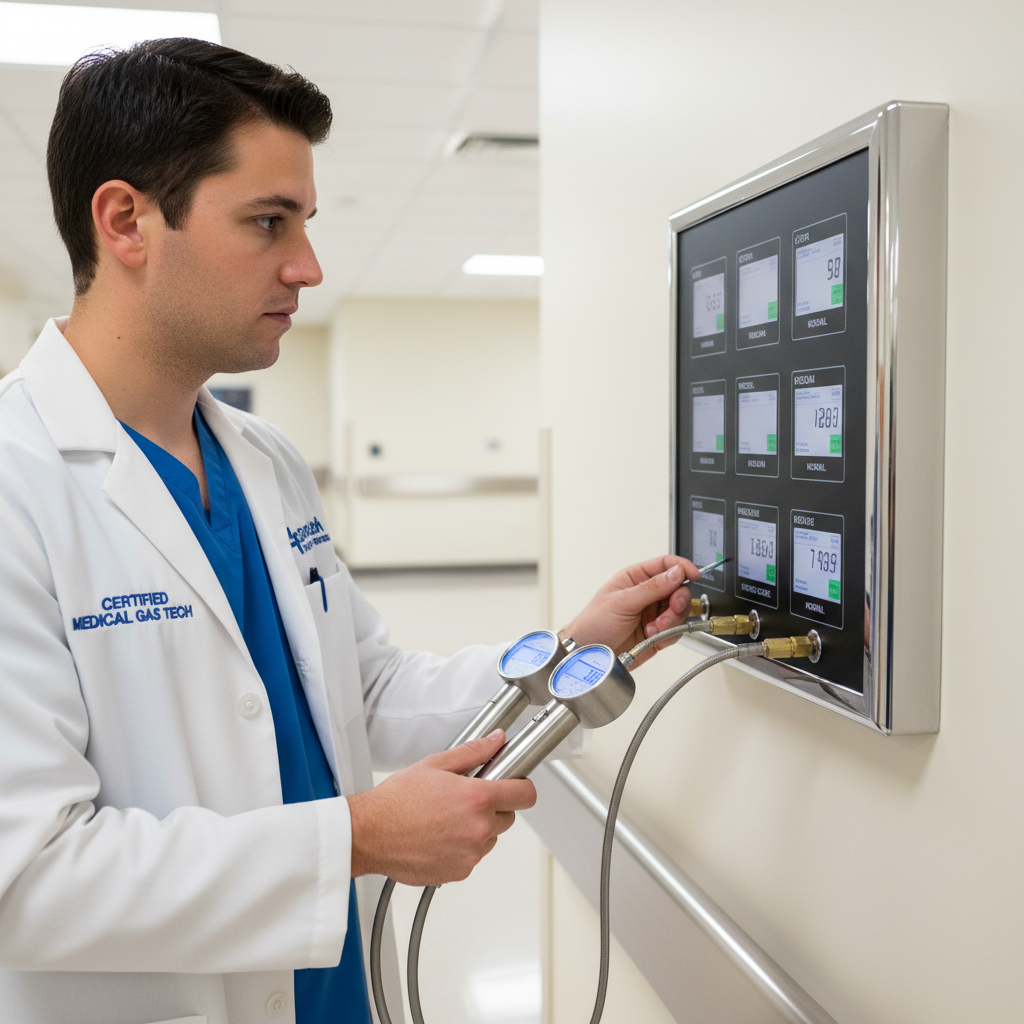
Master Alarm Panel Testing Miramar FL: Inspection & Upgrades
Every central piped medical gas system relies on master alarm panels to communicate critical life-support data across healthcare facilities. In high-acuity environments throughout South Florida, from outpatient surgical centers to regional hospitals, a malfunctioning alarm signal or degraded pressure sensor can compromise patient safety within seconds. Ensuring these warning systems activate during supply changes, pressure drops, or equipment failures is not merely sound engineering, it is a strict life-safety mandate.
Master alarm panel testing in Miramar, FL requires rigorous adherence to NFPA 99 (Health Care Facilities Code) standards, ASSE 6030 verification protocols, and local fire safety codes. Whether you operate a surgical center off Miramar Parkway or oversee clinical engineering for a regional hospital network, your alarm network must undergo routine functional testing, pressure switch calibration, and periodic upgrades.
In this guide, you will learn how master and area alarm systems operate, the essential testing protocols enforced by AHJs (Authorities Having Jurisdiction), key differences across major manufacturers like BeaconMedaes, Amico, and Tri-Tech Medical, and how Medical Testing Solutions delivers ASSE-certified compliance across Broward County.
1. The Role of Master vs. Area Alarm Panels in Healthcare Facilities
NFPA 99 categorizes medical gas alarm systems into distinct tiers based on operational scope, monitoring points, and clinical responsibility. Understanding the boundary between master alarm panels and area alarm panels is fundamental to proper testing and code compliance. | Diagram text | |, | | NFPA 99 Alarm Architecture | | [ Central Plant / Sources ] -- → MASTER ALARM PANEL 1 (Engineering) | | - Bulk Liquid O2 MASTER ALARM PANEL 2 (Continuous 24/7) | | - Med Air Compressors (Monitors source reserves, changeover, | | - Vacuum Pumps dew point, CO, line pressures) | | - Manifolds & High Pressure | | [ Zoned Distribution Lines ] - → AREA ALARM PANELS (Clinical Zones) | | - Med Gas Line Pressures (Monitors critical pressure +/- 20% | | - Local Zone Valve Boxes in ORs, ICUs, PACU, Cath Labs) |
Master Alarm Panels (NFPA 99, Section 5.1.9.2)
Master alarms monitor the operation and condition of medical gas source equipment (such as medical air compressors, medical vacuum pumps, high-pressure cylinder manifolds, and bulk cryogenic liquid systems) as well as the main supply line pressures.
According to NFPA 99, all Category 1 facilities must have at least two master alarm panels located in separate areas:
- One panel in the office or workspace of the individual responsible for maintenance (typically the facility engineering or clinical engineering department).
- A second panel in a continuously monitored location (such as a 24-hour telephone switchboard, security desk, or central nursing control station).
Master alarms monitor broad operational states: low liquid levels in bulk tanks, reserve manifold in use, compressor high temperature, desiccant dryer high dew point (> -22°F [-30°C] at 50 psig), and carbon monoxide levels exceeding 10 ppm.
Area Alarm Panels (NFPA 99, Section 5.1.9.3)
Area alarm panels provide continuous localized pressure monitoring for clinical care areas such as Operating Rooms (ORs), Intensive Care Units (ICUs), Post-Anesthesia Care Units (PACU), and endoscopy suites. Rather than monitoring central plant status, area alarms warn clinical staff if the pressure in local branch lines varies by more than ±20% from normal working pressure (e.g., Medical Air fluctuating below 40 psig or above 60 psig on a nominal 50 psig system).
For facilities operating dedicated procedure rooms and operating suites, area alarm panels work alongside electrical safety measures such as line isolation monitor testing to safeguard the entire surgical environment.
2. Regulatory Framework: NFPA 99 and ASSE 6000 Mandates
Medical gas alarm systems in Miramar, Florida are subject to oversight by several governing bodies: AHCA (Agency for Health Care Administration), local Miramar Fire Prevention Bureau inspectors, CMS (Centers for Medicare & Medicaid Services), and accreditation bodies like The Joint Commission (TJC) or DNV.
Why this matters for compliance: NFPA 99 (2012–2024 editions) classifies medical gas systems under Risk Categories 1 through 4. A Category 1 failure is likely to cause major injury or death to patients. Consequently, every sensor, contact point, visual indicator, and audible tone must function continuously. Skipped inspections, bypassed relays, or missing calibration records directly result in Joint Commission Requirements for Improvement (RFIs) or AHCA plan-of-correction citations.
Key code standards governing alarm panels include:
- NFPA 99 Section 5.1.9: Outlines design, location, operational requirements, and continuous monitoring parameters for Category 1 and Category 2 warning systems.
- NFPA 99 Section 5.1.14.3.3: Mandates periodic testing of all alarm panels, including sensor activation points, audible signals, visual indicators, and communication circuits.
- ASSE 6030 Professional Qualification Standard: Specifies that only certified Medical Gas Systems Verifiers, such as the field technicians at Medical Testing Solutions, are qualified to perform third-party testing and medical gas verification on newly installed or modified alarm infrastructure.
- ASSE 6040 Professional Qualification Standard: Defines the baseline competencies for healthcare facility maintenance personnel performing routine operational checks on medical gas equipment.
- NFPA 70 (National Electrical Code): Dictates electrical branch wiring, conduit isolation, and emergency power branch tie-ins for alarm panels.
3. Step-by-Step Master Alarm Testing Protocols
Alarm testing cannot simply rely on pressing the front-panel "push-to-test" or lamp-test button. While lamp testing verifies that LEDs illuminate and buzzers sound, it fails to verify sensor calibration, switch setpoints, or the physical integrity of the wiring back to the source equipment. True compliance requires functional physical testing. | Diagram text | |, | | Complete Alarm Functional Test Sequence |
Phase 1: Pre-Testing Coordination and Visual Inspection
- Clinical & Security Notification: Coordinate with the charge nurse, central dispatch, and facility engineering before testing. Master alarms trigger loud audible signals that must be anticipated by staff.
- Dual-Panel Verification: Confirm that both master alarm panels (Engineering and 24/7 monitored station) operate simultaneously without communication lag.
- Physical Inspection: Inspect wiring harnesses, transformer terminal strips, battery backups, and printed circuit boards (PCBs) for signs of heat stress, corrosion, or loose ground terminations.
Phase 2: Source Signal Simulation and Switch Calibration
Each monitored condition at the medical air compressor, vacuum pump, manifold, and bulk tank must be physically activated:
- Pressure Switches: Using a calibrated pneumatic test kit with an NIST-traceable digital gauge, technicians apply pressure to or bleed pressure from the source pressure switches to verify exact switch trip points (±20% variance for line pressure).
- Bulk Cryogenic Systems: Verify the liquid level switch (reserve in use, normal supply depleted) and pressure-relief warning circuits.
- Medical Air Quality: Test the carbon monoxide (CO) monitor alarm thresholds (tripping at > 10 ppm) and desiccant dryer high dew point sensors (tripping at > -22°F).
- Vacuum and WAGD Sources: Simulate lag pump operation, motor overload, and low system vacuum conditions (below 12 in-HgV).
Phase 3: Area Alarm Panel Testing
- OR and ICU Line Drops: Connect digital pressure calibration rigs directly to the gauge/sensor ports on local zone alarm panels.
- Alarm Limits: Verify that high-pressure and low-pressure visual indicators trip within code tolerances.
- Audible Silencing: Ensure the silence button temporarily mutes the buzzer while leaving the visual LED illuminated, and confirm the system re-alarms if a secondary alarm event occurs during silencing.
Following the evaluation, technicians document every signal trip point, make physical adjustments to pressure switches, and produce detailed records for the facility's annual medical gas inspections portfolio.
4. Comparing Leading Alarm Panel Brands: Amico, BeaconMedaes, and Tri-Tech Medical
Healthcare facilities throughout Miramar and South Florida utilize panels from three primary manufacturers. While all meet NFPA 99 requirements when installed properly, their communication architectures, sensor interfaces, and replacement availability differ significantly.
| Feature / Metric | Amico (Alert-2 / Master Series) | BeaconMedaes (Mega Systems / MedTouch) | Tri-Tech Medical (Genesis / Med-Line) |
|---|---|---|---|
| Interface Type | Digital LED / LCD Touchscreen Hybrid | Full-Color Touchscreen (MedTouch) | Modular Digital LED Display |
| Transducer Style | Microprocessor-based digital modules; Ethernet/DDC compatible | Digital Sensor Modules; native BACnet / Modbus integration | Remote digital transducer; compact modular push-in blocks |
| BMS Integration | Modbus / BACnet gateways (optional add-on boards) | Native BACnet IP on MedTouch series | Dry contact boards standard; Ethernet/BACnet optional |
| Wiring Architecture | Twisted-pair RS485 communication bus | Twisted shielded pair / Ethernet LAN | Multi-conductor wire or digital 2-wire bus |
| Retrofit Ease | High (drop-in retrofit kits for legacy boxes) | Moderate (often requires enclosure conversion kits) | High (fits standard rough-in boxes without wall cuts) |
| Common Failure Modes | Aging power supplies; relay contact oxidation | Touchscreen digitizer calibration drift; power board fuses | Transducer drift over 7-10 years; terminal strip loosening |
| Compliance Rating | NFPA 99, CSA Z7396.1, ISO 7396-1 | NFPA 99, HTM 02-01, ISO 7396-1 | NFPA 99, CGA, ASSE 6000 |
Medical Testing Solutions stocks and services replacement components for all three manufacturers. When older systems reach end-of-life, our team assists facilities in determining whether a modular retrofit or a complete panel upgrade is the most cost-effective path.