A hospital's medical gas system is a life-support utility. At its heart are the master and area alarm panels, the sentinels that provide immediate warnings of critical changes in pressure or supply. For healthcare facilities in Miami and throughout South Florida, ensuring these alarms are accurate, reliable, and compliant is not just a matter of best practice, it's a requirement by The Joint Commission (TJC), the Florida Agency for Health Care Administration (AHCA), and NFPA 99. This guide outlines the definitive requirements for master alarm panel testing, brand-specific considerations, and the significant advantages of partnering with a local, Florida-based verification team.
Medical Gas Service
Compliance & Standards
Florida Service
Master Alarm Panel Testing in Miami, FL: A Guide to NFPA 99 Compliance
Medical Testing SolutionsJune 4, 20266 min read
The Critical Role of Master & Area Alarms in Patient Safety
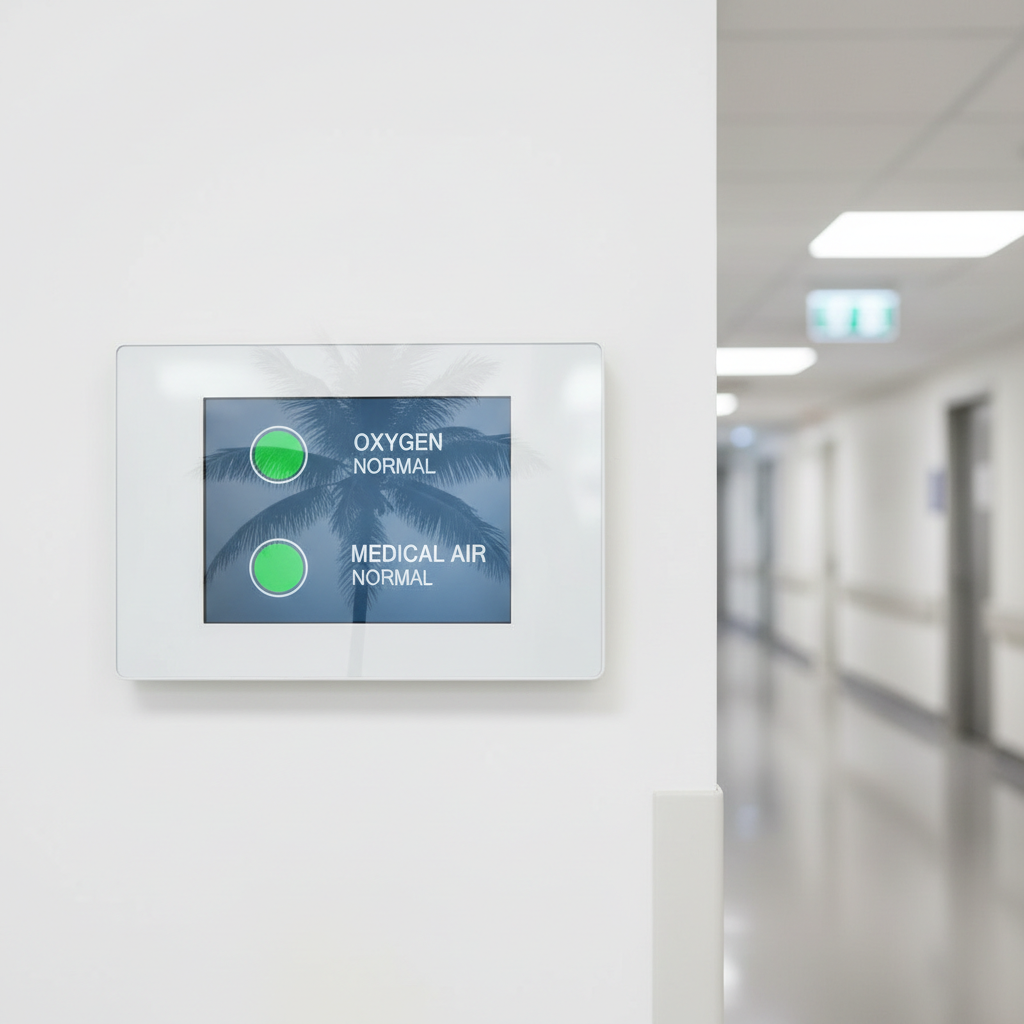
Medical gas alarm systems are the central nervous system of your piped gas infrastructure. They are designed to provide staff with immediate, audible, and visual alerts to problems within the system. Without them, a pressure drop or supply depletion could go unnoticed until it directly impacts patient care.
- Master Alarms: These panels monitor the primary source of gas supply. They are the first line of defense, alerting staff to issues like a low bulk oxygen tank, a failure of a medical air compressor, or a changeover to the secondary manifold.
- Area Alarms: These are located within specific zones of the hospital, such as an operating room suite, an ICU, or a patient floor. They monitor the pressure in the lines serving that specific area, warning of localized issues that may not affect the entire facility.
A failure in either type of alarm compromises the entire system and poses an unacceptable risk to patient safety.
NFPA 99 Master Alarm Testing Requirements
The National Fire Protection Association (NFPA) 99, Health Care Facilities Code, is the primary standard governing medical gas systems in the United States. The Joint Commission and other accrediting organizations base their survey criteria directly on these requirements.
According to NFPA 99 (2018 edition), Chapter 5.1.9, all master, area, and local alarm systems must be periodically tested to ensure they are functioning correctly. The key requirements include:
- Annual Testing: Alarm systems must be tested for accuracy and function annually. This is a core requirement for TJC accreditation.
- Signal Actuation: Each alarm signal (e.g., high pressure, low pressure, changeover) must be activated to verify it trips at the specified setpoint.
- Signal Verification: The test must confirm that the audible and visual signals at the master alarm panel and the station/room that is being monitored are functioning as intended.
Why This Matters for Compliance: Failure to produce a documented annual alarm test by a qualified technician is a common finding during Joint Commission surveys. It can lead to citations and potentially impact a facility's accreditation status. Regular, documented testing by an ASSE 6030 certified medical gas verifier is the only way to ensure compliance.
Florida-Specific Compliance: AHCA and Hurricane Preparedness
Hospitals in Miami and across Florida face unique regulatory and environmental challenges. Compliance isn't just about NFPA 99; it's also about satisfying state-level mandates and preparing for severe weather.
Medical Testing Solutions (MTS) is headquartered at 501 East Las Olas Blvd, Ste 300, Fort Lauderdale, FL 33301, giving us an unmatched understanding of the local landscape.
AHCA Reporting
The Florida Agency for Health Care Administration (AHCA) requires that all medical gas system testing and verification is documented to meet their standards, specifically AHCA OPS Form 3110 and Chapter 59A of the Florida Administrative Code. Your verification reports must be thorough and ready for submission to state regulators. An experienced Florida-based verifier will know exactly how to format reports to satisfy AHCA reviewers without delays.
Hurricane Re-Verification
South Florida is no stranger to hurricanes. NFPA 99, Section 5.1.12 addresses medical gas systems in the event of a disaster. It requires re-verification of the system if it is breached or source pressure is lost. After a hurricane, it is critical to have a local team that can mobilize quickly. MTS's South Florida crews can be on-site at facilities like Jackson Memorial Hospital or Baptist Health South Florida for post-storm inspections, ensuring your systems are safe to bring back online.
Common Master & Area Alarm Brands: Beacon, Amico, Tri-Tech
While the testing principles are universal, the hardware is not. Our technicians have deep experience with all major alarm manufacturers. Here is a comparison of common brands found in Florida hospitals:
| Feature | BeaconMeds Medipoint | Amico Alert-2/3 | Tri-Tech Axis |
|---|---|---|---|
| Display | LED or LCD Touchscreen | LED or LCD Touchscreen | LCD Touchscreen |
| Inputs | 8, 16, 32, 64 points | 8 to 64 points | 10 to 80 points |
| Connectivity | BACnet, Ethernet | BACnet, Ethernet | BACnet, Ethernet |
| Key Feature | Known for reliability | Highly customizable | Modular, field-upgradable |
Whether your facility uses Beacon, Amico, Tri-Tech, or another brand, our ASSE 6030 certified technicians have the equipment and expertise to test them accurately.
The MTS Advantage: Local Expertise & Lower Costs for Florida Facilities
Choosing a verifier for your Miami hospital shouldn't add unnecessary complexity or cost. As a Fort Lauderdale-headquartered company, MTS provides a distinct advantage over out-of-state competitors.
- NO Travel Fees: We never charge for travel, lodging, or per-diem anywhere in Florida.
- Significant Savings: Our clients typically save 10–25% on verification and annual medical gas inspections compared to using firms that have to fly in their technicians.
- Rapid Dispatch: Our proximity allows for same-day dispatch for emergency service in the Miami, Fort Lauderdale, and West Palm Beach metro areas. We are your local partners, not a distant contractor.
This local presence is critical for facilities from Cleveland Clinic Florida to Broward Health that require both routine maintenance and rapid emergency response.
The Alarm Verification Process: What to Expect
When an MTS technician arrives on-site, they follow a strict, documented procedure to ensure a thorough and compliant test:
- Coordinate with Facility Staff: We work with your facilities and clinical leadership to schedule testing with minimal disruption to patient care.
- Visual Inspection: The technician first inspects the alarm panel for any visible damage or wear.
- Simulate Alarm Conditions: Using specialized test equipment, the technician will safely simulate a high or low-pressure condition for each gas being monitored.
- Verify Setpoints: We confirm that the alarm triggers at the precise setpoint required by NFPA 99.
- Confirm Signal Integrity: The technician verifies that the audible and visual signals work correctly at both the alarm panel and the source location.
- Full Documentation: Every step is documented in a comprehensive report that satisfies TJC, AHCA, and NFPA 99 requirements. This report is your proof of compliance.
Your Partner for Compliance in Miami
Don't leave the safety of your patients and the compliance of your facility to chance. Ensure your master and area alarms are tested accurately and affordably by a team that knows Florida.
Medical Testing Solutions combines national-level ASSE certification with local, on-the-ground expertise. Call our Fort Lauderdale office today at +1 (754) 315-1078 or request a quote online to schedule your master alarm panel testing. '''
Frequently Asked Questions
Per NFPA 99 and The Joint Commission, all master and area alarm panels must be tested at least annually. More frequent testing may be required if the system is modified or repaired.
Testing must be performed by a technician certified to the ASSE 6030 Medical Gas Verifier standard. They must also be knowledgeable about Florida-specific AHCA reporting requirements.
A master alarm monitors the primary gas source (e.g., bulk tanks, compressors). An area alarm monitors gas pressure within a specific zone or department of the hospital, such as an operating room or ICU.
Yes. Medical Testing Solutions services the entire state of Florida from our headquarters in Fort Lauderdale. Our promise of no travel fees applies to all clients, whether in Miami, Orlando, Tampa, Jacksonville, or the Panhandle.
Choosing a local verifier like MTS saves you 10-25% by eliminating travel costs. It also ensures faster dispatch and response times, which is especially critical for post-hurricane inspections and emergency service calls in cities like Miami.
Request a quote for your facility
Talk with Medical Testing Solutions about your next inspection, repair or equipment request.